
Agent Trust Plane
Put a real authorization boundary between your AI agent and its tools, and turn every dangerous action into a regression test so it cannot silently come back.
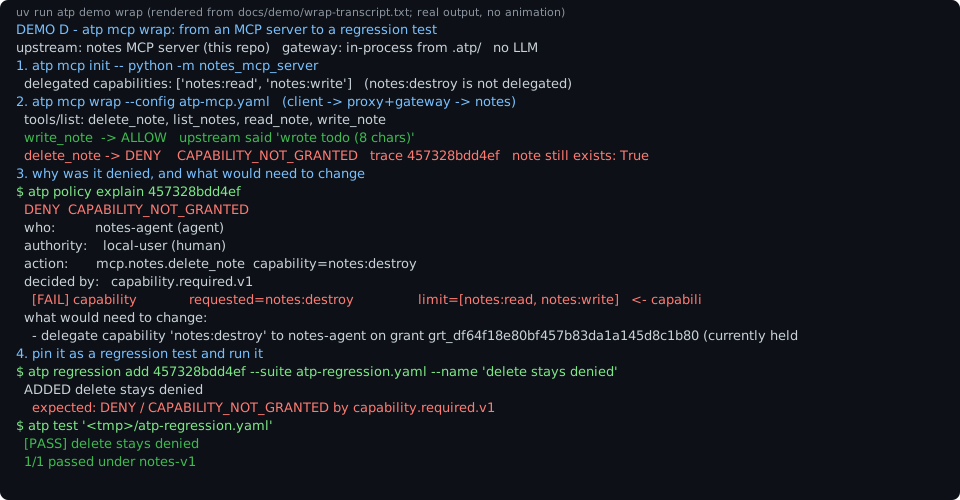
uv run atp demo wrap                        # a real MCP server, wrapped; one ALLOW, one DENY, one regression test
uv run atp mcp init -- <your mcp server>    # then: atp mcp wrap   (Streamable HTTP upstreams: --url)
uv run atp regression add <trace> && uv run atp test atp-regression.yaml
Status: experimental, v0.3.2, no users yet, not independently audited. Every claim below is backed by a test in this repository or says otherwise. What it does not protect is in docs/security/threat-model.md.
Why this exists
Agents act on tool calls, and the tool call is where prompt injection turns into damage: pay this account, delete that file, move this repo. Gateways in front of MCP servers authenticate the caller and allow tools by name; most cannot decide on the arguments (amount, path, destination) and none replay a recorded decision or keep it fixed in CI (research, with citations). ATP does that part and only that part: it is a decision-and-evidence layer, not a gateway (why-atp.md).
How it works
agent / MCP client ──stdio──▶ atp mcp wrap ──▶ upstream MCP server (stdio or Streamable HTTP)
                                   │
                    authenticate the agent; resolve HUMAN → agent delegation (capabilities,
                    resource scope, limits — a child can only narrow)
                    build an ActionEnvelope from the call (paths normalised, args bounded)
                    decide: kernel policies + your declared policy set   →  ALLOW / DENY / WOULD_DENY
                    ALLOW  → single-use grant over the exact action hash → forward → record outcome
                    DENY   → refuse (enforce)  |  forward and record WOULD_DENY (shadow)
                    everything on a hash-chained trace in .atp/
Then, offline: atp trace list · atp policy explain TRACE · atp regression add TRACE · atp test · atp policy impact --from A --to B · atp mutate TRACE · atp evidence export TRACE.
Quickstart (measured: docs/first-user-test-v2.md)
Prerequisites: Python ≥ 3.12 and uv. No API keys, no Docker, no database setup, no secrets to copy.
git clone <this repository> && cd agent-trust-plane
uv run atp demo wrap          # syncs the workspace on first run; 37 s cold on the maintainer machine
The same commands work in PowerShell. uv run atp doctor explains anything missing. Other demos: atp demo injection (an injected invoice tries to pay $12,500 on a $1,000 delegation), atp demo regression (a permitted payment reveals a policy hole; replay under the fix flips it), atp demo mcp (the proxy against a remote-style gateway) — docs/demos.md.
Wrap your own MCP server
uv run atp mcp init --name fs -- npx -y @modelcontextprotocol/server-filesystem /abs/sandbox
#   reads tools/list; proposes capabilities from the server's annotations (unverified: review them);
#   writes atp-mcp.yaml and .atp/policies.yaml (declared set fs-v1)
uv run atp mcp wrap --mode shadow      # observe first: denials are recorded as WOULD_DENY and forwarded
uv run atp mcp wrap                    # enforce
Tools the server itself marks destructive (write_file, edit_file, move_file on the reference server) get fs:destroy, which is not delegated by default: the first write is denied with CAPABILITY_NOT_GRANTED until you add fs:destroy to authority.capabilities in atp-mcp.yaml — a deliberate fail-closed default, and the one thing the first-user test tripped over.
Point your MCP client at the wrap command instead of the server (config example). Verified upstreams: this repo's notes server (stdio and Streamable HTTP, every CI run) and the reference @modelcontextprotocol/server-filesystem (opt-in test, run 2026-09-17). Everything else is listed as not verified in docs/integrations/compatibility.md.
Scope paths, not just tool names: resource_scope: ["path:/abs/sandbox/*"] with .., separators and (optionally) case normalised before matching. Argument limits go in .atp/policies.yaml:
rules:
  - id: no-large-writes
    applies_to: {tool: mcp.fs, action: write_file}
    kind: argument_max_length
    argument: content
    max_length: 20000
Security regression tests
uv run atp trace list                                   # what was ALLOWed / DENIED / WOULD_DENY
uv run atp policy explain 457328bdd4ef                  # which constraint failed, and what would need to change
uv run atp regression add 457328bdd4ef --name "delete stays denied"
uv run atp test atp-regression.yaml                     # exit 1 if the decision ever changes; --junit/--json for CI
uv run atp policy impact --from fs-v1 --to fs-v2        # which recorded actions flip; DENY -> ALLOW first
uv run atp mutate 457328bdd4ef                          # perturb the recorded action; authorize only, never execute
A suite is YAML: principals, a delegation graph, cases with the expected outcome / reason / policy. Runs use an ephemeral in-process gateway and call only /authorize — a spy on execute sees zero calls. CI example without secrets: examples/regression-suite and a copy-in composite action. Guide: docs/regression/regression-testing.md.
Architecture
Protocol-neutral kernel (atp_core envelope/decision, atp_identity credentials + delegation chains, atp_policy engine + declared sets, atp_audit hash chain, atp_gateway service/grants/API) with adapters on the edge (atp_adapter_mcp proxy, atp_adapter_http client) and the atp CLI. One distribution, agent-trust-plane, installs everything (uvx --from <wheel-or-git-url> atp …). The kernel imports nothing from MCP — a test enforces it. Details: docs/architecture/architecture.md, first principles, ADRs.
Overhead (docs/benchmarks.md, single machine, sequential): policy engine 0.26 ms; atp mcp wrap adds ~11 ms p50 to an MCP tool call with durable SQLite evidence; the HTTP-gateway proxy path adds ~21 ms.
Security model and limitations
Guarantees, assumptions, deployment requirements, non-guarantees and known gaps are separated in docs/security/threat-model.md; attempted attacks and results in docs/red-team/architecture-attacks.md; the self-review with severities in docs/security/security-review.md. Headlines:
- Only the mediated path is protected. An agent that can reach the tool without the proxy is not stopped — a test shows it on purpose. Whether that can happen is a deployment property: docs/security/enforcing-the-boundary.md.
- The operator (and
.atp/keys.env) is omnipotent; agent credentials are bearer tokens with expiry and revocation, no proof of possession. - Single-use grants prove one release, not exactly-once external effects: docs/security/idempotency.md.
- The hash chain catches edits by non-writers; a DB writer can recompute it: docs/security/trace-integrity.md.
- Declared policies are limit/equality rules; use OPA/Cedar for more (why-not-just-opa.md). Prompt injection is bounded, not detected.
Evidence for what is handled: 439 tests including property-based tests (delegation monotonicity, scope-algebra soundness, a stateful grant lifecycle with tampering and revocation interleaved), an exhaustive check of the grant state machine (spec), eight adversarial evals, and real-protocol MCP end-to-end tests.
Contributing
CONTRIBUTING.md, DEVELOPMENT.md (module map, invariants not to break, how to add a policy or adapter), ROADMAP.md, docs/good-first-issues.md, SECURITY.md for reporting a vulnerability, CHANGELOG.md. MIT licensed (dependency and copyright record: docs/release/licensing.md). No telemetry.
1 maintainer

Release files for agent-trust-plane 0.3.2
For a detailed explanation of source distributions (sdists) and built distributions (wheels), please see the package formats documentation.
Source distribution (sdist)
| File | Size | Uploaded | |
|---|---|---|---|
| agent_trust_plane-0.3.2.tar.gz | 122.0 kB | Details |
Built distribution (wheel)
| File | Interpreter | ABI | Platform | Reset |
|---|---|---|---|---|
| agent_trust_plane-0.3.2-py3-none-any.whl | Python 3 | none | any | Details |
Total release size: 279.1 kB
Release files / agent_trust_plane-0.3.2.tar.gz
| Download URL | agent_trust_plane-0.3.2.tar.gz |
|---|---|
| Size | 122.0 kB |
| Tags | Source |
|
SHA-256 checksum How to use checksums |
c2511e58a4e89f5dd8f66207d7c6ba7e24e269debe7141992d63952d76772fe1
|
|
BLAKE2b-256 checksum How to use checksums |
e46ca761dad3a6a349f92c9841a63df7ba1ecaa977b408e180234159e6e5ed40
|
| Upload date | |
|
Uploaded using Trusted Publishing? What is trusted publishing? |
Yes |
| Uploaded via |
twine/7.0.0 CPython/3.13.14
|
Provenance
Provenance describes where a file came from. On PyPI, provenance is shared via attestations, which provide a verifiable record of the build or publishing details. View details, limitations and caveats.


PyPI Publish Attestation
PyPI verified that this artifact, at this checksum, originated from the publisher listed below.
Signed by GitHub Actions, verified by PyPI on Sep 22, 2026.
Transparency logRelease files / agent_trust_plane-0.3.2-py3-none-any.whl
| Download URL | agent_trust_plane-0.3.2-py3-none-any.whl |
|---|---|
| Size | 157.1 kB |
| Tags | Python 3 |
|
SHA-256 checksum How to use checksums |
fb6cc40edcccd7b334ee3d2049760a80403762bd4b793c3142d665e4b13b241b
|
|
BLAKE2b-256 checksum How to use checksums |
1cbe274f41d4888215eb911e09e6c9bbdcd160c10a5cd833bd339cc115a50ac5
|
| Upload date | |
|
Uploaded using Trusted Publishing? What is trusted publishing? |
Yes |
| Uploaded via |
twine/7.0.0 CPython/3.13.14
|
Provenance
Provenance describes where a file came from. On PyPI, provenance is shared via attestations, which provide a verifiable record of the build or publishing details. View details, limitations and caveats.
PyPI Publish Attestation
PyPI verified that this artifact, at this checksum, originated from the publisher listed below.
Signed by GitHub Actions, verified by PyPI on Sep 22, 2026.
Transparency log












