Opinionated, sandboxed Python coding agent.

Project description

agent6

A sandboxed coding agent for Anthropic Claude and OpenAI-compatible backends (OpenAI, OpenRouter, Ollama, vLLM, LM Studio, llama.cpp). Linux-only.

  • LLM calls are wrapped in deterministic Python workflows with a fixed tool surface.
  • Every child process runs inside agent6-jail (Rust + Linux user namespaces + Landlock + seccomp).
  • The workflow's own git operations refuse push, --force, and history rewrite; the sandbox additionally re-binds .git/, agent6.toml, and .agent6/ read-only inside the jail so worker scripts cannot corrupt them.
  • No web UI, no plugin system, no telemetry, no auto-update.

Threat model

The worker model is treated as adversarial. It must not be able to:

  • write outside the project's working directory
  • read files outside the project (plus any sibling read-only paths)
  • reach the network except the host:port of each [providers.*] block (when sandbox.network = "provider_only")
  • corrupt the project's git history or its own configuration / run state from inside the sandbox
  • leave background processes running after the run ends

Enforcement is layered, and the threat model bullets above map to layers as follows:

  • git_ops.py refusals (push, --force, reset --hard, branch -D, history rewrite) constrain only the workflow's own git calls from the agent process. They do not police what the worker does. See src/agent6/git_ops.py.
  • Tool surface (src/agent6/tools/schema.py). The LLM cannot directly invoke shell or write_file. It has apply_edit, read_file, list_dir, grep, run_verify_command (operator-fixed argv), and — only when sandbox.run_commands is "yes" or "ask"run_command(argv). The first six tools cannot spawn an LLM-chosen subprocess.
  • agent6-jail wraps every child command (verify, run_command, curator): fresh user/mount/pid/ipc/uts/net namespace, pivots into a minimal rootfs, applies Landlock, seccomp filter, drops capabilities, NO_NEW_PRIVS. In strict profile the network namespace is empty when sandbox.network != "allow"git push, curl, pip install, DNS all fail with no route, even from an ad-hoc script that the worker writes and runs via run_command.
  • sandbox.protect_git + sandbox.protect_agent6 (default true) make .git/, agent6.toml, and .agent6/ read-only from the child's view. In strict they are re-bound RO on top of the workspace mount. In hardened (no mount namespace) the launcher switches its Landlock setup from "RW on cwd" to "R on cwd + RW on each top-level entry except the protect set" — same end result for paths that exist when the jail starts, at the cost of denying writes to new top-level entries created at the cwd root after launch (anything inside an existing top-level dir like src/ still gets the full recursive RW rule). This closes the "worker writes a shell script that does rm -rf .git or git reset --hard origin/main" loophole; the workflow's own commits go through git_ops.py from outside the jail and are unaffected.
  • Landlock on the agent process itself further restricts what the agent's Python code can read/write outside the jail.

What is NOT protected:

  • If you set sandbox.run_commands = "yes" (or "ask" and approve) and sandbox.network = "allow", the worker can talk to anywhere on the public internet from inside the sandbox. Don't do this.
  • The protected paths are read-only inside the jail, but the worker can still create new files anywhere else under the cwd. A worker that wants to corrupt your project can still write garbage source code; that's what the reviewer + verify_command are for, not the sandbox.

See SECURITY.md for the per-layer breakdown and ARCHITECTURE.md for state machines of each workflow.

Architecture

                     ┌───────────────────────────────────┐
                     │           agent6 CLI              │
                     └───────────────┬───────────────────┘
                                     │
                ┌────────────────────┼────────────────────┐
                │                    │                    │
        ┌───────▼───────┐  ┌─────────▼─────────┐  ┌──────▼──────┐
        │  workflows/   │  │      agents/      │  │   graph/    │
        │   implement   │  │   planner, worker │  │   curator   │
        │   plan_mode   │  │   critic, reviewer│  │   (subproc, │
        │   review      │  │   code_review,    │  │   own jail) │
        └───────┬───────┘  │   summarizer,     │  └─────────────┘
                │          │   alignment       │
                │          └───────┬───────────┘
                │                  │
        ┌───────▼──────────────────▼────────────┐
        │             tools/dispatch            │
        │  read_file list_dir grep apply_edit   │
        │  run_verify_command [run_command]     │
        └───────────────────┬───────────────────┘
                            │
                  ┌─────────▼─────────┐
                  │  sandbox/jail.py  │
                  └─────────┬─────────┘
                            │ JSON policy
                  ┌─────────▼─────────┐
                  │  agent6-jail      │  (Rust; userns + landlock + seccomp)
                  └───────────────────┘

Dependency direction is enforced by tach: cli → workflows → agents → tools → sandbox. Workflows never import each other; agents never import workflows or the CLI.

Requirements

  • Linux. macOS and Windows are not supported and never will be — the sandbox uses Linux-only kernel APIs (Landlock, seccomp-bpf, user/mount namespaces, pivot_root).
  • Linux kernel ≥ 6.7 for full Landlock TCP-connect rules. Older kernels fall back to filesystem-only Landlock with a loud warning.
  • kernel.unprivileged_userns_clone = 1 (default on Ubuntu, Debian, and most cloud images). Required for the strict sandbox profile; without it the agent falls back to hardened or refuses, per config.
  • Python ≥ 3.12.
  • Anthropic and/or OpenAI-compatible API key.

If installing from source, you also need:

  • A Rust toolchain on PATH (cargo, rustc). The hatch build hook invokes cargo build to compile agent6-jail. It does not install Rust for you — if cargo is not on PATH the hook skips with a message and the resulting install has no jail binary (agent6 check-sandbox will tell you).
  • Released PyPI wheels bundle a prebuilt agent6-jail and have no Rust toolchain requirement.

Install

From source (development):

git clone https://github.com/elesiuta/agent6
cd agent6
uv sync --extra tui
uv run agent6 --help

uv sync runs hatch_build.py, which:

  1. invokes cargo build --release --locked --manifest-path jail/Cargo.toml
  2. copies the resulting agent6-jail into src/agent6/sandbox/_bin/agent6-jail (gitignored)

The [tui] extra pulls in textual for the live dashboard. Skip it with uv sync if you don't want the TUI.

From PyPI:

uv tool install agent6

PyPI wheels ship with the jail binary inside. To override the bundled binary (custom build, alternate path), set AGENT6_JAIL_BIN=/path/to/agent6-jail.

Shell tab-completion

agent6 supports tab-completion for all subcommands and flags via argcomplete. To enable it for your current shell, source the completion script once:

# Bash (add to ~/.bashrc to persist).
eval "$(register-python-argcomplete agent6)"

# Zsh (add to ~/.zshrc; needs `autoload -U compinit && compinit` first).
eval "$(register-python-argcomplete agent6)"

# Fish (one-time write).
register-python-argcomplete --shell fish agent6 > ~/.config/fish/completions/agent6.fish

Or, for system-wide completion in all shells, run activate-global-python-argcomplete once (see argcomplete docs).

Quick start

export ANTHROPIC_API_KEY=sk-ant-...

# Scaffold agent6.toml + AGENTS.md and add .agent6/ to .gitignore.
agent6 init

# Sanity checks.
agent6 check-config
agent6 check-sandbox

# If `check-config` reports missing fields after an upgrade, walk through
# the additions interactively (each one sourced from the starter
# template, with a [y/N] prompt before any write):
agent6 check-config --fix

# Plan-only: cheap pre-flight, no code changes.
agent6 plan new "add a --json output mode to the CLI"

# Inspect a previously persisted plan (defaults to most recent).
agent6 plan show

# Apply free-form feedback to the last plan, producing a new run.
agent6 plan revise "split step 2 into smaller commits"

# Hand-edit the plan JSON in $EDITOR, producing a new run.
agent6 plan edit

# Offline Q&A: if the critic raises clarifying questions, write
# them to a file, fill in the 'answer' fields, then re-run.
agent6 plan new --questions-file q.json "add a --json output mode"
$EDITOR q.json
agent6 plan new --run-id <same-id> --answers-file q.json "add a --json output mode"

# Full implement workflow. --yes auto-confirms the plan.
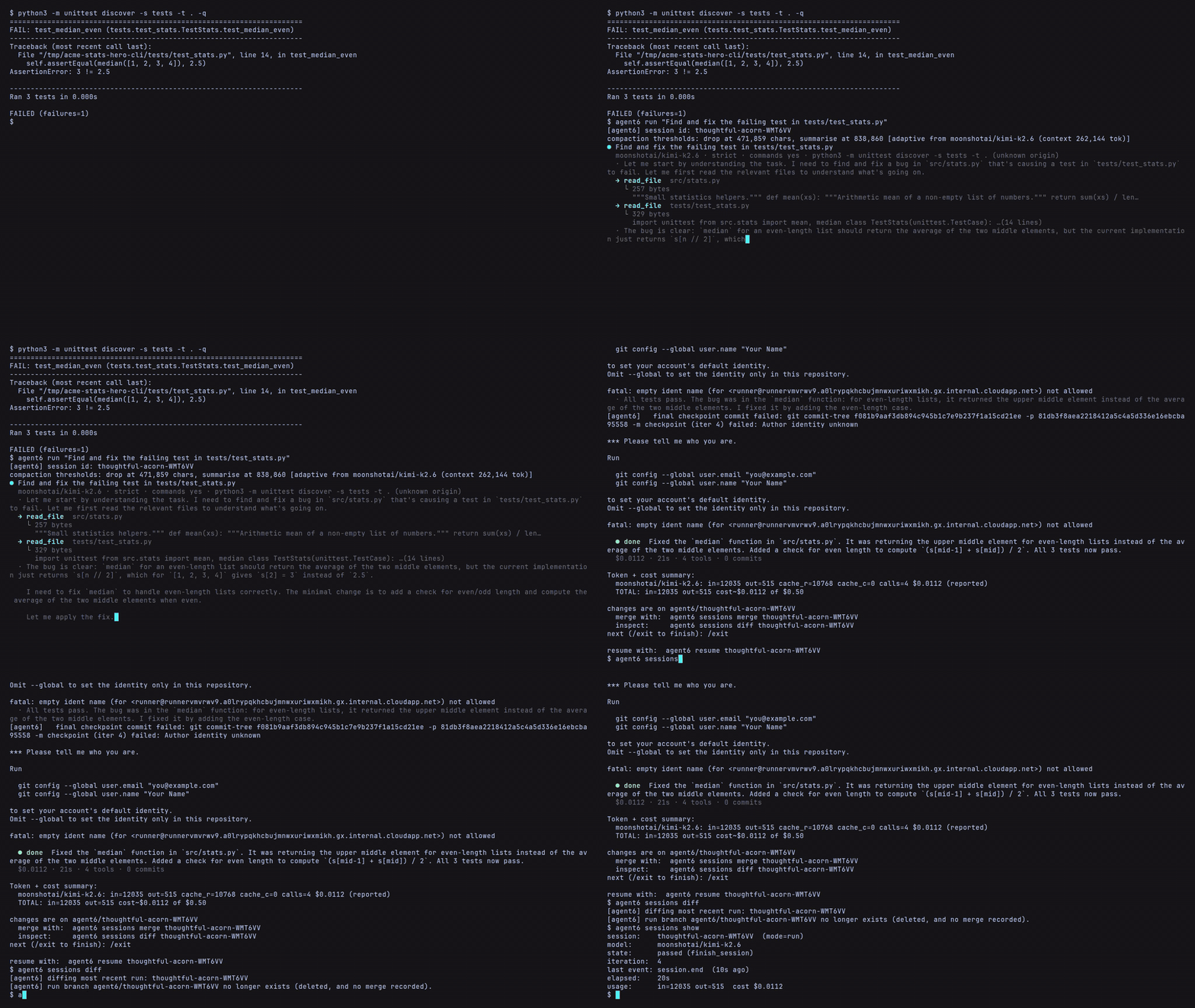
agent6 run --yes "add a --json output mode to the CLI"

# Resume an interrupted run (refuses if the worktree diverged).
agent6 resume <run-id>

# Read-only code review of a diff. Never touches the worktree.
agent6 review --base origin/main --head HEAD

Other commands:

  • agent6 watch [<run-id>] — attach the live TUI dashboard to an existing run (defaults to the most recent). Same view that agent6 run auto-launches in a TTY. Attach and detach freely.
  • agent6 memory — manage persistent agent memory under .agent6/memory/.
  • agent6 history — search transcripts and run data under .agent6/runs/. Subcommands:
    • agent6 history search <query> — ripgrep-backed text search.
    • agent6 history graph [<run-id>] — render the persisted task graph for a run as a DFS-ordered tree (defaults to the most recent run).
  • agent6 --help — full subcommand list.

Configuration

Every field in agent6.toml is required. No implicit defaults. Start from agent6.example.toml.

Highlights:

[sandbox]
profile = "auto"             # auto | strict | hardened
network = "provider_only"    # no | provider_only | allow
run_commands = "ask"         # yes | no | ask

[git]
require_clean_worktree = true
auto_stash = false
branch_per_run = true
commit_strategy = "per_step"  # per_step | squash | stage | none
allow_push = false           # cannot be true; ignored if set
allow_force = false
allow_history_rewrite = false

[workflow]
default = "implement"
verify_command = ["uv", "run", "pytest", "-x"]

[budget]
max_input_tokens  = 2000000
max_output_tokens = 200000

Sandbox profiles:

  • strict — user/mount/pid/ipc/uts/net namespaces + pivot_root into a minimal rootfs + Landlock + seccomp + capset(0) + rlimits + NO_NEW_PRIVS. Requires unprivileged user namespaces.
  • hardened — no namespaces, but still Landlock + seccomp + capset(0)
    • rlimits + NO_NEW_PRIVS. Works inside default-seccomp Docker.
  • auto — pick strict if the kernel allows, else hardened. Logs the chosen profile on every run.

Network modes are enforced by the jail's net-namespace setup (in strict) or by Landlock's TCP-connect rules (kernel ≥ 6.7) on the agent process.

Providers and sub-agents

Declare any number of providers as [providers.<name>] blocks. Each block sets kind = "anthropic" or kind = "openai" and has its own base_url and api_key_env. OpenAI, OpenRouter, Ollama, vLLM, llama.cpp, LM Studio etc. coexist under whatever names you pick.

Each sub-agent has a fixed system prompt, a pydantic-typed output schema, and only the tools its workflow gives it. Routing per role:

Sub-agent Routed by Purpose
planner [models.planner] Decomposes the refined task into ordered steps.
worker [models.worker] Executes one plan step using the tool surface.
critic [models.critic] Raises open questions; aborts on real ambiguity.
reviewer [models.reviewer] Reviews each step's diff; approves or asks for fixes.
code_review [models.reviewer] Powers agent6 review: read-only review of an arbitrary diff.
summarizer [models.summarizer] Compresses long verify output / file context to fit budgets.
alignment [models.worker] Guards agent6 resume: refuses if the worktree diverged.
planner_revise [models.planner] Revises a plan in response to a critic or reviewer objection.

Mixing vendors across roles (e.g. Anthropic planner + OpenRouter worker

  • Anthropic reviewer) helps catch shared-failure blind spots.

Workflows

  • implement — plan → critic → worker (loop) → reviewer per step. Verify runs after every step; failures retry within the step budget. State is persisted to .agent6/runs/<run-id>/.
  • plan_mode — produce a frozen plan only. Useful as a cheap "is the plan reasonable?" pre-flight.
  • review — drives the code_review sub-agent on a working-tree, branch-vs-base, or <base>..<head> diff. Always read-only.

Tool surface given to the LLM

Fixed and audited in src/agent6/tools/schema.py:

  • read_file(path, start_line?, end_line?)
  • list_dir(path)
  • grep(pattern, path?, glob?)
  • apply_edit(path, edits: list[{kind: "replace"|"create", old_string?, new_string}])
  • run_verify_command() — runs workflow.verify_command only
  • run_command(argv) — only if sandbox.run_commands ∈ {"yes", "ask"}

There is no write_file, no shell, no web_fetch. Adding a tool requires a security review note in the commit message.

Cost accounting

Every run prints a per-model token + cost summary at the end:

Token + cost summary:
  claude-opus-4-5:    in=18054 out=425  cache_r=0 cache_c=0 calls=1 $0.3027
  claude-sonnet-4-5:  in=8884  out=1171 cache_r=0 cache_c=0 calls=4 $0.0442
  TOTAL: in=26938/2000000 out=1596/200000 cost~$0.3469

Pricing lives in src/agent6/budget.py and is updated by hand from the Anthropic and OpenAI public pages. Budgets in agent6.toml hard-stop the run; a stopped run is resumable.

Live event log + TUI

Every run writes a structured JSONL event stream to .agent6/runs/<run-id>/logs.jsonl. The vocabulary is small and stable:

Event Emitted by Notable fields
run.start implement workflow user_task
plan.ready implement workflow summary, steps[]
step.start / step.end implement workflow index, title, status, commit_sha
step.diff implement workflow index, commit_sha, patch (truncated)
tool.call / .result tool dispatcher name, args (preview), ok, summary
verify.start / .end tool dispatcher cmd, exit_code, duration_s, *_tail
role.call / .result provider wrapper role, model, tokens_in, tokens_out
budget.update provider wrapper totals + caps for input/output tokens
approval.prompt/.answer tool dispatcher id, prompt, approved, source
run.end implement workflow all_passed

The shape is the data contract for any external viewer. The fold from event stream to UI state lives in src/agent6/ui/state.py as a pure function and is intended to be ported 1:1 to TypeScript.

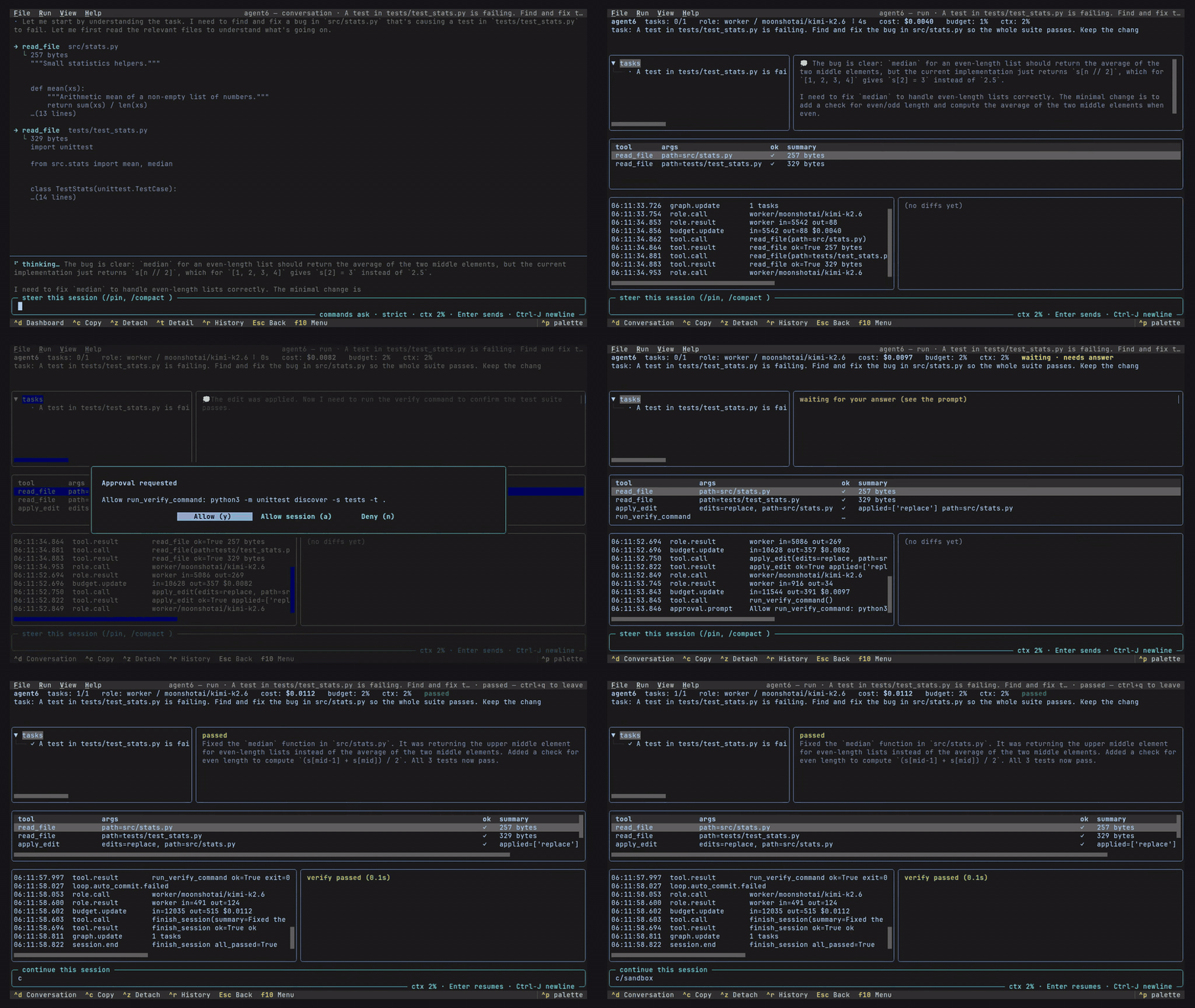
When agent6 is installed with the tui extra and stdout is a TTY, agent6 run spawns a separate process running python -m agent6.ui --watch <run-dir> that tails logs.jsonl and renders a plan tree, budget bar, tool table, log tail, and the latest step diff. The TUI is read-only on the log; the only thing it writes is <run-dir>/approvals/<id>.answer when the user clicks Allow/Deny on a run_command approval modal. Killing the TUI does not affect the workflow — it falls back to a plain stdin prompt. Pass --no-tui to disable, or attach later with agent6 watch.

Persistence

Each run writes to .agent6/runs/<run-id>/:

  • graph.jsonl — append-only journal of every mutation to the task graph.
  • graph.dot — current task graph (regenerated atomically on topology change).
  • nodes/*.md — one markdown file per node; rewritten atomically.
  • logs.jsonl — per-event log (planner output, tool calls, costs).
  • transcripts/ — full provider request/response pairs for replay.

A separate agent6-curator subprocess owns all writes to this directory and runs under its own jail policy allowing writes only to .agent6/. The main agent process talks to it over a Unix domain socket; no other process has authority to mutate the graph.

Benchmark

See bench/results.md for an 8-task synthetic benchmark (bug fix, CLI flag, refactor, type annotations, deprecation fix, subcommand, logging, extract-method). After fourteen iteration cycles all eight tasks now PASS three runs in a row at ~$0.45 per run. The iteration history in bench/results.md documents what broke at each step and the workflow / prompt fix that landed for it. Re-run with:

bash bench/run_bench.sh
cat /tmp/agent6-bench/*/result.json

A head-to-head against claude-code on the same task set is tracked separately under bench/comparison/.

Repository layout

src/agent6/
  cli.py            argparse entry points
  config.py         pydantic-strict config (all fields required)
  budget.py         per-model pricing + per-run accounting
  events.py         structured run-event log
  git_ops.py        pure-function git wrappers; refuses push/force/rewrite
  memory.py         persistent agent memory (read/write/delete)
  detect.py         kernel + container capability detection
  init.py           `agent6 init` scaffolding
  agents/           typed sub-agent prompts and pydantic IO schemas
  workflows/        deterministic Python orchestrators (implement, plan, review)
  tools/            dispatcher + schemas for the fixed LLM tool surface
  providers/        Anthropic + OpenAI HTTP clients (httpx, no SDK)
  sandbox/          jail.py (Python wrapper) + landlock.py (process-side)
  graph/            curator subprocess + UDS IPC + on-disk graph store
  ui/               pure event-fold + stdlib JSONL tailer + optional textual TUI
jail/               Rust crate for the agent6-jail launcher
tests/
  unit/             ~150 unit tests
  integration/      crash-resume, curator IPC, plan-mode, alignment
  sandbox/          live jail smoke tests + landlock probes
  security/         prompt-injection corpus tests
bench/              synthetic benchmark harness + results
.github/workflows/  build, ci, pypi (Trusted Publishing)

Roadmap

Open work, in priority order:

  1. Harder bench tasks — multi-file refactors, async bugs, type-error cascades, adversarial / prompt-injected AGENTS.md. The existing 8-task suite passes consistently; the next iteration needs tasks that exercise more of the failure surface.
  2. Network-egress test corpus — adversarial tests that try to exfiltrate via DNS, ICMP, IPv6, and unix sockets and assert they are all blocked under network = "provider_only".
  3. agent6 init --template — write a starter AGENTS.md for common stacks (Python lib, Node app, …) instead of just a stub.
  4. agent6 check-config --fix — implemented on dev-0.0.3: interactive repair that compares the user's TOML against the starter template, prints would-be additions, and inserts them after a [y/N] prompt.
  5. Headless run mode — non-interactive --no-confirm-anything for CI; today --yes auto-confirms the plan only, not every run_commands prompt.
  6. agent6 review against a remote PR — fetch + review without checkout.

Contributing

Read AGENTS.md before sending a PR. The repo's verify_command is the single source of truth for "is this PR landable":

uv run ruff check && uv run ruff format --check && \
  uv run pyright && uv run tach check && uv run pytest

Security-sensitive changes (anything in sandbox/, tools/, git_ops, providers/, graph/curator) must include a security review note in the commit message.

Project details


Download files

Download the file for your platform. If you're not sure which to choose, learn more about installing packages.

Source Distribution

agent6-0.0.4.tar.gz (148.8 kB view details)

Uploaded Source

Built Distribution

If you're not sure about the file name format, learn more about wheel file names.

agent6-0.0.4-py3-none-manylinux_2_34_x86_64.whl (435.2 kB view details)

Uploaded Python 3manylinux: glibc 2.34+ x86-64

File details

Details for the file agent6-0.0.4.tar.gz.

File metadata

  • Download URL: agent6-0.0.4.tar.gz
  • Upload date:
  • Size: 148.8 kB
  • Tags: Source
  • Uploaded using Trusted Publishing? Yes
  • Uploaded via: twine/6.1.0 CPython/3.13.13

File hashes

Hashes for agent6-0.0.4.tar.gz
Algorithm Hash digest
SHA256 009f909a359b4c6e924fc90e5543131e068664b494fe3bb199efc5787e0aa778
MD5 e0ef6667e98a47586aa4e2654fe04b94
BLAKE2b-256 85b452223819b5ffa493d59f009e6fa5fef4fb9f4c4b55cafb3fdeb853d2d21d

See more details on using hashes here.

Provenance

The following attestation bundles were made for agent6-0.0.4.tar.gz:

Publisher: pypi.yml on elesiuta/agent6

Attestations: Values shown here reflect the state when the release was signed and may no longer be current.

File details

Details for the file agent6-0.0.4-py3-none-manylinux_2_34_x86_64.whl.

File metadata

File hashes

Hashes for agent6-0.0.4-py3-none-manylinux_2_34_x86_64.whl
Algorithm Hash digest
SHA256 bd0c9f9266817307cad9c0455868d090a3bfd8dd475b3db35f84586ce2152ffe
MD5 0ec6bf2eb71d91c4cbad80eb16ca9ba7
BLAKE2b-256 d2a4e0a07e3d3c21dcbe886600fb32c140c695f78d7b891149f6143166ae49cb

See more details on using hashes here.

Provenance

The following attestation bundles were made for agent6-0.0.4-py3-none-manylinux_2_34_x86_64.whl:

Publisher: pypi.yml on elesiuta/agent6

Attestations: Values shown here reflect the state when the release was signed and may no longer be current.

Supported by

AWS Cloud computing and Security Sponsor Datadog Monitoring Depot Continuous Integration Fastly CDN Google Download Analytics Pingdom Monitoring Sentry Error logging StatusPage Status page