
AgentCare
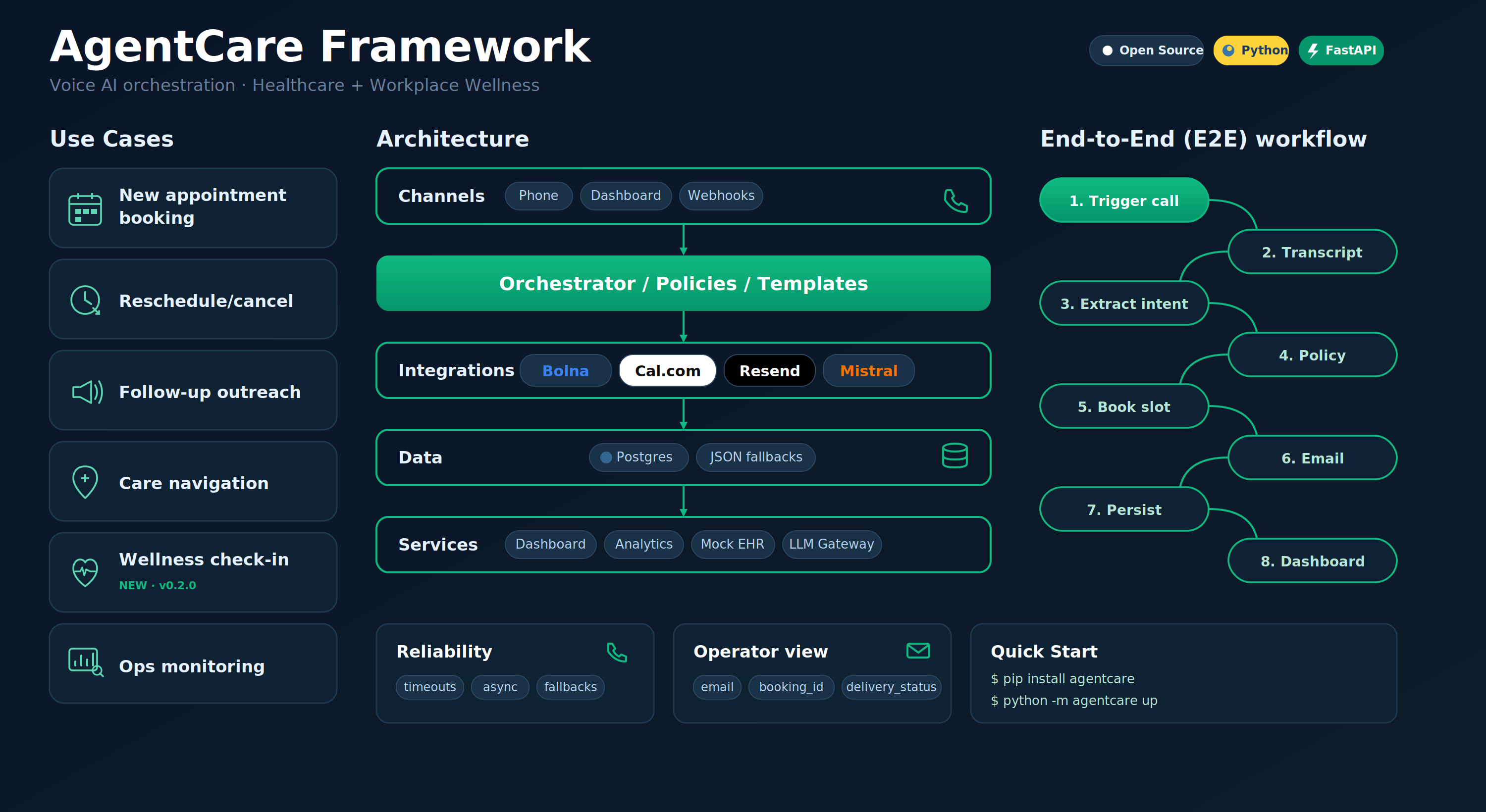
A Python framework for healthcare voice-AI agents: it turns post-call transcripts into triaged, policy-checked bookings, follow-ups and wellness escalations.







Why
A voice agent can hold the conversation; the hard part is what happens after the call. Someone has to pull the patient's details out of the transcript, decide whether the request is routine or urgent, pick the right clinician, book a real slot, confirm by email, and remember the patient next time. AgentCare is that post-call layer. Every step is a small, replaceable port (calendar, EHR, email, memory, LLM), and the safety decisions (risk triage, auto-booking policy, escalation) are deterministic Python you can read and test, with the LLM used only for field extraction.
Features
| Four registered workflows | frontdesk_booking, care_navigation, followup_outreach, wellness_checkin, with Bolna agent specs generated from one registry |
| Post-call pipeline | Regex + Mistral extraction, customer-memory back-fill, healthcare risk/category analysis, booking policy, doctor routing, slot check, booking, confirmation email, analytics |
| Safety-first policy | High-risk calls (e.g. chest pain, fainting, self-harm cues) are never auto-booked and go to a clinical triage queue; rules are overridable from a JSON file |
| Appointment connectors | Cal.com, FHIR R4 (Slot search + Appointment create) and a mock connector behind one AppointmentConnectorPort |
| Wellness check-ins | Maslach Burnout Inventory-aligned signals, LLM/regex score fusion, Mann-Kendall trend test, crisis-cue override |
| Memory and analytics | Customer profiles and call events in JSON (atomic writes, corruption-safe) or Postgres; KPI, funnel, cohort and case-queue projections |
| Local stack | agentcare up runs webhook, analytics, dashboard, mock EHR and an OpenAI-compatible LLM gateway (FastAPI) |
| CLI | Bolna calls, agents, knowledge bases, execution sync, extraction, evaluation, templates |
| Typed | Ships py.typed; checked with mypy |
Install
Requires Python 3.10+.
pip install agentcare
# or
uv add agentcare            # inside a uv project
uv pip install agentcare    # into the active environment
Extras:
pip install "agentcare[web]"        # FastAPI services (webhooks, analytics, dashboard)
pip install "agentcare[postgres]"   # Postgres-backed customer memory and analytics
pip install "agentcare[email]"      # Resend confirmation emails
pip install "agentcare[semantic]"   # ragfallback + FAISS semantic customer lookup
pip install "agentcare[dev]"        # pytest, coverage, ruff, mypy, pre-commit, build, twine
Quickstart
The analysis and policy layers are plain Python and need no API keys. This scores a check-in transcript, tests a score series for a trend, and routes the result:
from agentcare.analysis import analyze_burnout_context, detect_trend
from agentcare.policies.wellness import evaluate_wellness_policy

analysis = analyze_burnout_context(
    transcript=(
        "I'm exhausted every single day and I can't switch off. "
        "Honestly I've stopped caring about the team and nothing I do seems to matter."
    )
)
print(analysis.risk_band, round(analysis.composite_score, 2), analysis.ee_tags)
# low 3.14 ['exhaustion_explicit', 'cant_disconnect']

trend = detect_trend([3.1, 3.8, 4.6, 5.2, 6.4, 7.3])
print(trend.direction, trend.triage_trigger)
# deteriorating True

decision = evaluate_wellness_policy(
    risk_band=analysis.risk_band,
    high_acuity_flag=analysis.high_acuity_flag,
    trend_direction=trend.direction,
    triage_trigger=trend.triage_trigger,
)
print(decision.escalation_target, decision.follow_up_sla_hours)
# confidential_human_followup 24
A single low-risk session would auto-close; the deteriorating trend is what escalates it. For the
front-desk pipeline end to end (booking, escalation, confirmation), run
examples/frontdesk_offline_pipeline.py.
The full local stack runs the FastAPI services and helper scripts in the repository, so start it from a clone:
git clone https://github.com/irfanalidv/AgentCare && cd AgentCare
pip install -e ".[web]"
cp .env.example .env          # add BOLNA_API_KEY and MISTRAL_API_KEY
python -m agentcare up        # --dry-run validates configuration without starting anything
| Service | URL |
|---|---|
| Dashboard | http://127.0.0.1:8050 |
| Analytics API | http://127.0.0.1:8040/healthz |
| Webhooks | http://127.0.0.1:8030/healthz |
| Mock EHR | http://127.0.0.1:8020/healthz |
| LLM gateway | http://127.0.0.1:8010/healthz |
How it works
flowchart TD
    CALL["Bolna call ends"] --> IN{"Ingestion"}
    IN -->|"POST /bolna/execution"| WH["services/webhooks"]
    IN -->|"agentcare bolna sync-executions"| SYNC["sync_bolna_executions"]
    IN -->|"agentcare framework process-execution"| CLI["CLI"]
    WH --> ROUTER
    SYNC --> ROUTER
    CLI --> ROUTER
    ROUTER["execution_router<br/>resolve_execution_workflow"] -->|"frontdesk / care / follow-up"| FD
    ROUTER -->|"wellness_checkin"| WL

    subgraph FD["process_frontdesk_execution"]
        direction TB
        X["regex + Mistral extraction<br/>(TranscriptExtractorPort)"] --> RAG["memory back-fill<br/>(CustomerStorePort.semantic_lookup)"]
        RAG --> HA["analyze_healthcare_context<br/>risk, urgency, category"]
        HA --> POL["evaluate_frontdesk_policy<br/>auto-book? escalate? SLA"]
        POL --> DOC["assign_doctor"]
        DOC -->|"allowed + completed call"| SLOT["AppointmentConnectorPort<br/>check_slots, book_slot<br/>Cal / FHIR / mock"]
        SLOT --> MAIL["send_confirmation_email<br/>(Resend)"]
        DOC -->|"blocked"| QUEUE["triage queue + reason"]
    end

    subgraph WL["process_wellness_execution"]
        direction TB
        BX["Mistral MBI scores"] --> BA["analyze_burnout_context<br/>regex signals, 0.75/0.25 fusion"]
        BA --> TR["detect_trend<br/>Mann-Kendall + OLS slope"]
        TR --> WP["evaluate_wellness_policy"]
    end

    MAIL --> STORE
    QUEUE --> STORE
    WP --> HIST[("wellness history<br/>JSON")]
    STORE[("customer memory + call events<br/>JSON or Postgres")] --> DASH["analytics API + dashboard"]
Key design decisions:
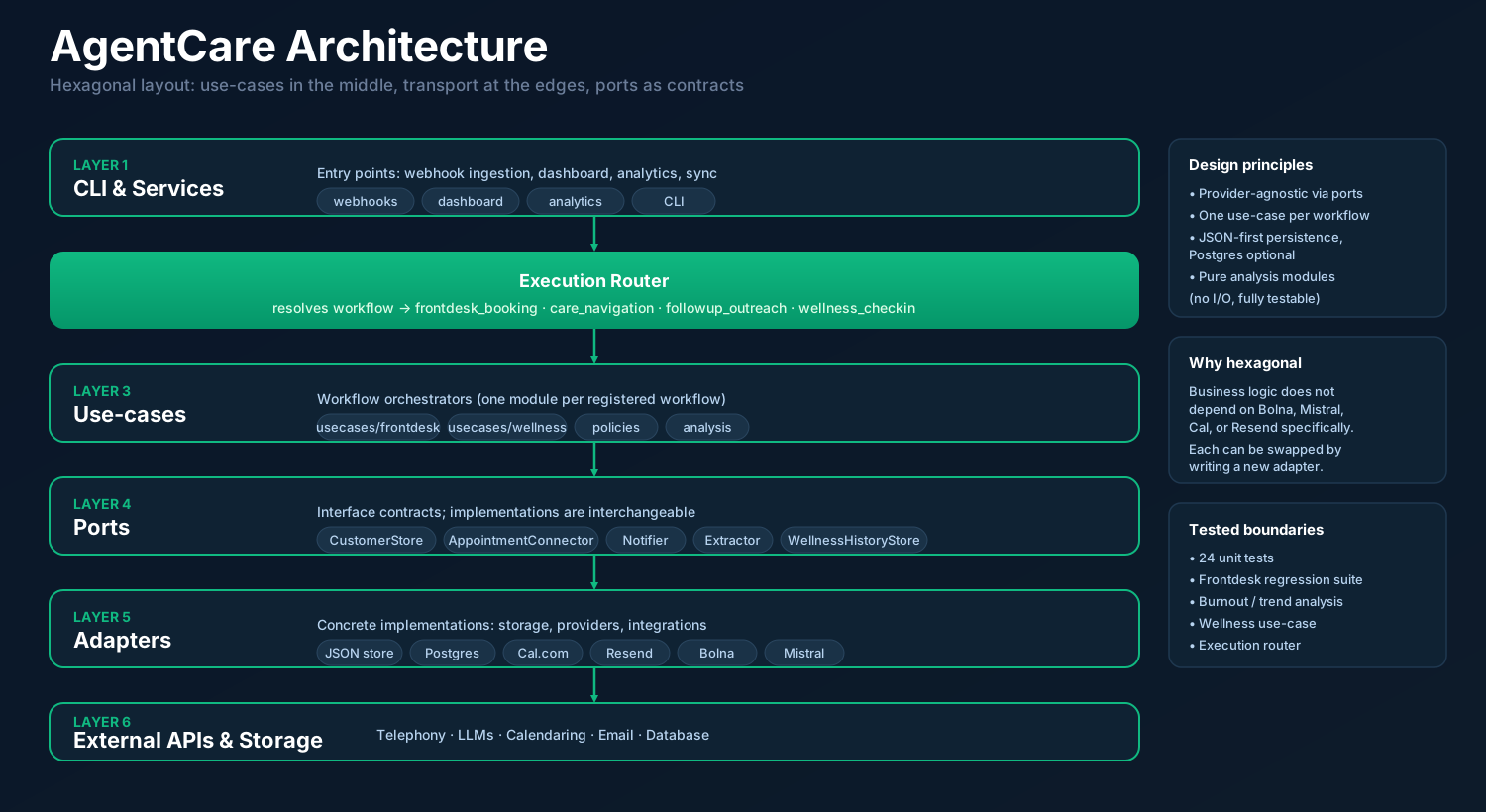
- Ports and adapters. Use cases depend on protocols in
agentcare.ports(AppointmentConnectorPort,CustomerStorePort,TranscriptExtractorPort, ...). Every dependency is injected throughFrontdeskDeps/WellnessDeps, which is how the examples and tests run the real pipeline offline. - The LLM extracts; Python decides. Mistral fills structured fields under a Pydantic schema. Risk level, auto-booking, escalation and SLA come from deterministic analysis and policy code. If extraction fails, the fields stay empty, the failure is logged, and the regex layer still runs.
- Bookings only from completed calls. Automation runs only for
status == "completed"; transcript-echoed appointment IDs are not trusted for new bookings; high-risk calls are blocked from auto-booking by policy. - Degrade, don't crash. Missing keys skip the integration with a reason (
skipped=True,error="CAL_API_KEY not configured") instead of raising mid-pipeline; Postgres falls back to JSON when unreachable. - Local data is safe to keep. JSON stores write atomically, and a corrupt file is moved aside
(
<name>.corrupt-<timestamp>) instead of being overwritten.
Package layout
src/agentcare/
  usecases/      workflow orchestration (frontdesk, wellness, execution router)
  ports/         protocol interfaces
  connectors/    appointment connectors (Cal, FHIR, mock)
  calendar/      Cal.com client and natural-language slot parsing
  customer/      customer memory (JSON, Postgres; optional semantic lookup)
  email/         Resend notifier
  analysis/      healthcare risk, burnout signals, trend detection
  extraction/    transcript -> structured fields (Mistral)
  policies/      front-desk and wellness decisions
  doctor/        doctor directory and specialty routing
  analytics/     call-event store, KPIs, dashboard projections
  bolna/         Bolna API client and models
  sync/          Bolna execution sync job
  workflows/     workflow registry; templates/ builds Bolna agent specs
  cli.py         Typer CLI

services/        FastAPI apps: webhooks, analytics, dashboard, llm_gateway, mock_ehr
experiments/     reproducible benchmark layer (separate requirements)
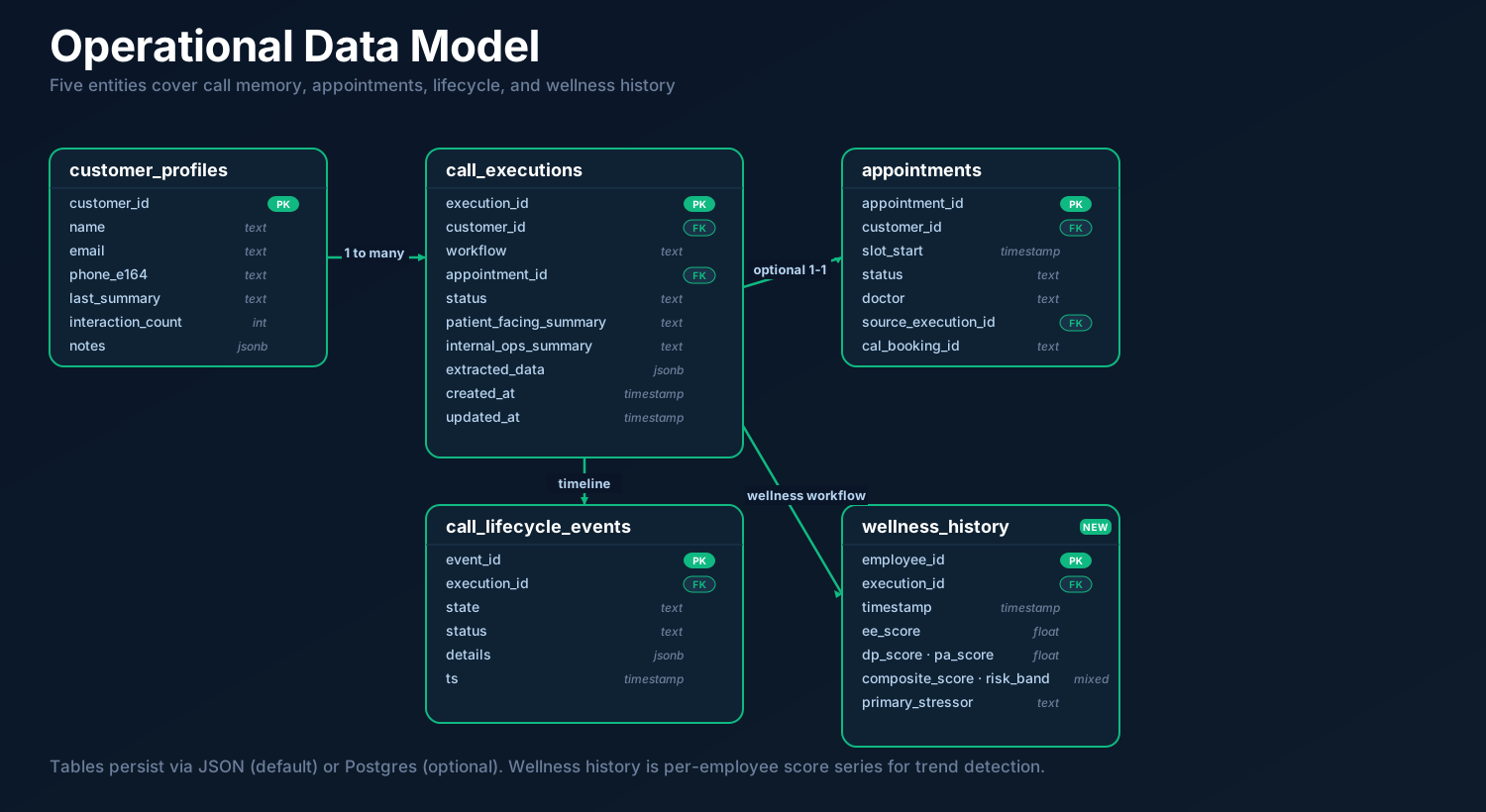
The four operational entities are customer_profiles, call_executions, appointments and
call_lifecycle_events; the wellness workflow adds a per-employee score history. More detail in
ARCHITECTURE.md and
docs/.
Use cases and recipes
All four examples run offline with no API keys.
| Script | What it shows |
|---|---|
frontdesk_offline_pipeline.py |
A knee-pain call booked with an orthopedist and confirmed; a chest-pain call escalated to clinical triage and never auto-booked |
wellness_trend_monitoring.py |
Six weekly check-ins for one employee: MBI dimension scores, Mann-Kendall trend, escalation from none to manager check-in to confidential follow-up |
fhir_booking_local_server.py |
FHIRAppointmentConnector searching free Slots and creating an Appointment against a localhost FHIR-shaped server |
transcript_triage_batch.py |
Deterministic triage table (category, risk, specialty, auto-book, queue, SLA) for a batch of transcripts; optional Mistral extraction when MISTRAL_API_KEY is set |
The wellness workflow in detail
wellness_checkin runs a short weekly conversational check-in with an employee, scores the
transcript on the three Maslach Burnout Inventory (MBI) dimensions, tracks the score history per
employee, and routes to one of three actions: auto-close, manager check-in, or confidential human
follow-up. It produces routing signals; it does not diagnose.
analysis/burnout.pyscores emotional exhaustion, depersonalisation and reduced personal accomplishment with a regex taxonomy.extraction/burnout.pyasks the LLM for 0-10 scores per dimension under a Pydantic-validated schema with verbatim quote evidence. The two are fused with a 0.75/0.25 LLM/regex weighting.analysis/trend.pyapplies the Mann-Kendall test (with tie correction) and an OLS slope to the per-employee composite series. A triage trigger fires on three consecutive worsening sessions, a composite of 7.0 or more, or a deteriorating trend with the latest composite at 5.0 or more.- Crisis cues (explicit hopelessness, self-harm references, breakdown language) set a separate acuity flag that overrides the policy unconditionally (1-hour SLA, confidential human follow-up).
- History sits behind
WellnessHistoryStorePort; the default JSON adapter writesartifacts/wellness_history.json.
Dashboard API:
GET /api/wellness/cohort                  cohort summary by latest band
GET /api/wellness/flagged                 employees flagged for follow-up
GET /api/wellness/employee/{employee_id}  full session history + recomputed trend
GET /api/wellness/series?limit=50         per-employee composite trajectories
Configuration
Settings come from environment variables (a .env file in the working directory is read
automatically). The library itself needs none of them; the live stack needs BOLNA_API_KEY for
calls and MISTRAL_API_KEY for extraction. Without a key, the matching integration is skipped
with a reason rather than failing.
| Variable | Default | Purpose |
|---|---|---|
BOLNA_API_KEY, BOLNA_BASE_URL, BOLNA_AGENT_ID, BOLNA_FROM_NUMBER |
-, https://api.bolna.ai |
Telephony provider, default agent, caller ID |
MISTRAL_API_KEY, MISTRAL_MODEL |
-, mistral-small-latest |
Extraction, evaluation, summary polish |
AGENTCARE_LLM_GATEWAY_URL, AGENTCARE_MOCK_EHR_URL |
http://localhost:8010/v1, http://localhost:8020 |
Local service endpoints used in agent specs |
APPOINTMENT_CONNECTOR_BACKEND |
cal |
cal, fhir or mock |
CAL_API_KEY, CAL_EVENT_TYPE_ID, CAL_TIMEZONE |
-, -, Asia/Kolkata |
Cal.com booking (event type is auto-discovered if unset) |
FHIR_BASE_URL, FHIR_AUTH_TOKEN, FHIR_SCHEDULE_ID, FHIR_ORGANIZATION_ID |
- | FHIR R4 connector |
FHIR_TIMEOUT_SEC, FHIR_SLOT_SEARCH_COUNT |
10, 20 |
FHIR request timeout and slot page size |
RESEND_API_KEY, AGENTCARE_EMAIL_FROM |
-, AgentCare <onboarding@resend.dev> |
Confirmation email (falls back to the Resend test sender if your domain is unverified) |
CUSTOMER_STORE_BACKEND |
auto |
auto, json or postgres |
CUSTOMER_STORE_PATH, PROCESSED_EXECUTIONS_PATH, WELLNESS_HISTORY_STORE_PATH |
artifacts/*.json |
Local JSON stores |
DATABASE_URL (or SUPABASE_DB_URL) |
- | Postgres for memory and analytics |
FRONTDESK_POLICY_PATH |
- | JSON file overriding the booking policy |
artifacts/ is git-ignored; do not commit call data or .env.
API overview
| Object | Purpose |
|---|---|
usecases.process_agentcare_execution(execution, source, workflow=None, ...) |
Route one post-call payload to the right workflow |
usecases.process_frontdesk_execution(execution, source, deps=None, ...) |
Front-desk pipeline; returns FrontdeskProcessingResult |
usecases.process_wellness_execution(execution, source, deps=None) |
Wellness pipeline; returns WellnessExecutionResult |
usecases.FrontdeskDeps, usecases.WellnessDeps |
Dependency containers for injecting your own adapters |
analysis.analyze_healthcare_context, analyze_burnout_context, detect_trend |
Deterministic analysis |
policies.evaluate_frontdesk_policy, evaluate_wellness_policy |
Decisions (auto-book, escalate, SLA) |
doctor.assign_doctor, load_doctor_schema |
Specialty routing over a doctor directory |
connectors.CalAppointmentConnector, FHIRAppointmentConnector, MockAppointmentConnector, get_appointment_connector() |
Booking adapters |
customer.CustomerMemoryStore, PostgresCustomerMemoryStore, get_customer_store() |
Customer memory |
extraction.extract_conversation_fields, extract_burnout_fields |
Mistral extraction into Pydantic models |
bolna.BolnaClient |
Bolna API: agents, calls, executions, voices, knowledge bases |
workflows.WORKFLOW_REGISTRY, orchestrator.Orchestrator |
Workflow registry; create a Bolna agent from a workflow |
CLI reference
agentcare doctor                                  # effective configuration, no secrets
agentcare init-artifacts                          # create artifacts/
agentcare up --dry-run                            # validate the local stack config
agentcare framework list-workflows                # registered workflows (JSON)
agentcare framework create-agent --workflow wellness_checkin
agentcare framework process-execution --execution-json call.json [--workflow wellness_checkin]
agentcare framework provider-test                 # check provider connectivity
agentcare extract transcript call.txt             # Mistral field extraction
agentcare eval transcript call.txt                # LLM quality evaluation of a call
agentcare customer upsert --name Ava --email ava@example.com
agentcare customer lookup --query "knee pain"
agentcare templates frontdesk --out agent.json    # Bolna agent spec
agentcare bolna voices | call | execution | create-agent | sync-executions
agentcare bolna kb create-url | create-pdf | list | get | delete
Research and references
The wellness layer builds on:
- Maslach Burnout Inventory dimensions (emotional exhaustion, depersonalisation, reduced personal accomplishment): C. Maslach and S. E. Jackson, "The measurement of experienced burnout," Journal of Occupational Behaviour 2(2), 99-113, 1981. AgentCare maps conversational cues to these dimensions; it does not administer or reproduce the MBI questionnaire.
- Mann-Kendall trend test: H. B. Mann, "Nonparametric tests against trend," Econometrica
13(3), 245-259, 1945; M. G. Kendall, Rank Correlation Methods, Griffin, 1975 (variance with tie
correction as implemented in
analysis/trend.py).
Reproducible experiments
experiments/ is a separate benchmark layer (scikit-learn, numpy, matplotlib); the runtime does not
need it.
pip install -r experiments/requirements.txt
bash scripts/run_all_experiments.sh
The script generates a deterministic synthetic corpus (180 employees, 8 sessions each, seed 42)
and runs four experiments: extraction quality, trend detection across window sizes, predictive
modelling at a four-session horizon with a feature ablation, and adversarial robustness on
edge-case transcripts. Outputs land in experiments/output/.
Regex-only run (no LLM) on the default seed, re-run for this README on 2026-10-31:
| Experiment | Metric | Value |
|---|---|---|
| Trend detection, window = 8 | Accuracy | 0.972 |
| Predictive, logistic regression (test n = 27) | F1 | 0.952 |
| Predictive, logistic regression (test n = 27) | ROC-AUC | 0.997 |
| Adversarial edge cases (n = 12) | Band accuracy | 0.833 |
| Adversarial edge cases (n = 12) | Band false positives | 0 |
These numbers validate the pipeline mechanics on synthetic data generated by the same project; they are not claims about real-world burnout detection. See experiments/README.md for interpretation and limitations.
When to use it
- Good fit: you run (or plan) a voice agent for a clinic or HR wellness line and need the post-call layer: extraction, triage, booking, confirmations, memory and dashboards, with the safety logic in reviewable code.
- Not a fit as-is: clinical decision support or diagnosis, or regulated production use without your own compliance review (consent, PHI handling, BAAs, audit logging). The keyword risk rules are a conservative routing aid, not a clinical triage protocol.
Roadmap
- Postgres adapter for the wellness history store.
- More EHR connectors on the FHIR path (vendor sandboxes) and Cal.com v2-only flows.
- Pluggable LLM providers for extraction beyond Mistral.
- Human-labelled transcripts to evaluate extraction and triage beyond the synthetic corpus.
Project context
The healthcare workflows (frontdesk_booking, care_navigation, followup_outreach) and the
framework itself are an independent open-source project published on PyPI under the MIT license.
The wellness_checkin workflow and the experiments/ benchmark layer were added in v0.2.0
(April-May 2026) as the deliverable for the M.Sc. Data Science & AI individual project at the
Indian Institute of Science Education and Research (IISER) Tirupati. The methodology (MBI dimension
mapping, Mann-Kendall trend detection, predictive modelling at a multi-session horizon) and the
experimental results are documented in the project's end-semester report.
Contributing, security, citation, license
- CONTRIBUTING.md: setup and
checks (
ruff check .,ruff format --check .,mypy,pytest --cov=agentcare,pre-commit install). - SECURITY.md: private
vulnerability reports.
scripts/check_no_secrets.shis a local pre-push safety check. - CHANGELOG.md: release history.
- Cite via CITATION.cff (GitHub's "Cite this repository" button).
- MIT License.
1 maintainer

Metadata
1 maintainer
Release files for agentcare 0.3.1
For a detailed explanation of source distributions (sdists) and built distributions (wheels), please see the package formats documentation.
Source distribution (sdist)
| File | Size | Uploaded | Provenance | Actions |
|---|---|---|---|---|
| agentcare-0.3.1.tar.gz | 106.4 kB | Without provenance | Details for agentcare-0.3.1.tar.gz |
Built distribution (wheel)
| File | Interpreter | ABI | Platform | Actions Reset |
|---|---|---|---|---|
| agentcare-0.3.1-py3-none-any.whl | Python 3 | none | any | Details for agentcare-0.3.1-py3-none-any.whl |
Total release size: 199.1 kB
Release files / agentcare-0.3.1.tar.gz
| Download URL | agentcare-0.3.1.tar.gz |
|---|---|
| Size | 106.4 kB |
| Tags | Source |
|
SHA-256 checksum How to use checksums |
5ad3f03bc98e11775b5b7660ea2f3ef5ddb1eff870a6463cf623802f9115c647
|
|
BLAKE2b-256 checksum How to use checksums |
eb1fe8f7a0153789ba89546970758690e1dff7efc8547fb0bd9c6d6972a9b5d4
|
| Upload date | |
|
Uploaded using Trusted Publishing? What is trusted publishing? |
No |
| Uploaded via |
twine/7.0.0 CPython/3.11.7
|
Release files / agentcare-0.3.1-py3-none-any.whl
| Download URL | agentcare-0.3.1-py3-none-any.whl |
|---|---|
| Size | 92.7 kB |
| Tags | Python 3 |
|
SHA-256 checksum How to use checksums |
28b0b0ff09e26b160752c19e55adca6815ba74dddb4bc6a16917979671e197e3
|
|
BLAKE2b-256 checksum How to use checksums |
00c10c476912bfbb99af92be218165edc1c84408b2247a647f829096ac0688db
|
| Upload date | |
|
Uploaded using Trusted Publishing? What is trusted publishing? |
No |
| Uploaded via |
twine/7.0.0 CPython/3.11.7
|
Security for agentcare 0.3.1
Provenance
Provenance describes where a file came from. On PyPI, provenance is shared via attestations, which provide a verifiable record of the build or publishing details. View details, limitations and caveats.
No provenance found
None of the files in this release were uploaded with provenance metadata.
A note on package security
PyPI is a repository for distributing packages, not a service for auditing them. While third-party security researchers and our staff do their best to detect and remove malicious packages, PyPI cannot guarantee the quality, security or suitability of any given package.
To learn more about protecting yourself from malicious actors, visit our package security documentation.














