
AgentDescent
Website & interactive demo · Get started · Documentation
Gradient descent — but the parameters are agents. AgentDescent evolves prompts, skills, agent directories, agent code and host plugins against your own examples. N workers propose edits in parallel, one aggregator merges them into a version-controlled artifact, and a held-out gate decides what is kept. Use it from Python with one
evolve()call, from the CLI, or from inside Claude Code, Codex, OpenCode, DeepSeek Harness or Grok Bot — and swap in any of the named algorithms or twenty-three published-method ports on the same engine.





Install
pip install "agentdescent[mcp]>=0.10.0"
agentdescent demo                         # a complete evolution, offline, no API key, ~10 s
agentdescent doctor                       # which agent CLIs and provider keys this machine has
Host / MCP default loop is Path A (doctor → plan → start → apply); advanced MCP tools need agentdescent mcp --advanced — see docs/mcp-path-a.md.
[mcp] adds the agent-facing MCP server and needs Python ≥ 3.10; the library
itself supports 3.9, where you drop [mcp] and drive it with the CLI. Research examples are outside the wheel: to run
python -m examples.run_demo or any algorithm port, clone the repo and follow
install and first run:
git clone https://github.com/ThinkFlowLab/agentdescent && cd agentdescent
pip install -e ".[dev,mcp]"
agentdescent demo builds a skill whose rules name the wrong CSV column, twelve
cases with known totals and a local program as the agent, then runs the real
loop — only the model is replaced — and ends with:
held-out reward: 1.000 outcomes: {'committed': 1}
what it learned: rules.md -> 'COLUMN: amount'
60-second quickstart
Runnable as-is — no API key, no dependencies. Three functions are the whole contract: how to run a task, how to score it, and what to propose on a failure.
from agentdescent import Task, evolve

tasks = [Task(id=f"t{i}", prompt=f"item {i}") for i in range(12)]

def reward(task, output):                  # must return [0, 1]
    return 1.0 if "2026" in output else 0.0

def run(rendered, task):                   # your solver
    return "answer" + (" 2026" if "year" in rendered else "")

def propose(rendered, task, output, reward):   # what to add on a failure
    return "always state the year"

result = evolve(tasks, reward, run=run, propose=propose,
                rounds=6, n_workers=3, max_concurrency=3)
print(result.rendered, result.final_reward, result.error)
With a real model and a real dataset
Credentials are read from the environment at call time — never from code — and the base URL picks the provider (every provider →):
export OPENAI_BASE_URL=https://api.deepseek.com   # or GLM, Ark, a local vLLM, OpenAI itself
export OPENAI_API_KEY=sk-...                      # your key for *that* endpoint
from agentdescent import SingleSlot, evolve, openai_compatible, reflector, scorer, tasks_from
from agentdescent.dataloader import hf_rows

rows = hf_rows("hotpotqa/hotpot_qa", "validation", config="distractor", limit=40)
model = openai_compatible(model="deepseek-v4-flash")

tasks = tasks_from(rows, prompt="question", gold="answer")     # rows -> Task objects
run = lambda instruction, task: model(f"{instruction}\n\n{task.prompt}")

result = evolve(tasks, scorer("exact"), run=run, propose=reflector(model),
                strategy=SingleSlot(initial_value="You are a helpful assistant."),
                rounds=8, n_workers=8, max_concurrency=8, held_out_frac=0.3,
                patience=3, target_reward=0.98)

print(result.rendered)        # the instruction it learned
print(result.final_reward)    # held-out reward
print(result.outcomes())      # why it went that way
On 40 HotpotQA items (12 held out) this took held-out exact match from 0.167
to 0.583, learning "Respond with only the requested answer, omitting any extra
explanation or restatement." That evolves an instruction (SingleSlot), not
an Agent Skill folder — for a library run agentdescent demo --kind skill_library.
Pass agent=LLMAgent(claude_code()) (or any
agent or LLM) instead of
run/propose to evolve against a tool-using CLI agent.
Quickstart — dataset to skill →
From the CLI, on a file or directory
agentdescent init ./my-skill --data cases.jsonl --out spec.json   # cases: {"prompt": ..., "gold": ...} per line
agentdescent plan spec.json            # validates and prices it; runs nothing
agentdescent evolve spec.json --detach
agentdescent status                    # then: show <run_id>, apply <run_id> --dry-run, apply <run_id>
Nothing is written back until apply, which backs up first.
Call any algorithm
Every named algorithm is a set of defaults over the same engine, selectable by name from the CLI, a spec, MCP, or the host plugins:
agentdescent algorithms list                   # ace, archive_selection, dgm, evoskill, gepa, rrsi, skillopt, …
agentdescent algorithms show gepa              # what it changes, its parameters
agentdescent algorithms run gepa ./prompt.txt cases.jsonl --rounds 1 --workers 1   # writes a spec and plans it
agentdescent demo --algorithm archive_selection   # watch one run offline
In a spec it is one field — "algorithm": "gepa" or
{"name": "gepa", "params": {...}} — and every explicit field still wins.
The catalog →
Cards vs ports: Path A names cards (wheel mechanism slices). The
twenty-three research ports are source-only under examples/ — same slug is
not the same fidelity; never read a card run as paper numbers
(decision tree, #384).
Ports run from a checkout, each with a --dry-run that needs no API key:
- Benchmark-faithful (8): ACE · GEPA · EvoSkill · SkillOpt · ADAS · DGM · OpenEvolve · ERA
- Microports and analogues (15): PromptBreeder · AFlow · Self-Refine · Reflexion · SICA · Gödel Agent · Voyager · SkillWeaver · Absolute Zero · R-Zero · Agent0 · gskill · TextGrad · Dynamic Cheatsheet · Genesis
python -m examples.gepa.gepa_prompt_evolution --dry-run
python -m examples.ace.ace_context_evolution --model claude-haiku-4-5 --async   # barrier-free
Fidelity is declared per port and follows each project's released code; analogues are not benchmark reproductions. All twenty-three, with measured results →
Add an algorithm
-
A named card, in one PR — a
build(ctx, params) -> Overridesthat fills policy slots andevolve()knobs. Copyagentdescent/algorithms/_TEMPLATE.py, register it, and regenerate the catalog withpython -m tools.gen_algorithms_docs. Register a named Algorithm card → -
From your own package — no fork needed; expose it as an entry point and
agentdescent algorithms listpicks it up:[project.entry-points."agentdescent.algorithms"] my_method = "my_pkg:ALGORITHM"
-
A full research port — porting checklist (benchmark-faithful) or MethodPolicy checklist (microports).
Use it from your agent
The same engine as a plugin: a shared skill teaches the host when to reach
for it, an MCP server exposes doctor / plan / start / status / show / apply / cancel / resume (and the algorithm, audit and archive tools), and the CLI
mirrors them, so a run started from an agent can be inspected from a shell.
| host | install | then |
|---|---|---|
| Claude Code | agentdescent install claude-code |
claude --plugin-dir ~/.agentdescent/plugins/claude-code |
| Codex | codex plugin marketplace add ThinkFlowLab/agentdescent && codex plugin add agentdescent@agentdescent |
codex mcp list |
| OpenCode | agentdescent install opencode |
opencode mcp list |
| DeepSeek Harness | agentdescent install dsh |
dsh --profile web --dump-config | grep agentdescent |
| Grok Bot | agentdescent install grok-bot (a scaffold, not one-click) |
read HOST.md; MCP via agentdescent mcp --transport streamable-http behind an HTTPS tunnel |
From a checkout, bash scripts/setup-hosts.sh installs AgentDescent and wires
every agent CLI it finds. Then say "improve this prompt against these
examples" inside the agent: it runs doctor, writes a spec, quotes the call
count before starting, waits for your yes, runs detached, and asks again
before it writes anything back. No cases yet is not a blocker — it drafts 8–20
for you to check first.
kind is text, skill_dir, skill_library (multi-file */SKILL.md tree),
agent_dir, agent_code, policy_slot — or plugin: the host plugins
themselves are evolvable, each rollout in an isolated copy of the host with
hooks and permissions frozen and a recursion guard. Flagship library demo:
agentdescent demo --kind skill_library.
The plugin, step by step →
· set it up and test it →
How it works
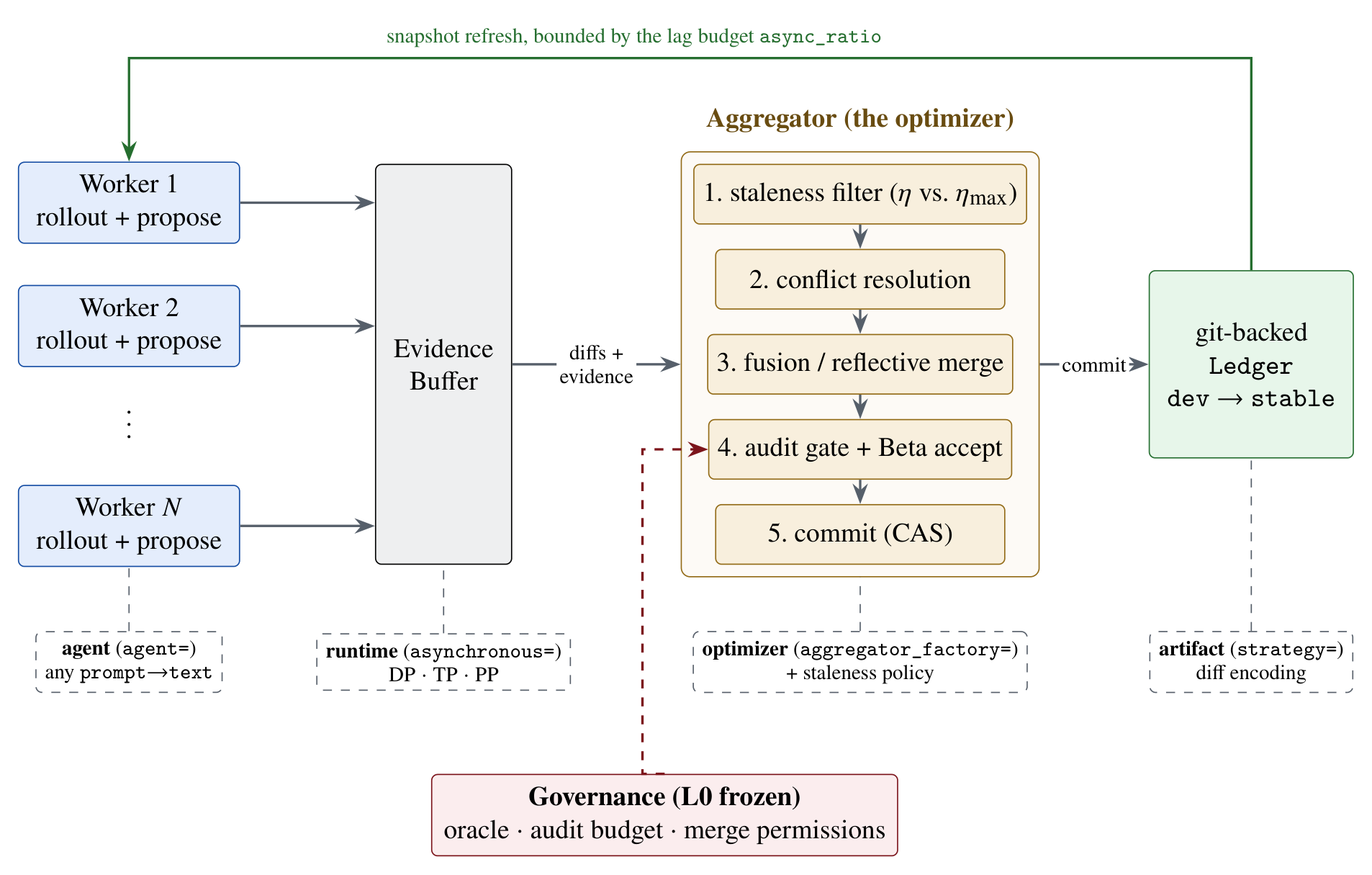
Serial self-improvement is bounded at one accepted change per iteration;
merging concurrent edits is the attempt to lift that bound. The analogy breaks
exactly where the design lives: gradients add, diffs do not, so aggregation
is conflict resolution, fusion, statistical acceptance and a transactional
commit rather than averaging. The governance layer (red) is deliberately not a
seam — a self-modifying system must not be able to replace its own evaluator.
The figure is regenerated from TikZ by
tools/gen_architecture_figure.py.
What you can replace. Two typing.Protocol seams carry the algorithm:
- the strategy — what evolves.
AppendRules(lessons; proposals almost always fuse),KeyedRules(one entry per category),FileTree(a directory, one key per path),SingleSlot(one value; proposals always contradict), or your own three-method class. Its key space decides whether concurrent edits can fuse at all. - eight policy slots — the rules of evolution:
selection,task_sampler,proposal,staleness,conflict,fusion,acceptance,promotion. Each defaults to the shipped rule; a driver refuses a field it cannot honour rather than ignoring it. Mechanisms that need state the pipeline does not keep take theaggregator_factoryexit. How to fill a slot →
What it measures
Every row names the setting that produced it; the results page also reports the runs where there was nothing left to learn.
| measured | setting | |
|---|---|---|
| An artifact held in one key, where a keyed union can never fuse | keyed union fuses 0 of 48 merges · reflective merge 42 of 48 | BBH dyck_languages, GLM-5.2, N=4, 4 seeds |
| What that costs, at a pinned rollout budget | 40% fewer model calls (95% CI 27–54%, same direction on every seed) | the same runs |
| Wall-clock against a faithful serial control | median 6.8× (three seeds, 3.1–9.5×) | GEPA on HotpotQA, N=4, 16 rollouts pinned |
| The one-call path, end to end | held-out exact match 0.167 → 0.583 | 40 HotpotQA items, 12 held out |
Quality is claimed only where the design can support it: intervals rather than p-values where a comparison cannot reach significance, and it says so.
Documentation
Full docs: thinkflowlab.github.io/agentdescent.
| Start | Install · The plugin, step by step · Quickstart — dataset to skill · Evolve a directory · Evolve agent code |
| Agents | Use it from your agent · Set it up and test it · Agents & LLMs |
| Algorithms | Named algorithms · Register a card · Twenty-three ports · Port fidelity |
| Engine | The evolve() method · Strategies · Policies · Architecture · Concepts · API reference |
| Results | Measured results · Efficiency · Runtime matrix |
Citing, scope and contributing
Use GitHub's Cite this repository button (CITATION.cff);
per-result raw data is in bench/results/.
A research reference implementation, not a production system. The novelty is
a narrow engineering synthesis — concurrent, staleness-bounded,
conflict-resolved diff-level merge over a git-backed versioned ledger — and its
throughput premise is a testable hypothesis rather than community consensus.
Contributions welcome: CONTRIBUTING.md. The suite is offline
and deterministic, so pytest -q needs no API key.
1 maintainer

Metadata
1 maintainer
Release files for agentdescent 0.10.0
For a detailed explanation of source distributions (sdists) and built distributions (wheels), please see the package formats documentation.
Source distribution (sdist)
| File | Size | Uploaded | Provenance | Actions |
|---|---|---|---|---|
| agentdescent-0.10.0.tar.gz | 2.3 MB | With provenance | Details for agentdescent-0.10.0.tar.gz |
Built distribution (wheel)
| File | Interpreter | ABI | Platform | Actions Reset |
|---|---|---|---|---|
| agentdescent-0.10.0-py3-none-any.whl | Python 3 | none | any | Details for agentdescent-0.10.0-py3-none-any.whl |
Total release size: 3.7 MB
Release files / agentdescent-0.10.0.tar.gz
| Download URL | agentdescent-0.10.0.tar.gz |
|---|---|
| Size | 2.3 MB |
| Tags | Source |
|
SHA-256 checksum How to use checksums |
9702bfa1473a12a9d05c5d2f5db72cbef385a04f3c7490fd1c86a0aa87368540
|
|
BLAKE2b-256 checksum How to use checksums |
0d3e1c77992233f9b8bad87cb2a7989be1037e916fd397643063faacdddbd670
|
| Upload date | |
|
Uploaded using Trusted Publishing? What is trusted publishing? |
Yes |
| Uploaded via |
twine/7.0.0 CPython/3.13.16
|
Provenance
Provenance describes where a file came from. On PyPI, provenance is shared via attestations, which provide a verifiable record of the build or publishing details. View details, limitations and caveats.


PyPI Publish Attestation
PyPI verified that this artifact, at this checksum, originated from the publisher listed below.
Signed by GitHub Actions, verified by PyPI on Nov 13, 2026.
Transparency logRelease files / agentdescent-0.10.0-py3-none-any.whl
| Download URL | agentdescent-0.10.0-py3-none-any.whl |
|---|---|
| Size | 1.4 MB |
| Tags | Python 3 |
|
SHA-256 checksum How to use checksums |
059c81a1a2fdc1c5b1c7d5dbc76faeb56061044d46e5f2a717e58222620ce677
|
|
BLAKE2b-256 checksum How to use checksums |
e1b2dbd8e3350de1e3ab87434a76c39da2d942522e08161424e4fe449e81cf32
|
| Upload date | |
|
Uploaded using Trusted Publishing? What is trusted publishing? |
Yes |
| Uploaded via |
twine/7.0.0 CPython/3.13.16
|
Provenance
Provenance describes where a file came from. On PyPI, provenance is shared via attestations, which provide a verifiable record of the build or publishing details. View details, limitations and caveats.
PyPI Publish Attestation
PyPI verified that this artifact, at this checksum, originated from the publisher listed below.
Signed by GitHub Actions, verified by PyPI on Nov 13, 2026.
Transparency logSecurity for agentdescent 0.10.0
Provenance
Provenance describes where a file came from. On PyPI, provenance is shared via attestations, which provide a verifiable record of the build or publishing details. View details, limitations and caveats.
Full provenance
Both files in this release have been uploaded with provenance metadata.
Attestation for agentdescent-0.10.0.tar.gz
PyPI Publish Attestation
PyPI verified that this artifact, at this checksum, originated from the publisher listed below.
Signed by GitHub Actions, verified by PyPI on Nov 13, 2026.
Transparency logA note on package security
PyPI is a repository for distributing packages, not a service for auditing them. While third-party security researchers and our staff do their best to detect and remove malicious packages, PyPI cannot guarantee the quality, security or suitability of any given package.
To learn more about protecting yourself from malicious actors, visit our package security documentation.














