
AgentFlight
A black box recorder for AI agents. AgentFlight records what an agent does during a run: model calls, tool executions, decisions, state changes, token spend and failures. Every run is stored as an ordered timeline you can query, replay and fork.
Status: early development (week 5, viewer). APIs may change; see CHANGELOG.md.
AgentFlight, Langfuse, LangSmith or Phoenix?
Langfuse, LangSmith and Arize Phoenix are full LLM engineering platforms. Besides tracing they offer evaluations, datasets and experiments, prompt management and dashboards, with many framework and provider integrations. Langfuse and Phoenix can be self-hosted and accept OpenTelemetry traces. LangSmith runs as a LangChain cloud service, with self-hosted and bring-your-own-cloud options on its Enterprise plan.
AgentFlight is much smaller: a Python recorder, one server on Postgres (or SQLite) and a read-only viewer, with no evaluations, prompt management or dashboards. Its focus is re-running your own agent code from a recording. Replay serves the recorded model and tool outputs back to the same code in your process, offline, and fork swaps one step and runs live from there. That's different from re-running a single LLM call in a playground (Phoenix's span replay, for example, replays LLM calls with different inputs). Choose one of the platforms if you need evaluations, prompt management or team features; AgentFlight if you want a small self-hosted recorder with step-by-step replay of agent runs.
Architecture
flowchart LR
    subgraph Agent process
        A[Your agent code] -->|run / llm_call / @tool / decision / state_change| SDK[agentflight SDK]
        SDK --> OTel[OpenTelemetry spans<br/>private TracerProvider]
        OTel --> EXP[AgentFlightExporter<br/>batched HTTP JSON]
    end
    EXP -->|POST /v1/spans| API[FastAPI ingest server]
    API --> DB[(PostgreSQL<br/>runs + events)]
    C[curl / scripts] -->|GET /v1/runs, /v1/runs/:id| API
    V[Browser] -->|/ui viewer| API
- One run = one OpenTelemetry trace.
agentflight.run(...)opens the root span; its trace id is the run id. Everything recorded inside it is a child span. - Each span carries
agentflight.*attributes (kind, model, messages, tokens, tool args/result, error type...). Structured values are stored as JSON. - The SDK uses its own TracerProvider, so it doesn't change any global OTel setup your app already has.
- The server upserts by span id (re-sent batches are idempotent) and accepts child spans
before their root span arrives (the run shows as
runninguntil then; see Run status). - Run totals are stored on the run row (calls, errors, tokens, cost) and recomputed in SQL for every run an ingest batch touches, so listing runs never reads their events and re-sent spans can't make the totals drift.
Quickstart
# 0. A key for the server and the SDK (never commit it)
export AGENTFLIGHT_API_KEY=$(openssl rand -hex 32)

# 1. Server + Postgres + retention job (applies Alembic migrations on start)
docker compose up --build

# or without Docker, using SQLite (from a checkout; once 0.1.0 is on PyPI,
# `pip install "agentflight-sdk[server]"` works too):
pip install -e ".[server]"
agentflight-server migrate      # uses AGENTFLIGHT_DATABASE_URL, default sqlite:///./agentflight.db
agentflight-server serve        # http://127.0.0.1:8000

# 2. Record the toy agent (the SDK reads AGENTFLIGHT_API_KEY)
pip install -e .                # or, once 0.1.0 is on PyPI: pip install agentflight-sdk
                                # (the package is agentflight-sdk; you import agentflight)
python examples/toy_agent.py

# 3. Inspect: open http://localhost:8000/ui and sign in with the key, or use the API
curl -H "Authorization: Bearer $AGENTFLIGHT_API_KEY" localhost:8000/v1/runs
curl -H "Authorization: Bearer $AGENTFLIGHT_API_KEY" localhost:8000/v1/runs/<run_id>
Viewer
The server includes a read-only viewer at /ui:
- Runs: every run with its status, start time, duration, call counts, failures, tokens
and cost, filtered by status, name, model, tool, errors, metadata (
key:value) and start time. Filters update the table in place. A run whose recorder dropped spans is marked "incomplete recording: N spans dropped" (see "Dropped spans are counted" below). - Run page: the run's spans as an indented tree (each span under its parent, siblings in start order) with a bar per span on the run's time axis, failures highlighted with their messages, and replay/fork runs linked to the run they came from. A span whose parent never arrived starts its own subtree at the left. Events load in pages of 100 without payloads, and the next page continues the tree where the last one stopped; selecting an event loads its messages, outputs, arguments and stack traces on demand. An incomplete recording gets a warning above the timeline. (To page in tree order the server reads every span's id and parent for each page, which is cheap next to loading the events themselves.)
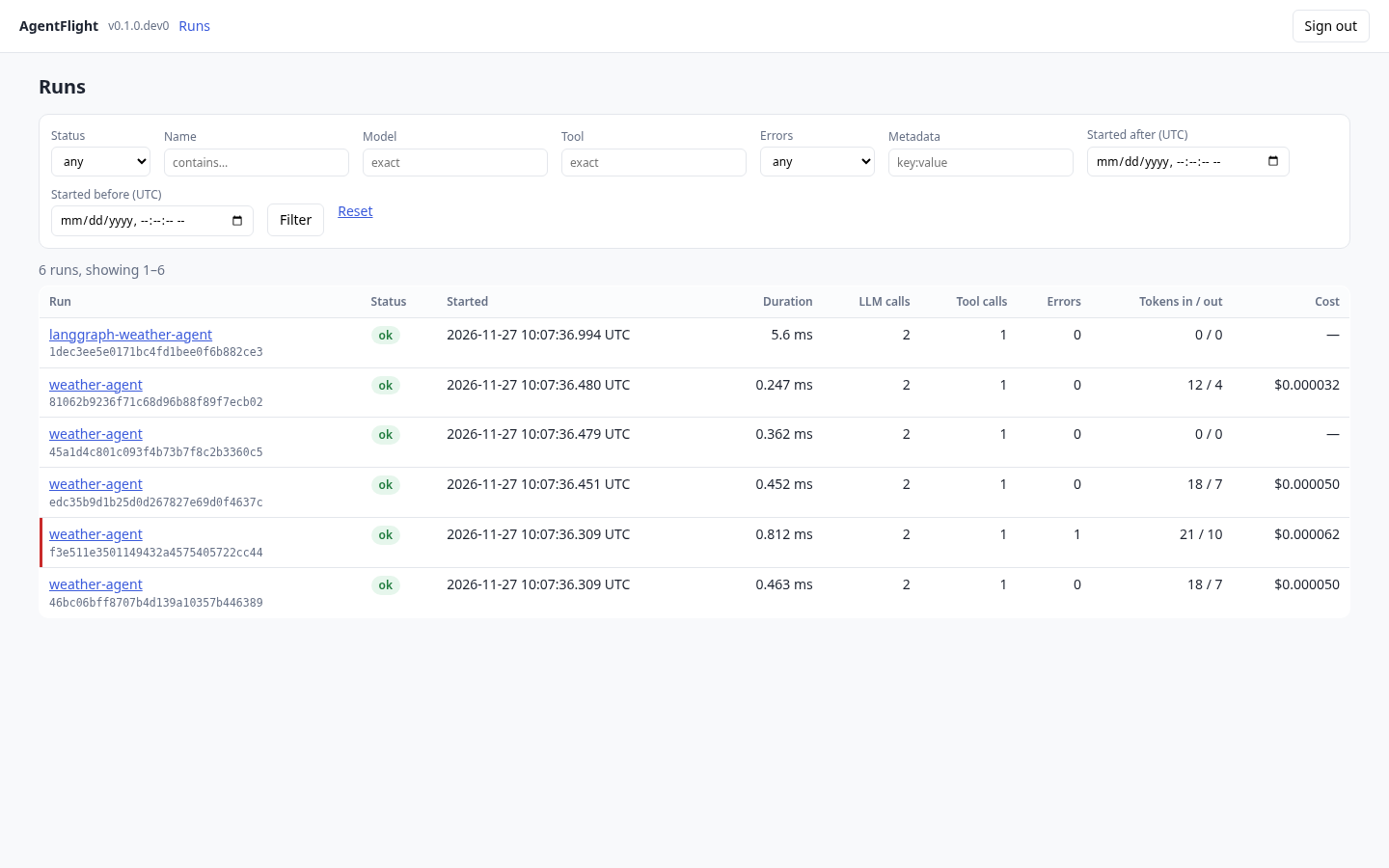
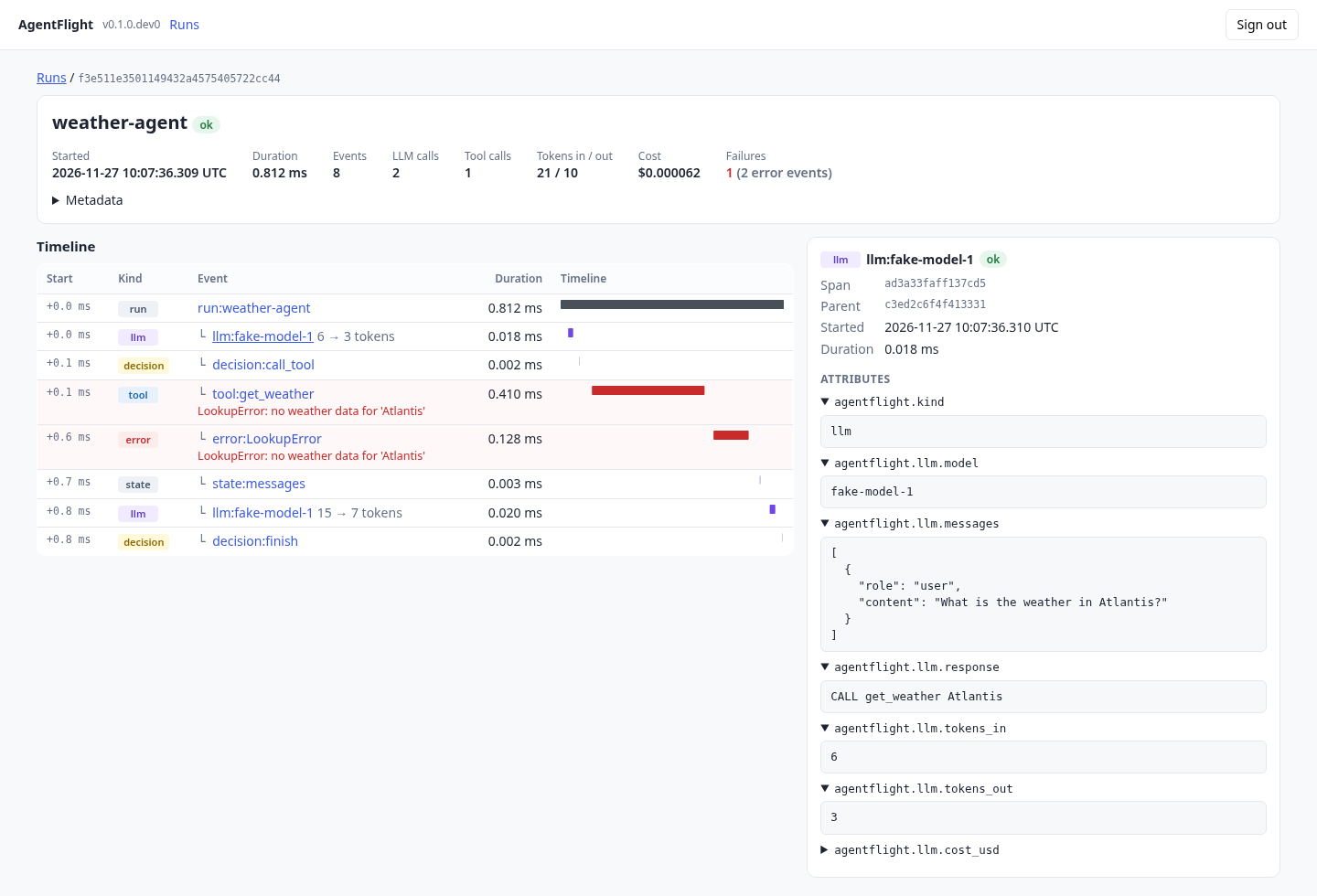
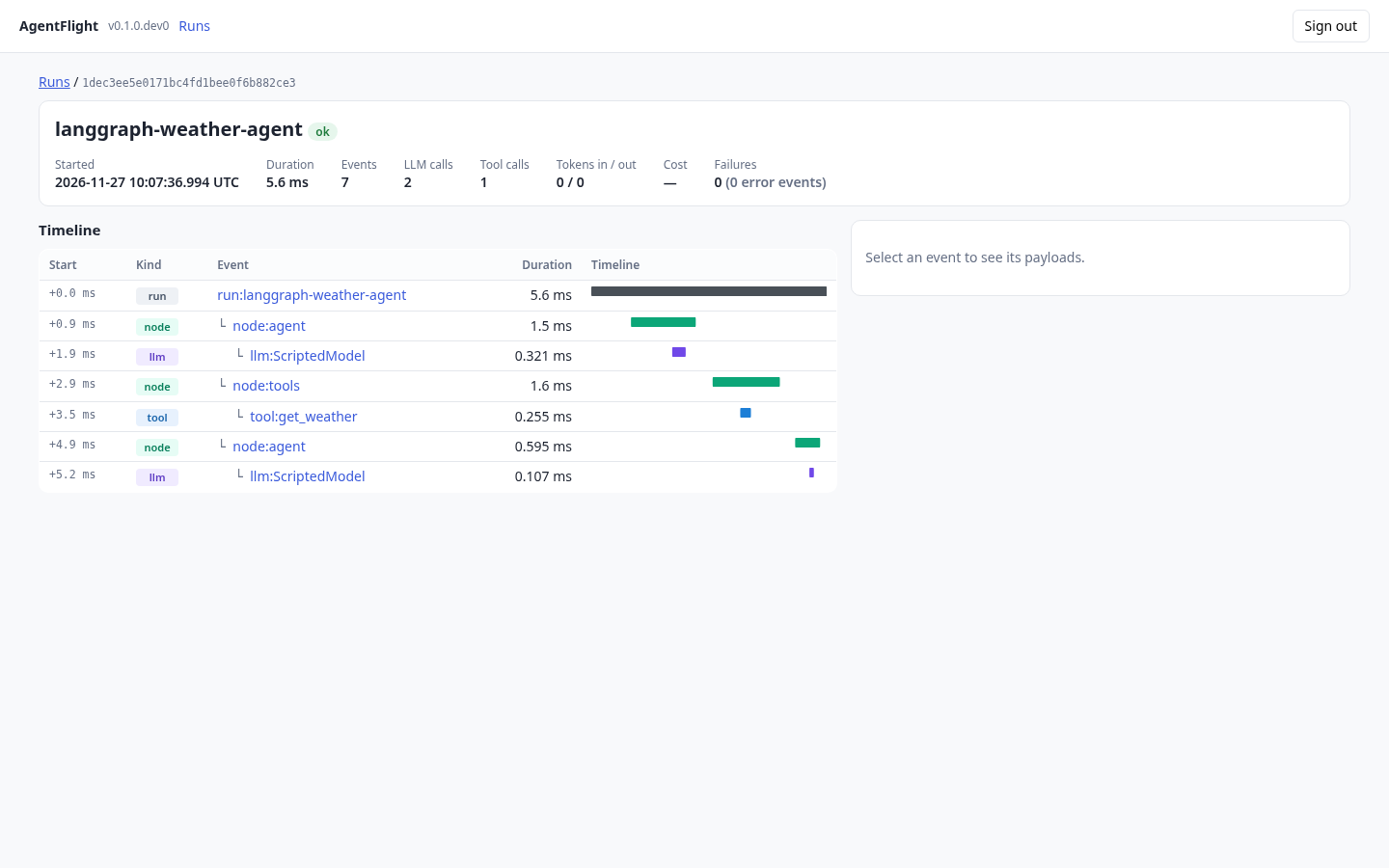
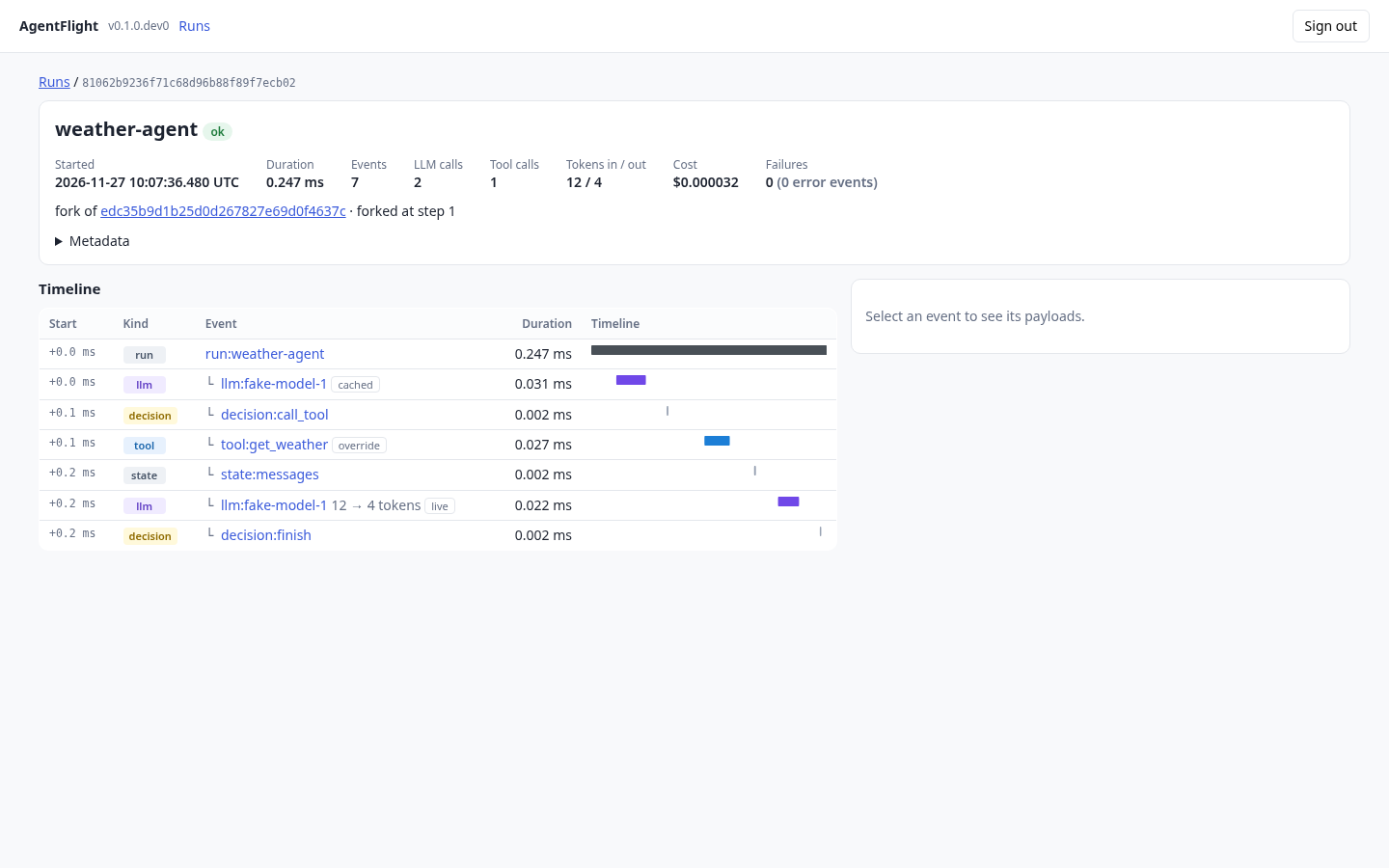
The screenshots come from the browser smoke test against the example agents; regenerate
them with AGENTFLIGHT_SCREENSHOT_DIR=docs/screenshots pytest tests/test_viewer_browser.py.
It is server-rendered (Jinja2 and htmx, vendored, no build step) and
reads through the same service functions and JSON shapes as the /v1 API, so another
frontend can be built on the API alone. Everything a run recorded is treated as untrusted:
templates autoescape everything and nothing is marked safe, and pages are served with a
Content-Security-Policy that allows no inline script or style (script-src 'self'). See
Viewer sign-in for how sessions work.
Recording API
import agentflight

agentflight.configure("http://localhost:8000")


@agentflight.tool  # records name, bound args, result or exception
def search(query: str) -> list[str]: ...


with agentflight.run("support-agent", metadata={"ticket": 42}) as run:
    with agentflight.llm_call("gpt-4o-mini", messages) as call:
        resp = client.chat(...)  # your model client
        call.record(resp.text, tokens_in=..., tokens_out=..., cost_usd=...)  # cost optional
    agentflight.decision("next_step", "search", reason="needs docs")
    agentflight.state_change("plan", new_plan, old=old_plan)
    try:
        search("refund policy")
    except Exception as exc:
        agentflight.error(exc)  # handled error: recorded, run continues

agentflight.flush()  # before exit, so batched spans are sent
- Latency is the span duration (
duration_msin the API). - An exception escaping
run,llm_callor a@toolmarks that span (and the run) aserrorand is re-raised unchanged. @agentflight.toolworks on sync and async functions;@agentflight.tool(name="...")overrides the name.- If the server is unreachable, export fails with a logged warning; your agent keeps running.
Integrations
Optional extras; the core SDK depends on neither package.
OpenAI-style chat clients
pip install "agentflight-sdk[openai]"
from openai import OpenAI
from agentflight.integrations.openai import instrument_openai

client = instrument_openai(OpenAI())  # same client, now recorded
with agentflight.run("support-agent"):
    resp = client.chat.completions.create(model="gpt-4o-mini", messages=msgs, tools=tools)
- Each
chat.completions.createcall is anllmspan with the model, messages, request params (tools,temperature, ...), the full response (tool calls included) andtokens_in/tokens_outfromresponse.usage. - Works with
OpenAIandAsyncOpenAI, and with any client that has the sameclient.chat.completions.create(model=..., messages=...)shape.openaiitself is never imported by AgentFlight. - Cost isn't guessed. There's no built-in price table, so pass
instrument_openai(client, cost=lambda model, tokens_in, tokens_out: ...)if you want it. extra_headers,extra_query,extra_bodyandtimeoutare passed to the client but never recorded (headers can carry credentials). Everything recorded goes through yourredacthook.- Fail-open: the call happens exactly once with your arguments and its response or
exception comes back unchanged. If response parsing or your
costfunction fails, that's logged and ignored. A client without the expected shape is returned untouched. - Not recorded yet:
stream=Truecalls (passed straight through) and the Responses API.
LangGraph
pip install "agentflight-sdk[langgraph]"
from agentflight.integrations.langgraph import AgentFlightCallbackHandler

handler = AgentFlightCallbackHandler(run_name="react-agent")
graph.invoke(inputs, config={"callbacks": [handler]})
print(handler.run_id)
- The graph becomes a
run. Inside anagentflight.run(...)it's anodespan in that run instead. Each executed node is anodespan withagentflight.node.name,.step,.input(state in) and.output(state update). - Chat model and LLM calls inside nodes are
llmspans (messages, params, response, token usage fromusage_metadataortoken_usage). LangChain tools aretoolspans. Socreate_react_agent-style graphs record without any SDK calls in your code. - LangChain's own runnables inside a node (prompts, sequences, routers) aren't recorded. Their children attach to the nearest recorded span.
- Errors are recorded where they happen and share one failure id up the graph. LangGraph
interrupts aren't errors: the node's output records
{"interrupted": ...}. - Params whose names contain
api_key,secret,passwordorauthorizationare dropped. - Fail-open: every callback is guarded, so a broken recorder never changes the graph's result or exception.
- Limitation: spans you record yourself inside a node (
@agentflight.tool,llm_call) attach to the surroundingagentflight.run, not to the node span, and are only part of a run if one is open.
Both examples run offline (scripted model, no API key needed):
python examples/openai_agent.py      # uses the real API if OPENAI_API_KEY is set
python examples/langgraph_agent.py
Replay and fork
Re-run an agent against a recorded run. Recorded model and tool outputs are served instead of calling anything, so a replay costs nothing and gives the same result. A fork replays up to a step, then runs live from there.
Know the limits first:
- Only intercepted calls are replayed. Replay suits agents that only call models and tools. File writes, database queries, raw HTTP, the clock and randomness inside your agent still run live during a replay. Replay only notices them indirectly, when they change the input of a later step and that step diverges.
- An incomplete recording can't replay faithfully. If the recorder dropped spans of
the run (full export queue),
replay()andfork()log a warning as they start, before any step runs, andRecording.incomplete/Recording.dropped_spanssay so. Missing steps then show up as divergences, or as live calls withon_divergence="live". - Not covered yet: LangGraph runs (their model and tool calls go through LangChain,
which can't be intercepted yet; LangGraph's own checkpointer time travel covers some of
this) and streamed OpenAI calls (
stream=True). - Sequential agents only. Steps are matched in recorded order, so calls made in parallel threads or tasks can come in a different order and diverge.
recording = agentflight.Recording.fetch(run_id)  # or Recording.load("run.json")
for step in recording.steps:
    print(step.index, step.kind, step.name)  # 0 llm gpt-4o-mini, 1 tool search, ...

with agentflight.replay(recording) as session:
    answer = my_agent(question)  # same code as the recorded run
assert session.remaining == 0  # the replay covered every recorded step

with agentflight.fork(recording, at=1, output="no results"):
    answer = my_agent(question)  # step 0 cached, step 1 returns "no results", rest live

with agentflight.fork(recording, at=2):
    answer = my_agent(question)  # steps 0-1 cached, live from step 2 (e.g. a changed prompt)
Steps. A step is one @agentflight.tool call or one model call (instrument_openai, or
an llm_call block), in the order recorded. A call made inside another step (say, a model
call inside a tool) is part of that step. Serving the outer call means the inner one
never runs.
What gets intercepted. Only these calls are intercepted:
-
@agentflight.toolfunctions: the recorded result is returned and the function doesn't run. -
Clients wrapped with
instrument_openai: the client isn't called. The recorded response comes back as anopenaiChatCompletion(or as a dict with attribute access ifopenaiisn't installed). -
Manual
llm_callblocks, only if your code checkscall.replayed:with agentflight.llm_call(model, messages) as call: if call.replayed: reply = call.response else: reply = client.chat(...) call.record(reply, tokens_in=..., tokens_out=...)
What replay guarantees:
- Each intercepted call is checked against its recorded step: the same kind, the same
model or tool name, and the same inputs (messages and params, or bound tool arguments).
Inputs are compared after the same redaction and truncation that was used for recording.
Any mismatch, or a call beyond the end of the recording, raises
ReplayDivergencenaming the step and the field. Values are never included in the error. - By default, replay never falls back to a live call. If a step can't be served, it
raises (unlike recording, which is fail-open). A recorded failure is re-raised. Built-in exception types
(
LookupError,ValueError...) come back as that type with the recorded message. Other types raiseReplayedError, which carrieserror_typeandmessage. - A replay or fork is recorded as a new run. Its run carries
agentflight.replay.source_run,.mode(replay/fork) and.fork_step. Each step span carriesagentflight.replay.stepandagentflight.replay.source(cached,overrideorlive). Cached calls record no tokens or cost, because nothing was spent.
Going live on divergence (opt-in). replay(recording, on_divergence="live") and
fork(..., on_divergence="live") don't raise on the first mismatch. Instead they stop
serving recorded outputs: that step and every later call run live, and the steps are marked
live. The step and the reason are recorded on the session (session.diverged_at,
session.divergence), on the innermost open run as agentflight.replay.diverged_at and
agentflight.replay.divergence, and in a warning on the agentflight logger.
with agentflight.replay(recording, on_divergence="live") as session:
    answer = my_agent(new_question)
print(session.diverged_at)  # e.g. 0: the first model call already differed
- This makes real model and tool calls from the divergence point on, so use it only where that's acceptable.
- Only mismatches switch to live. That covers a different kind, name or input, or a call
beyond the recording. A step whose recorded output was truncated still raises
ReplayError, and a recorded failure is still re-raised.
What it doesn't guarantee:
- Only intercepted calls are replayed (see the limits above).
- Outputs come back as recorded JSON. Tuples come back as lists, and custom objects
come back as whatever was recorded (often a
reprstring). Redacted values come back redacted. A step whose recorded output was truncated raisesReplayErrorinstead of returning a partial value. If an input was truncated, only the stored prefix is compared. - Use the same
redacthook (andmax_attr_chars) as when recording, or the inputs won't match. - Sequential agents only (see above). The replay is bound to the current context (a
ContextVar): asyncio tasks started inside it see it, but new threads don't.
python examples/replay_agent.py records the toy agent, replays it and forks it at the
tool step (needs the server running).
Failure isolation
AgentFlight follows one rule: observability must never become a dependency for
successful agent execution. tests/test_failure_isolation.py checks each guarantee.
Guarantees:
- Return values and exceptions pass through unchanged.
run,llm_calland@toolreturn what your code returns and re-raise your exact exception object, even if recording that exception fails. - Recorder failures never raise into agent code. Each of these is caught and logged as a
warning on the
agentflightlogger: the server being down, HTTP 4xx/5xx, redirects, malformed or truncated responses, transport exceptions, timeouts, exceptions from the exporter'sexport/force_flush/shutdown, exceptions from span processor hooks, and a broken tracer or serializer. If a span can't be opened, your code still runs under a non-recording span. - Weird payloads are safe. Payloads that JSON can't serialize fall back to
repr. Ifrepritself raises, the value is stored as<unrepresentable Type>. This covers circular structures,NaN, bytes, locks, generators and objects whose__repr__or__str__raise. Values are cut off at 32,000 characters. - No blocking in the default mode. With
batch=True(the default), spans are exported on a background thread, so a hanging server doesn't slow the agent down. - Run spans skip the queue. A run's root span (the one that closes the run and
carries its status and drop count) doesn't go through the bounded batch queue. It goes
to a lane of its own, which a dedicated thread sends as soon as the run ends, several at
a time if runs end together. So a run whose other spans were dropped still closes on
the server instead of staying
runningand later showing asabandoned. Ending a run only appends the span to that lane under a lock; the agent thread never waits on the network. Each send has a deadline: no request starts after it, and each request's timeouts are capped to what is left of it (the exporter'stimeout, 5 s by default). It's still best effort and fail-open: if the send fails or runs out of time, the run span is lost like any failed export (and the run can end upabandoned), and if more than 1,024 run spans are waiting, new ones are dropped and counted. Each run span is handed to the exporter once, never to both the lane and the queue. The exporter is only ever called by one thread at a time, so a run span can wait for a batch that is being sent.flush()andshutdown()wait for the lane too, within their timeouts. - Bounded waits.
flush(timeout_millis=30_000)andshutdown(timeout_millis=30_000)never raise and return within their timeout. AgentFlight enforces this itself, because OpenTelemetry's isn't reliable: in opentelemetry-sdk 1.45,force_flush(300)against a hanging server with four batches queued took 4.0 s (one 1 s HTTP timeout per batch). When the wait runs out,flush()returnsFalseand export carries on in the background; whatevershutdown()hasn't sent by then is lost. Interpreter exit is also clean: AgentFlight replaces OpenTelemetry's atexit hook with a fail-safe one, bounded the same way. - A bad configuration disables recording instead of raising.
On-disk spool (opt-in)
agentflight.configure("http://localhost:8000", spool_dir="/var/tmp/agentflight-spool")
# or AGENTFLIGHT_SPOOL_DIR=/var/tmp/agentflight-spool
With a spool directory, spans that weren't stored because of a failure that may clear up (server down, transport error, timeout, 5xx, 408/425/429, rejected credentials, the attempt cap or the run span deadline) are written to disk, one file per failed batch, instead of being dropped. Every later export first sends what is spooled, oldest first, then its own batch; when a process restarts (or crashed), its first export sends what the last one left behind. Run spans are sent before the spool is replayed.
- Same rules as any export. Replay shares the export's attempt cap
(
max_export_attempts), is split on 413 like any batch, and stops at the first other failure; what isn't sent stays on disk for the next export. A file that was partly sent keeps only the spans still unsent, in its place in line. Spans the server rejects for good (a single span over its body cap, other 4xx) are not spooled. The server upserts by span id, so a span that is sent twice (the server stored it, but the response was lost) is harmless. - Bounded. At most
spool_max_bytes(AGENTFLIGHT_SPOOL_MAX_BYTES, default 64 MiB) and 10,000 files; when a new batch doesn't fit, the oldest files are deleted. Files older thanspool_max_age_s(AGENTFLIGHT_SPOOL_MAX_AGE_SECONDS, default 24 h) are deleted unsent. A batch bigger than the whole spool isn't kept. - Private. The spool holds recorded payloads (after
redact) in plain JSON. The directory is created0700(an existing one you own is tightened to0700) and files are created0600; a directory that is a symlink or belongs to another user is not used. - Fail-open. A full disk, a directory that can't be created or written, or a corrupt
file (deleted when found) loses those spans, logs one warning per kind of problem and
never raises. Files are written to a temporary name and renamed, so a crash mid-write
leaves no half file in line (stale temporary files are cleaned up after an hour).
get_recorder().spool.droppedcounts the spans the spool gave up on. - Never on the agent's thread. Spool writes and replay run on the export threads
(the batch worker and the run-span lane). That's why it needs
batch=True: withbatch=Falsethe export runs on the agent's thread, sospool_diris ignored with a warning. It also only works with the built-in exporter. - One process per directory is best. Two processes sharing one spool can both send the same file; that's safe (ingest is idempotent) but wasted work.
Limitations (known, not yet handled):
- Lost spans, unless you turn on the spool. By default, spans whose export fails are dropped, and if the server is unreachable the run is missing from the recording. With the on-disk spool (below), failures that may clear up are retried on later exports; without it there's no retry.
- The batch queue is bounded. It holds 2048 finished spans by default; set it with
configure(max_queue_size=...)orAGENTFLIGHT_MAX_QUEUE_SIZE(OpenTelemetry'sOTEL_BSP_MAX_QUEUE_SIZEalso works). When the queue is full, spans are dropped rather than blocking the agent. A bigger queue absorbs longer bursts at the cost of memory (each queued span holds its payloads, up tomax_attr_charseach). - Dropped spans are counted, on a best-effort basis. AgentFlight checks the queue
itself before handing a span to OpenTelemetry, so it knows every span it drops (on its
own, OpenTelemetry 1.45 drops the oldest queued span, which can belong to another
run). When a run ends, the spans of that run dropped so far go on the run span as
agentflight.run.dropped_spans, and the viewer and replay warn about it. Run spans skip the queue (see "Run spans skip the queue"), so the span carrying the count isn't competing with the spans it counts. What this can't cover: spans of the run that end after the run span (background threads or tasks still running), a run span dropped because more than 1,024 were waiting to be sent, and spans lost later in export (server down, see "Lost spans"). Those are only in the recorder's total,agentflight.get_recorder().dropped_spans, and a warning is logged on the first drop.batch=Falsehas no queue and never drops this way. batch=Falseblocks. It exports inside the agent's thread, so each span can block for up to the HTTP timeout. Use it only for tests or debugging.- A partly broken span processor can mis-parent later spans. If a processor fails while a span is closing, the current-span context may not be restored. The agent still runs, but later spans in that run may be attached to the wrong parent.
- Custom exporters must honor timeouts. If you write a custom exporter
that blocks forever (ignoring timeouts), only
flush/shutdowntimeouts protect you. BaseExceptions are recorded and re-raised.KeyboardInterruptandSystemExitare never swallowed. Only ordinaryExceptions raised by the instrumentation are suppressed.
Overhead
Measured with scripts/bench_overhead.py on 2026-11-27, with run
spans on their own lane (0.1.0): 5 repeats, each against a fresh server. Raw output:
docs/benchmarks/overhead-2026-11-27-run-lane.md
(and .json). Earlier numbers (a single run
for week 6, 5 repeats before run spans had their own lane) are in the git history.
Method. The "agent" makes 5 model calls and 5 tool calls that do no work, so a run is
11 spans and nearly all of its time is recording overhead. In each repeat, each scenario
runs it 2,000 times (200 for batch=False) after 200 warm-up runs, timing each run on
the agent thread with time.perf_counter_ns. The table gives the median of the five
per-repeat medians, the spread of those medians (min to max), the median p95, and the
added time per span versus the same code without AgentFlight. The HTTP scenarios export
to a real server (uvicorn + SQLite, separate process); the benchmark is pinned to one CPU
and the server to the other seven, and afterwards the spans the server stored, the spans
the SDK counted as dropped and the runs the server has with a final status are added up
over all repeats. Messages are about 100 characters ("small") or 8,000 ("large").
Machine. Linux 6.12 x86_64 VM (KVM), Intel Xeon, 8 vCPUs; CPython 3.13.5, opentelemetry-sdk 1.45.2, httpx 0.29.0, uvicorn 0.54.0. The box is shared: the 1-minute load average at the start of the repeats ranged from 0.81 to 1.24.
| Payload | Scenario | Median per run | Spread (5 medians) | p95 | Added per span | Spans stored | Dropped (SDK count / on runs) | Runs closed |
|---|---|---|---|---|---|---|---|---|
| small | no AgentFlight | 0.7 µs | 0.7 to 0.8 µs | 0.8 µs | — | — | — | — |
| small | SDK, no exporter | 383.3 µs | 381.3 to 389.8 µs | 458.5 µs | 34.8 µs | — | — | — |
| small | SDK + JSON serialization, no network | 532.0 µs | 528.4 to 535.9 µs | 623.2 µs | 48.3 µs | — | — | — |
| small | HTTP, batch=True (default), queue drained every 100 runs |
421.4 µs | 413.0 to 457.3 µs | 784.3 µs | 38.2 µs | 121,000 of 121,000 | 0 / 0 | 11,000 of 11,000 |
| small | HTTP, batch=True, tight loop |
420.0 µs | 416.4 to 447.4 µs | 533.9 µs | 38.1 µs | 55,718 of 121,000 | 65,282 / 65,282 | 11,000 of 11,000 |
| small | HTTP, batch=False |
64,347.6 µs | 59,479.7 to 65,389.2 µs | 71,882.5 µs | 5,849.7 µs | 12,100 of 12,100 | 0 / 0 | 1,100 of 1,100 |
| large | no AgentFlight | 1.5 µs | 1.4 to 1.6 µs | 1.5 µs | — | — | — | — |
| large | SDK, no exporter | 833.4 µs | 826.0 to 836.4 µs | 946.6 µs | 75.6 µs | — | — | — |
| large | SDK + JSON serialization, no network | 1,235.4 µs | 1,228.5 to 1,252.0 µs | 1,397.1 µs | 112.2 µs | — | — | — |
| large | HTTP, batch=True (default), queue drained every 100 runs |
875.7 µs | 865.9 to 878.7 µs | 1,640.2 µs | 79.5 µs | 121,000 of 121,000 | 0 / 0 | 11,000 of 11,000 |
| large | HTTP, batch=True, tight loop |
864.9 µs | 861.3 to 928.2 µs | 1,127.0 µs | 78.5 µs | 60,018 of 121,000 | 60,982 / 60,982 | 11,000 of 11,000 |
| large | HTTP, batch=False |
70,389.9 µs | 66,609.9 to 72,645.4 µs | 80,479.0 µs | 6,398.9 µs | 12,100 of 12,100 | 0 / 0 | 1,100 of 1,100 |
Server ingest rate, measured by sending already-recorded spans in 512-span batches back to back from one thread (20 batches per payload and repeat), next to how fast the tight loop makes spans:
| Payload | Server ingest, spans/s (median of 5) | Spread | Tight loop makes, spans/s | Tight loop: stored, spans/s |
|---|---|---|---|---|
| small | 9,604 | 9,211 to 9,773 | 26,189 | 7,162 |
| large | 4,248 | 3,735 to 4,362 | 12,718 | 3,371 |
What this says:
- With the default
batch=True, recording costs the agent about 38 µs per span with small payloads and 79 µs with 8,000-character ones, about 0.42 ms and 0.87 ms for this 11-span run. In thebatch=Truerows the slowest repeat was up to 8.5% above the median and the fastest within 2% of it (the box is shared). - The dropped spans are a rate mismatch. The tight loop makes spans 2.7 to 3.0 times faster than one exporter thread and this server store them (26,189 vs 9,604 spans/s small, 12,718 vs 4,248 large), and while the loop runs the exporter also shares the agent's CPU, so the server stored only 7,162 and 3,371 spans/s. The 2,048-span queue fills in well under a second, and about half the spans were dropped (54% and 50% over the five repeats). The SDK counted every one (stored + dropped = sent), every drop is recorded on its run (65,282 of 65,282 small, 60,982 of 60,982 large), and every run closed (11,000 of 11,000): run spans skip the queue.
- Real agents spend hundreds of milliseconds on each model call, far below these rates.
A burst of thousands of spans can still lose some;
max_queue_sizebuys headroom. batch=Falsewaits for an HTTP round trip and a database commit per span, about 6 ms each here. Use it for short scripts and debugging, not in a loop.
These are one machine's numbers for a synthetic agent, not a guarantee; run the script on
yours (python scripts/bench_overhead.py, about 5 minutes; --quick for a short run).
Run status
| Status | Meaning |
|---|---|
running |
The run span hasn't arrived with an end time yet. |
ok / error |
The run span ended with that status. |
unknown |
The run span ended without setting a status (possible with raw /v1/spans senders and non-SDK OTel spans; the SDK always sets one). |
abandoned |
Still running, but no span of the run has been received for AGENTFLIGHT_STALE_AFTER_MINUTES (default 60, 0 turns it off), e.g. because the agent process crashed. |
abandoned is never stored. It's decided when runs are read, from the run's
last_seen_ns (server time of its last received span), so changing the threshold needs no
data fix, and a late span turns the run back into running or its final status. Filter
with GET /v1/runs?status=abandoned.
Errors and failures
Each run summary has two error numbers:
errorsis the number of distinct logical failures.error_eventsis the number of events with error status.
Every error event carries agentflight.failure.id. The id follows the exception object, so
a tool raising LookupError, the agent calling agentflight.error(exc) on it, and the run
failing with it all share one id and count as one failure. An exception raised while
handling a recorded one (raise X from exc, or inside its except) inherits that id.
Independent exceptions get new ids and count separately. Every event is still stored.
Error events from SDKs that don't send ids count one each.
Payload size and redaction
agentflight.configure(
    max_attr_chars=32_000,  # per payload; None disables the cap
    redact=agentflight.redact_fields("api_key", "password", "authorization"),
)
- Truncation is explicit. A payload (messages, response, tool args/result, metadata,
decision choice, state) longer than
max_attr_charsis cut to that length. Its key is then listed in the span'sagentflight.truncatedattribute, and in the API's per-eventtruncatedfield, as{"original_length": ..., "stored_length": ..., "reason": "exceeds max_attr_chars=..."}. So you can always tell a truncated recording from the original message. The limit is a storage limit, not a model context limit. - Redaction.
redact(key, value)runs on every payload before it is serialized, andkeyis the attribute name (for exampleagentflight.tool.args).redact_fields(...)masks dict entries with those names (case-insensitive) at any depth. If your hook raises, the value is replaced with"<redaction failed>"; it fails closed and nothing is recorded. - Errors are redacted too. Exception messages go through the hook with the key
agentflight.error.message, and stack traces withexception.stacktrace, before they are stored (in the error attributes, the span status and the OpenTelemetryexceptionevent). Both are plain strings, so a hook that should scrub them has to handlestrvalues;redact_fields(...)only masks dict entries. Both are capped atmax_attr_chars, and a cut message is listed inagentflight.truncated. - Names are not redacted. Run, tool and model names are stored as given, because replay matches steps by them. Don't put personal data or secrets in run names (or tool names); put them in metadata or arguments, where the hook applies.
Authentication
The server requires an API key by default and refuses to start without one.
| Setting | Meaning |
|---|---|
AGENTFLIGHT_API_KEY |
A key with every permission. Clients send Authorization: Bearer <key> (or X-AgentFlight-Key). |
AGENTFLIGHT_API_KEYS |
Scoped keys: comma-separated <key>:<permission>[+<permission>...], e.g. k1:ingest,k2:read,k3:read+delete. |
AGENTFLIGHT_AUTH_DISABLED=true |
Explicit opt-out for local development only. A warning is logged at startup. |
The server starts if at least one of AGENTFLIGHT_API_KEY and AGENTFLIGHT_API_KEYS is
set. Give recorders an ingest-only key, so a leaked agent key can't read or delete
history, and give people and dashboards a read key.
- Every configured key must be at least 32 characters (
openssl rand -hex 32gives 64); a shorter one stops the server at startup, and the error names the setting, not the key. That is what makes guessing impractical: the sign-in page and the API have no rate limit on failed keys yet (deferred; put a rate-limiting proxy in front if you need one now). - Keys are compared in constant time (
hmac.compare_digest). Wrong or missing keys get401, and the response never echoes the key. - Endpoints require an
ingest,readordeletepermission. A valid key without the needed permission gets403. A malformedAGENTFLIGHT_API_KEYS(unknown permission, duplicate key) stops the server at startup, and the error never includes the key. AuthorizationandX-AgentFlight-Keyare never logged.redact_headers()is the helper for anything that logs headers, and a log filter on the server's loggers scrubs the configured keys from any message as a backstop.- SDK:
configure(api_key=...), or theAGENTFLIGHT_API_KEYenvironment variable. If the server rejects the key, the SDK logs one warning (without the key) and drops the spans. The agent keeps running. /healthand/readyare unauthenticated so orchestrators can probe them.
Viewer sign-in
The viewer at /ui asks once for a key with the read permission (an all-permission key
works too) and then keeps a signed session in a cookie:
- The cookie never contains the key. It holds an HMAC fingerprint of the key, the
readpermission and an expiry, signed with the session secret. Every request re-checks the fingerprint against the configured keys, so removing a key ends its sessions. - The cookie is
HttpOnly,SameSite=Strict, scoped to/ui, andSecurewhen the request is HTTPS (behind a TLS-terminating proxy, run uvicorn with--proxy-headers, or setAGENTFLIGHT_COOKIE_SECURE=true). - Sessions are read-only. The
/v1API never accepts the cookie, and the viewer has no delete or ingest actions. - Sign-in and sign-out posts must carry an
Originheader whose host matchesHost; a cross-site,nullor missingOrigingets403(current browsers always send it on form posts). A reverse proxy must pass the originalHostthrough. - With
AGENTFLIGHT_AUTH_DISABLED=truethere is no sign-in page. - By default the signing secret is an HMAC of all configured API keys, so every worker
and replica with the same keys accepts the same sessions and restarts don't sign anyone
out. Rotating, adding or removing any key ends every viewer session; people sign in
again. Set
AGENTFLIGHT_SESSION_SECRETto decouple sessions from the keys.
| Setting | Default | Meaning |
|---|---|---|
AGENTFLIGHT_SESSION_SECRET |
derived from the API keys | Override for the signing secret, at least 32 characters. |
AGENTFLIGHT_SESSION_HOURS |
12 |
Session lifetime. |
AGENTFLIGHT_COOKIE_SECURE |
false |
Always mark the cookie Secure. |
Ingest limits
Every ingest request is bounded. The defaults are deliberately generous, so they shouldn't
reject anything the SDK sends with its default settings; they will be tuned once real
batch sizes are measured. A request over a limit gets 413 and nothing from it is stored.
| Setting | Default | Limit |
|---|---|---|
AGENTFLIGHT_MAX_BODY_BYTES |
16777216 (16 MiB) |
Request body size, checked from Content-Length and while reading chunked bodies |
AGENTFLIGHT_MAX_SPANS_PER_BATCH |
2048 |
Spans in one POST /v1/spans (the SDK's batch processor sends at most 512 by default) |
AGENTFLIGHT_MAX_ATTRIBUTE_CHARS |
262144 |
Characters in one attribute value, span event attribute value or status message (the SDK caps payloads at 32,000 by default) |
AGENTFLIGHT_MAX_ATTRIBUTES_PER_SPAN |
1024 |
Attributes on one span or span event (OpenTelemetry's SDK keeps 128 by default) |
AGENTFLIGHT_MAX_EVENTS_PER_SPAN |
1024 |
Events on one span (OpenTelemetry's SDK keeps 128 by default) |
A full SDK batch of payload-heavy spans can be bigger than 16 MiB. When the server answers
413, the SDK's exporter splits the batch in half and retries each half, so only spans
over the cap on their own are dropped, with one warning per export.
Splitting is capped at max_export_attempts HTTP requests per export (default 32, set
it with configure(max_export_attempts=...)), and the first failure that isn't a 413
(a timeout, a transport error, a 5xx, rejected credentials) stops the export: the halves
not yet sent are dropped (or spooled, with the on-disk spool)
instead of being tried against a server that is already failing. Isolating one oversized span in a full 512-span batch takes 19 requests.
Worst case for one export: a server that is down or hanging costs one timeout (5 s by
default), since the first failure ends the export. Only a server that keeps answering
413 slowly can make an export take up to max_export_attempts × timeout. Replaying
the spool is part of the same export and shares its attempt cap, so it doesn't change
these bounds. With
batch=True (the default) exports run on a background thread; flush() and
shutdown() stop waiting at their own timeouts (see Failure isolation).
With batch=False every span is exported on its own as it ends, so there is nothing to
split and a span end blocks for at most one timeout.
Span, span event and attribute names are limited to 255 characters (422 above that). If
you turn off the SDK's payload cap (max_attr_chars=None), raise
AGENTFLIGHT_MAX_ATTRIBUTE_CHARS too, or large payloads will be rejected.
Retention and deletion
| Setting | Default |
|---|---|
AGENTFLIGHT_RETENTION_ENABLED |
true |
AGENTFLIGHT_RETENTION_DAYS |
30 |
AGENTFLIGHT_CLEANUP_INTERVAL_HOURS |
24 |
agentflight-server cleanup --dry-run    # count runs older than the retention period
agentflight-server cleanup              # delete them (and all their events)
agentflight-server cleanup --days 7     # one-off override
agentflight-server cleanup --loop       # repeat every CLEANUP_INTERVAL_HOURS (Compose runs this)
A run's age is measured from when it ended, or from when it started if it never finished.
Runs with no timestamps are kept. DELETE /v1/runs/{id} (which needs the delete
permission) removes a single run with all its events, including the messages and tool
payloads stored on them.
HTTP API
The API is versioned by its /v1 prefix. From 0.1.0 on, /v1 only changes in ways
that don't break clients (new endpoints, optional fields, new response fields; clients
should ignore fields they don't know); a breaking change would mean /v2, served next to
/v1 for a while. The full policy is in the
changelog.
| Method | Path | Permission | Description |
|---|---|---|---|
POST |
/v1/spans |
ingest | Ingest a batch of spans ({"spans": [...]}) |
GET |
/v1/runs |
read | List runs, newest first, with token/cost/error totals. Paging: limit (1-500, default 50), offset. Filters (all must match): status (running, ok, error, unknown, abandoned), name (case-insensitive substring), since_ns/until_ns (run start, Unix ns), has_errors, model, tool (exact), meta=key:value (string metadata values, exact; up to 5) |
GET |
/v1/runs/{run_id} |
read | One run with its events ordered by start time. Every event with payloads by default (what replay uses). events_limit (1-1000) and events_offset page the events; payloads=false leaves recorded payloads (messages, outputs, args, stack traces) out and lists them in each event's omitted |
GET |
/v1/runs/{run_id}/events/{span_id} |
read | One event with all of its payloads |
DELETE |
/v1/runs/{run_id} |
delete | Delete a run and all its events (204, or 404) |
GET |
/health |
none | Liveness (process is up) |
GET |
/ready |
none | Readiness (database reachable and migrated); 503 otherwise |
Interactive docs at /docs when the server is running.
Development
python -m venv .venv && . .venv/bin/activate
pip install -e ".[dev]"
ruff check . && ruff format --check . && mypy && pytest
Tests use in-memory SQLite by default. Set AGENTFLIGHT_TEST_DATABASE_URL to a Postgres URL
to run the same suite against Postgres (CI does both).
CI also runs a Compose smoke test with a throwaway key. It brings up
docker compose up --wait (Postgres plus the server, both health-checked) and runs
scripts/compose_smoke.py, which checks that:
- missing and wrong keys are rejected;
- the toy agent still completes with a wrong key, and nothing is persisted;
- with the right key, both runs are persisted with the expected token, cost and (deduplicated) error totals;
DELETEremoves a run.
The stack is always torn down afterwards. You can run it locally:
export AGENTFLIGHT_API_KEY=$(openssl rand -hex 32)
docker compose up --build --wait
python scripts/compose_smoke.py
docker compose down --volumes
Roadmap
- Week 1: recorder core (done): SDK, OTel exporter, ingest API, Postgres storage, migrations, failure isolation, tests, CI with a Compose smoke test.
- Week 2: hardening (done): logical failure counting, API-key auth, retention and deletion, explicit truncation and redaction.
- Week 3: integrations (done): OpenAI-style chat client instrumentation (usage from responses) and a LangGraph callback handler, with offline example agents. Deferred: streaming and the Responses API.
- Week 4: deterministic replay and fork (done): replay a recorded run from cached model and tool outputs with divergence checks, and fork from any step with a substituted output or changed code. Deferred: LangGraph replay, streamed calls, parallel tool calls, a server-side "fork" endpoint.
- Week 5: viewer and scale fixes (this branch): a server-rendered viewer (Jinja2 and
htmx, no JavaScript build) with a run list, filters, a run timeline and highlighted
failures; stored run totals and batched ingest; run filters and paged run detail;
scoped API keys;
unknownandabandonedrun status; ingest limits; redacted exception messages and stack traces. - Week 6: tree, screenshots, overhead (done): an indented span tree in the viewer, README screenshots, an overhead benchmark with its method and measured results, and a cap on the exporter's split-on-413 requests.
- Week 7: dropped spans (done): spans dropped from a full export queue are counted
and shown as incomplete recordings in the viewer and replay; a configurable queue size;
split retries stop at the first non-413 failure; bounded
flush()andshutdown(); benchmark repeats and the server's ingest rate. - 0.1.0 (this branch): run spans on their own lane, so runs with drops still close;
release packaging (migrations in the package,
agentflight-server migrate, a Trusted Publishing release workflow) and the/v1stability policy; an opt-in on-disk spool for failed exports. Next: OTLP ingest,parent_run_id, server-side redaction, run diff. Deferred: a demo, overhead on real (non-synthetic) agent runs, and a rate limit on failed keys.
License
MIT
1 maintainer

Metadata
1 maintainer
Release files for agentflight-sdk 0.1.0
For a detailed explanation of source distributions (sdists) and built distributions (wheels), please see the package formats documentation.
Source distribution (sdist)
| File | Size | Uploaded | Provenance | Actions |
|---|---|---|---|---|
| agentflight_sdk-0.1.0.tar.gz | 178.1 kB | With provenance | Details for agentflight_sdk-0.1.0.tar.gz |
Built distribution (wheel)
| File | Interpreter | ABI | Platform | Actions Reset |
|---|---|---|---|---|
| agentflight_sdk-0.1.0-py3-none-any.whl | Python 3 | none | any | Details for agentflight_sdk-0.1.0-py3-none-any.whl |
Total release size: 292.6 kB
Release files / agentflight_sdk-0.1.0.tar.gz
| Download URL | agentflight_sdk-0.1.0.tar.gz |
|---|---|
| Size | 178.1 kB |
| Tags | Source |
|
SHA-256 checksum How to use checksums |
f5d44cae685314d9a5cc9cbb5ce277ad2e84c9361999a25fb5904b301c7dd41f
|
|
BLAKE2b-256 checksum How to use checksums |
bbe09b53a6aedf7801bf30f453ac85943158d3d0d0ae0a34f55cfa5f1c02b512
|
| Upload date | |
|
Uploaded using Trusted Publishing? What is trusted publishing? |
Yes |
| Uploaded via |
twine/7.0.0 CPython/3.13.16
|
Provenance
Provenance describes where a file came from. On PyPI, provenance is shared via attestations, which provide a verifiable record of the build or publishing details. View details, limitations and caveats.


PyPI Publish Attestation
PyPI verified that this artifact, at this checksum, originated from the publisher listed below.
Signed by GitHub Actions, verified by PyPI on Nov 27, 2026.
Transparency logRelease files / agentflight_sdk-0.1.0-py3-none-any.whl
| Download URL | agentflight_sdk-0.1.0-py3-none-any.whl |
|---|---|
| Size | 114.5 kB |
| Tags | Python 3 |
|
SHA-256 checksum How to use checksums |
5c7adad19f39dbb396a39f9ba79058e2eef71db5c005281964fc35789864108d
|
|
BLAKE2b-256 checksum How to use checksums |
c416566e800a8e7122202db92e75b68482a7de2adea0d00618bcb25d2300045b
|
| Upload date | |
|
Uploaded using Trusted Publishing? What is trusted publishing? |
Yes |
| Uploaded via |
twine/7.0.0 CPython/3.13.16
|
Provenance
Provenance describes where a file came from. On PyPI, provenance is shared via attestations, which provide a verifiable record of the build or publishing details. View details, limitations and caveats.
PyPI Publish Attestation
PyPI verified that this artifact, at this checksum, originated from the publisher listed below.
Signed by GitHub Actions, verified by PyPI on Nov 27, 2026.
Transparency logSecurity for agentflight-sdk 0.1.0
Provenance
Provenance describes where a file came from. On PyPI, provenance is shared via attestations, which provide a verifiable record of the build or publishing details. View details, limitations and caveats.
Full provenance
Both files in this release have been uploaded with provenance metadata.
Attestation for agentflight_sdk-0.1.0.tar.gz
PyPI Publish Attestation
PyPI verified that this artifact, at this checksum, originated from the publisher listed below.
Signed by GitHub Actions, verified by PyPI on Nov 27, 2026.
Transparency logA note on package security
PyPI is a repository for distributing packages, not a service for auditing them. While third-party security researchers and our staff do their best to detect and remove malicious packages, PyPI cannot guarantee the quality, security or suitability of any given package.
To learn more about protecting yourself from malicious actors, visit our package security documentation.













