
AgentFlow
A Multi-Agent Framework for AI-Powered Enterprise API Orchestration





AgentFlow is a production-grade Python framework where autonomous AI agents dynamically orchestrate, compose, and self-heal API workflows across enterprise integration platforms — with first-class MuleSoft Anypoint support.
The Problem
Modern enterprises run hundreds of APIs across MuleSoft, AWS API Gateway, Azure APIM, and custom services. Composing these APIs into reliable workflows requires:
- Static orchestration that breaks when APIs change
- Manual error handling per integration point
- No intelligent routing based on latency, cost, or capability
- Zero natural-language accessibility for non-technical stakeholders
The Solution
AgentFlow introduces autonomous AI agents that understand API capabilities semantically and can:
- Parse natural-language intents into executable API workflows
- Dynamically discover and compose APIs at runtime
- Route intelligently based on latency, cost, rate limits, and capability matching
- Self-heal with circuit breakers, adaptive retries, and fallback chains
- Collaborate via a multi-agent protocol for complex cross-platform orchestrations
Architecture
┌─────────────────────────────────────────────────┐
│                  Intent Layer                     │
│   Natural Language → Structured API Plan          │
├─────────────────────────────────────────────────┤
│              Agent Orchestrator                   │
│   ┌──────────┐ ┌──────────┐ ┌──────────────┐    │
│   │ Planner  │ │ Executor │ │  Validator    │    │
│   │  Agent   │ │  Agent   │ │    Agent      │    │
│   └──────────┘ └──────────┘ └──────────────┘    │
├─────────────────────────────────────────────────┤
│            Dynamic Router                        │
│   Latency │ Cost │ Rate Limit │ Capability       │
├─────────────────────────────────────────────────┤
│           Resilience Layer                       │
│   Circuit Breaker │ Retry │ Fallback │ Bulkhead  │
├─────────────────────────────────────────────────┤
│              Connector Layer                     │
│   MuleSoft │ REST │ GraphQL │ gRPC │ Custom      │
└─────────────────────────────────────────────────┘
Quick Start
from agentflow import AgentOrchestrator, MuleSoftConnector

# Initialize with MuleSoft Anypoint
orchestrator = AgentOrchestrator(
    connectors=[
        MuleSoftConnector(
            anypoint_url="https://anypoint.mulesoft.com",
            org_id="your-org-id",
            environment="production"
        )
    ]
)

# Natural language orchestration
result = await orchestrator.execute(
    "Fetch customer 12345 from CRM, enrich with credit score, "
    "and create a loan application if score > 700"
)

# (Legacy v1.0 typed API still works; v1.1+ users should prefer the
# HybridIntentParser path shown above.)
from agentflow.agents import PlannerAgent, ExecutorAgent

plan = await PlannerAgent().create_plan(
    intent="Sync inventory across all warehouses",
    available_apis=orchestrator.discover_apis()
)
result = await ExecutorAgent().execute_plan(plan)
v1.1 — Hybrid LLM + rule-based intent parsing
from agentflow import (
    AgentOrchestrator, HybridIntentParser, RESTConnector,
)

# Default: rule-based when offline; swap in an LLM provider for richer parsing.
orchestrator = AgentOrchestrator(
    intent_parser=HybridIntentParser(),
    connectors=[RESTConnector(base_url="https://api.example.com")],
)
result = await orchestrator.execute(
    "Fetch customer 42 from CRM and create an order if KYC is valid"
)
To plug in a real LLM (zero AgentFlow dependency on vendor SDKs):
from agentflow.nlp import CallableLLMProvider, HybridIntentParser, LLMIntentParser

async def call_openai(req):
    # ... your async OpenAI call returning a JSON string ...
    return json_string

provider = CallableLLMProvider(call_openai, name="openai", model="gpt-4o-mini")
parser   = HybridIntentParser(llm_parser=LLMIntentParser(provider=provider))
Key Features
Multi-Agent Collaboration
Each orchestration is handled by specialized agents (Planner, Executor, Validator) that communicate through a shared context and can negotiate execution strategies.
MuleSoft-Native
First-class integration with MuleSoft Anypoint Platform: auto-discovery of APIs from Exchange, RAML/OAS parsing, CloudHub deployment awareness, and runtime policy compliance.
Intelligent Routing
The Dynamic Router scores candidate APIs on latency (P95), cost-per-call, current rate-limit headroom, and semantic capability match — then selects the optimal endpoint in real time.
Self-Healing Resilience
Adaptive circuit breakers learn from failure patterns. Retry policies adjust backoff based on error classification. Fallback chains provide graceful degradation.
Installation
pip install agentflow-orchestrator-orchestrator
Documentation
See the docs/ directory for detailed guides:
Who's Using AgentFlow?
Are you using AgentFlow at your company or in a project? We'd love to hear from you!
👉 Open an Adoption Story issue — takes 2 minutes and helps the project grow.
| Company / Project | Industry | Use Case |
|---|---|---|
| Your company here | Your industry | Share your story → |
Community
| Channel | Purpose |
|---|---|
| 💬 Discussions — Show & Tell | Share what you built |
| ❓ Discussions — Q&A | Ask questions |
| 🔌 Integration Requests | Request a new connector |
| ✨ Feature Requests | Suggest improvements |
| 🐛 Bug Reports | Report issues |
If AgentFlow saves you time or solves a real problem, a ⭐ on this repo goes a long way — it helps more engineers find the framework.
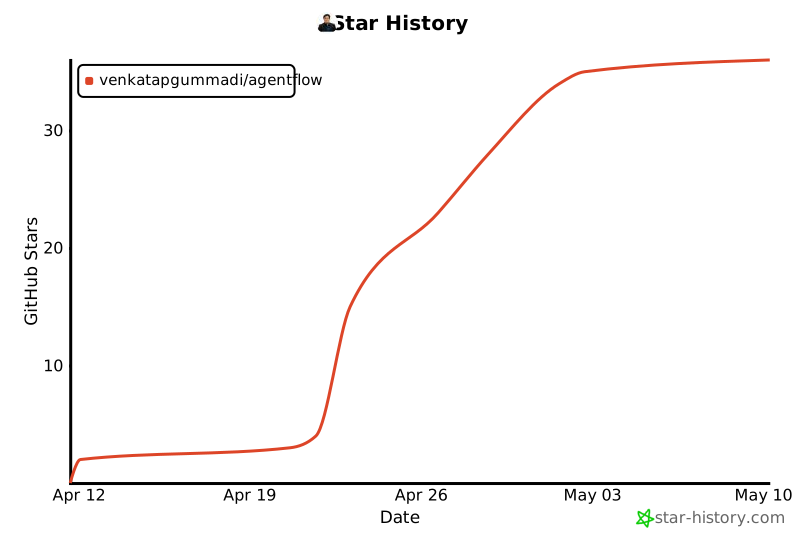
Star History
Contributing
Pull requests are welcome — see CONTRIBUTING.md for the dev workflow, and check the good first issue and help wanted labels for places to start. By participating you agree to the Code of Conduct.
License
Apache License 2.0 — see LICENSE for details.
Author
Venkata Pavan Kumar Gummadi
1 maintainer

Release files for agentflow-orchestrator 1.3.0
For a detailed explanation of source distributions (sdists) and built distributions (wheels), please see the package formats documentation.
Source distribution (sdist)
| File | Size | Uploaded | |
|---|---|---|---|
| agentflow_orchestrator-1.3.0.tar.gz | 82.9 kB | Details |
Built distribution (wheel)
| File | Interpreter | ABI | Platform | Reset |
|---|---|---|---|---|
| agentflow_orchestrator-1.3.0-py3-none-any.whl | Python 3 | none | any | Details |
Total release size: 186.1 kB
Release files / agentflow_orchestrator-1.3.0.tar.gz
| Download URL | agentflow_orchestrator-1.3.0.tar.gz |
|---|---|
| Size | 82.9 kB |
| Tags | Source |
|
SHA-256 checksum How to use checksums |
20971e85f71ad0f27a1aac7f2bcf856cd33ac978622730f5f4cdee6679f6af7c
|
|
BLAKE2b-256 checksum How to use checksums |
866294ef3de3d85b84db3f264eae309143e5f40eca64b6e2cd14d2cc201f6ec2
|
| Upload date | |
|
Uploaded using Trusted Publishing? What is trusted publishing? |
Yes |
| Uploaded via |
twine/6.1.0 CPython/3.13.12
|
Provenance
Provenance describes where a file came from. On PyPI, provenance is shared via attestations, which provide a verifiable record of the build or publishing details. View details, limitations and caveats.


PyPI Publish Attestation
PyPI verified that this artifact, at this checksum, originated from the publisher listed below.
Signed by GitHub Actions, verified by PyPI on May 8, 2026.
Transparency logRelease files / agentflow_orchestrator-1.3.0-py3-none-any.whl
| Download URL | agentflow_orchestrator-1.3.0-py3-none-any.whl |
|---|---|
| Size | 103.2 kB |
| Tags | Python 3 |
|
SHA-256 checksum How to use checksums |
dd2a4ae3b149ff15e6db869be9f097b2f6beb3ebcbd9aef32180c928debfef91
|
|
BLAKE2b-256 checksum How to use checksums |
6b295c67e4f0f265468355e69c8c40205e8b4a8500ae27a091193359f4409f57
|
| Upload date | |
|
Uploaded using Trusted Publishing? What is trusted publishing? |
Yes |
| Uploaded via |
twine/6.1.0 CPython/3.13.12
|
Provenance
Provenance describes where a file came from. On PyPI, provenance is shared via attestations, which provide a verifiable record of the build or publishing details. View details, limitations and caveats.
PyPI Publish Attestation
PyPI verified that this artifact, at this checksum, originated from the publisher listed below.
Signed by GitHub Actions, verified by PyPI on May 8, 2026.
Transparency log












