
AgentForge
An AI-agent framework that behaves like infrastructure, not a demo you ship once. Production plumbing — cost, tracing, memory, guardrails, failover — comes as swap-by-config packages behind version-locked contracts. You write your use case; the framework is already production-grade.



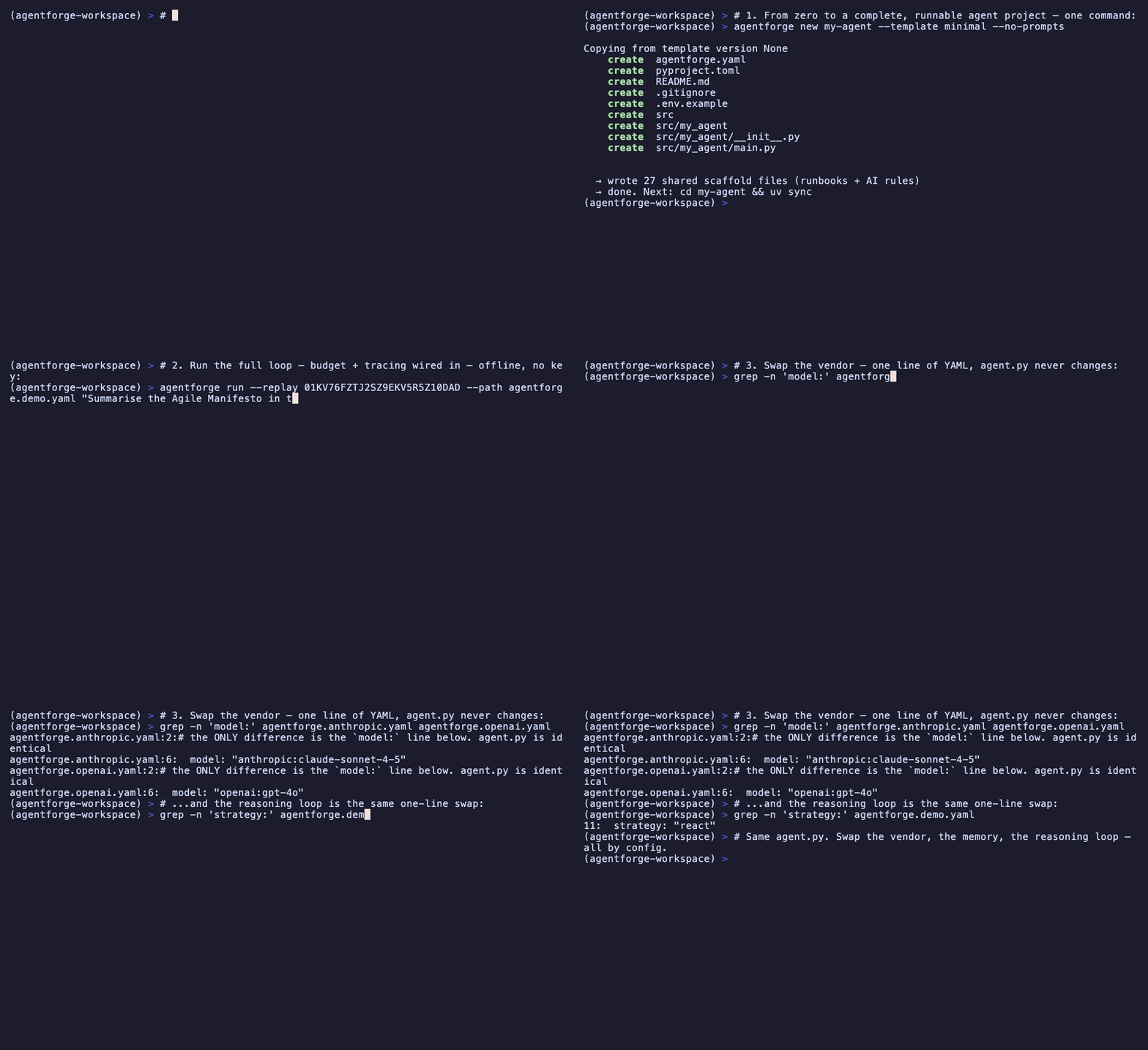
From zero: agentforge new scaffolds a runnable project → the full loop runs
offline, no API key (a recorded run) with budget + tracing already wired →
swap the vendor or the reasoning loop by editing one line of YAML,
agent.py never changes.
Runnable example →
AgentForge treats an agent like a system you operate, not a demo you ship once. Four things at its core:
- Version-locked contracts. ~30 ABCs in a small
agentforge-coredescribe the agent surface, and breaking one is a major version bump (ADR-0007) — so you can build on them like a stable API.- Every backend is its own package, swapped by config. LLM provider, memory store, observability stack, reranker, guardrail — each ships as a separate PyPI distribution you plug in and swap by editing one line of YAML, never your agent code.
- The reasoning loop is swap-by-config too. ReAct, Plan-and-Execute, Tree-of-Thoughts, and a Multi-Agent Supervisor ship behind one
Strategycontract — pick the loop in YAML, or compose your own from the ABC. The same agent code runs under any of them; the strategy is a configuration choice, not a rewrite.- Scaffolds keep your AI coding assistant on-idiom. Every generated project ships framework-aware instructions for Claude Code, Cursor, GitHub Copilot, Aider, Codex, and Windsurf plus task runbooks — so the AI helping you build stays inside the framework's conventions automatically.
Cost guardrails, OpenTelemetry tracing, vendor failover, PII redaction, and reproducible evals are wired in too — behind those same locked contracts, so you can depend on them in production.
from agentforge import Agent

async with Agent(model="anthropic:claude-sonnet-4-7") as agent:
    result = await agent.run("Summarise this PR in three bullets.")
    print(result.output)
Swap anthropic: for openai:, bedrock:, ollama:, or
litellm: — same code, different vendor. Swap the reasoning loop the
same way: strategy: react → plan-execute → tree-of-thoughts →
supervisor, no code change. Every swap happens behind a locked
contract, so it can't quietly change the shape of what your agent gets
back.
Why AgentForge
For developers
The plumbing every production agent needs — cost limits, run-id propagation, distributed tracing, vendor failover, durable state, prompt-injection defenses, PII redaction, hybrid retrieval — is configured, not coded. You focus on what your agent does, not on the harness around it.
For organisations
Audit-ready by default. Every call traces through OpenTelemetry with run_id propagation. Cost guardrails reject runs that exceed their budget before the LLM bill lands. PII redaction happens inside the framework, not in app code. Built-in evaluators turn "did this prompt change regress?" into a reproducible CI gate. SOC 2 / GDPR / ISO 27001 conversations get shorter.
For your AI coding assistant
Every scaffolded agent ships with framework-aware instructions
for Claude Code, Cursor, GitHub Copilot, Aider, Codex CLI, and
Windsurf — plus 21 task-oriented runbooks. Your AI builds
inside the framework's idioms automatically. agentforge upgrade
keeps the instructions current as new capabilities ship, so the AI
learns the new APIs without you teaching it.
Quick start
Day 1 — install, scaffold, run:
pip install "agentforge-py[anthropic]"   # or [openai], [bedrock], [ollama], [litellm]
agentforge new my-agent --template minimal
cd my-agent

export ANTHROPIC_API_KEY=sk-ant-…
agentforge run "Hi"
Six starter templates ship in the wheel: minimal, code-reviewer,
patch-bot, docs-qa, triage, research.
Want proof before you install a provider?
examples/swap-by-config/runs the full agent loop offline with no API key (python smoke.py), and shows the sameagent.pydriving Anthropic or OpenAI with a one-line config change.
Day N — add modules, swap backends, upgrade the framework:
# add a sister module (memory backend, reranker, observability, guard, protocol…)
pip install agentforge-memory-postgres
agentforge add memory-postgres
agentforge config validate

# swap providers / strategies / backends without touching code
agentforge swap llm openai

# upgrade the framework — managed files + runbooks refresh,
# your custom code + `<!-- agentforge:custom -->` blocks survive
agentforge upgrade --to 0.4.0
Every command has a matching docs/runbooks/NN-*.md step-by-step
guide that ships in the scaffold — your AI coding assistant
follows the relevant runbook automatically when you ask it for
"add a reranker" / "configure multi-provider" / "use streaming
guardrails".
What's in the box
AgentForge is a contracts-first framework: ~30 locked ABCs in
agentforge-core describe the agent surface; everything else is a
plug-in module shipped as its own PyPI package. Pick the modules
you need, swap them via config when requirements change.
Pluggable providers
LLMs: Anthropic · OpenAI · AWS Bedrock · Ollama (local) · LiteLLM
(100+ underlying providers). Embeddings: OpenAI Matryoshka · Voyage
multimodal · Bedrock · Ollama. One string ID
(anthropic:claude-sonnet-4-7) selects the model; no
provider-specific code paths in your agent.
Reasoning strategies
ReAct · Plan-and-Execute · Tree-of-Thoughts · Multi-Agent Supervisor. Pick the loop in YAML, compose your own from the strategy ABC when you need to.
Persistence + retrieval
One MemoryStore + VectorStore (+ GraphStore) contract, five
backends: SQLite · Postgres · Neo4j · SurrealDB · Kùzu (embedded,
zero-ops graph). Hybrid retrieval (vector + BM25 over native
indexes, RRF fusion), four reranker vendors, directional GraphRAG
expansion for graph backends, schema migrations across all stores
via agentforge db migrate.
Guardrails — cost, safety, reliability
Cost. BudgetPolicy checks every LLM, tool, and retriever
call against the run's budget — over-budget runs fail fast,
before the bill lands.
Safety. Input / output / tool-call validator pipelines with
four built-in basics + four vendor wrappers — LLM Guard,
Microsoft Presidio, NVIDIA NeMo Guardrails, Meta Llama Guard —
for PII, prompt injection, toxicity, and off-topic detection.
Reliability. Run-id propagation, idempotency_key_for() for
side-effecting tools, FallbackChain cross-provider failover.
Governance
A governance spine behind locked contracts: typed Principal
identities (kind / owner) and an IdentityProvider contract,
with an offline local driver (HMAC, URN ids) in the
agentforge-governance package — the foundation for registry,
policy-as-code, and audit (ADR-0023).
Observability
JSON-structured logs + OpenTelemetry (with child spans, A2A trace propagation, PII redaction) + Langfuse + Arize Phoenix + Evidently + StatsD. Everything wires in via config; nothing to instrument in your agent code.
Evaluation
Deterministic graders — Coverage, FormatCompliance, RegressionVsBaseline, Consistency — plus six LLM judges (Correctness, Faithfulness, Groundedness, Hallucination, Relevance, Helpfulness). Turn prompt and model upgrades into a CI gate.
Chat + protocols
ChatSession with in-memory / SQLite / Postgres / Redis history,
four truncation strategies, sentence-window streaming guardrails
(PII redaction over a streamed response), and a Slack adapter.
MCP stdio + HTTP/SSE servers. A2A HTTP + streaming +
discovery + bearer / mTLS auth.
CLI
agentforge run · eval · debug · db migrate · health ·
config validate · list / add / remove / swap (module
management) · new · upgrade · fork / unfork · status ·
docs.
Build your own agent
You don't need to clone the repository. AgentForge ships as PyPI packages — your agent lives in your own project, with the framework as a dependency. Cloning the repo is only for contributing to the framework itself.
1. Install from PyPI
pip install "agentforge-py[anthropic]"   # or [openai], [bedrock], [ollama], [litellm]
# combine extras
pip install "agentforge-py[anthropic,openai,memory-postgres,otel]"
# or install sister packages directly
pip install agentforge-py agentforge-memory-postgres agentforge-langfuse
Every module is its own PyPI distribution. Install only what you use; the framework lazy-imports vendor SDKs so unused providers don't add startup cost.
2. Scaffold your agent project
agentforge new my-agent --template minimal
cd my-agent
Pick from six templates: minimal, code-reviewer, patch-bot,
docs-qa, triage, research. You get a complete, runnable
project:
my-agent/
├── agentforge.yaml     # model, strategy, budget — the swap-by-config surface
├── pyproject.toml
├── .env.example        # copy to .env, add your API key
├── src/my_agent/
│   └── main.py         # your agent code — start editing here
├── docs/runbooks/      # step-by-step guides your AI assistant follows
├── AGENTS.md           # framework-aware instructions for AI coding
└── CLAUDE.md           # assistants (Claude Code, Cursor, Copilot, …)
3. Add your API key
cp .env.example .env # then set ANTHROPIC_API_KEY=sk-ant-…
4. Write what your agent does
Edit src/my_agent/main.py. Give the agent your own tools — a
typed function plus the @tool decorator is all it takes (the
input schema is inferred from the signature and docstring):
from agentforge import Agent, tool

@tool
def lookup_order(order_id: str) -> dict:
    """Fetch an order record from your backend."""
    return orders_db.get(order_id)

async with Agent(tools=[lookup_order]) as agent:
    result = await agent.run("What's the status of order 1042?")
    print(result.output)
Stateful tools subclass the Tool ABC instead. Four defaults ship
in agentforge.tools: web_search, calculator, file_read,
shell.
5. Configure behaviour in YAML, not code
agentforge.yaml is where the model, reasoning strategy, and
guardrails live — your Python never names a vendor:
agent:
  model: "anthropic:claude-sonnet-4-5"
  strategy: "react"        # swap-by-config: plan-execute · tree-of-thoughts · supervisor
  budget:
    usd: 2.0               # over-budget runs fail before the bill lands
Switching providers is agentforge swap llm openai — one config
line changes, your agent code doesn't.
6. Run and validate
agentforge run "What's the status of order 1042?"
agentforge config validate
7. Grow it as your needs grow
# durable state, tracing, safety, retrieval — one pip install + one `add` each
pip install agentforge-memory-postgres && agentforge add memory-postgres
pip install agentforge-otel            && agentforge add otel

# framework upgrades refresh managed files; your custom code survives
agentforge upgrade --to 0.4.0
Memory backends, rerankers, guardrail vendors, observability
stacks, MCP/A2A protocols, evaluators — every capability in
What's in the box plugs in the same way, and
each has a matching docs/runbooks/NN-*.md guide in your scaffold
that your AI coding assistant follows automatically.
Repository structure
uv workspace — one git repo, 36 installable packages in lock-step.
agentforge-py/
├── packages/
│   ├── agentforge-core/                                          locked contracts (~30 ABCs)
│   ├── agentforge/                                               default runtime + CLI + templates
│   ├── agentforge-{anthropic,openai,bedrock,ollama,litellm}/     LLM providers
│   ├── agentforge-voyage/                                        embeddings
│   ├── agentforge-memory-{sqlite,postgres,neo4j,surrealdb,kuzu}/ persistence
│   ├── agentforge-reranker-{cohere,voyage,mixedbread,sentence-transformers}/
│   ├── agentforge-guard-{llmguard,presidio,nemo,llamaguard}/     safety
│   ├── agentforge-governance/                                    identity + governance spine
│   ├── agentforge-{otel,langfuse,phoenix,evidently,statsd}/      observability
│   ├── agentforge-{mcp,a2a}/                                     protocols
│   ├── agentforge-chat / chat-http / chat-history-{postgres,redis} / chat-slack/
│   ├── agentforge-eval-geval/                                    LLM judges
│   └── agentforge-testing/                                       golden sets + recordings
├── docs/features/                                                canonical feat-NNN specs
├── docs/design/                                                  architecture + module system
├── docs/adr/                                                     immutable decision records
└── docs/roadmap.md                                               shipped + backlog
Development (contributing to the framework)
You only need this section to work on AgentForge itself. To build an agent, you never clone the repo — see Build your own agent.
Prereqs: Python 3.13 + uv.
git clone git@github.com:Scaffoldic/agentforge-py.git
cd agentforge-py
uv sync --all-extras --dev
uv run pre-commit install
uv run pre-commit run --all-files   # ruff + mypy + bandit + pytest + ≥90 % cov
Linux CI runs on every PR. Windows and macOS CI run on
workflow_dispatch — invoke before cutting a release or when
touching path / subprocess / filesystem code.
Status
Early but production-minded. AgentForge is v0.4.x and
solo-maintained — the API surface is stabilising, the contracts are
locked (ADR-0007), and it's tested like infrastructure
(mypy --strict, ≥90 % coverage, a conformance harness every backend
must pass, live integration tests in CI). Issues, feedback, and
contributors are very welcome.
Contributing
Start with CONTRIBUTING.md
— setup, the hard rules, branch/PR conventions, and the pre-commit gate. The
deeper conventions live in
AGENTS.md.
Be excellent to each other:
CODE_OF_CONDUCT.md.
Found a security issue? See
SECURITY.md
(please report privately).
- Branch from
main:feat/<NNN>-<slug>,fix/<slug>,docs/<slug>,chore/<slug> - Conventional Commits
- One feature = one PR, squash-merged
- 90 % coverage floor
- Every feature PR updates its spec's
Implementation status
Looking for somewhere to start? Issues labelled good first issue
and help wanted, plus the
docs/roadmap.md
backlog.
Roadmap
docs/roadmap.md
tracks shipped + backlog.
License
1 maintainer

Metadata
1 maintainer
Release files for agentforge-py 0.4.0
For a detailed explanation of source distributions (sdists) and built distributions (wheels), please see the package formats documentation.
Source distribution (sdist)
| File | Size | Uploaded | Provenance | |
|---|---|---|---|---|
| agentforge_py-0.4.0.tar.gz | 277.5 kB | With provenance | Details |
Built distribution (wheel)
| File | Interpreter | ABI | Platform | Reset |
|---|---|---|---|---|
| agentforge_py-0.4.0-py3-none-any.whl | Python 3 | none | any | Details |
Total release size: 528.7 kB
Release files / agentforge_py-0.4.0.tar.gz
| Download URL | agentforge_py-0.4.0.tar.gz |
|---|---|
| Size | 277.5 kB |
| Tags | Source |
|
SHA-256 checksum How to use checksums |
a8df862ee6d4c80fab1fd5d562bc5c58dbc21a9a19e9cb16eb0a46a634c3fb06
|
|
BLAKE2b-256 checksum How to use checksums |
29b46e5cced4f34f4a90bd7b87003761bc55a352803f315ff8a93cf43006784d
|
| Upload date | |
|
Uploaded using Trusted Publishing? What is trusted publishing? |
Yes |
| Uploaded via |
twine/6.1.0 CPython/3.13.12
|
Provenance
Provenance describes where a file came from. On PyPI, provenance is shared via attestations, which provide a verifiable record of the build or publishing details. View details, limitations and caveats.


PyPI Publish Attestation
PyPI verified that this artifact, at this checksum, originated from the publisher listed below.
Signed by GitHub Actions, verified by PyPI on Jun 24, 2026.
Transparency logRelease files / agentforge_py-0.4.0-py3-none-any.whl
| Download URL | agentforge_py-0.4.0-py3-none-any.whl |
|---|---|
| Size | 251.3 kB |
| Tags | Python 3 |
|
SHA-256 checksum How to use checksums |
266fbba2a5d30bc7b2f6a1ff9e524e831609ada7a059adc7f6b20b6244f26f91
|
|
BLAKE2b-256 checksum How to use checksums |
3ad073a629849ab8c08e8a0b432531f3d484e5f74393c525d0b1144a72503240
|
| Upload date | |
|
Uploaded using Trusted Publishing? What is trusted publishing? |
Yes |
| Uploaded via |
twine/6.1.0 CPython/3.13.12
|
Provenance
Provenance describes where a file came from. On PyPI, provenance is shared via attestations, which provide a verifiable record of the build or publishing details. View details, limitations and caveats.
PyPI Publish Attestation
PyPI verified that this artifact, at this checksum, originated from the publisher listed below.
Signed by GitHub Actions, verified by PyPI on Jun 24, 2026.
Transparency logSecurity for agentforge-py 0.4.0
Provenance
Provenance describes where a file came from. On PyPI, provenance is shared via attestations, which provide a verifiable record of the build or publishing details. View details, limitations and caveats.
Full provenance
All 2 files in this release have been uploaded with provenance metadata.
Attestation for agentforge_py-0.4.0.tar.gz
PyPI Publish Attestation
PyPI verified that this artifact, at this checksum, originated from the publisher listed below.
Signed by GitHub Actions, verified by PyPI on Jun 24, 2026.
Transparency logA note on package security
PyPI is a repository for distributing packages, not a service for auditing them. While third-party security researchers and our staff do their best to detect and remove malicious packages, PyPI cannot guarantee the quality, security or suitability of any given package.














