

AgentFox
Find, govern and protect every AI agent you run. Guardrails that don't block your real customers.
Open source. Attack-test your own agent in about three minutes, then watch the same attacks get stopped. Works with the OpenAI Agents SDK, LangGraph, LangChain, CrewAI, AutoGen, OpenAI, Anthropic, LiteLLM, MCP servers, Claude Code and Codex.





▶ Try it in the browser, no account · Docs · Benchmarks · Discussions
If AgentFox is useful to you, a ⭐ helps other people find it.
What it does
| Discover | Reads your code (never runs it) and maps every agent, the tools it can call, the MCP servers and skills it loads, and who hands work to whom. |
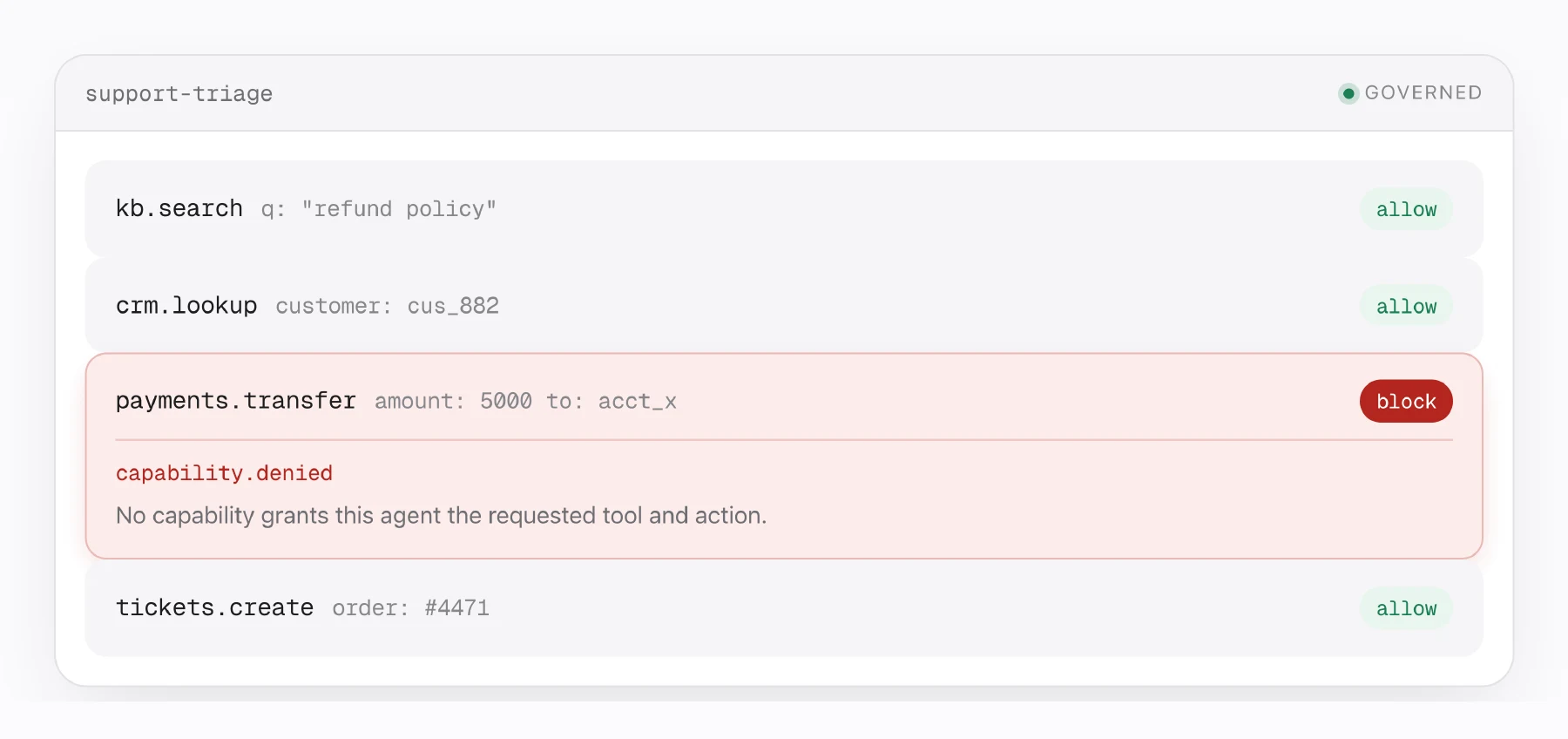
| Govern | Each agent gets only the tools its own code hands it, with limits on the values it may pass (an amount cap, an allowed recipient). Anything else is refused or held for a person. |
| Protect | Checks every model and tool call at runtime: prompt injection, instructions hidden in documents and tool results, personal data and secrets leaving in replies. Starts in watch mode, so nothing your users do is blocked until you say so. |
| Test | Attacks your real agent with its own tools faked, shows what got through, then shows the same attacks against your guardrails. |
| Prove | Every decision lands in a tamper-evident audit trail you can verify without trusting us. |
The part that does not depend on catching the attack: a transfer whose recipient came out of a retrieved document is refused because of where the value came from, not because a detector recognised the payload.
Quickstart
Python 3.11 or newer.
Attack your own agent (about three minutes)
-
Sign in; signing in creates your workspace. Press Create a key.
-
In your agent's repository, with its dependencies installed, run the command the page shows:
pip install -U agentfox
agentfox init --key nom_api_… --server https://…
initreads your code without running it and reports the agents and tools it found. Leave it running: the attack test runs your agent on your machine, with every tool faked so nothing real happens. -
Press Add N agents to AgentFox. The attack test starts by itself and shows, per kind of attack, how many got through.
-
Press Turn on basic guardrails and test again. Basic guardrails go on and the same attacks run again, so you see the before and after side by side, including how many normal requests were still answered.
-
Add the one line
initprints (agentfox.auto("<agent>")) and run your app. Its calls show up on the agent's Activity tab.
From the command line only
pip install agentfox
agentfox scan                    # names every agent it found, ends with: agentfox up
agentfox up                      # registers them, declares their tools, adds agentfox.auto()
python main.py                   # run your app as usual
agentfox findings                # what it saw, and what it would have stopped
agentfox test redteam <agent>    # attack-test it
up uses the names the code gives your agents, the same names scan printed, and adds
agentfox.auto("<agent>") to the file that starts one (a pyproject.toml script, the graph
langgraph.json loads, or the file that runs it, src/ included), for Python apps on
LangGraph, LangChain, CrewAI, AutoGen, pydantic-ai and the OpenAI Agents SDK. The name is the
agent that file runs (a crew or swarm takes its project's name), shown before anything changes
so you can edit it. In a folder of separate examples it sets up one, with only that agent's
tools, and says how to pick another (agentfox up --agent <name>); in a monorepo that edits
the picked agent's own app, and scan, up, init and auto() all name one agent the same
way (FinancialPlannerAgent is financial-planner-agent everywhere). auto() also governs
Google ADK (its google-genai model calls and function calls) and smolagents (its
huggingface_hub model calls, and each tool where it runs). It starts in watch mode:
every library records what it would have stopped and stops nothing (destructive commands such as
rm -rf ~/ and tampering with AgentFox aside). Turn blocking on one library at a time when its
decisions look right: agentfox policy enforce tool-containment for tool calls,
agentfox policy enforce baseline for prompt attacks, personal data and secrets. up changes
nothing else by default: coding-agent hooks, the GitHub workflow and the local API are
--with coding-agents, --with ci and --with view. Everything stays on your machine; a pip
install has no web dashboard (agentfox findings is the terminal view), which comes with
AgentFox Cloud or the self-hosted stack.
The prompt-injection classifier (PIGuard) is an extra, not part of pip install agentfox:
pip install 'agentfox[classifiers]'
agentfox admin detectors pull injection.classifier   # downloads the model weights once
Without it, injection checks use the pattern-based detector only, alongside the PII, secrets
and hidden-Unicode checks and tool containment, all of which work on a plain install.
agentfox doctor says which detectors run on your machine, and auto() says once that the
classifier is skipped rather than on every run. The Docker image ships the extra and the
weights.
One key everywhere
export AGENTFOX_URL=https://…
export AGENTFOX_API_KEY=nom_api_…
Or run agentfox login, which checks the key and saves both in .agentfox/agentfox.env
(as agentfox init --key and agentfox up do). With a key set, every check
agentfox.auto() makes goes to your account's gateway and the calls appear on the
dashboard, and the CLI reads and writes the same account: findings, agents list,
permit, declare, policy, report and test suites show what the dashboard shows,
and each says on its first line which it is using (Account: https://… (workspace …) or
Local: ~/.agentfox/agentfox.db). agentfox doctor checks the server and the key. Without
a key everything checks and records locally. Every OpenAI, Anthropic, LiteLLM, LangChain,
google-genai and huggingface_hub call in the process is checked, and every tool call in a response is checked
before your code can run it; a refused one raises agentfox.Blocked. Coding-agent hooks
record on this machine; AGENTFOX_LOCAL=1 agentfox findings reads them in a project
connected to an account.
Other ways in
-
Check your machine (about 2 seconds):
agentfox scan machinereads the MCP configs and skills that Claude Code, Cursor, Claude Desktop, VS Code, Windsurf, Gemini CLI and Codex load. Nothing is started, written or sent. Without installing:uvx agentfox scan machine. -
Your coding agent: in a project where you use Claude Code or Codex,
agentfox up --with coding-agentswrites the hooks, grants the agent its built-in tools and starts in watch mode, except shapes such asrm -rf ~/, which are refused from the start. In a repository set up for a coding agent with no agent of its own,agentfox updoes this by default. The hooks call AgentFox by absolute path, so they work from a virtualenv install too. -
Behind a LiteLLM proxy: one block in the proxy's
config.yamlchecks every agent behind it (guide). -
Look around first:
agentfox init && agentfox demo.initcreates a SQLite database and loads 44 controls and the policy packs in about a second;demoruns a thirteen-step walkthrough in about five, in a database of its own (~/.agentfox/demo.db), so your project'sagentfox findingsnever shows the demo's made-up agents. Both are offline: no API key, no downloaded weights, no network egress. -
Scan this directory without installing:
curl -fsSL https://raw.githubusercontent.com/architsharm/agentfox/main/scripts/quickscan.sh | bashinstalls the published release into a throwaway virtualenv (| bash -s -- --mainfor the current main). -
On every pull request: the GitHub Action annotates lethal trifectas, ungoverned model calls and poisoned skills, and fails the check on the kinds you list in
fail-on:- uses: actions/checkout@v4 - uses: architsharm/agentfox@main with: fail-on: trifecta,skills
Contain a tool call
Any language can ask the gateway about one call before running it:
agentfox serve                              # gateway + control-plane API on 127.0.0.1:8080
# in a second terminal:
agentfox admin users create you@example.com --token   # first operator + API token, shown once
export AGENTFOX_API_KEY=…                   # the token it printed

agentfox declare tool payments.transfer --impact irreversible
agentfox permit grant payments-ops payments.transfer --yes
agentfox policy enforce tool-containment    # watching until now: start blocking

curl -s -X POST http://localhost:8080/v1/guard/tool_call \
  -H "Authorization: Bearer $AGENTFOX_API_KEY" -H "Content-Type: application/json" \
  -d '{"agent":"payments-ops","tool":"payments.transfer",
       "arguments":{"amount":250,"currency":"USD","to":"acct_991"},
       "provenance":{"to":"tool_result","amount":"user"},
       "intent":"refund a duplicate charge"}' | jq '{verdict, approval_id}'
{ "verdict": "escalate", "approval_id": "apr_01m376q43zby33tbsp" }
The recipient came from a tool result, so the transfer waits for a human. Flip "to" to
"user" and the same call returns allow. Before policy enforce, Tool containment only
watches: the same call returns allow with "effective_verdict": "escalate", what it would
have done. Once a person approves it
(agentfox permit approvals approve apr_…), the same call with "approval_id" added runs, once.
Pointed at /v1 as an OpenAI or Anthropic base URL, the gateway proxies model calls too, and a held
one returns HTTP 428 with its approval_id.
LangGraph, MCP, Claude Code hooks, the SDK and the
full command set are in the website guides and the
product tour.
Tracking without anyone running a command
A scan is a snapshot. With AgentFox Enterprise (Cloud or self-hosted), connect a GitHub repository, a hosted API's OpenAPI document or an MCP server once and AgentFox keeps re-checking it: every few hours, and on every push once the GitHub webhook is registered. What changed since the last run becomes a finding, and the finding closes itself when the condition clears. Setup and every finding type: Keep re-checking connected sources.
What we measured
The detector comparison behind these numbers is peer reviewed: No Tier Wins Everywhere, accepted at WAITI 2026, a workshop of ACSAC 2026 (artifact).
We do not claim adversarial robustness, and we do not believe anyone can. The Attacker Moves Second (Nasr, Carlini, Schulhoff et al., 2025) reports over 90% attack success against twelve published defences once the attacker adapts. So the number we lead with does not depend on catching anything: both rows below were measured with every detector switched off.
| Evidence | Result |
|---|---|
| Containment under total detector bypass | 8/8 attacks contained with zero detector signal; 4/4 legitimate calls still allowed |
| AgentDojo, replayed end to end: 97 user tasks and 949 attack pairs, with argument provenance inferred from the real tool outputs | 588/588 attack pairs contained with session-level taint, but only 24/97 benign tasks (24.7% [17.2, 34.2]) run without escalating to a human. Per-argument taint: 37/97 benign tasks, 527/588 attack pairs contained. Taking provenance from the benchmark's own labels gives 97/97 and 588/588; that is an upper bound, not a measurement |
The cost is benign utility: when provenance is inferred, a legitimate action that copies a value out of a tool output looks the same as an attack, and it is escalated.
Optionally, detection gets better. The judgment tiers are off by default; with them on, agentfox catches 160/165 of the injection payloads that defeated our own pattern detectors, at 94.7% precision against the NotInject over-defense set. What each tier is worth, and what it costs.
Where we are still improving
Detection is the layer we trust least, so we publish its numbers.
- The default injection stack (heuristic plus the PIGuard classifier) has a held-out recall of
68.3%, at 100% precision (REPORT.md). It needs
agentfox[classifiers]and the model weights, which the Docker image ships; without them the heuristic runs alone, and its held-out injection recall is 16.7%; the startup warning andagentfox doctorsay so. - On NotInject, 339 benign prompts built to trip keyword guardrails, the classifier flags 11.5% (39/339) at the level an enforcing policy acts on (PIGuard alone), and 41% (140/339) counting the advisory backstop hits that observe mode records.
- An adaptive attacker that reads our verdict and retries gets 74% of the attacks we catch through within 50 attempts, measured against the heuristic-only stack that was the default until October 2026.
- The deterministic answerability classifier abstains on 57/676 contested questions; with a judgment tier that becomes 572/676, at the cost of over-refusal rising from 0.75% to 6.8%.
- Against a real, independently installed
llm-guardon indirect injection via tool output, it is more precise than us: 81.8% against our 66.7% on the same 20 cases, though of the 10 attacks among them we catch all 10 and it catches 9. That run predates October 2026, while the backstop model's hits still counted toward a block (agent_security). - On AgentDojo, per-argument taint misses 61 of 702 attacker write calls; session-level taint misses none of them and escalates three in four benign tasks.
- The default stack reaches 86.4% and 98.4% recall on two independent datasets (SPML and yanismiraoui), but on long prompts (around 2,000 characters and up) the classifier mostly times out within its 250 ms budget and the request falls back to the heuristic.
Treat every detection number as a speed bump that raises attacker cost, never as a defence.
Not built yet
- It is only as good as your declarations. A destructive tool declared
readis treated asread.agentfox doctorgrades this;agentfox scanfinds undeclared tools. - You declare the estate yourself. No Okta, no DataHub; principals and grants live in AgentFox.
- Compliance mappings are DRAFT, not reviewed by counsel, and labelled so in every export.
- No live IdP or SSO. Multi-tenancy is enforced at the session within one deployment, and only text is inspected.
Live per-capability status, computed by probe: docs/status.md.
Documentation
| Website docs | Install, guides for every integration, and the CLI, API and config reference |
| Getting started | The short path, then a linear first hour ending with your own agent governed |
| Product tour | The reference view: every integration surface, commands by task, the demo output, self-hosting |
| ARCHITECTURE.md | The domain model, a tool call traced through the code, and the code map |
| CONTRIBUTING.md | Setup in three commands, just ci, and the conventions |
| docs/ | Design, threat model, requirements and how the numbers were measured |
| Benchmarks | Every number above, with the script that reproduces it |
| SECURITY.md | Report a vulnerability privately; please not in a public issue |
Questions and ideas go to Discussions; bugs to Issues. New contributors: start with a good first issue.
Licence
The open core is Apache-2.0: the SDKs, the gateway and CLI, enforcement and containment, every detector and validator, custom rules, policy packs, the benchmarks and the dashboard. It runs on its own, with no licence key and no limit on agents.
AgentFox Enterprise (ee/) adds what an organisation needs to govern many
agents and prove it: compliance status against EU AI Act, ISO 42001, SOC 2 and NIST AI RMF,
auditor evidence packages, fleet monitoring with alerts, and checks against your own access
control. It is source-available under the Business Source License 1.1: free in
production for one workspace with up to four agents, and each release becomes Apache-2.0
three years after it ships. It is included on AgentFox Cloud.
1 maintainer

Metadata
1 maintainer
Release files for agentfox 0.5.2
For a detailed explanation of source distributions (sdists) and built distributions (wheels), please see the package formats documentation.
Source distribution (sdist)
| File | Size | Uploaded | Provenance | Actions |
|---|---|---|---|---|
| agentfox-0.5.2.tar.gz | 37.0 MB | With provenance | Details for agentfox-0.5.2.tar.gz |
Built distribution (wheel)
| File | Interpreter | ABI | Platform | Actions Reset |
|---|---|---|---|---|
| agentfox-0.5.2-py3-none-any.whl | Python 3 | none | any | Details for agentfox-0.5.2-py3-none-any.whl |
Total release size: 39.3 MB
Release files / agentfox-0.5.2.tar.gz
| Download URL | agentfox-0.5.2.tar.gz |
|---|---|
| Size | 37.0 MB |
| Tags | Source |
|
SHA-256 checksum How to use checksums |
693a9e98988fa0eae4db273cde9d60370004aed21b452e0bbc1ef1a0b8305669
|
|
BLAKE2b-256 checksum How to use checksums |
1c761b67b207f13fb55dc56298fd7c0c13b6d5b6bdd2880c88dffad8f0407ad0
|
| Upload date | |
|
Uploaded using Trusted Publishing? What is trusted publishing? |
Yes |
| Uploaded via |
twine/7.0.0 CPython/3.13.16
|
Provenance
Provenance describes where a file came from. On PyPI, provenance is shared via attestations, which provide a verifiable record of the build or publishing details. View details, limitations and caveats.


PyPI Publish Attestation
PyPI verified that this artifact, at this checksum, originated from the publisher listed below.
Signed by GitHub Actions, verified by PyPI on Nov 9, 2026.
Transparency logRelease files / agentfox-0.5.2-py3-none-any.whl
| Download URL | agentfox-0.5.2-py3-none-any.whl |
|---|---|
| Size | 2.3 MB |
| Tags | Python 3 |
|
SHA-256 checksum How to use checksums |
54489f756600697e234a0aa7323d05d2d0f24f617c85ac3b7c796b6a4476a553
|
|
BLAKE2b-256 checksum How to use checksums |
498a3b939840fe32d1f3901e0aa0ebbb0b7ffaca3050e52243134ffc56ce9523
|
| Upload date | |
|
Uploaded using Trusted Publishing? What is trusted publishing? |
Yes |
| Uploaded via |
twine/7.0.0 CPython/3.13.16
|
Provenance
Provenance describes where a file came from. On PyPI, provenance is shared via attestations, which provide a verifiable record of the build or publishing details. View details, limitations and caveats.
PyPI Publish Attestation
PyPI verified that this artifact, at this checksum, originated from the publisher listed below.
Signed by GitHub Actions, verified by PyPI on Nov 9, 2026.
Transparency logSecurity for agentfox 0.5.2
Provenance
Provenance describes where a file came from. On PyPI, provenance is shared via attestations, which provide a verifiable record of the build or publishing details. View details, limitations and caveats.
Full provenance
Both files in this release have been uploaded with provenance metadata.
Attestation for agentfox-0.5.2.tar.gz
PyPI Publish Attestation
PyPI verified that this artifact, at this checksum, originated from the publisher listed below.
Signed by GitHub Actions, verified by PyPI on Nov 9, 2026.
Transparency logA note on package security
PyPI is a repository for distributing packages, not a service for auditing them. While third-party security researchers and our staff do their best to detect and remove malicious packages, PyPI cannot guarantee the quality, security or suitability of any given package.
To learn more about protecting yourself from malicious actors, visit our package security documentation.














