
Pytest for multi-agent systems: regression tests, credit assignment, and prompt patches for AI agent workflows.
Verified details
These details have been verified by PyPIProject links
GitHub Statistics
Maintainers

Project description
agentgrade




Pytest for multi-agent systems.
Most frameworks help you build agents. agentgrade helps you stop them from silently getting worse.
agentgrade is a local-first CLI + GitHub Action that runs regression tests on AI agent workflows, traces failures, and assigns credit across agents/tools/handoffs.
The headline feature: when an agent workflow fails, agentgrade tells you which agent, tool, or handoff likely caused the failure — and suggests a deterministic prompt patch to fix it.
Why this exists
Eval dashboards tell you that your agents regressed; they rarely tell you who did it.
agentgrade is built for the inner loop of multi-agent development: it runs offline and
deterministically in CI like a unit-test suite, traces every named agent/tool step, and
pins each failed check on the specific agent that caused it — then emits a copy-pasteable
prompt patch. No dashboard to host, no API key to manage, no vendor lock-in: just
agentgrade test next to pytest in your pipeline.
- Local-first, framework-agnostic, no vendor lock-in.
- No required API key — works with any plain Python callable.
- Fully deterministic, offline-friendly.
- Terminal UI only (no dashboard), beautiful and copy-pasteable output.
Security model / trust boundary
[!IMPORTANT] agentgrade imports and runs the Python code referenced by your
agentgrade.yaml. Loading the agententrypointand every module listed underplugins:executes that code in your process. Treatagentgrade test/recordexactly like running that code directly.
- Only run agentgrade against code you trust. Pointing it at a config whose entrypoint or plugins you did not write is equivalent to running arbitrary code from that source.
- Do NOT run it on untrusted pull requests from forks. In CI, use the
pull_requesttrigger on trusted/same-repo branches only — neverpull_request_target, and never against fork PRs. The bundled.github/workflows/agentgrade.ymlsetspermissions: contents: readand carries this warning. - On every run agentgrade prints a one-line stderr warning naming the module(s)
it is about to import. Set
AGENTGRADE_NO_WARN=1to silence it; this does not change what is imported. - Regex checks (ReDoS):
regexchecks and inferred-credit regex matching run patterns from your (trusted) config against agent output. A maliciously crafted pattern can backtrack catastrophically; agentgrade caps the searched output length and guards against invalid patterns, but you should still avoid running untrusted regex patterns.
Table of contents
- Install
- Security model / trust boundary
- Quickstart
- Demo
- How it works
- Example config
- Example output
- Deterministic CI with record/replay
- Machine-readable output (
--json) - CLI commands
- Evaluators
- Custom evaluators (plugin API)
- Inferred credit (no annotations required)
- LangGraph
- GitHub Action
- Development
- Contributing
- License
Install
pip install agentgrade
Or from source:
pip install -e .
Requires Python >= 3.10.
Quickstart
agentgrade init                 # create an example agentgrade.yaml
agentgrade test                 # run your agent tests
agentgrade improve --suggest    # get a deterministic prompt patch from failures
Or point at one of the bundled examples:
agentgrade test --config examples/simple_agent/agentgrade.yaml
Demo
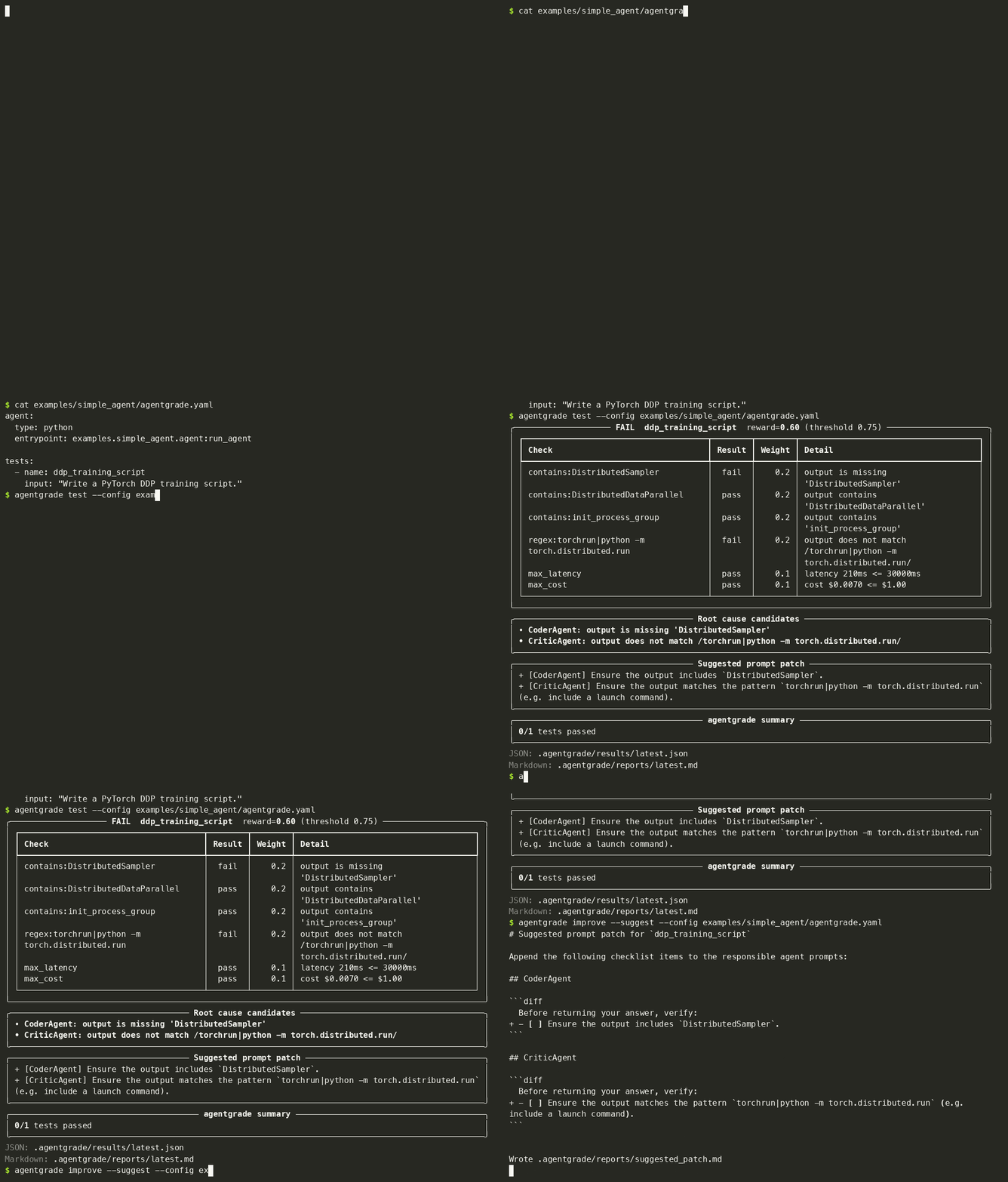
The bundled simple_agent is a scripted Coder → Critic pipeline that deliberately
ships an incomplete DDP script. Running it fails the reward threshold and names the
culprits (exit code 1, so CI fails the build).
The demo above is a committed, self-hosted recording — no external host. Re-render it from the checked-in
assets/demo.castwithagg assets/demo.cast assets/demo.gif, or regenerate the whole thing withbash scripts/demo.sh. A static, dependency-light SVG version lives atassets/demo.svg.
Copy-pasteable example output (text fallback)
$ agentgrade test --config examples/simple_agent/agentgrade.yaml
╭────────── FAIL  ddp_training_script  reward=0.60 (threshold 0.75) ───────────╮
│ ┏━━━━━━━━━━━━━━━━━━━━━━━━━━━━┳━━━━━━━━┳━━━━━━━━┳━━━━━━━━━━━━━━━━━━━━━━━━━━━┓ │
│ ┃ Check                      ┃ Result ┃ Weight ┃ Detail                    ┃ │
│ ┡━━━━━━━━━━━━━━━━━━━━━━━━━━━━╇━━━━━━━━╇━━━━━━━━╇━━━━━━━━━━━━━━━━━━━━━━━━━━━┩ │
│ │ contains:DistributedSampl… │  fail  │    0.2 │ output is missing         │ │
│ │                            │        │        │ 'DistributedSampler'      │ │
│ │ contains:DistributedDataP… │  pass  │    0.2 │ output contains           │ │
│ │                            │        │        │ 'DistributedDataParallel' │ │
│ │ contains:init_process_gro… │  pass  │    0.2 │ output contains           │ │
│ │                            │        │        │ 'init_process_group'      │ │
│ │ regex:torchrun|python -m   │  fail  │    0.2 │ output does not match     │ │
│ │ torch.distributed.run      │        │        │ /torchrun|python -m       │ │
│ │                            │        │        │ torch.distributed.run/    │ │
│ │ max_latency                │  pass  │    0.1 │ latency 210ms <= 30000ms  │ │
│ │ max_cost                   │  pass  │    0.1 │ cost $0.0070 <= $1.00     │ │
│ └────────────────────────────┴────────┴────────┴───────────────────────────┘ │
╰──────────────────────────────────────────────────────────────────────────────╯
╭─────────────────────────── Root cause candidates ────────────────────────────╮
│ • CoderAgent: output is missing 'DistributedSampler'                         │
│ • CriticAgent: output does not match /torchrun|python -m                     │
│ torch.distributed.run/                                                       │
╰──────────────────────────────────────────────────────────────────────────────╯
╭─────────────────────────── Suggested prompt patch ───────────────────────────╮
│ + [CoderAgent] Ensure the output includes `DistributedSampler`.              │
│ + [CriticAgent] Ensure the output matches the pattern `torchrun|python -m    │
│ torch.distributed.run` (e.g. include a launch command).                      │
╰──────────────────────────────────────────────────────────────────────────────╯
╭───────────────────────────── agentgrade summary ─────────────────────────────╮
│ 0/1 tests passed                                                             │
╰──────────────────────────────────────────────────────────────────────────────╯
JSON: .agentgrade/results/latest.json
Markdown: .agentgrade/reports/latest.md
How it works
Your "agent" is any Python callable f(input: str) -> (final_output: str, AgentTrace).
Inside it, record a step for each named agent/tool using the bundled TraceRecorder:
from agentgrade.integrations import TraceRecorder

def run_agent(task: str):
    rec = TraceRecorder(test_name="ddp_training_script")
    draft = coder_agent(task)
    rec.step("CoderAgent", input=task, output=draft, latency_ms=120, cost_usd=0.004)
    reviewed = critic_agent(draft)
    rec.step("CriticAgent", input=draft, output=reviewed, latency_ms=90, cost_usd=0.003)
    return reviewed, rec.finalize(final_output=reviewed)
Because each step carries a distinct agent_name, agentgrade can blame the agent
responsible for a failed check.
Example config
examples/simple_agent/agentgrade.yaml:
agent:
  type: python
  entrypoint: examples.simple_agent.agent:run_agent

tests:
  - name: ddp_training_script
    input: "Write a PyTorch DDP training script."
    checks:
      - type: contains
        value: "DistributedSampler"
        weight: 0.2
        agent_name: CoderAgent
      - type: contains
        value: "DistributedDataParallel"
        weight: 0.2
        agent_name: CoderAgent
      - type: contains
        value: "init_process_group"
        weight: 0.2
        agent_name: CoderAgent
      - type: regex
        value: "torchrun|python -m torch.distributed.run"
        weight: 0.2
        agent_name: CriticAgent
      - type: max_latency
        seconds: 30
        weight: 0.1
      - type: max_cost
        usd: 1.0
        weight: 0.1

settings:
  fail_below_reward: 0.75
  output_dir: ".agentgrade"
The agent_name metadata on each keyword check is what lets credit assignment point at a
specific agent.
Example output
The bundled simple_agent is a scripted Coder → Critic pipeline that deliberately
ships an incomplete DDP script (the CoderAgent forgets DistributedSampler, and neither
agent adds a torchrun launch command). Running it fails the reward threshold and names
the culprits (see Demo above for the full panel).
The process exits non-zero (1) so CI fails the build. Results are written to
.agentgrade/results/latest.json and .agentgrade/reports/latest.md.
Suggested patch
agentgrade improve --suggest reads the last failed run and emits a copy-pasteable patch
(no LLM calls — pure deterministic heuristics):
$ agentgrade improve --config examples/simple_agent/agentgrade.yaml --suggest
# Suggested prompt patch for `ddp_training_script`

Append the following checklist items to the responsible agent prompts:

## CoderAgent

```diff
  Before returning your answer, verify:
+ - [ ] Ensure the output includes `DistributedSampler`.
CriticAgent
  Before returning your answer, verify:
+ - [ ] Ensure the output matches the pattern `torchrun|python -m torch.distributed.run` (e.g. include a launch command).
Compare against `examples/ddp_coding_agent`, a more complete pipeline that emits all
required elements and **passes** (`reward=1.00`).

## Deterministic CI with record/replay

Real LLM agents are nondeterministic, so running them live in CI flakes. agentgrade can
record a single real run and then **replay** it deterministically and offline:

```bash
# 1. Record once: runs the real agent and saves each test's trace as a fixture.
agentgrade record --config examples/simple_agent/agentgrade.yaml
# -> writes .agentgrade/fixtures/<test_name>.json

# 2. Replay forever: no agent import/call, fully deterministic, identical reward + credit.
agentgrade test --config examples/simple_agent/agentgrade.yaml --replay
In replay mode the runner never imports or calls the real agent entrypoint — it loads
the saved AgentTrace fixture and re-runs the checks, credit assignment, and patch
suggestions against it. Enable it per-run with --replay, or persistently in config:
settings:
  replay: true
  fixtures_dir: ".agentgrade/fixtures"   # optional; defaults to <output_dir>/fixtures
If a fixture is missing for a test, that test fails clearly (no replay fixture for <test>; run \agentgrade record` first`) instead of crashing the suite.
Machine-readable output (--json)
Pass --json to agentgrade test to suppress the Rich panels and print only the JSON
results (the same payload written to latest.json) to stdout, so CI tooling can consume
it. Files are still written and the process still exits non-zero on failure:
agentgrade test --config examples/simple_agent/agentgrade.yaml --json | jq '.[0].reward'
CLI commands
| Command | Description |
|---|---|
agentgrade init |
Create an example agentgrade.yaml if none exists. |
agentgrade test |
Run each test case, evaluate checks, compute reward, write JSON + Markdown, print a Rich summary, exit non-zero on failure. Accepts --replay and --json. |
agentgrade record |
Run the real agent once and save each test's trace as a replay fixture. |
agentgrade report |
Print the path to the latest report (and optionally a summary). |
agentgrade improve --suggest |
Suggest a deterministic prompt patch from the latest failed run. |
Evaluators
contains, not_contains, regex, exact_match, max_latency, max_cost,
python_import_check, unit_tests. Each returns a score in [0.0, 1.0].
Reward is the weighted average: sum(score * weight) / sum(weights). A test passes
when its reward is >= settings.fail_below_reward.
Custom evaluators (plugin API)
You can add new check types without forking. Register an evaluator with the
@evaluator decorator (or register_evaluator(name, fn)):
from agentgrade.evaluators import evaluator
from agentgrade.trace import EvaluationResult

@evaluator("min_length")
def eval_min_length(output, trace, check):
    minimum = int(getattr(check, "min_chars", 0) or 0)
    passed = len(output) >= minimum
    return EvaluationResult(
        check_name=f"min_length:{minimum}",
        passed=passed,
        score=1.0 if passed else 0.0,
        weight=check.weight,
        message=f"output length {len(output)} >= {minimum}" if passed
        else f"output length {len(output)} below minimum {minimum}",
    )
Then load it declaratively from your config via a top-level plugins: list of
module.path:function (called to register) or bare module.path (imported so
its decorators run) entrypoints:
plugins:
  - examples.inferred_agent.plugins:register

tests:
  - name: summarizer
    checks:
      - type: min_length
        min_chars: 50
        weight: 0.3
Installed packages can also auto-register via the agentgrade.evaluators
entry points
group (loaded best-effort at startup):
[project.entry-points."agentgrade.evaluators"]
my_plugin = "mypkg.evaluators:register"
Patch suggestions for custom checks
By default agentgrade improve only knows how to phrase patches for the built-in text
checks. A plugin can teach it about a custom check type via
register_patch_suggester, mirroring the evaluator registry:
from agentgrade.improve import register_patch_suggester

@register_patch_suggester("json_schema")
def suggest_schema(check):
    return f"Ensure the output validates against `{getattr(check, 'schema', '?')}`."
The returned text flows into both suggest_patches and the generated patch Markdown,
grouped under the responsible agent like the built-ins.
Inferred credit (no annotations required)
Credit assignment does not require hand-written agent_name metadata. When a
check omits agent_name, agentgrade infers the culprit from the trace:
- Required content (
contains/regex/exact_match): blames the most downstream agent whose output still lacked the value. - Forbidden content (
not_contains): blames the earliest agent whose output introduced the value. - Latency/cost: blames the slowest / most-expensive step's agent.
An explicit agent_name on a check always overrides inference.
examples/inferred_agent is a scripted Draft → Refine pipeline whose
agentgrade.yaml carries no agent_name annotations. The RefineAgent drops a
required summary keyword and keeps a TODO the DraftAgent introduced:
$ agentgrade test --config examples/inferred_agent/agentgrade.yaml
╭─────────────── FAIL  summarizer  reward=0.30 (threshold 0.75) ───────────────╮
│ ┃ Check             ┃ Result ┃ Weight ┃ Detail                             ┃ │
│ │ contains:summary  │  fail  │    0.4 │ output is missing 'summary'        │ │
│ │ not_contains:TODO │  fail  │    0.3 │ output unexpectedly contains 'TODO'│ │
│ │ min_length:50     │  pass  │    0.3 │ output length 193 >= 50            │ │
╰──────────────────────────────────────────────────────────────────────────────╯
╭─────────────────────────── Root cause candidates ────────────────────────────╮
│ • RefineAgent: output is missing 'summary' (inferred: last agent to leave    │
│   it out)                                                                    │
│ • DraftAgent: output unexpectedly contains 'TODO' (inferred: first agent to  │
│   introduce it)                                                              │
╰──────────────────────────────────────────────────────────────────────────────╯
The min_length row above is supplied by the examples/inferred_agent/plugins.py
custom evaluator, loaded via the plugins: key — proof the plugin path works
end-to-end.
LangGraph
If you already have a real LangGraph graph,
the bundled adapter turns its streamed node updates into an AgentTrace — one
AgentStep per node update — so credit assignment works out of the box. Install the
optional extra:
pip install agentgrade[langgraph]
Then wire your compiled graph into an entrypoint callable:
from agentgrade.integrations.langgraph import trace_langgraph

def run_agent(task):
    return trace_langgraph(graph, {"messages": [("user", task)]}, test_name="my_test")
trace_langgraph runs graph.stream(..., stream_mode="updates"), maps each node name to
an agent_name, extracts the last AIMessage content as that step's output, captures
tool_calls/ToolMessage results, and reconstructs the final output. A mid-run exception
is captured on trace.error and the partial trace is still returned. Pass output_key to
pull the final output from a specific state key, or messages_key if your graph stores
messages under a non-default key.
Note: per-node
latency_msis wall-clock between streamed updates, so for graphs with parallel/fan-out nodes the per-step latencies are approximate.
GitHub Action
.github/workflows/agentgrade.yml:
# SECURITY: this imports and runs the code referenced by agentgrade.yaml.
# Only run on trusted, same-repo branches — never pull_request_target / forks.
name: agentgrade

on: [pull_request]

permissions:
  contents: read

jobs:
  agentgrade:
    runs-on: ubuntu-latest
    steps:
      - uses: actions/checkout@v4
      - name: Set up Python
        uses: actions/setup-python@v5
        with:
          python-version: "3.11"
      - name: Install agentgrade
        run: pip install -e .
      - name: Run agent regression tests
        run: agentgrade test --config examples/simple_agent/agentgrade.yaml
Development
python -m venv .venv
source .venv/bin/activate
pip install -e ".[dev]"
pytest -q
Contributing
Contributions are welcome! See CONTRIBUTING.md for how to set up the dev environment, run the examples, add a custom evaluator or framework adapter, and open a pull request.
License
MIT — see LICENSE.
Project details
Verified details
These details have been verified by PyPIProject links
GitHub Statistics
Maintainers
Release history Release notifications | RSS feed

Download files
Download the file for your platform. If you're not sure which to choose, learn more about installing packages.
Source Distribution
Built Distribution
Filter files by name, interpreter, ABI, and platform.
If you're not sure about the file name format, learn more about wheel file names.
Copy a direct link to the current filters
File details
Details for the file agentgrade-0.1.0.tar.gz.
File metadata
- Download URL: agentgrade-0.1.0.tar.gz
- Upload date:
- Size: 39.2 kB
- Tags: Source
- Uploaded using Trusted Publishing? Yes
- Uploaded via: twine/6.1.0 CPython/3.13.12
File hashes
| Algorithm | Hash digest | |
|---|---|---|
| SHA256 |
ab2d1aad44326e488bc478a5c7a73a0bae697d71848ddff3fd454309758ffde4
|
|
| MD5 |
85f8fd5eadf4bb7db8505eb7a151f4af
|
|
| BLAKE2b-256 |
ba4f39dbb19c192c33159c6fa99596f3a67184d43a83d855c5d3fa1ae5d54740
|
Provenance
The following attestation bundles were made for agentgrade-0.1.0.tar.gz:
Publisher:
publish.yml on shengyongniu/agentgrade
-
Statement:
-
Statement type:
https://in-toto.io/Statement/v1 -
Predicate type:
https://docs.pypi.org/attestations/publish/v1 -
Subject name:
agentgrade-0.1.0.tar.gz -
Subject digest:
ab2d1aad44326e488bc478a5c7a73a0bae697d71848ddff3fd454309758ffde4 - Sigstore transparency entry: 1998900978
- Sigstore integration time:
-
Permalink:
shengyongniu/agentgrade@ab6bb48b081811dbe00a0f6fbdb2b8549c4533d4 -
Branch / Tag:
refs/heads/master - Owner: https://github.com/shengyongniu
-
Access:
public
-
Token Issuer:
https://token.actions.githubusercontent.com -
Runner Environment:
github-hosted -
Publication workflow:
publish.yml@ab6bb48b081811dbe00a0f6fbdb2b8549c4533d4 -
Trigger Event:
workflow_dispatch
-
Statement type:
File details
Details for the file agentgrade-0.1.0-py3-none-any.whl.
File metadata
- Download URL: agentgrade-0.1.0-py3-none-any.whl
- Upload date:
- Size: 29.8 kB
- Tags: Python 3
- Uploaded using Trusted Publishing? Yes
- Uploaded via: twine/6.1.0 CPython/3.13.12
File hashes
| Algorithm | Hash digest | |
|---|---|---|
| SHA256 |
11cec8b90df43782d9b6f06332ba47fa7f15f170a629c62ae121b17f30e50432
|
|
| MD5 |
875479c1e7ce73d7d7620ca06b0fc7b3
|
|
| BLAKE2b-256 |
1131044ea2db595b82ea3e9c1a6694a6c150be3da9f57dba501d3e1178b9389d
|
Provenance
The following attestation bundles were made for agentgrade-0.1.0-py3-none-any.whl:
Publisher:
publish.yml on shengyongniu/agentgrade
-
Statement:
-
Statement type:
https://in-toto.io/Statement/v1 -
Predicate type:
https://docs.pypi.org/attestations/publish/v1 -
Subject name:
agentgrade-0.1.0-py3-none-any.whl -
Subject digest:
11cec8b90df43782d9b6f06332ba47fa7f15f170a629c62ae121b17f30e50432 - Sigstore transparency entry: 1998901037
- Sigstore integration time:
-
Permalink:
shengyongniu/agentgrade@ab6bb48b081811dbe00a0f6fbdb2b8549c4533d4 -
Branch / Tag:
refs/heads/master - Owner: https://github.com/shengyongniu
-
Access:
public
-
Token Issuer:
https://token.actions.githubusercontent.com -
Runner Environment:
github-hosted -
Publication workflow:
publish.yml@ab6bb48b081811dbe00a0f6fbdb2b8549c4533d4 -
Trigger Event:
workflow_dispatch
-
Statement type:







