
AgentHub


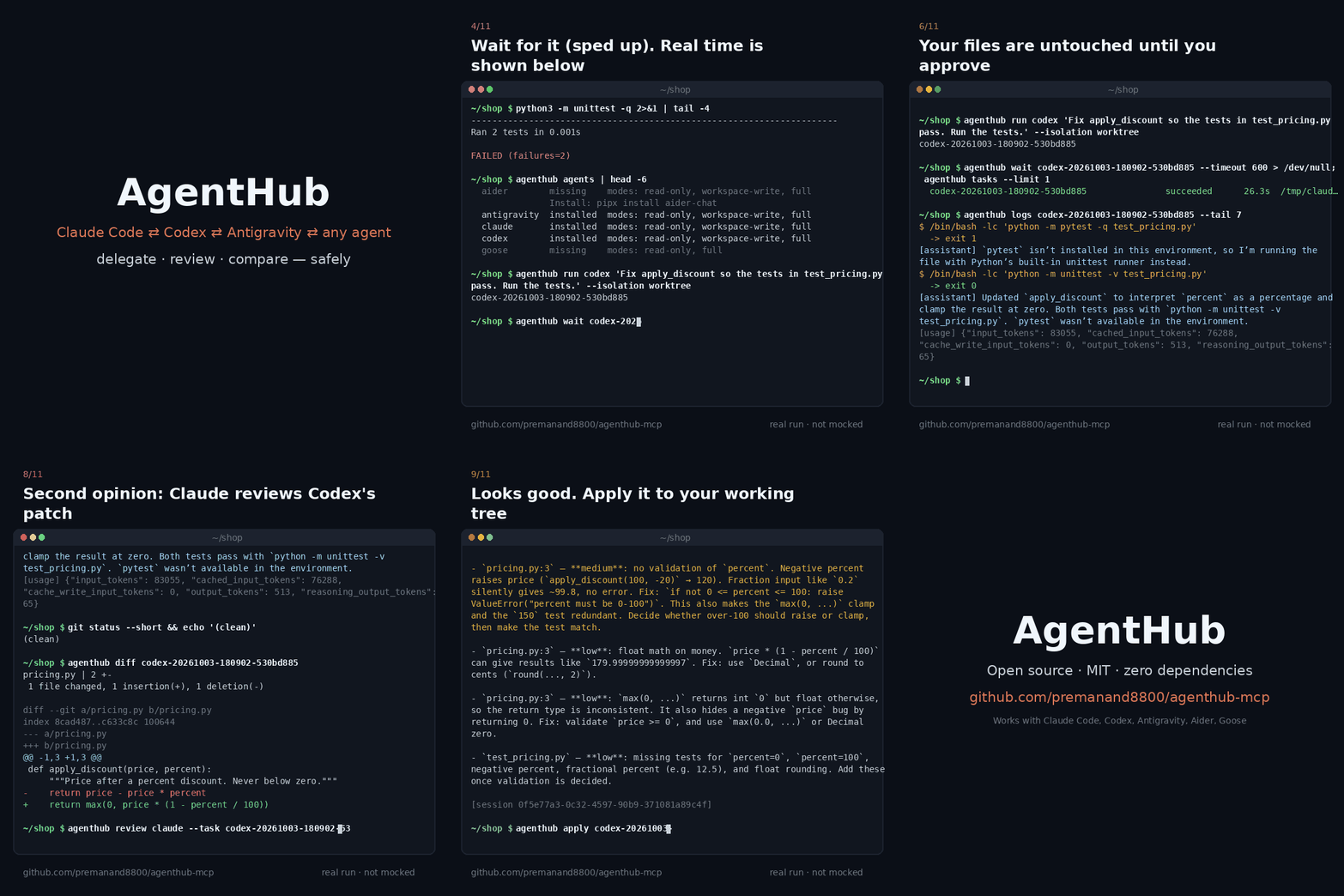
▶ Watch the demo in full quality (MP4, 50 s): a real run, not a mock-up.
Let Claude Code hand work to other coding agents (Codex, Antigravity, Claude, Aider, Goose, or any CLI) without handing them your whole machine.
AgentHub is a small MCP server, CLI and optional HTTP API. Use it to:
- Get a second opinion. Send one question to several agents and compare the answers (
compare). - Get a cross-model review of your diff before you commit (
review). - Delegate safely. An agent works in its own git worktree. You see the diff, then apply or discard it.
- Use the subscriptions you already pay for. ChatGPT through Codex, Google through Antigravity, all from one place, with automatic fallback when one runs out of quota.
- Run long jobs in the background, wait for them, read readable logs.
- Search other agents' past sessions, or continue them.
Every request goes through one policy layer: trusted folders, permission modes, a minimal environment, timeouts, quota tracking and a hash-chained audit log.
Pure Python standard library. No dependencies. Linux and macOS. About 20 MB of RAM.
Quick start
pipx install agenthub-gateway       # or: uv tool install agenthub-gateway
                                     # or run without installing: uvx agenthub-gateway doctor
agenthub config --init               # writes ~/.agenthub/config.json
$EDITOR ~/.agenthub/config.json      # set "trusted_workspaces": ["~/code"]
agenthub doctor
Then connect it to Claude Code in one of two ways:
# A) Plugin: MCP server plus slash commands (/second-opinion, /cross-review, /delegate, /agent-tasks)
#    Starts the server with `uvx agenthub-gateway mcp`, so it needs uv (https://docs.astral.sh/uv/).
claude plugin marketplace add premanand8800/agenthub-mcp
claude plugin install agenthub@agenthub

# B) MCP server only
agenthub install-claude
Restart Claude Code and try:
/cross-review codex
/delegate codex add input validation to the signup handler and run its tests
Use agenthub to compare codex and claude on: what's the safest way to migrate this table?
How a delegated change works
start_task(isolation="worktree")  →  agent edits a private checkout (your files are untouched)
wait_task                         →  blocks until done; returns final output, session_id, token usage
get_task_diff                     →  file list + patch
review(task_id=…)                 →  optional: another model reviews that patch
apply_task  |  discard_task       →  patch lands in your working tree (uncommitted), or is thrown away
The worktree starts from your current state, including uncommitted changes to tracked files. Build junk (__pycache__, node_modules, …) is left out of the diff. If your files changed in the meantime, apply_task tries a 3-way merge. If that conflicts, it keeps the worktree so you can resolve it by hand.
Permission modes
| Mode | Meaning | Codex | Claude | Antigravity | Aider | Goose |
|---|---|---|---|---|---|---|
read-only |
Inspect only | -s read-only |
plan |
--mode plan --sandbox |
--dry-run |
GOOSE_MODE=chat |
workspace-write (default) |
Edit files in workdir |
-s workspace-write |
acceptEdits |
--mode accept-edits --sandbox |
no shell commands | – |
full |
No sandbox, no approvals | --dangerously-bypass-… |
bypassPermissions |
--dangerously-skip-permissions |
--yes-always |
GOOSE_MODE=auto |
fullis off until a human sets"allow_full_access": true. A model cannot turn it on.reviewandcomparealways runread-only.- If an agent can't enforce a mode, AgentHub refuses the request instead of quietly running with weaker settings.
- A delegated Claude runs with
--strict-mcp-config, so it can't use your other MCP servers (email, chat, AgentHub itself).
MCP tools
| Tool | What it does | Read-only |
|---|---|---|
list_agents |
Installed agents, modes, features, quota health | yes |
ask |
Run a prompt and wait. Returns reply, session_id, usage, cost_usd |
no |
start_task |
Background job, optionally isolation:"worktree" |
no |
wait_task |
Block until a task finishes (up to 10 min per call) | yes |
get_task / get_task_logs / list_tasks |
Status, final output, readable logs | yes |
cancel_task |
Kill a task and all its child processes | no |
get_task_diff |
What a worktree task changed | yes |
apply_task / discard_task |
Land or drop a worktree task's changes | no |
review |
Read-only review of git diff <base> or of a task's diff |
yes* |
compare |
Same prompt to 2–5 agents in parallel | yes* |
list_sessions / search_sessions / get_transcript |
Other agents' history | yes |
list_models |
Model IDs per agent | yes |
send_message |
Message a live session | no |
* These don't change your files, but they do send code to the agents' vendors and use quota.
Options for ask and start_task: workdir, permission_mode, model, and session_id (continue a conversation). Also:
add_dirs: extra directoriesimages: Codex onlyoutput_schema: a JSON Schema; the answer comes back parsed instructuredfallback_agents: other agents to try if this one is out of quota or not installed
Long calls send MCP progress notifications every 10 s when the client asks for them.
To skip permission prompts for tools that only read:
// ~/.claude/settings.json
{ "permissions": { "allow": [
  "mcp__agenthub__list_agents", "mcp__agenthub__wait_task", "mcp__agenthub__get_task",
  "mcp__agenthub__get_task_logs", "mcp__agenthub__list_tasks", "mcp__agenthub__get_task_diff",
  "mcp__agenthub__list_sessions", "mcp__agenthub__search_sessions", "mcp__agenthub__get_transcript",
  "mcp__agenthub__list_models"
] } }
Reliability
- Quota-aware. When a provider reports a quota or rate limit, AgentHub records it, including the reset time when the message gives one ("Resets in 137h"). That agent then fails fast with
quota_exhausteduntil the reset time.fallback_agentsmoves on to the next agent automatically.list_agentsshows each agent's health. - No unsafe retries. An agent run that failed partway may already have edited files, so AgentHub never retries it automatically. Falling back to another agent only happens when nothing ran.
- Survives restarts. Background tasks keep running if Claude Code closes, and their status still works from any process. In-flight
askcalls are killed when the client disconnects, so nothing keeps spending. - Global limits.
max_concurrent_tasksholds across every Claude Code session, enforced with a file lock.
CLI (also built for agents)
Every command is non-interactive, has --json, and uses stable exit codes. Other agents can call AgentHub from their own terminals.
agenthub agents [--json]
agenthub ask codex "explain main.py" -m read-only [--session ID] [--schema s.json] [--fallback claude]
agenthub run codex "add tests" --isolation worktree      → prints task ID
agenthub wait ID [--timeout 600]      exit 0 succeeded · 1 failed · 3 still running
agenthub diff ID | apply ID | discard ID
agenthub review codex [--base main | --task ID]
agenthub compare codex,claude "which approach is safer?"
agenthub tasks | task ID | logs ID | cancel ID
agenthub audit [--verify] · config [--init] · token [--rotate] · serve · doctor
agenthub approve antigravity "Bash(npm test)"     human-only
Exit codes: 0 ok · 1 the agent or task failed · 2 usage error · 3 still running (for wait).
Configuration
~/.agenthub/config.json. Every key is optional. Unknown keys are an error, so typos don't fail silently. Set AGENTHUB_HOME to move the whole directory.
| Key | Default | |
|---|---|---|
trusted_workspaces |
["~"] |
Agents may only run inside these. Narrow this. |
denied_paths |
~/.ssh, ~/.gnupg, ~/.aws, ~/.config/gcloud, ~/.kube, ~/.agenthub |
Always refused |
default_permission_mode |
workspace-write |
|
allow_full_access |
false |
Allows full mode |
env_passthrough |
[] |
Extra env vars for agents (globs), e.g. ["GH_TOKEN"] |
inherit_env |
false |
true passes your entire environment (not recommended) |
ask_timeout_seconds / task_timeout_seconds |
900 / 14400 |
|
max_concurrent_tasks |
4 |
Across all sessions |
max_prompt_chars / max_output_chars |
100000 / 60000 |
|
max_delegation_depth |
2 |
Stops agent → hub → agent loops |
quota_backoff_seconds |
900 |
How long to skip an agent after a quota error with no reset time |
audit_prompt_preview_chars |
80 |
0 logs only prompt length and SHA-256 |
task_retention_days |
7 |
Old tasks and their worktrees are deleted |
http_allowed_origins |
[] |
Browser origins allowed to call the HTTP API |
Environment: agents get only what they need:
PATH,HOME, locale, proxies, CA bundles- toolchain variables (nvm, cargo, go, java, venv, …)
- their own API-key variables (
OPENAI_*for Codex,ANTHROPIC_*for Claude, …)
Cloud credentials such as AWS_* and GH_TOKEN are not passed unless you list them in env_passthrough.
Custom agents
Put a JSON file in ~/.agenthub/agents/ (mode 600). See examples/custom-agent.json.
{
  "name": "myagent",
  "command": "myagent",
  "args": ["run", "--prompt={prompt}"],
  "model_args": ["--model", "{model}"],
  "add_dir_args": ["--add-dir", "{dir}"],
  "output_schema_args": ["--schema", "{schema_file}"],
  "json_output": { "reply": "result", "session_id": "session_id", "cost_usd": "cost" },
  "env_passthrough": ["MYAGENT_API_KEY"],
  "modes": { "read-only": ["--no-write"], "workspace-write": ["--sandbox"] }
}
modeslists only what your CLI can really enforce.json_outputtells AgentHub where to find the reply and session ID when your CLI prints JSON.- Specs that are group- or world-writable are refused, and so are specs that reuse a built-in name.
agenthub doctorreports why.
HTTP API (optional)
agenthub serve                                   # 127.0.0.1:8765
TOKEN=$(agenthub token)
curl -s localhost:8765/v1/agents/codex/ask -H "Authorization: Bearer $TOKEN" \
     -H 'Content-Type: application/json' -d '{"prompt":"hi","permission_mode":"read-only"}'
| Method | Path |
|---|---|
| GET | /health (no auth) · /v1/agents · /v1/agents/{agent}/models |
| POST | /v1/agents/{agent}/ask · /v1/agents/{agent}/tasks · /v1/review · /v1/compare |
| GET | /v1/agents/{agent}/sessions · …/sessions/search?q= · …/sessions/{id} |
| POST | /v1/agents/{agent}/sessions/{id}/messages |
| GET | /v1/tasks · /v1/tasks/{id} · /v1/tasks/{id}/wait?timeout= · /v1/tasks/{id}/logs?tail= · /v1/tasks/{id}/diff |
| POST | /v1/tasks/{id}/cancel · /v1/tasks/{id}/apply · /v1/tasks/{id}/discard |
Errors are always {"ok": false, "error": {"code", "message"}}. A quota_exhausted error also includes retry_after_seconds.
Security model
See SECURITY.md. In short:
- The model is untrusted. Defaults assume a prompt injection will reach AgentHub. Every agent run is sandboxed, limited to trusted folders, given a minimal environment, time-limited and audited. A model can't enable
fullmode or approve its own tools. - No shell, ever. Prompts can't become CLI options.
- Private state. All state lives in
~/.agenthub(0700), never in/tmp. - Tamper-evident audit log.
agenthub audit --verify.
Development
git clone https://github.com/premanand8800/agenthub-mcp && cd agenthub-mcp
PYTHONPATH=src python -m unittest discover -s tests -t tests -v
Tests use a fake agent: no API keys, no quota. To add a built-in adapter, subclass agenthub.adapters.base.Adapter, then:
- implement
build_command(spec), andparse_outputif your CLI prints JSON - declare
modesandenv_allow - register it in
adapters/__init__.py
Contributing
Issues and PRs welcome — see CONTRIBUTING.md. Security reports: SECURITY.md.
License
MIT
1 maintainer

Metadata
1 maintainer
Release files for agenthub-gateway 1.2.3
For a detailed explanation of source distributions (sdists) and built distributions (wheels), please see the package formats documentation.
Source distribution (sdist)
| File | Size | Uploaded | Provenance | Actions |
|---|---|---|---|---|
| agenthub_gateway-1.2.3.tar.gz | 68.7 kB | With provenance | Details for agenthub_gateway-1.2.3.tar.gz |
Built distribution (wheel)
| File | Interpreter | ABI | Platform | Actions Reset |
|---|---|---|---|---|
| agenthub_gateway-1.2.3-py3-none-any.whl | Python 3 | none | any | Details for agenthub_gateway-1.2.3-py3-none-any.whl |
Total release size: 133.4 kB
Release files / agenthub_gateway-1.2.3.tar.gz
| Download URL | agenthub_gateway-1.2.3.tar.gz |
|---|---|
| Size | 68.7 kB |
| Tags | Source |
|
SHA-256 checksum How to use checksums |
c7b97225f72eec885e3af9590de364683b51b7f3c288c20c6f9cfe03f71353e7
|
|
BLAKE2b-256 checksum How to use checksums |
d2aaebc56f4df7ee45aa79a8b19488058e1bad4e25915a41cc14e6b97f2c2f86
|
| Upload date | |
|
Uploaded using Trusted Publishing? What is trusted publishing? |
Yes |
| Uploaded via |
twine/7.0.0 CPython/3.13.14
|
Provenance
Provenance describes where a file came from. On PyPI, provenance is shared via attestations, which provide a verifiable record of the build or publishing details. View details, limitations and caveats.


PyPI Publish Attestation
PyPI verified that this artifact, at this checksum, originated from the publisher listed below.
Signed by GitHub Actions, verified by PyPI on Oct 7, 2026.
Transparency logRelease files / agenthub_gateway-1.2.3-py3-none-any.whl
| Download URL | agenthub_gateway-1.2.3-py3-none-any.whl |
|---|---|
| Size | 64.7 kB |
| Tags | Python 3 |
|
SHA-256 checksum How to use checksums |
543413e880033c5ab3e8e855e798ba3f015482f1cf4a50b62944a14d00e9b8be
|
|
BLAKE2b-256 checksum How to use checksums |
bf2404a50bf05db0409db989dbd1f09d8032c39447f8da3742b0476ca22697a4
|
| Upload date | |
|
Uploaded using Trusted Publishing? What is trusted publishing? |
Yes |
| Uploaded via |
twine/7.0.0 CPython/3.13.14
|
Provenance
Provenance describes where a file came from. On PyPI, provenance is shared via attestations, which provide a verifiable record of the build or publishing details. View details, limitations and caveats.
PyPI Publish Attestation
PyPI verified that this artifact, at this checksum, originated from the publisher listed below.
Signed by GitHub Actions, verified by PyPI on Oct 7, 2026.
Transparency logSecurity for agenthub-gateway 1.2.3
Provenance
Provenance describes where a file came from. On PyPI, provenance is shared via attestations, which provide a verifiable record of the build or publishing details. View details, limitations and caveats.
Full provenance
Both files in this release have been uploaded with provenance metadata.
Attestation for agenthub_gateway-1.2.3.tar.gz
PyPI Publish Attestation
PyPI verified that this artifact, at this checksum, originated from the publisher listed below.
Signed by GitHub Actions, verified by PyPI on Oct 7, 2026.
Transparency logA note on package security
PyPI is a repository for distributing packages, not a service for auditing them. While third-party security researchers and our staff do their best to detect and remove malicious packages, PyPI cannot guarantee the quality, security or suitability of any given package.
To learn more about protecting yourself from malicious actors, visit our package security documentation.














