

Agentic Bus
Reference implementation of the Liquid Interfaces Protocol
A dynamic, negotiation-driven, multi-agent coordination runtime where interfaces are not static contracts — they are ephemeral relational events.
See It Work • Quick Start • Architecture • Key Concepts • Embedding • Dashboard UI • REST API • CLI Reference • Testing • Contributing • License




🧭 Overview
Agentic Bus introduces a coordination paradigm in which interfaces are not persistent technical artifacts, but ephemeral relational events that emerge through intention articulation and semantic negotiation at runtime.
Instead of pre-wired API contracts, a requesting agent simply states its intent in natural language — e.g., "deliver this container within 200 km of the closed port, optimizing for cost and time" — and the runtime discovers capable agents, negotiates terms, composes an execution graph, and dissolves everything once the task is complete, leaving zero technical debt.
📄 Read the full paper: lip.md — "Liquid Interfaces: A Dynamic Ontology for the Interoperability of Autonomous Systems"
👀 See it work
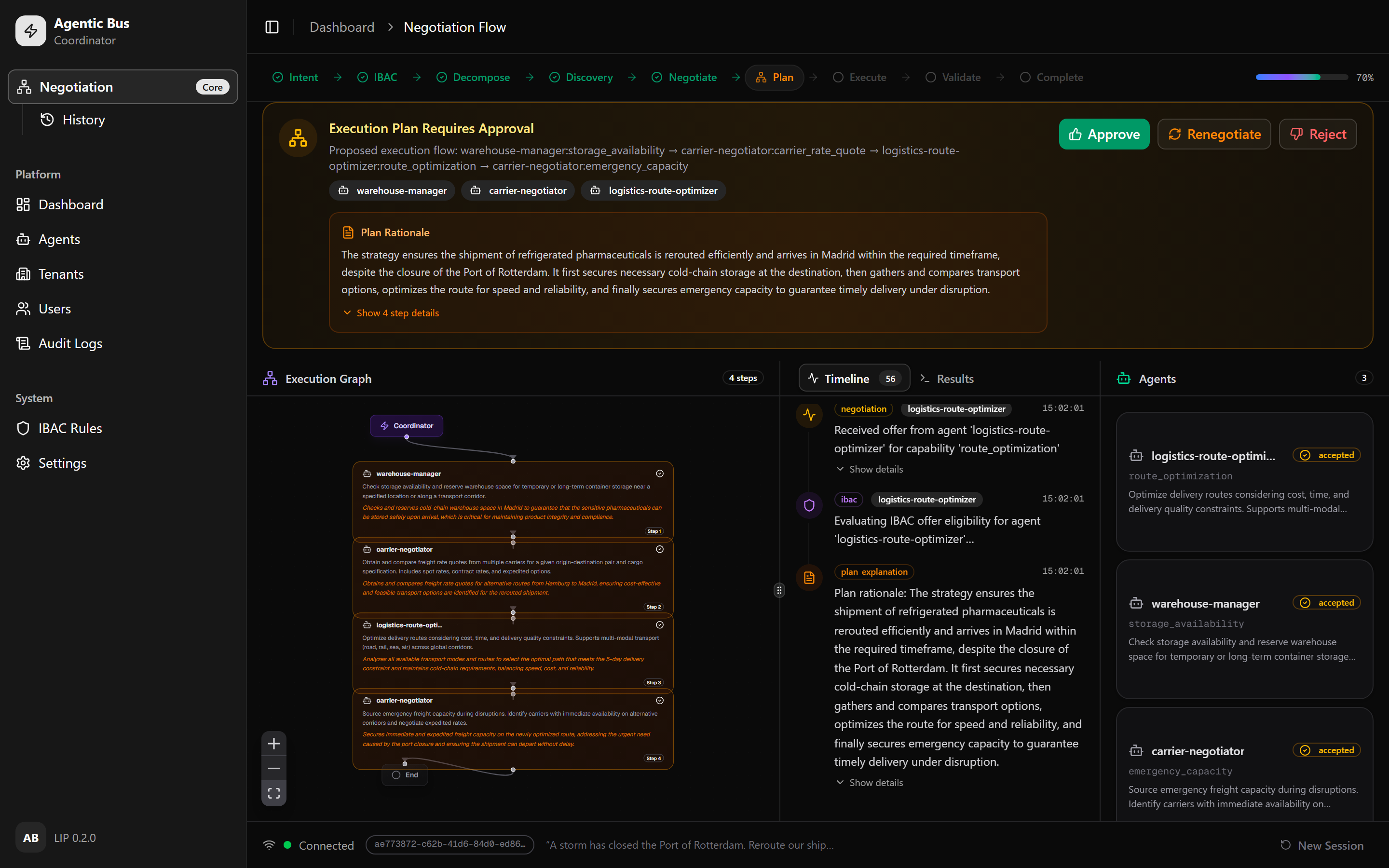
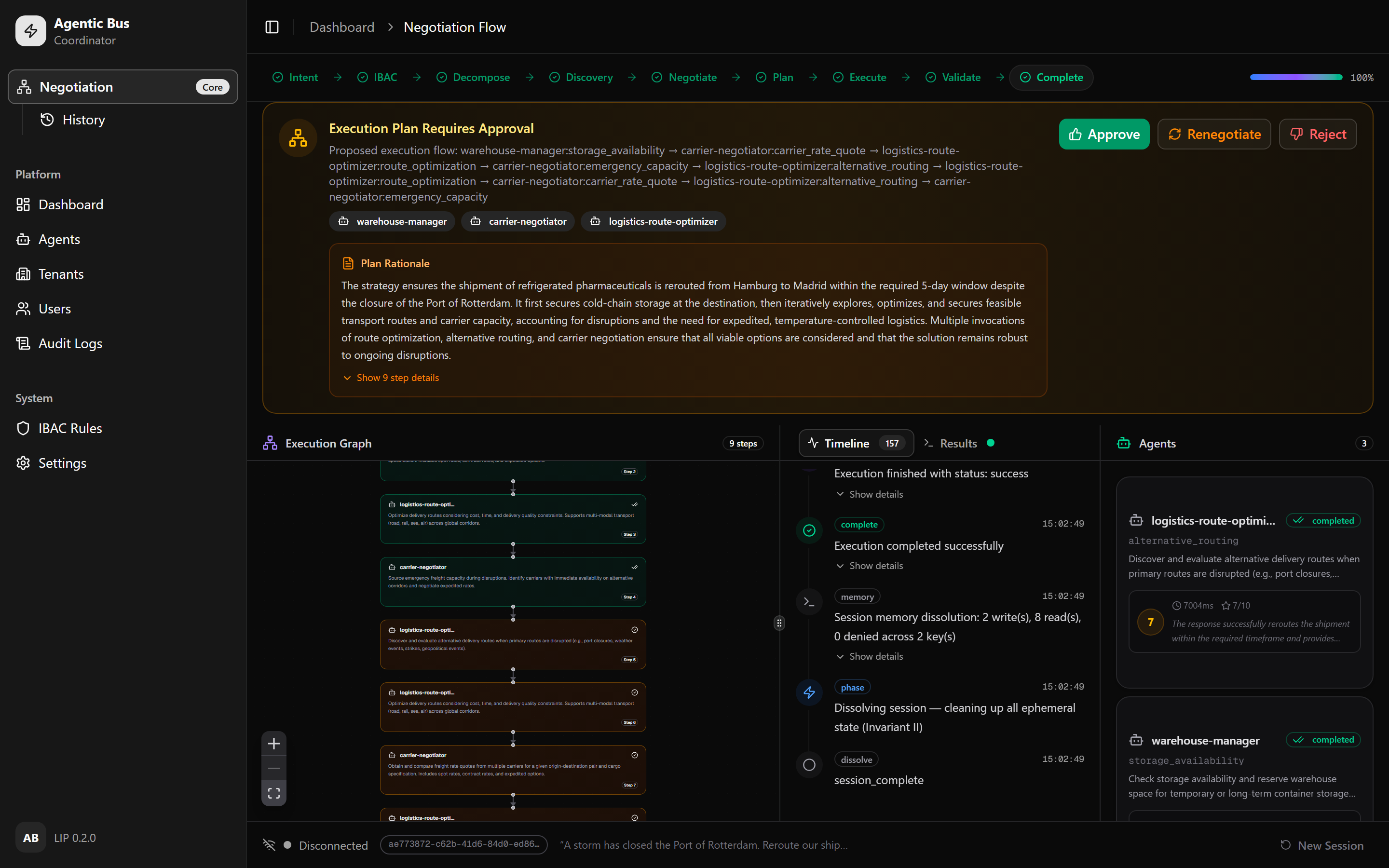
A single sentence — "a storm has closed the Port of Rotterdam, reroute our refrigerated pharmaceuticals from Hamburg to Madrid within 5 days" — decomposed, negotiated across four agents that were never wired to each other, executed, and dissolved.
The plan, waiting for a human. The coordinator has admitted the intent, broken it into sub-intents, discovered which agents can serve them, collected their offers and composed an execution graph — and stops there, because committing to a carrier creates a contractual obligation.
Approved and carried out. Every step green, agent quality scored, and the session dissolved on completion — Invariant II: nothing outlives the interaction that created it.
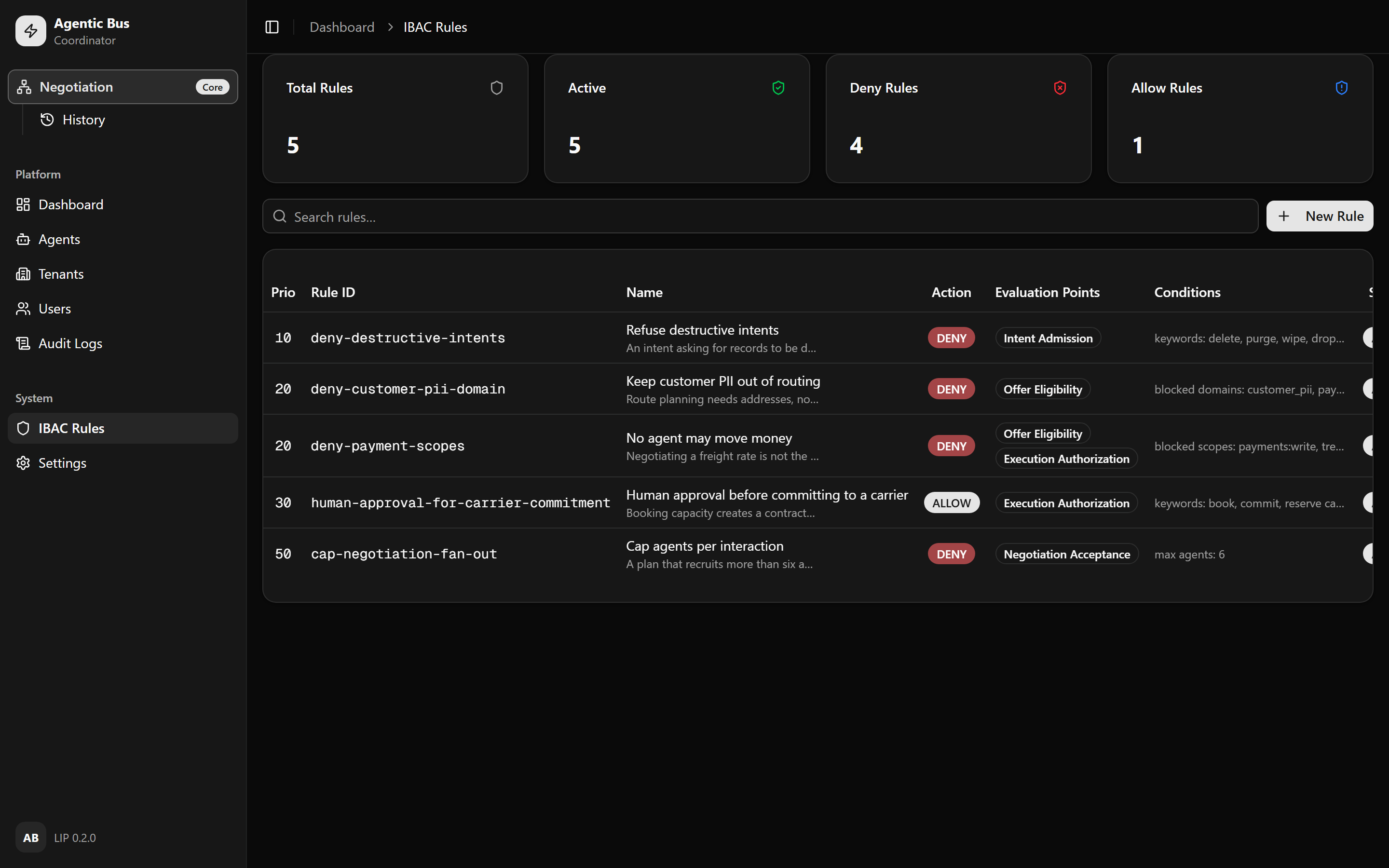
Authorisation, at five points in the lifecycle. IBAC judges the purpose of a request, not the endpoint it targets — so the same intent is evaluated again at admission, offer eligibility, negotiation, execution and artifact emission, each time against what is known by then.
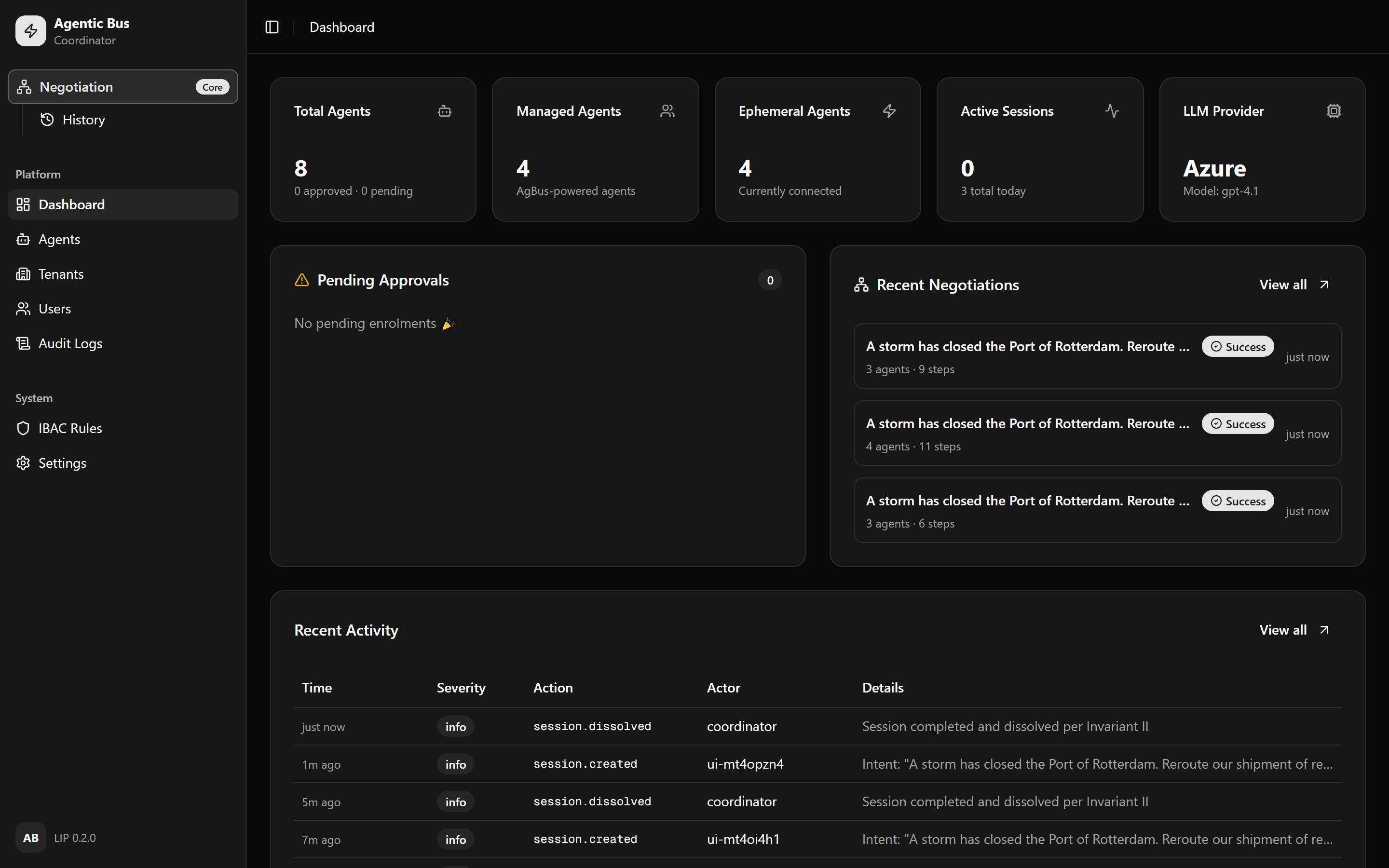
And the run afterwards. Which agents took part, what they cost, what was produced, and every decision that allowed it.
Reproduce these against your own bus with
node ui/scripts/capture-screenshots.mjs http://localhost:3000 — it drives a
real intent through a running coordinator rather than mocking one.
✨ Key Concepts
| Principle | Description |
|---|---|
| Intent-first | Coordination starts from a natural-language objective, not from an endpoint or schema. |
| Negotiated | Interfaces emerge through semantic negotiation at runtime — no prior contracts required. |
| Ephemeral | All coordination artifacts are dissolved after task completion — zero technical debt. |
| Governed | IBAC (Intention-Based Access Control) is enforced at every phase of the lifecycle. |
How is this different?
| Paradigm | Focus | Agentic Bus Difference |
|---|---|---|
| REST / GraphQL | Static contracts & schemas | No pre-defined endpoints; interfaces emerge dynamically |
| Service Mesh | Syntactic routing between known services | Semantic discovery & negotiation among unknown agents |
| FIPA-ACL | Formal logic between rational agents | Probabilistic LLM-driven negotiation; tolerates heterogeneous reasoning |
| Smart Contracts | Immutable deterministic agreements | Ephemeral, adaptive contracts that dissolve post-execution |
| MCP | "What is available?" (tool exposure) | "What should happen?" (intent orchestration) — complementary; MCP servers join the bus via the MCP bridge |
| A2A | Agent-to-agent messaging over declared Agent Cards | A layer above: intent expressed before a counterparty is known, plus purpose-bound governance (IBAC). A2A can carry LIP as transport |
🏗️ Architecture
                          ┌──────────────┐
                          │   Dashboard  │  (Next.js 16 — ui/)
                          │   React UI   │
                          └──────┬───────┘
                                 │ REST
                                 ▼
Requester ──WebSocket──► Coordinator ──WebSocket──► Provider Agents
                              │  │
                         ┌────┘  └────┐
                    ┌────┴────┐  Admin REST API
                    │ LangGraph│  (FastAPI :8766)
                    └────┬────┘
                         │
               IBAC ◄────┤────► Registry
                         │
                    Telemetry (OTel)
                         │
                    Persistence (SQLAlchemy)
The Coordinator implements the full Agentic Bus session lifecycle:
- Accept & authenticate WebSocket connections (OIDC)
- Open intent sessions
- Discover eligible agents via semantic adjudication
- Request offers from matching agents
- Evaluate offers through IBAC governance
- Negotiate & compose offers into an execution plan
- Build a LangGraph dynamically
- Supervise execution with failure handling
- Dissolve the session — all artifacts are ephemeral
Project Layout
agentic-bus/
│
├── docker-compose.yml          # Full stack: Ollama + coordinator + dashboard
├── Dockerfile                  # Coordinator image
├── docker/                     # Container entrypoint
├── schemas/                    # Generated LIP JSON Schemas (see CONTRIBUTING)
│
├── agentic_bus/                # Python package
│   ├── cli.py                  # CLI entry point (agbus command)
│   ├── core/                   # Shared infrastructure
│   │   ├── protocol/           #   Message model & envelope
│   │   ├── transport/          #   WebSocket server / client
│   │   ├── session/            #   Session lifecycle management
│   │   ├── registry/           #   Dynamic capability registry
│   │   ├── ibac/               #   Intention-Based Access Control engine
│   │   ├── telemetry/          #   OpenTelemetry instrumentation
│   │   ├── auth/               #   OIDC authentication & admin auth
│   │   ├── llm/                #   Multi-provider LLM factory
│   │   └── persistence/        #   SQLAlchemy models & repositories
│   │       ├── models.py       #     DB models (agents, tenants, users, IBAC rules, LLM configs)
│   │       ├── repository.py   #     Agent repository
│   │       ├── tenant_repository.py
│   │       ├── user_repository.py
│   │       ├── ibac_repository.py
│   │       ├── llm_repository.py
│   │       └── managed_agent_repository.py
│   │
│   ├── coordinator/            # Coordination runtime
│   │   ├── server.py           #   Server entry point (WS + REST)
│   │   ├── runtime.py          #   Core coordinator runtime
│   │   ├── intent/             #   Intent admission & decomposition
│   │   ├── negotiation/        #   Offer collection, scoring, composition
│   │   ├── graph/              #   Dynamic LangGraph synthesis
│   │   ├── execution/          #   Supervised execution & failure handling
│   │   └── admin/              #   Admin REST API (FastAPI)
│   │       ├── api.py          #     All REST endpoints
│   │       ├── service.py      #     Business logic
│   │       ├── schemas.py      #     Pydantic DTOs
│   │       ├── serializers.py  #     Model → DTO serializers
│   │       └── audit.py        #     Audit logging
│   │
│   └── agents/                 # Agent SDK & examples
│       ├── base/               #   Base agent framework
│       ├── factory.py          #   Agent factory (CrewAI integration)
│       ├── managed_server.py   #   Managed agent server
│       ├── requester.py        #   Intent requester client
│       └── examples/           #   Sample provider agents
│           ├── logistics_agent/
│           └── intent_client_example.py
│
├── ui/                         # Admin Dashboard (Next.js 16)
│   ├── src/
│   │   ├── app/                #   App Router pages
│   │   │   ├── page.tsx        #     Dashboard home (stats overview)
│   │   │   ├── agents/         #     Agent management (persistent & managed)
│   │   │   ├── intent/         #     Intent session inspector
│   │   │   ├── ibac/           #     IBAC rule management
│   │   │   ├── audit/          #     Audit log viewer
│   │   │   ├── tenants/        #     Multi-tenant management
│   │   │   ├── users/          #     User administration
│   │   │   └── settings/       #     Coordinator & LLM settings
│   │   ├── components/         #   Reusable UI components (shadcn/ui)
│   │   ├── hooks/              #   Custom React hooks
│   │   │   ├── use-async.ts    #     Async data fetching
│   │   │   └── use-intent-ws.ts#     WebSocket intent streaming
│   │   └── lib/                #   Shared utilities
│   │       ├── api.ts          #     REST API client
│   │       ├── protocol.ts     #     Protocol type definitions
│   │       └── types.ts        #     TypeScript types
│   └── package.json
│
└── tests/                      # Test suite (22 modules, 411 tests)
    ├── test_admin.py
    ├── test_auth.py
    ├── test_cli.py
    ├── test_graph.py
    ├── test_ibac.py
    ├── test_ibac_rules.py
    ├── test_intent_client.py
    ├── test_llm_config.py
    ├── test_llm_factory.py
    ├── test_managed_agents.py
    ├── test_negotiation.py
    ├── test_persistence.py
    ├── test_protocol.py
    ├── test_registry.py
    ├── test_session.py
    ├── test_telemetry.py
    └── test_tenants_users.py
🚀 Quick Start
Try it with no API keys
git clone https://github.com/draiven-io/agentic-bus.git && cd agentic-bus && docker compose up
That brings up a local model (Ollama), the coordinator with the paper's four logistics agents already seeded and running, and the dashboard:
| Dashboard | http://localhost:3000 |
| REST API | http://localhost:8766/api/docs |
| LIP bus | ws://localhost:8765 |
Open the dashboard, go to Intent, and submit something like "a storm has closed the port — find me an alternative route and tell me what it costs". You'll watch discovery, negotiation, plan approval, execution and dissolution happen live.
On the local model. The compose stack defaults to
qwen2.5:3bso the first run is a ~2 GB download rather than a signup. It is enough to watch the full lifecycle, but negotiation quality scales with the model. For results worth judging the paradigm on, point the coordinator at a hosted model — setAGBUS_BOOTSTRAP_LLM_PROVIDER,AGBUS_BOOTSTRAP_LLM_MODELandAGBUS_BOOTSTRAP_LLM_API_KEYindocker-compose.yml, or pick a larger local one withAGBUS_DEMO_MODEL=qwen2.5:14b docker compose up.
Write an agent
pip install agentic-bus
That is a small install — pydantic, websockets and OpenTelemetry — because writing an agent should not require a web framework, an ORM and an LLM stack. An agent is two methods:
from agentic_bus import AgentCapability, BaseAgent


class WeatherAgent(BaseAgent):
    def capabilities(self):
        return [AgentCapability(
            capability_id="forecast",
            description="Weather forecast for a city",
        )]

    async def execute_task(self, payload, context):
        return {"forecast": "sunny"}


WeatherAgent(agent_id="weather-01").run_forever()
Work that a permission is meant to govern says so where the work happens:
from agentic_bus import require_scope

async def execute_task(self, payload, context):
    require_scope("payments:refund")      # raises if this execution was not granted it
    return {"refunded": payload["order_id"]}
The grant comes from the coordinator, not from the agent asking — an agent
declares what it does and an administrator decides what that requires
(RFC 0003). scope_is_held() is the non-raising form, for narrowing an answer
rather than refusing one. Both record the attempt, so a coordinator can tell
afterwards what an execution reached for.
It connects to a coordinator (AGBUS_COORDINATOR_URI, default
ws://localhost:8765), registers its capabilities, and from then on
participates in discovery, negotiation, IBAC governance and execution. You
never write an endpoint, a schema or a route.
The runtime handles the parts that bite in production:
- Reconnects with exponential backoff and jitter, and re-registers on every reconnect — a coordinator restart doesn't leave the agent silently orphaned.
- Runs tasks concurrently (bounded by
max_concurrent_tasks, default 8), so one slow task doesn't stop the agent answering anything else. - Cancels in-flight work on
dissolve, soexecute_taskreceivesCancelledErrorand can clean up — the protocol's ephemerality guarantee is actually enforced, not just documented.
For a coordinator with real OIDC, supply a token provider. It's called on every reconnect, so short-lived tokens refresh rather than going stale:
WeatherAgent(
    agent_id="weather-01",
    token_provider=lambda: my_oidc_client.access_token(),   # may be async
)
Submitting an intent is the other half:
from agentic_bus import submit_intent

result = await submit_intent("what's the weather in Lisbon?")
Test it without any of the infrastructure
agentic_bus.testing ships a stand-in coordinator, so testing an agent needs
no Docker, no model provider and no network:
from agentic_bus.testing import LocalBus

async def test_forecast():
    async with LocalBus() as bus:
        agent = await bus.add_agent(WeatherAgent(agent_id="weather-01"))

        result = await bus.execute(agent.agent_id, {"city": "Lisbon"})

        assert result.status == "success"
        assert result.artifacts[0]["forecast"] == "sunny"
It speaks LIP over a real socket rather than calling your handlers directly,
so serialisation, the receive loop and concurrency all take part — faking
those out is what lets connection-level bugs survive a green suite. You can
also drive intents (send_intent), tear sessions down (dissolve), inspect
the transcript (messages, events), check the token your agent sent
(auth_headers), and simulate a coordinator that refuses registration or
predates LIP 0.2.0.
It is not a coordinator: discovery and negotiation are LLM-driven in the real runtime and are not reproduced, so tests stay deterministic. Use it to check what your agent does, not how a coordinator would choose it.
Check an implementation against the specification
agbus conformance drives a candidate agent over a real WebSocket and reports,
per requirement, whether it behaved as LIP says it must:
agbus conformance --port 9100
Point your agent at the printed URI. It speaks only the protocol, so the agent under test can be written in any language — which is the point: a specification becomes a standard when a second implementation can be built from it and shown to interoperate.
Requirements are graded. A MUST failure means the implementation is not
conformant; a SHOULD failure is reported without failing the run. --json
emits a machine-readable report for CI.
The reference SDK is tested against this suite, so if BaseAgent ever stops
satisfying the specification it publishes, our own build fails.
Run a coordinator
The coordinator is a much heavier thing — LangGraph, FastAPI, SQLAlchemy, the LLM providers — so it lives behind an extra:
pip install "agentic-bus[server]"
agbus install && agbus serve
agbus install is an interactive wizard: it writes a .env for the server
and database settings and stores your LLM provider in the database. To skip
the wizard, see Configuration below.
Install matrix
| Command | Gives you |
|---|---|
pip install agentic-bus |
Write agents, submit intents, speak LIP |
pip install "agentic-bus[server]" |
Run a coordinator (agbus serve), including the managed agents it hosts |
pip install "agentic-bus[mcp]" |
Bridge MCP servers onto the bus |
pip install "agentic-bus[all]" |
Everything |
Commands that need an extra you don't have say so, and name the extra.
Develop against a checkout
git clone https://github.com/draiven-io/agentic-bus.git
cd agentic-bus
pip install -e ".[dev]"
agbus serve
cd ui && npm install && npm run dev
python -m agentic_bus.agents.examples.logistics_agent.agent
⚠️ Note: run
agbusfrom the directory containing your.env.
Configuration
Configuration is split in two, deliberately:
| What | Where | Why |
|---|---|---|
| Server, database, OIDC | .env |
Needed before the process can reach a database |
| LLM providers (and their API keys) | Database | Switchable at runtime without restarting the coordinator; credentials never sit in a file |
agbus install writes the .env and stores your first LLM provider in the
database. Add or switch providers later without touching either by hand:
agbus llm add --name prod --provider anthropic --model claude-sonnet-4-20250514 --api-key sk-ant-... --activate
agbus llm list
The .env covers the runtime itself:
AGBUS_HOST=0.0.0.0
AGBUS_PORT=8765
AGBUS_DATABASE_URL=sqlite:///agbus_agents.db
AGBUS_AGENT_AUTO_APPROVE=false
Supported LLM providers
openai, anthropic, google, azure, and ollama (local, no API key).
Azure additionally needs an endpoint, deployment name and API version, which
agbus install and agbus llm add both prompt for.
Run agbus config show to display the resolved runtime configuration and the
active LLM provider.
🧩 Embedding the coordinator
Agentic Bus runs as a service by default: agents connect over WebSocket from wherever they live. But the coordination logic never touches the wire — it asks a transport for a peer and sends an envelope — so it can also run as a library inside an application you already have.
from agentic_bus.coordinator.runtime import CoordinatorRuntime
from agentic_bus.core.transport.local import LocalTransport

transport = LocalTransport()
runtime = CoordinatorRuntime(transport=transport)
await runtime.start()          # no port bound, no socket opened

await my_agent.attach(transport)   # instead of dialling a URI
No port, no second service to operate, no loopback serialisation between co-located agents. Everything else is unchanged: agents still register per connection, IBAC still evaluates, sessions still dissolve.
Envelopes are deep-copied across the in-process boundary. That costs something, and it is deliberate — a socket hands each side its own object, and a local transport that skipped the copy would let code pass here and misbehave over a network. The point of the abstraction is that both paths mean the same thing.
Two things do not carry over. A LocalTransport has no address, so
agent_endpoint is None and the coordinator cannot spawn managed agents or
MCP bridges — there is nowhere for them to dial, and it says so rather than
guessing. Attach your own agents instead.
🖥️ Admin Dashboard (UI)
The Admin Dashboard is a full-featured Next.js 16 application that provides a visual management interface for the entire Agentic Bus runtime. Built with React 19, Tailwind CSS 4, shadcn/ui, and Recharts.
Pages
| Page | Description |
|---|---|
Dashboard (/) |
Real-time stats overview — active agents, sessions, recent audit events |
Agents (/agents) |
Manage persistent (self-enrolled) and managed (coordinator-created) agents; approve, reject, revoke, activate, disable |
Create Agent (/agents/create) |
Interactive form to create a new managed agent with capabilities and CrewAI tool selection |
Intent (/intent) |
Live intent session inspector with WebSocket streaming |
IBAC Rules (/ibac) |
Create, edit, and delete Intention-Based Access Control rules |
Audit Log (/audit) |
Searchable audit trail of all administrative actions |
Tenants (/tenants) |
Multi-tenant management — create tenants, assign agents to tenants |
Users (/users) |
User administration — create, edit, assign roles and tenants |
Settings (/settings) |
Coordinator configuration and LLM provider management |
Running the UI
cd ui
npm install
npm run dev       # Development mode (http://localhost:3000)
npm run build     # Production build
npm run start     # Production server
🔌 Admin REST API
The coordinator exposes a FastAPI admin REST API on port 8766 (configurable via AGBUS_API_PORT). Interactive Swagger documentation is available at /api/docs, and an unauthenticated liveness probe at /health.
Endpoints
| Method | Endpoint | Description |
|---|---|---|
GET |
/api/admin/stats |
Dashboard statistics |
GET |
/api/admin/me |
Current authenticated user |
GET |
/api/admin/agents/persistent |
List persistent (self-enrolled) agents |
GET |
/api/admin/agents/persistent/{id} |
Get a persistent agent |
POST |
/api/admin/agents/persistent/{id}/approve |
Approve enrolment |
POST |
/api/admin/agents/persistent/{id}/reject |
Reject enrolment |
POST |
/api/admin/agents/persistent/{id}/revoke |
Revoke an agent |
DELETE |
/api/admin/agents/persistent/{id} |
Delete an agent |
GET |
/api/admin/agents/managed |
List managed agents |
GET |
/api/admin/agents/managed/{id} |
Get a managed agent |
POST |
/api/admin/agents/managed |
Create a managed agent |
POST |
/api/admin/agents/managed/{id}/activate |
Activate |
POST |
/api/admin/agents/managed/{id}/disable |
Disable |
DELETE |
/api/admin/agents/managed/{id} |
Delete |
GET |
/api/admin/agents/ephemeral |
List ephemeral (in-session) agents |
GET |
/api/admin/agents/tools |
List available CrewAI tools |
GET |
/api/admin/sessions |
List active sessions |
GET |
/api/admin/audit |
Query audit log |
GET |
/api/admin/tenants |
List tenants |
GET |
/api/admin/tenants/{id} |
Get a tenant |
POST |
/api/admin/tenants |
Create a tenant |
PUT |
/api/admin/tenants/{id} |
Update a tenant |
DELETE |
/api/admin/tenants/{id} |
Delete a tenant |
POST |
/api/admin/tenants/{id}/agents/{agent_id} |
Assign agent to tenant |
DELETE |
/api/admin/tenants/{id}/agents/{agent_id} |
Remove agent from tenant |
GET |
/api/admin/users |
List users |
GET |
/api/admin/users/{id} |
Get a user |
POST |
/api/admin/users |
Create a user |
PUT |
/api/admin/users/{id} |
Update a user |
DELETE |
/api/admin/users/{id} |
Delete a user |
GET |
/api/admin/ibac/rules |
List IBAC rules |
GET |
/api/admin/ibac/rules/{id} |
Get an IBAC rule |
POST |
/api/admin/ibac/rules |
Create an IBAC rule |
PUT |
/api/admin/ibac/rules/{id} |
Update an IBAC rule |
DELETE |
/api/admin/ibac/rules/{id} |
Delete an IBAC rule |
GET |
/api/admin/llm/configs |
List LLM configurations |
POST |
/api/admin/llm/configs |
Create an LLM configuration |
POST |
/api/admin/llm/configs/{name}/activate |
Activate a configuration |
PUT |
/api/admin/llm/configs/{name} |
Update a configuration |
DELETE |
/api/admin/llm/configs/{name} |
Delete a configuration |
GET |
/api/admin/settings |
Get coordinator settings |
💻 CLI Reference
agbus install                          # Interactive setup wizard
agbus serve                            # Start the coordinator server

agbus db init                          # Create / migrate database tables

agbus agent list                       # List all registered agents
agbus agent show  <id>                 # Inspect a single agent
agbus agent approve <id>               # Approve a pending enrolment
agbus agent reject  <id>               # Reject a pending enrolment
agbus agent revoke  <id>               # Revoke an approved agent
agbus agent delete  <id>               # Permanently remove an agent
agbus agent create                     # Create a managed agent (interactive)
agbus agent activate <id>              # Activate a managed agent
agbus agent disable <id>               # Disable a managed agent
agbus agent add-capability <id>        # Add capability to a managed agent
agbus agent remove-capability <id> <c> # Remove a capability
agbus agent tools                      # List available CrewAI tools

agbus llm list                         # List LLM configurations
agbus llm show <name>                  # Inspect one configuration
agbus llm add                          # Add a provider configuration
agbus llm activate <name>              # Make a configuration current
agbus llm update <name>                # Update a configuration
agbus llm remove <name>                # Delete a configuration

agbus config show                      # Display resolved configuration
agbus config init                      # Write a starter .env file

agbus help                             # Comprehensive documentation
agbus help quickstart                  # Step-by-step setup guide
🧪 Testing
The project includes a comprehensive test suite — 411 tests across 22 modules — covering every subsystem.
The suite is hermetic: it ignores your .env, requires no API keys, and
never touches the network. Each test gets a scrubbed environment and its own
migrated database (see tests/conftest.py), so a green run on your machine
means a green run in CI.
# Run all tests
pytest

# Run a specific test file
pytest tests/test_negotiation.py

# Run with verbose output
pytest -v
Test Coverage
| Test File | Subsystem |
|---|---|
test_protocol.py |
Message model & envelope |
test_session.py |
Session lifecycle |
test_registry.py |
Capability registry |
test_auth.py |
OIDC authentication |
test_ibac.py |
IBAC engine |
test_ibac_rules.py |
IBAC rule CRUD |
test_negotiation.py |
Negotiation engine |
test_graph.py |
LangGraph builder |
test_persistence.py |
Database persistence |
test_admin.py |
Admin REST API |
test_managed_agents.py |
Managed agent lifecycle |
test_llm_config.py |
LLM configuration management |
test_llm_factory.py |
Multi-provider LLM factory |
test_intent_client.py |
Intent requester client |
test_telemetry.py |
OpenTelemetry tracing |
test_cli.py |
CLI commands |
test_tenants_users.py |
Multi-tenant & user management |
test_agent_stats.py |
Agent scoring & latency priors |
test_execution_supervisor.py |
Supervised execution & failure handling |
test_mcp_bridge.py |
MCP server bridging |
test_session_memory.py |
Session memory policies |
test_validation.py |
Assigned-validator renegotiation loop |
🗺️ Roadmap
- Admin Dashboard (Web UI)
- Admin REST API (FastAPI)
- Multi-tenant & user management
- IBAC rule management
- Audit logging
- LLM configuration management
- Managed agent lifecycle (CrewAI integration)
- Distributed coordinator clustering
- Persistent session replay & auditing
- Agent marketplace & trust scoring
- Plugin system for custom negotiation strategies
- Multi-modal intent support (voice, image, structured data)
🤝 Contributing
Contributions are welcome! Whether it's bug reports, feature requests, documentation improvements, or code contributions — we'd love your help.
- Fork the repository
- Create a feature branch (
git checkout -b feature/amazing-feature) - Commit your changes (
git commit -m 'Add amazing feature') - Push to the branch (
git push origin feature/amazing-feature) - Open a Pull Request
Please make sure all tests pass before submitting:
pip install -e ".[dev]"
pytest
ruff check .
📖 Citation
If you use Agentic Bus in your research, please cite:
@misc{desá2026liquidinterfacesdynamicontology,
      title={Liquid Interfaces: A Dynamic Ontology for the Interoperability of Autonomous Systems},
      author={Dhiogo de Sá and Carlos Schmiedel and Carlos Pereira Lopes},
      year={2026},
      eprint={2601.21993},
      archivePrefix={arXiv},
      primaryClass={cs.AI},
      url={https://arxiv.org/abs/2601.21993},
}
📄 License
This project is licensed under the MIT License — see the LICENSE file for details.
Made with ❤️ by Draiven
1 maintainer

Download files
Download the file for your platform. If you're not sure which to choose, learn more about installing packages.
Source Distribution
Built Distribution
Filter files by name, interpreter, ABI, and platform.
If you're not sure about the file name format, learn more about wheel file names.
Copy a direct link to the current filters
File details
Details for the file agentic_bus-0.3.0.tar.gz.
File metadata
- Download URL: agentic_bus-0.3.0.tar.gz
- Upload date:
- Size: 359.8 kB
- Tags: Source
- Uploaded using Trusted Publishing? Yes
- Uploaded via:
twine/7.0.0 CPython/3.13.14
File hashes
| Algorithm | Hash digest | |
|---|---|---|
| SHA256 |
1502389aa840857c057520271c6c4ddbd141dbf72ee2a4271eb2540cce81097b
|
|
| MD5 |
359baeb3aaa8b4ee84723a9548797582
|
|
| BLAKE2b-256 |
635994c6eefa8a59acdbffc8a61cb7c163ffcf233aa64c266102e511d035d188
|
Provenance
The following attestation bundles were made for agentic_bus-0.3.0.tar.gz:
Publisher:
release.yml on draiven-io/agentic-bus
-
Statement:
-
Statement type:
https://in-toto.io/Statement/v1 -
Predicate type:
https://docs.pypi.org/attestations/publish/v1 -
Subject name:
agentic_bus-0.3.0.tar.gz -
Subject digest:
1502389aa840857c057520271c6c4ddbd141dbf72ee2a4271eb2540cce81097b - Sigstore transparency entry: 2573703952
- Sigstore integration time:
-
Permalink:
draiven-io/agentic-bus@51039785ae3d2791f307cdd60c2bd47a3b0e6e23 -
Branch / Tag:
refs/tags/v0.3.0 - Owner: https://github.com/draiven-io
-
Access:
public
-
Token Issuer:
https://token.actions.githubusercontent.com -
Runner Environment:
github-hosted -
Publication workflow:
release.yml@51039785ae3d2791f307cdd60c2bd47a3b0e6e23 -
Trigger Event:
push
-
Statement type:
File details
Details for the file agentic_bus-0.3.0-py3-none-any.whl.
File metadata
- Download URL: agentic_bus-0.3.0-py3-none-any.whl
- Upload date:
- Size: 263.1 kB
- Tags: Python 3
- Uploaded using Trusted Publishing? Yes
- Uploaded via:
twine/7.0.0 CPython/3.13.14
File hashes
| Algorithm | Hash digest | |
|---|---|---|
| SHA256 |
a0effc60f31d8b6dcce6497f1e35d0f840e055d1f2a86e4eaf875d0c363eb9fa
|
|
| MD5 |
d53ee294f7a9d95ca026e04ddd06b8b6
|
|
| BLAKE2b-256 |
0ee9984d77f476ac76ef310504ffe4f6e349721a8a02b2972f86f678f3bb7703
|
Provenance
The following attestation bundles were made for agentic_bus-0.3.0-py3-none-any.whl:
Publisher:
release.yml on draiven-io/agentic-bus
-
Statement:
-
Statement type:
https://in-toto.io/Statement/v1 -
Predicate type:
https://docs.pypi.org/attestations/publish/v1 -
Subject name:
agentic_bus-0.3.0-py3-none-any.whl -
Subject digest:
a0effc60f31d8b6dcce6497f1e35d0f840e055d1f2a86e4eaf875d0c363eb9fa - Sigstore transparency entry: 2573703986
- Sigstore integration time:
-
Permalink:
draiven-io/agentic-bus@51039785ae3d2791f307cdd60c2bd47a3b0e6e23 -
Branch / Tag:
refs/tags/v0.3.0 - Owner: https://github.com/draiven-io
-
Access:
public
-
Token Issuer:
https://token.actions.githubusercontent.com -
Runner Environment:
github-hosted -
Publication workflow:
release.yml@51039785ae3d2791f307cdd60c2bd47a3b0e6e23 -
Trigger Event:
push
-
Statement type:














