
Agentic Hardware-in-the-Loop (Agentic HIL) tools for AI-assisted embedded firmware loops
Verified details
These details have been verified by PyPIProject links
GitHub Statistics
Maintainers

Project description
Agentic HIL
Your AI agent can develop firmware on its own — because Agentic HIL closes the loop with real hardware.
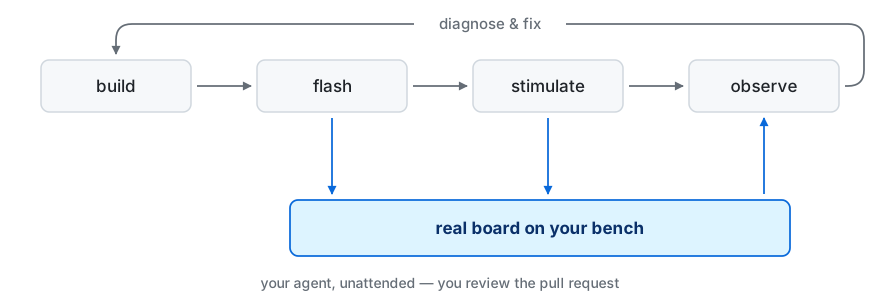
Agentic Hardware-in-the-Loop (Agentic HIL) is a Python package that exposes bounded MCP tools for probing, flashing, resetting, artifact validation, serial and CAN stimulus/feedback, reports, and logs — without giving an agent arbitrary host or debugger access. Each project has exactly one authoritative configuration stored outside the repository. Agentic HIL discovers it from the project root, while AGENTIC_HIL_CONFIG can select an explicit absolute-path override. The file defines the workspace binding, devices, actions, paths, and limits.
Names: the Python distribution/install target, CLI command, repository URL, and MCP server name use agentic-hil. Python imports, pytest plugin names, fixtures, and Python examples use agentic_hil.
Install
The easiest path: copy/paste this prompt to your AI agent:
Read and follow the complete guide at https://github.com/agentic-hil/agentic-hil/blob/master/AI_AGENT_QUICKSTART.md to install Agentic HIL and set it up for this project.
Agents follow AI_AGENT_QUICKSTART.md — everything installs user-local, no admin rights required, ever. The same is true doing it by hand.
Installing it yourself
Two commands: install the package user-locally, then set up the project from its root.
pip install --user agentic-hil
agentic-hil setup                 # add --agent codex or --agent opencode for those
setup creates the deny-by-default policy outside the repository, installs the
agent skill, registers the MCP server with a verified absolute executable path,
and runs doctor. It prints where the policy file landed — review it before
enabling anything.
If pip is missing, Python is externally managed, or agentic-hil does not end
up on PATH, install it persistently with a tool installer instead and rerun
setup:
uv tool install agentic-hil # or: pipx install agentic-hil
Never use pip install --break-system-packages. Never persist a uvx
invocation, a workspace virtual environment, or a bare PATH name as the MCP
launcher: each resolves anew later, so the program behind the hardware gate
could change without anyone editing anything.
AI_AGENT_QUICKSTART.md has the complete fallback chain,
and TROUBLESHOOTING.md covers what to do when something
does not start.
For direct PEAK/SocketCAN adapters add the CAN extra — uv tool install 'agentic-hil[can]' — and for the pyOCD backend agentic-hil[pyocd]. Both are
optional because they carry platform-specific drivers that flashing and UART do
not need; without them those tools refuse with can_backend_not_available
rather than failing at import.
To check a version without installing anything, uvx --from agentic-hil agentic-hil --version is a diagnostic only.
Why
A green build is not enough in embedded development: firmware has to behave correctly on the real board. Classic tools automate single steps — flash here, read a log there — but the moment real hardware has to respond, a human is back in the loop. Handing an agent a raw debugger shell or direct serial access instead is neither safe nor reproducible. Agentic HIL closes the gap with a small, auditable gate:
AI agent / CI  ──MCP (stdio)──▶  Agentic HIL  ──authoritative config──▶  OpenOCD / pyOCD / STM32CubeProgrammer
                                    │                        serial ports (pyserial)
                                    │                        CAN (PEAK / SocketCAN / bridge)
                                    ▼
                       structured results, reports, logs
Every hardware action is validated against the selected authoritative configuration, executed with timeouts, logged to .agentic-hil/logs/, and answered with a structured JSON result (ok, error_type, summary, likely_causes, report_path, log_path) that an agent can act on.
MCP Entry
Every MCP host starts the same local stdio server from the firmware project root, using the reviewed absolute path of its persistent installation:
/absolute/path/to/persistent/agentic-hil mcp-stdio
Host configuration schemas are not portable: VS Code uses servers, Claude Code uses mcpServers, Codex uses TOML, and OpenCode uses a command array. agentic-hil setup --agent <agent> performs secure user-level registration for Claude Code, Codex, and OpenCode. See MCP host configuration for the remaining hosts. agentic-hil mcp-config --output .mcp.json generates only a machine-local Claude-compatible form with an absolute executable path; keep it uncommitted.
mcp-stdio discovers the authoritative file from its project working directory: %APPDATA%/agentic-hil/projects/<project-id>/config.yaml on Windows or ${XDG_CONFIG_HOME:-~/.config}/agentic-hil/projects/<project-id>/config.yaml on POSIX. Set AGENTIC_HIL_CONFIG only when an operator-controlled absolute-path override is needed; never commit a machine-specific override in repository-controlled MCP configuration.
Configuration
agentic-hil setup already created this file; agentic-hil init creates only it, without the skill and the MCP registration. Either way it lands outside the repository, deny-by-default, with workspace_root bound to the current absolute project path. It defines the target, artifact roots, and the project's named devices — debug probes, serial ports, and CAN buses — each with its own deny-by-default permissions:
workspace_root: "/absolute/path/to/firmware-project"
state_root: "/absolute/operator-controlled/user-state/agentic-hil"

target:
  name: "sensor-board"
  controller: "stm32f4"

# Every device is named, and every device carries its own permissions. Test
# plan steps address a device by that name. The MCP tool surface drives the
# single configured probe, so a project with several probes runs multi-board
# work through `agentic-hil test-reactor`.
debuggers:
  dut:
    type: "openocd"          # or "pyocd" (most Cortex-M targets), or "stlink" (STM32CubeProgrammer CLI)
    probe_id: "0668FF383036" # required once several probes are configured: it is
                             # the only field that selects a physical probe
    interface_cfg: "/absolute/path/to/openocd/scripts/interface/stlink.cfg"
    target_cfg: "/absolute/path/to/openocd/scripts/target/stm32f4x.cfg"
    timeout_s: 60
    permissions:
      allow_probe: true
      allow_flash: true
      allow_reset: true
      allow_raw_debugger_commands: false
      allow_mass_erase: false
  probe_b:                   # a second, independently controlled board
    type: "openocd"
    probe_id: "0669FF505153" # pin the physical probe so boards cannot swap silently
    interface_cfg: "/absolute/path/to/openocd/scripts/interface/stlink.cfg"
    target_cfg: "/absolute/path/to/openocd/scripts/target/stm32f4x.cfg"
    target:                  # optional per-probe override of the project target
      name: "sensor-node"
    permissions:
      allow_probe: true
      allow_flash: false     # this board is read-only for now

debug:
  allowed_symbols: ["main", "sensor_state", "capture_done", "capture_buffer"]
  allow_all_symbols: false

artifacts:
  allowed_roots: ["build"]   # firmware may only be flashed from here
  allowed_extensions: [".elf", ".hex", ".bin"]

com_ports:
  dut_uart:
    device: "/dev/ttyACM0"  # Windows example: "COM5"
    baudrate: 115200
    permissions:
      allow_read: true
      allow_write: true

can_buses:
  dut_can:
    adapter: "socketcan"     # or "peak", or "process" for a custom bridge
    channel: "can0"
    bitrate: 500000
    permissions:
      allow_read: true
      allow_write: false
The operator reviews this file and explicitly enables only the required resources and permissions. workspace_root is mandatory and must exactly match the project root used to launch Agentic HIL. state_root is also mandatory: it must be an absolute, operator-controlled directory outside and non-overlapping with the workspace. Every trusted launcher for the same host resources must use this pinned root; changing LOCALAPPDATA or XDG_STATE_HOME after initialization does not change a running service's coordination namespace. Configured debugger/GDB/process-bridge executables and OpenOCD scripts must resolve to existing host-owned files outside the workspace. Empty symbol allowlists deny all symbols; unrestricted symbol access requires allow_all_symbols: true. Set optional resource_id on a debugger, COM, or CAN entry when different host paths/wrappers address the same physical resource; matching IDs share one cross-process lease. Two debuggers entries that resolve to the same physical probe are rejected outright, so a plan naming one board can never drive another.
All hardware entry points use this same file: doctor, mcp-stdio, com-stdio, the pytest plugin, and test-reactor. Deprecated configuration-path options remain parseable for patch-release compatibility but cannot redirect authority away from the discovered external file.
Export the full JSON schema with agentic-hil schema --output agentic-hil-config.schema.json.
MCP Tools
| Group | Tools | Notes |
|---|---|---|
| Debugger | debugger_info, debugger_probes_list, probe_target, reset_target |
Probe-ID listing uses pyOCD or STM32CubeProgrammer; OpenOCD cannot enumerate all attached probes |
| Firmware | flash_firmware, artifact_upload |
artifacts are validated, rechecked, and copied to private process staging before flashing; allow_reset is additionally required when reset_after_flash is requested |
| Serial | com_ports_list, com_session_start, com_session_stop, com_write, com_read |
named ports only, buffered background reader |
| CAN | can_buses_list, can_session_start, can_session_stop, can_send, can_read |
PEAK, SocketCAN, or a process bridge |
| Diagnostics | get_last_report, classify_last_error |
structured error classification with likely causes |
| Debug sessions | debug_* (start/stop/status, breakpoints, continue/halt, symbol info, memory dump) |
typed GDB/MI sessions via the OpenOCD backend's gdbserver; unexpected breakpoints and target exceptions are returned as structured stop reasons; symbol allowlist and dump-size limits come from the debug: config section |
A typical loop: build firmware → flash_firmware with reset_after_flash: true when a fresh boot is required → com_session_start → stimulate via com_write/can_send → assert on com_read/can_read → on failure, classify_last_error.
Test Reactor
Write a hardware test as a plan, not a script: one reviewable YAML file describes flash → stimulate → break → dump, and the reactor guarantees it is either executed exactly as written or rejected before the first hardware action. No half-run plans, no leftover breakpoints, no orphaned debug or UART sessions — the same file behaves identically on your bench and in CI, and it diffs like code in a pull request.
The test reactor executes a strict, sequential YAML or JSON test plan against the named devices in the authoritative config. A debugger step names a debuggers entry (debugger: <name>); a UART step names a com_ports entry (port_id: <name>). debugger may be omitted while the config declares exactly one probe — with several, the plan must name one, because picking a board for the author is how the wrong board gets flashed. Every probe carries its own permissions, so a step is judged by the grants of the board it names. Probes other than the bound one run on their own service under one shared project lease. Typed debug actions currently require OpenOCD; flash/UART-only plans can use the other backends.
Before the first hardware action, the reactor validates every device name, permission, session order, artifact, breakpoint symbol, and dump path. Execution is fail-fast, each reactor-created breakpoint is removed after use, and debug/UART sessions opened by the runner are closed even when a step raises an exception. Breakpoint and dump symbols must be present in debug.allowed_symbols unless allow_all_symbols: true is explicitly set.
The run pipeline is deliberately simple — validate everything, then execute, then always clean up:

# .agentic-hil/testconfig.yaml
version: 2
name: capture-state
steps:
  - {debugger: dut, action: flash, image_path: build/app.elf}
  - {port_id: dut_uart, action: uart_open}
  - {debugger: dut, action: debug_start, image_path: build/app.elf, mode: attach}
  - {debugger: dut, action: run_until_breakpoint, location: capture_done, timeout_s: 5}
  - {debugger: dut, action: dump_memory, symbol: capture_buffer, output_path: build/capture.hex}
  - {debugger: dut, action: debug_stop}
  - {port_id: dut_uart, action: uart_close}
.agentic-hil/testconfig.yaml and --test-config select only this test plan: ordered test steps and the device names they run on. They contain no hardware resources or permissions. The reactor gets all hardware settings from the discovered authoritative config or its AGENTIC_HIL_CONFIG override:
agentic-hil test-reactor --test-config .agentic-hil/testconfig.yaml
See examples/testconfig.example.yaml for the expanded form.
Safety Model
Leave an agent alone with real bench hardware and still trust the board, the host, and the logs afterwards. The agent can edit every file inside the workspace, so nothing there is trusted — all authority sits outside, beyond its reach:

Every hardware action, from every entry point, walks the same gate:

- Deny-by-default permission switches per action class, with deliberate interlocks — flashing is refused while
allow_raw_debugger_commandsorallow_mass_eraseis enabled.permission_deniedresults are authoritative and agents are instructed to stop (see AGENTS.md). - Configured executables and OpenOCD scripts are pinned at startup and must resolve outside the workspace; firmware artifacts are validated, hashed, and staged in a private process directory before any backend consumes them.
- Serial/CAN writes and reads are size- and buffer-capped; debugger calls run with timeouts and OpenOCD's TCP servers disabled.
- One live owner per project and physical probe/port/bus across all entry points; a second process gets
resource_busy, and crashes or unknown effects quarantine the resource until explicit operator recovery (TROUBLESHOOTING.md). - Canonical reports and the tamper-evident audit chain live under the operator-pinned
state_root; workspace logs and reports are untrusted mirrors, verified against the chain on read.
The complete threat model and design rationale: docs/security-design.md.
pytest Plugin
Installing agentic_hil registers the agentic_hil pytest plugin, so CI regression suites can drive the same permission-gated tools without an MCP client.
The agentic_hil fixture uses the same discovered config or absolute-path override as every other entry point and verifies that its workspace_root matches the pytest rootdir. Tests using the fixture skip when no config exists and fail loudly when an available config is invalid. Pytest executes project code and is therefore not a sandbox or security boundary; real unattended hardware runners must still use OS isolation and host-managed invocation. COM and CAN sessions opened during a test are stopped afterwards so stimulus state cannot leak between tests. See examples/nucleo-f446re_demo/ for the complete loop on real hardware.
Common Commands
agentic-hil setup --agent <claude-code|codex|opencode>
agentic-hil init
agentic-hil doctor
agentic-hil debugger-probes
agentic-hil com-ports
agentic-hil mcp-config --output .mcp.json
agentic-hil mcp-stdio
agentic-hil test-reactor --test-config .agentic-hil/testconfig.yaml
agentic-hil com-stdio --port dut_uart
agentic-hil schema --output agentic-hil-config.schema.json
agentic-hil test-schema --output testconfig.schema.json
agentic-hil skill-install --agent opencode
Platform Support
Linux, macOS, and Windows (CI-tested on Python 3.10–3.13). Debugger backends: OpenOCD, pyOCD (agentic-hil[pyocd] — covers most ARM Cortex-M targets via CMSIS packs and CMSIS-DAP/ST-Link/J-Link probes, set debuggers.<name>.target_type), and STM32CubeProgrammer CLI (auto-discovered on Windows). Direct CAN requires agentic-hil[can] (python-can); CAN also supports a configured process bridge backend.
Development
python -m pip install -e '.[dev]'
ruff check src tests evals tools
pytest
python -m build
twine check dist/*
The package is configured for PyPI publishing through GitHub trusted publishing in .github/workflows/workflow.yml.
Security
Policy bypasses are treated as vulnerabilities — see SECURITY.md.
License
Apache-2.0 — see LICENSE.
Project details
Verified details
These details have been verified by PyPIProject links
GitHub Statistics
Maintainers
Release history Release notifications | RSS feed


Download files
Download the file for your platform. If you're not sure which to choose, learn more about installing packages.
Source Distribution
Built Distribution
Filter files by name, interpreter, ABI, and platform.
If you're not sure about the file name format, learn more about wheel file names.
Copy a direct link to the current filters
File details
Details for the file agentic_hil-0.6.0.tar.gz.
File metadata
- Download URL: agentic_hil-0.6.0.tar.gz
- Upload date:
- Size: 247.8 kB
- Tags: Source
- Uploaded using Trusted Publishing? Yes
- Uploaded via: twine/7.0.0 CPython/3.13.14
File hashes
| Algorithm | Hash digest | |
|---|---|---|
| SHA256 |
06b785b2bb01f647f5ae1303dcf3a41f124af587c633344d717bfba6f1f8b1de
|
|
| MD5 |
3cfaf0d2ab0fc54aef3a7814b0306add
|
|
| BLAKE2b-256 |
18ba74c6477fe9499cc93b5c806df38e5c24d1226ce47cb3c640c0f7a025b752
|
Provenance
The following attestation bundles were made for agentic_hil-0.6.0.tar.gz:
Publisher:
workflow.yml on agentic-hil/agentic-hil
-
Statement:
-
Statement type:
https://in-toto.io/Statement/v1 -
Predicate type:
https://docs.pypi.org/attestations/publish/v1 -
Subject name:
agentic_hil-0.6.0.tar.gz -
Subject digest:
06b785b2bb01f647f5ae1303dcf3a41f124af587c633344d717bfba6f1f8b1de - Sigstore transparency entry: 2328093825
- Sigstore integration time:
-
Permalink:
agentic-hil/agentic-hil@5403e0ccb20a56345e75130a360dc5c8658edf0f -
Branch / Tag:
refs/tags/v0.6.0 - Owner: https://github.com/agentic-hil
-
Access:
public
-
Token Issuer:
https://token.actions.githubusercontent.com -
Runner Environment:
github-hosted -
Publication workflow:
workflow.yml@5403e0ccb20a56345e75130a360dc5c8658edf0f -
Trigger Event:
release
-
Statement type:
File details
Details for the file agentic_hil-0.6.0-py3-none-any.whl.
File metadata
- Download URL: agentic_hil-0.6.0-py3-none-any.whl
- Upload date:
- Size: 177.2 kB
- Tags: Python 3
- Uploaded using Trusted Publishing? Yes
- Uploaded via: twine/7.0.0 CPython/3.13.14
File hashes
| Algorithm | Hash digest | |
|---|---|---|
| SHA256 |
ea9a6527dd1f005b12f75ee47e63b1ea70e4d95bd37e96939ff8fcc8e8268346
|
|
| MD5 |
fe65417709aa50ff10ebf0dd97e8742a
|
|
| BLAKE2b-256 |
014bf87bef56c5810188d30403fab4b2604a029b2cd429e9be853cae26427c30
|
Provenance
The following attestation bundles were made for agentic_hil-0.6.0-py3-none-any.whl:
Publisher:
workflow.yml on agentic-hil/agentic-hil
-
Statement:
-
Statement type:
https://in-toto.io/Statement/v1 -
Predicate type:
https://docs.pypi.org/attestations/publish/v1 -
Subject name:
agentic_hil-0.6.0-py3-none-any.whl -
Subject digest:
ea9a6527dd1f005b12f75ee47e63b1ea70e4d95bd37e96939ff8fcc8e8268346 - Sigstore transparency entry: 2328093928
- Sigstore integration time:
-
Permalink:
agentic-hil/agentic-hil@5403e0ccb20a56345e75130a360dc5c8658edf0f -
Branch / Tag:
refs/tags/v0.6.0 - Owner: https://github.com/agentic-hil
-
Access:
public
-
Token Issuer:
https://token.actions.githubusercontent.com -
Runner Environment:
github-hosted -
Publication workflow:
workflow.yml@5403e0ccb20a56345e75130a360dc5c8658edf0f -
Trigger Event:
release
-
Statement type:






