
agentic-loadout

One command that gives a project a coding-agent setup, for Claude Code, Cursor and Codex.
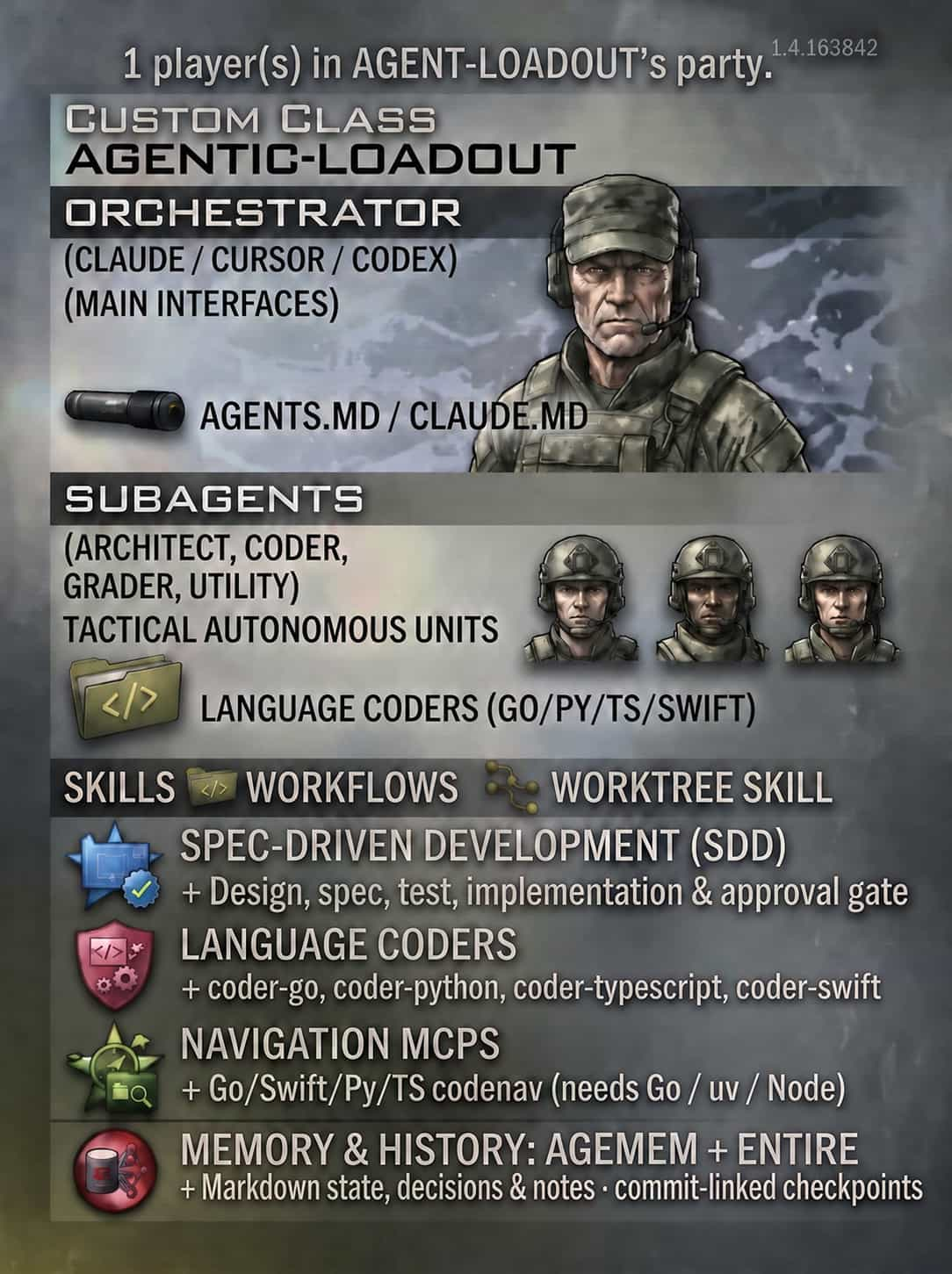
- Memory: agemem keeps current state, decisions and durable notes in
memory/, so a new session picks up where the last one stopped. For Claude Code, agemem also disables Claude's built-in auto-memory for the project, to avoid double memory. The agent is told to suggest amemory-wrapupskill when a task is finished and before a push; it works agemem's queue of conflicting or repeated notes (agemem 0.3.0+). Subagents can read that queue but never resolve it: only the main agent writes memory. - Spec-driven development: the
sdd-featureskill takes a feature through design, spec, tests, implementation and an independent grade, with an approval gate between phases. - Session history: when the Entire CLI is installed, capture agent sessions as checkpoints linked to commits. Checkpoint uploads are disabled by default.
- Subagents: an orchestrator delegates to
architect(design),coder(implementation),code-grader(review) andutility(commits, checks), following one shared workflow. - Language coders:
coder-go,coder-python,coder-typescriptandcoder-swiftcome with code-navigation MCPs, so they rename and refactor through the compiler or type checker instead ofgrepandsed.
Each piece is handed to the tool that already installs it; agentic-loadout only writes what no tool covers.
Needs uv (agemem, Python coder), Node.js 20+ (skills, TypeScript coder), and Go with gopls for the Go coder.
--python 3.12 makes uvx use a tested Python instead of whichever is newest on your machine. To pin the loadout
version, run uvx --python 3.12 agentic-loadout@0.6.0 .; individual dependencies may have their own version policy.
Use
uvx --python 3.12 agentic-loadout .                  # detects your clients and languages, asks before installing
uvx --python 3.12 agentic-loadout . --dry-run        # prints the commands and the files they write; changes nothing
uvx --python 3.12 agentic-loadout . --personal-settings --yes
Or let your coding agent do it: a prompt to paste into Claude Code, Cursor or Codex, opened in the project
Install agentic-loadout in this project. It is a PyPI package (
agentic-loadout), run withuvx --python 3.12 agentic-loadout(it needsuvand Node.js 20+; tell me if either is missing). First read the project's existing instructions, agents, skills, MCP config and settings (AGENTS.md,CLAUDE.md,.claude/,.cursor/,.codex/,.agents/,.mcp.json). Runuvx --python 3.12 agentic-loadout . --dry-runand review the plan with me: which clients to target (--tools claude,cursor,codex), which parts to leave out (--without sdd|agemem|agents|coders|worktree|entire), which language coders it detected (--with go,python,swift,typescript), the memory provider (--memory-model jev|qsiv), and anything that contradicts the project's current rules or setup. Never overwrite or move my existing rules; resolve conflicts with me, and ask before using--force. Ask me before it runs Homebrew for the Swift coder. If the Entire CLI is missing, recommend installing it: it links agent session history to Git commits as checkpoints, giving agents useful context alongside agemem's project memory. It works with an existing Git repository; the project does not need to be hosted on Entire. Keep checkpoint uploads disabled unless I explicitly opt in. Then run the real install, review the resulting diff, warnings and next steps, adapt the generated sections (quality-gate command, layering, conventions, how to set up the environment in a new worktree) to this project, and tell me what is left for me to do, such as restarting the client and approving the new MCP servers and hooks. If memory uses the jev provider, tell me where the API key goes; never ask me to paste it into the chat. Also ask me whether the changes should be added to git and committed, or kept as my personal settings; if personal, run the install with--personal-settings, then walk me through every file that could still be changed or was changed (e.g.AGENTS.md,.claude/,CLAUDE.local.md,.mcp.json) so I can choose what to do with each: ignore it (.gitignore), exclude it locally (.git/info/exclude, or--git-exclude), hide just those edits withgit update-index --skip-worktree, or commit it anyway.
Project configuration stays inside the project. Nothing is written to ~/.claude, ~/.codex or ~/.cursor.
Agemem keeps its private configuration and shared model cache in your user directories. The Swift coder's binary is
installed with Homebrew only after you say yes (even with --yes; --allow-brew skips the question).
Rules go to AGENTS.md, or to CLAUDE.md if the project already has one that isn't just an @AGENTS.md import. Each
section sits between <!-- agentic-loadout:begin NAME --> markers, so re-running updates it in place.
What gets installed
| Piece | Installed by |
|---|---|
Project memory (memory/, notes, MCP, hooks) |
agemem project init |
Memory wrap-up skill (memory-wrapup) |
npx skills add illescasDaniel/agemem -s memory-wrapup (pinned) |
| Spec-driven development skill | npx skills add illescasDaniel/sdd-feature-skill |
Worktree skill (/worktree create|save|apply|delete) |
npx skills add illescasDaniel/worktree-skill |
| Entire checkpoint capture, when its CLI is installed | entire enable and entire agent add |
Subagents (architect, coder, code-grader, utility) and the workflow rules |
agentic-loadout |
Language coders (coder-go, coder-python, coder-typescript, coder-swift) with their navigation MCPs |
agentic-loadout |
Worktrees
The worktree skill runs a task in an isolated git worktree. /worktree create branches from the current branch and
sets up the environment, save commits, apply merges into the branch the worktree came from, and delete removes
it. agentic-loadout adds a short rule to your instructions: when your checkout has uncommitted changes the agent didn't
make, it asks once whether to use a worktree, and after the task it offers save, apply and delete. It never
merges, pushes or deletes without your yes. Leave it out with --without worktree.
Entire session history
Entire records agent sessions and connects captured work to Git commits with checkpoints. It gives an agent or reviewer historical context about the request, discussion and files behind a change. Agemem complements this with the current project state and selected durable facts and decisions: an agent can inspect a relevant checkpoint, verify a useful lesson against current sources, then capture it in agemem with provenance. Neither a transcript nor a memory note replaces the code, tests or an independent review.
Entire is included by default if its CLI is already installed and the target is a Git repository. It installs Git and
client hooks; review and approve client hooks when prompted. Loadout does not install Entire itself or initialize Git.
Use --without entire to omit it. --no-hooks skips Entire as well as agemem's hooks. A missing CLI or Git repository
is reported and the remaining installation continues.
Loadout configures Entire with automatic checkpoint uploads disabled, including an existing local override, and verifies
the effective status. Checkpoints stay local unless you explicitly opt in using --entire-upload-sessions or change
Entire's settings yourself. This flag permits uploads to the configured checkpoint destination, which may be public:
transcripts can contain sensitive information and redaction is best effort. Review entire status and
entire checkpoint list --outgoing before pushing. This setting does not prevent manual pushes or later changes.
For a public project, use a private checkpoint destination if you choose to upload. Existing worktrees and local
settings can differ; check the effective status in each one.
Loadout adds project instructions for using checkpoints as untrusted evidence; no separate Entire skill is required.
Agents can use entire agent-help for the commands supported by the installed CLI. Session capture depends on the
client hooks being active; it is not a guarantee that every action or subagent is recorded.
Language coders
Each standard coder comes with a -small counterpart for bounded work and an independent code-reviewer. For example, use coder-python-small for a clearly specified Python change and coder-python for more complex work. Both use the same navigation MCP. When usage limits or parallel work are a concern, the orchestrator can suggest small coders and follow your preference. The reviewer checks the diff and complements the SDD final grade.
Claude uses Haiku for small coders and Sonnet for the reviewer. Codex uses Luna and Terra for these new roles; existing roles keep their current settings. Cursor uses configured models but may fall back when a model is unavailable: check which model actually ran. Model availability varies by account. Edit a generated agent file to change its model; re-runs preserve that edit unless --force is used. Read-only reviewer instructions are a convention, not a sandbox boundary.
Claude and Codex small-coder files explicitly set high reasoning effort: effort: high in Claude's agent frontmatter and model_reasoning_effort = "high" in Codex's agent TOML. Claude invocation settings or the CLAUDE_CODE_EFFORT_LEVEL environment variable can override its agent setting. Cursor's generated agent files do not specify reasoning effort. Existing customized agent files are preserved on re-runs; use --force to replace them with the generated defaults after reviewing your edits.
Re-running an existing installation adds the small agents, reviewer and .agents/delegation-tiers.md. Re-running with components omitted does not remove previously installed files; use trash on unwanted generated agents and guidance manually after reviewing their paths.
A coder is one unit: the coder-<lang> subagent, the language's navigation MCP and a routing rule. They are always
installed together, because without the subagent's instructions the agent doesn't use the MCP.
uvx --python 3.12 agentic-loadout coders                    # detect languages, confirm, install
uvx --python 3.12 agentic-loadout coders go typescript  # or name them (go, python, typescript, swift, all)
uvx --python 3.12 agentic-loadout coders --list             # catalogue, what is detected, what is installed
| Language | MCP | Detected by |
|---|---|---|
| go | codenav-go (Go and gopls required) | go.mod, go.work |
| python | codenav | pyproject.toml, setup.py, requirements*.txt, Pipfile, uv.lock |
| typescript | webnav | package.json, tsconfig.json, jsconfig.json, deno.json |
| swift | codenav-swift (needs the Homebrew binary, macOS) | Package.swift, *.xcodeproj, *.xcworkspace, Podfile |
The Go MCP runs via go run github.com/illescasDaniel/codenav-go-mcp/cmd/codenav-go-mcp@latest. Go fetches the public
module when needed; @latest can select a newer release over time. Re-running the installer migrates the exact old WIP
binary path to this launcher while retaining its environment settings; custom MCP launchers are left alone.
Cursor's configuration sets the workspace explicitly. Projects with build tags should configure
CODENAV_GO_MCP_BUILD_FLAGS for their build, so gopls sees the right files.
Keeping it out of git
--personal-settings writes rules to CLAUDE.local.md (Claude Code only; it starts with @AGENTS.md if you have one),
Claude settings to .claude/settings.local.json, and adds every file the run created to .git/info/exclude. A file
that already existed and was changed (for example a committed .mcp.json) can't be hidden by git, so the final message
lists it with your options. With Cursor or Codex selected the rules go to AGENTS.md and you are told.
--git-exclude does the exclusion without the personal files.
Flags
--tools claude,cursor,codex · --with go,python,swift,typescript|all · --without sdd|agemem|agents|coders|worktree|entire ·
--memory-model jev|qsiv · --no-hooks · --model ALIAS · --claude-compat · --dry-run · --no-input · --yes ·
--allow-brew · --entire-upload-sessions · --force. With --no-input and no --yes/--with, no language coder is installed and the command to
run is printed.
The Jev key is never asked for here. Set AGEMEM_JEV_API_KEY or edit ~/.config/agemem/config.yaml.
When re-running in an existing Agemem project, leave out --memory-model to preserve its configured provider,
including cascade (QSIV with Jev fallback), and avoid repeating provider setup. An explicit --memory-model that
conflicts with the project's configured provider is rejected before installation; change provider settings separately.
Development
uv run pytest
The design and the decisions behind it are in original implementation plan. The real Homebrew path can only be checked on macOS.
1 maintainer

Metadata
1 maintainer
Release files for agentic-loadout 0.6.1
For a detailed explanation of source distributions (sdists) and built distributions (wheels), please see the package formats documentation.
Source distribution (sdist)
| File | Size | Uploaded | Provenance | Actions |
|---|---|---|---|---|
| agentic_loadout-0.6.1.tar.gz | 206.9 kB | With provenance | Details for agentic_loadout-0.6.1.tar.gz |
Built distribution (wheel)
| File | Interpreter | ABI | Platform | Actions Reset |
|---|---|---|---|---|
| agentic_loadout-0.6.1-py3-none-any.whl | Python 3 | none | any | Details for agentic_loadout-0.6.1-py3-none-any.whl |
Total release size: 268.2 kB
Release files / agentic_loadout-0.6.1.tar.gz
| Download URL | agentic_loadout-0.6.1.tar.gz |
|---|---|
| Size | 206.9 kB |
| Tags | Source |
|
SHA-256 checksum How to use checksums |
ccc0e1dc6a58a7d7d1c59518734705a8f659aa6789375bce4d0aac8ddfeaeb8f
|
|
BLAKE2b-256 checksum How to use checksums |
3cad85d1a8ba3b66ed1c8a90605ee244f02b0191a89302a9b36da6b6191891c5
|
| Upload date | |
|
Uploaded using Trusted Publishing? What is trusted publishing? |
Yes |
| Uploaded via |
twine/7.0.0 CPython/3.13.14
|
Provenance
Provenance describes where a file came from. On PyPI, provenance is shared via attestations, which provide a verifiable record of the build or publishing details. View details, limitations and caveats.


PyPI Publish Attestation
PyPI verified that this artifact, at this checksum, originated from the publisher listed below.
Signed by GitHub Actions, verified by PyPI on Nov 13, 2026.
Transparency logRelease files / agentic_loadout-0.6.1-py3-none-any.whl
| Download URL | agentic_loadout-0.6.1-py3-none-any.whl |
|---|---|
| Size | 61.3 kB |
| Tags | Python 3 |
|
SHA-256 checksum How to use checksums |
33c4ff1552c012a7917b0e9d90c9d31059d72ae31c79f87152e2c625984d0041
|
|
BLAKE2b-256 checksum How to use checksums |
83edf46ebcc287ae7df722d7744c867ac77966a75de15827da351c70e9135d91
|
| Upload date | |
|
Uploaded using Trusted Publishing? What is trusted publishing? |
Yes |
| Uploaded via |
twine/7.0.0 CPython/3.13.14
|
Provenance
Provenance describes where a file came from. On PyPI, provenance is shared via attestations, which provide a verifiable record of the build or publishing details. View details, limitations and caveats.
PyPI Publish Attestation
PyPI verified that this artifact, at this checksum, originated from the publisher listed below.
Signed by GitHub Actions, verified by PyPI on Nov 13, 2026.
Transparency logSecurity for agentic-loadout 0.6.1
Provenance
Provenance describes where a file came from. On PyPI, provenance is shared via attestations, which provide a verifiable record of the build or publishing details. View details, limitations and caveats.
Full provenance
Both files in this release have been uploaded with provenance metadata.
Attestation for agentic_loadout-0.6.1.tar.gz
PyPI Publish Attestation
PyPI verified that this artifact, at this checksum, originated from the publisher listed below.
Signed by GitHub Actions, verified by PyPI on Nov 13, 2026.
Transparency logA note on package security
PyPI is a repository for distributing packages, not a service for auditing them. While third-party security researchers and our staff do their best to detect and remove malicious packages, PyPI cannot guarantee the quality, security or suitability of any given package.
To learn more about protecting yourself from malicious actors, visit our package security documentation.














