
A unified, scalable, production-ready multi-agent application development framework

Project description
AgenticX: Unified Multi-Agent Framework





Vision
AgenticX aims to create a unified, scalable, production-ready multi-agent application development framework, empowering developers to build everything from simple automation assistants to complex collaborative intelligent agent systems.
Core Features
Core Framework (Completed)
- Agent Core: Agent execution engine based on 12-Factor Agents methodology
- Orchestration Engine: Graph-based orchestration engine supporting complex workflows, conditional routing, and parallel execution
- Tool System: Unified tool interface supporting function decorators, remote tools (MCP), and built-in toolsets
- Memory System: Deep integration with Mem0 for long-term memory, supporting arbitrary LLM models
- Communication Protocol: A2A inter-agent communication, MCP resource access protocol
- Task Validation: Pydantic-based output parsing and auto-repair
- GUI Agent / Embodiment: Complete GUI automation framework with action reflection, stuck detection, action caching, REACT parsing, device-cloud routing, and DAG task verification
Enterprise-Grade Monitoring (Completed)
- Observability: Complete callback system, real-time monitoring, trajectory analysis
- Performance Monitoring: Real-time metrics collection, Prometheus integration, system monitoring
- Trajectory Analysis: Execution path tracing, failure analysis, performance bottleneck identification
- Data Export: Multi-format export (JSON/CSV/Prometheus), time series analysis
Developer Experience (Planned)
- CLI Tools: Command-line tools for project creation, deployment, and monitoring
- Web UI: Visual agent management and monitoring interface
- IDE Integration: VS Code extension, Jupyter kernel support
Enterprise Security (Planned)
- Security Sandbox: Secure code execution environment and resource isolation
- Multi-tenancy: RBAC permission control, data isolation
- Human Approval: Human-in-the-loop workflows, risk control
Quick Start
Installation
Option 1: Using uv (Recommended - Faster)
# Clone repository
git clone https://github.com/DemonDamon/AgenticX.git
cd AgenticX

# Install uv (if not already installed)
pip install uv

# Install in editable mode with all dependencies
uv pip install -e .

# Or install with locked dependencies (for reproducible builds)
uv pip install -r requirements.lock
uv pip install -e . --no-deps

# Install with optional dependencies
uv pip install -e ".[dev]"      # Include development tools
uv pip install -e ".[docs]"     # Include documentation tools
uv pip install -e ".[all]"      # Include all optional dependencies
Option 2: Using pip (Traditional)
# Clone repository
git clone https://github.com/DemonDamon/AgenticX.git
cd AgenticX

# Install in editable mode
pip install -e .

# Or install from requirements.txt
pip install -r requirements.txt
pip install -e . --no-deps

# Install with optional dependencies
pip install -e ".[dev]"      # Include development tools
pip install -e ".[docs]"     # Include documentation tools
pip install -e ".[all]"      # Include all optional dependencies
Environment Setup
# Set environment variables
export OPENAI_API_KEY="your-api-key"
export ANTHROPIC_API_KEY="your-api-key"  # Optional
Complete Installation Guide: For system dependencies (antiword, tesseract) and advanced document processing features, see INSTALL.md
Tip: Using
uvis 10-100x faster thanpipfor dependency resolution. Therequirements.lockfile ensures reproducible builds across different environments.
Create Your First Agent
from agenticx import Agent, Task, AgentExecutor
from agenticx.llms import OpenAIProvider

# Create agent
agent = Agent(
    id="data-analyst",
    name="Data Analyst",
    role="Data Analysis Expert",
    goal="Help users analyze and understand data",
    organization_id="my-org"
)

# Create task
task = Task(
    id="analysis-task",
    description="Analyze sales data trends",
    expected_output="Detailed analysis report"
)

# Configure LLM
llm = OpenAIProvider(model="gpt-4")

# Execute task
executor = AgentExecutor(agent=agent, llm=llm)
result = executor.run(task)
print(result)
Tool Usage Example
from agenticx.tools import tool

@tool
def calculate_sum(x: int, y: int) -> int:
    """Calculate the sum of two numbers"""
    return x + y

@tool
def search_web(query: str) -> str:
    """Search web information"""
    return f"Search results: {query}"

# Agents will automatically invoke these tools
Complete Examples
We provide rich examples demonstrating various framework capabilities:
Agent Core (M5)
Single Agent Example
# Basic agent usage
python examples/m5_agent_demo.py
- Demonstrates basic agent creation and execution
- Tool invocation and error handling
- Event-driven execution flow
Multi-Agent Collaboration
# Multi-agent collaboration example
python examples/m5_multi_agent_demo.py
- Multi-agent collaboration patterns
- Task distribution and result aggregation
- Inter-agent communication
Orchestration & Validation (M6 & M7)
Simple Workflow
# Basic workflow orchestration
python examples/m6_m7_simple_demo.py
- Workflow creation and execution
- Task output parsing and validation
- Conditional routing and error handling
Complex Workflow
# Complex workflow orchestration
python examples/m6_m7_comprehensive_demo.py
- Complex workflow graph structures
- Parallel execution and conditional branching
- Complete lifecycle management
Agent Communication (M8)
A2A Protocol Demo
# Inter-agent communication protocol
python examples/m8_a2a_demo.py
- Agent-to-Agent communication protocol
- Distributed agent systems
- Service discovery and skill invocation
Observability Monitoring (M9)
Complete Monitoring Demo
# Observability module demo
python examples/m9_observability_demo.py
- Real-time performance monitoring
- Execution trajectory analysis
- Failure analysis and recovery recommendations
- Data export and report generation
Memory System
Basic Memory Usage
# Memory system example
python examples/memory_example.py
- Long-term memory storage and retrieval
- Context memory management
Healthcare Scenario
# Healthcare memory scenario
python examples/mem0_healthcare_example.py
- Medical knowledge memory and application
- Personalized patient information management
Human-in-the-Loop
Human Intervention Flow
# Human-in-the-loop example
python examples/human_in_the_loop_example.py
- Human approval workflows
- Human-machine collaboration patterns
- Risk control mechanisms
Detailed documentation: examples/README_HITL.md
LLM Integration
Chatbot
# LLM chat example
python examples/llm_chat_example.py
- Multi-model support demonstration
- Streaming response handling
- Cost control and monitoring
Security Sandbox
Code Execution Sandbox
# Micro-sandbox example
python examples/microsandbox_example.py
- Secure code execution environment
- Resource limits and isolation
Technical blog: examples/microsandbox_blog.md
GUI Agent / Embodiment (M16)
GUI Automation Agent
# GUI Agent example
python examples/agenticx-for-guiagent/AgenticX-GUIAgent/main.py
- Complete GUI automation framework with human-aligned learning
- Action reflection (A/B/C classification) and stuck detection
- Action caching system for performance optimization
- REACT output parsing and compact action schema
- Device-Cloud routing for intelligent model selection
- DAG-based task verification
Key capabilities:
- Action Reflection: Automatic action result classification (success/wrong_state/no_change)
- Stuck Detection: Continuous failure detection and recovery strategy recommendation
- Action Caching: Trajectory caching with exact and fuzzy matching (up to 9x speedup)
- REACT Parsing: Standardized REACT format output parsing
- Smart Routing: Dynamic device-cloud model selection based on task complexity and sensitivity
- DAG Verification: Multi-path task verification with dual-semantic dependencies
See: examples/agenticx-for-guiagent/
Technical Architecture
graph TD
    subgraph "User Interface Layer"
        SDK[Python SDK]
        CLI[CLI Tools]
        UI[Web UI]
    end

    subgraph "Core Framework Layer"
        subgraph "Orchestration Engine"
            Orchestrator[Workflow Orchestrator]
        end
        subgraph "Execution Engine"
            AgentExecutor[Agent Executor]
            TaskValidator[Task Validator]
        end
        subgraph "Core Components"
            Agent[Agent]
            Task[Task]
            Tool[Tool]
            Memory[Memory]
            LLM[LLM Provider]
        end
    end

    subgraph "Platform Services Layer"
        subgraph "Observability"
            Monitoring[Monitoring System]
        end
        subgraph "Communication Protocols"
            Protocols[Protocol Handler]
        end
        subgraph "Security Governance"
            Security[Security Service]
        end
    end

    SDK --> Orchestrator
    Orchestrator --> AgentExecutor
    AgentExecutor --> Agent
    Agent --> Tool
    Agent --> Memory
    Agent --> LLM
    AgentExecutor --> Monitoring
    Agent --> Protocols
Development Progress
✅ Completed Modules (M1-M9, M16)
| Module | Status | Description |
|---|---|---|
| M1 | ✅ | Core Abstraction Layer - Basic data structures like Agent, Task, Tool, Workflow |
| M2 | ✅ | LLM Service Layer - Unified LLM interface based on LiteLLM, supporting 100+ models |
| M3 | ✅ | Tool System - Function decorators, MCP remote tools, built-in toolsets |
| M4 | ✅ | Memory System - Deep integration with Mem0, supporting custom LLM |
| M5 | ✅ | Agent Core - Complete think-act loop, event-driven architecture |
| M6 | ✅ | Task Validation - Pydantic-based output parsing and auto-repair |
| M7 | ✅ | Orchestration Engine - Graph-based workflows, conditional routing, parallel execution |
| M8 | ✅ | Communication Protocols - A2A agent communication, MCP resource access |
| M9 | ✅ | Observability - Complete monitoring, trajectory analysis, performance metrics |
| M16 | ✅ | Embodiment Module - GUI Agent framework with action reflection, stuck detection, action caching, REACT output parsing, device-cloud routing, and DAG task verification |
Planned Modules (M10-M13)
| Module | Status | Description |
|---|---|---|
| M10 | 🚧 | Developer Experience - CLI, Web UI, IDE integration |
| M11 | 🚧 | Enterprise Security - Multi-tenancy, RBAC, security sandbox |
| M12 | 🚧 | Agent Evolution - Architecture search, knowledge distillation |
| M13 | 🚧 | Knowledge Hub - Enterprise data connection, unified search |
Core Advantages
- Unified Abstraction: Clear and consistent core abstractions, avoiding conceptual confusion
- Pluggable Architecture: All components are replaceable, avoiding vendor lock-in
- Enterprise-Grade Monitoring: Complete observability, production-ready
- Security First: Built-in security mechanisms and multi-tenant support
- High Performance: Optimized execution engine and concurrent processing
- Rich Ecosystem: Complete toolset and example library
System Requirements
- Python: 3.10+
- Memory: 4GB+ RAM recommended
- System: Windows / Linux / macOS
- Dependencies: See
requirements.txt
Contributing
We welcome community contributions! Please refer to:
- Submit Issues to report bugs or request features
- Fork the project and create feature branches
- Submit Pull Requests, ensuring all tests pass
- Participate in code reviews and discussions
License
This project is licensed under the GNU Affero General Public License v3.0 (AGPL-3.0) - see LICENSE file for details
Star History
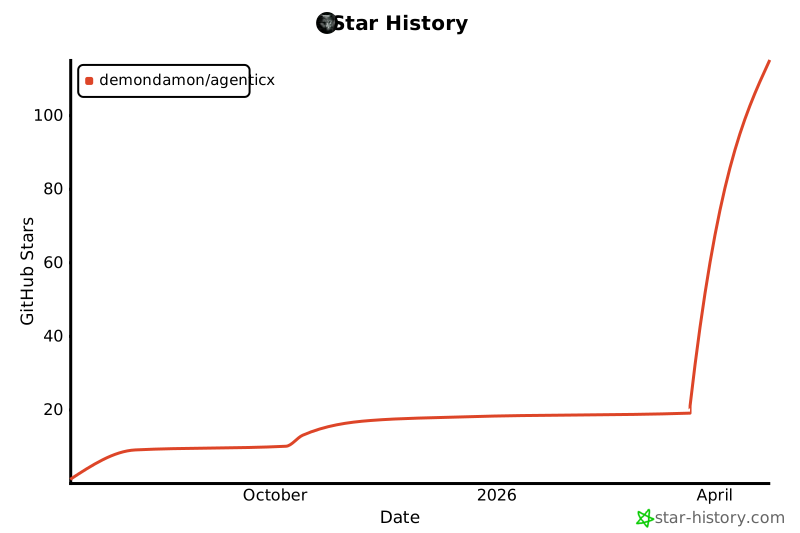
If AgenticX helps you, please give us a Star!
Release history Release notifications | RSS feed


Download files
Download the file for your platform. If you're not sure which to choose, learn more about installing packages.
Source Distribution
Built Distribution
Filter files by name, interpreter, ABI, and platform.
If you're not sure about the file name format, learn more about wheel file names.
Copy a direct link to the current filters
File details
Details for the file agenticx-0.2.1.tar.gz.
File metadata
- Download URL: agenticx-0.2.1.tar.gz
- Upload date:
- Size: 1.1 MB
- Tags: Source
- Uploaded using Trusted Publishing? No
- Uploaded via: twine/6.1.0 CPython/3.13.1
File hashes
| Algorithm | Hash digest | |
|---|---|---|
| SHA256 |
90442a1576cc0bd9ebf67b6bb0f4938ef359ebd9a3395d68a85cc4d75f32ad4f
|
|
| MD5 |
38dc04b5b107ef542cb1e4cd046899f1
|
|
| BLAKE2b-256 |
49aab825f83b9529f806d63bd72ee9646d7c176a9217ee143f429b583d238b67
|
File details
Details for the file agenticx-0.2.1-py3-none-any.whl.
File metadata
- Download URL: agenticx-0.2.1-py3-none-any.whl
- Upload date:
- Size: 1.4 MB
- Tags: Python 3
- Uploaded using Trusted Publishing? No
- Uploaded via: twine/6.1.0 CPython/3.13.1
File hashes
| Algorithm | Hash digest | |
|---|---|---|
| SHA256 |
bf0e59337c7f9eea3ec781c85afade58bec16c2a2946965f40cd31f745b013f7
|
|
| MD5 |
fe657cb549f7697d9cf2b635232e1471
|
|
| BLAKE2b-256 |
3aec39a1067f10d018f9ffb1b590ed9fc14117631e5eea222ede9fbf5fbc2d72
|






