
🤖 Agentman: A tool for building and managing AI agents





Agentman is a powerful Docker-like tool for building, managing, and deploying AI agents using the Model Context Protocol (MCP). With its intuitive Agentfile syntax, you can define complex multi-agent workflows and deploy them as containerized applications with a single command.
Get Started
Install the agentman package and start building AI agents in minutes:
pip install agentman-mcp                    # Install agentman
agentman build .                            # Build agent from Agentfile
agentman run --from-agentfile -t my-agent . # Build and run agent
🧠 Framework Support
Agentman supports two powerful AI agent frameworks:
FastAgent (Default)
- Decorator-based approach with
@fast.agent()and@fast.chain() - MCP-first design with seamless tool integration
- Production-ready with comprehensive logging and monitoring
- Configuration: Uses
fastagent.config.yamlandfastagent.secrets.yaml
Agno
- Class-based approach with
Agent()andTeam() - Multi-model support for OpenAI, Anthropic, and more
- Rich tool ecosystem with built-in integrations
- Configuration: Uses environment variables via
.envfile
Switch between frameworks:
FRAMEWORK fast-agent  # Default
FRAMEWORK agno        # Alternative framework
Prerequisites
- Python 3.10+ installed on your system
- Docker installed and running
- Basic understanding of AI agents and MCP concepts
Your First Agent
Create a URL-to-social-media content pipeline in under 5 minutes:
1. Create a new directory:
mkdir my-first-agent && cd my-first-agent
2. Create an Agentfile:
FROM yeahdongcn/agentman-base:latest
MODEL generic.qwen3:latest

SECRET GENERIC
API_KEY ollama
BASE_URL http://host.docker.internal:11434/v1

MCP_SERVER fetch
COMMAND uvx
ARGS mcp-server-fetch
TRANSPORT stdio

AGENT url_fetcher
INSTRUCTION Given a URL, provide a complete and comprehensive summary
SERVERS fetch

AGENT social_media
INSTRUCTION Write a 280 character social media post for any given text. Respond only with the post, never use hashtags.

CHAIN post_writer
SEQUENCE url_fetcher social_media

CMD ["python", "agent.py"]
3. Build and run:
agentman run --from-agentfile -t my-first-agent .
4. Test your agent by providing a URL when prompted!
Adding Default Prompts
Make your agent start automatically with predefined tasks:
echo "Fetch and summarize https://github.com/yeahdongcn/agentman and create a social media post about it." > prompt.txt
agentman run --from-agentfile -t my-agent-with-prompt .
Your agent will now automatically execute this prompt on startup! 🎉
Overview
agentman enables you to create and deploy sophisticated AI agents and workflows in minutes. It is the first Docker-like framework with complete end-to-end MCP (Model Context Protocol) support, bringing familiar containerization concepts to AI agent development.
The simple declarative Agentfile syntax lets you concentrate on composing your prompts and MCP servers to build effective agents, while Agentman handles the complex orchestration, containerization, and deployment automatically.
Key Capabilities
- 🐳 Docker-compatible Interface: Familiar
buildandruncommands with container-like semantics - 📝 Declarative Configuration: Define agents, workflows, and dependencies in simple
Agentfileformat - 🔗 Multi-Agent Orchestration: Support for chains, routers, parallel execution, and complex workflows
- 🔌 Native MCP Integration: Built-in support for Model Context Protocol servers with zero configuration
- 📄 Intelligent Prompt Loading: Automatically detect and load default prompts from
prompt.txtfiles - 🚀 Production-Ready Deployment: Generate optimized Docker containers with all dependencies
- 🔐 Secure Secrets Management: Environment-based secret handling with templating support
- 🧪 Comprehensive Testing: 91%+ test coverage ensuring reliability and maintainability
Agent Application Development
Prompts and configurations that define your Agent Applications are stored in simple files, with minimal boilerplate, enabling simple management and version control.
Chat with individual Agents and Components before, during and after workflow execution to tune and diagnose your application. Agents can request human input to get additional context for task completion.
Simple model selection makes testing Model <-> MCP Server interaction painless.
🚀 Quick Demo
Want to see Agentman in action? Watch our demonstration:
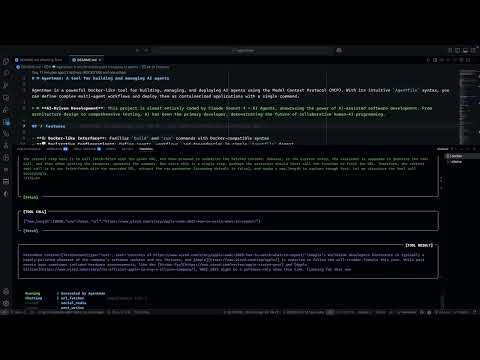
What you'll see:
- Creating an
Agentfilewith multi-agent workflow - Building and running the agent with one command
- Real-time agent execution with URL fetching and social media post generation
📖 Detailed Usage
Building Agents
Build agent applications from an Agentfile using Docker-like syntax:
# Build in current directory
agentman build .

# Build with custom Agentfile and output directory
agentman build -f MyAgentfile -o my-output .

# Build and create Docker image
agentman build --build-docker -t my-agent:v1.0 .
Generated files include:
agent.py- Main agent application with runtime logicfastagent.config.yaml- FastAgent configuration and workflow definitionsfastagent.secrets.yaml- Secrets template for environment variablesDockerfile- Optimized container definition with multi-stage buildsrequirements.txt- Python dependencies (auto-generated from MCP servers).dockerignore- Docker build optimization (excludes unnecessary files)prompt.txt- Default prompt file (copied if exists in source directory)
Running Agents
Deploy and run agent containers with flexible options:
# Run existing image
agentman run my-agent:latest

# Build from Agentfile and run (recommended for development)
agentman run --from-agentfile --path ./my-project

# Interactive mode with port forwarding
agentman run -it -p 8080:8080 my-agent:latest

# Auto-remove container when done
agentman run --rm my-agent:latest
🏗️ Agentfile Reference
The Agentfile uses a Docker-like syntax to define your agent applications. Here's a comprehensive reference:
Base Configuration
FROM yeahdongcn/agentman-base:latest   # Base image
FRAMEWORK fast-agent                   # AI framework (fast-agent or agno)
MODEL anthropic/claude-3-sonnet        # Default model for agents
EXPOSE 8080                            # Expose ports
CMD ["python", "agent.py"]             # Container startup command
Framework Configuration
Choose between supported AI agent frameworks:
FRAMEWORK fast-agent  # Default: FastAgent framework
FRAMEWORK agno        # Alternative: Agno framework
Framework Differences:
| Feature | FastAgent | Agno |
|---|---|---|
| API Style | Decorator-based (@fast.agent()) |
Class-based (Agent()) |
| Configuration | YAML files | Environment variables |
| Model Support | MCP-optimized models | Multi-provider support |
| Tool Integration | MCP-first | Rich ecosystem |
| Use Case | Production MCP workflows | Research & experimentation |
MCP Servers
Define external MCP servers that provide tools and capabilities:
MCP_SERVER filesystem
COMMAND uvx
ARGS mcp-server-filesystem
TRANSPORT stdio
ENV PATH_PREFIX /app/data
Agent Definitions
Create individual agents with specific roles and capabilities:
AGENT assistant
INSTRUCTION You are a helpful AI assistant specialized in data analysis
SERVERS filesystem brave
MODEL anthropic/claude-3-sonnet
USE_HISTORY true
HUMAN_INPUT false
Workflow Orchestration
Chains (Sequential processing):
CHAIN data_pipeline
SEQUENCE data_loader data_processor data_exporter
CUMULATIVE true
Routers (Conditional routing):
ROUTER query_router
AGENTS sql_agent api_agent file_agent
INSTRUCTION Route queries based on data source type
Orchestrators (Complex coordination):
ORCHESTRATOR project_manager
AGENTS developer tester deployer
PLAN_TYPE iterative
PLAN_ITERATIONS 5
HUMAN_INPUT true
Secrets Management
Secure handling of API keys and sensitive configuration:
# Environment variable references
SECRET OPENAI_API_KEY
SECRET ANTHROPIC_API_KEY

# Inline values (for development only)
SECRET DATABASE_URL postgresql://localhost:5432/mydb

# Grouped secrets with multiple values
SECRET CUSTOM_API
API_KEY your_key_here
BASE_URL https://api.example.com
TIMEOUT 30
Default Prompt Support
Agentman automatically detects and integrates prompt.txt files, providing zero-configuration default prompts for your agents.
🌟 Key Features
- 🔍 Automatic Detection: Simply place a
prompt.txtfile in your project root - 🐳 Docker Integration: Automatically copied into containers during build
- 🔄 Runtime Loading: Agent checks for and loads prompt content at startup
- ⚡ Zero Configuration: No Agentfile modifications required
📋 How It Works
- Build Time: Agentman scans your project directory for
prompt.txt - Container Build: If found, the file is automatically copied to the Docker image
- Runtime: Generated agent checks for the file and loads its content
- Execution: Prompt content is passed to
await agent(prompt_content)at startup
📁 Project Structure Example
my-agent/
├── Agentfile                # Agent configuration
├── prompt.txt              # ← Your default prompt (auto-loaded)
└── agent/                  # ← Generated output directory
    ├── agent.py            #   Generated agent with prompt loading logic
    ├── prompt.txt          #   ← Copied during build process
    ├── Dockerfile          #   Contains COPY prompt.txt instruction
    └── requirements.txt    #   Python dependencies
💡 Example Prompts
Task-Specific Prompt:
Analyze the latest GitHub releases for security vulnerabilities and generate a summary report.
User-Specific Prompt:
I am a GitHub user with the username "yeahdongcn" and I need help updating my GitHub profile information.
Complex Workflow Prompt:
Process the following workflow:
1. Clone the repository https://github.com/ollama/ollama
2. Checkout the latest release tag
3. Analyze the changelog for breaking changes
4. Generate a migration guide
🛠️ Generated Logic
When prompt.txt exists, Agentman automatically generates this logic in your agent.py:
import os

# Check for default prompt file
prompt_file = "prompt.txt"
if os.path.exists(prompt_file):
    with open(prompt_file, 'r', encoding='utf-8') as f:
        prompt_content = f.read().strip()
    if prompt_content:
        await agent(prompt_content)
This ensures your agent automatically executes the default prompt when the container starts.
🎯 Example Projects
1. GitHub Profile Manager (with Default Prompt)
A comprehensive GitHub profile management agent that automatically loads a default prompt.
Project Structure:
github-profile-manager/
├── Agentfile
├── prompt.txt          # Default prompt automatically loaded
└── agent/              # Generated files
    ├── agent.py
    ├── prompt.txt      # Copied during build
    └── ...
prompt.txt:
I am a GitHub user with the username "yeahdongcn" and I need help updating my GitHub profile information.
Key Features:
- Multi-agent chain for profile data collection, generation, and updating
- Automatic prompt loading from
prompt.txt - Integration with GitHub MCP server and fetch capabilities
2. GitHub Repository Maintainer
A specialized agent for maintaining GitHub repositories with automated release management.
Project Structure:
github-maintainer/
├── Agentfile
├── prompt.txt          # Default task: "Clone https://github.com/ollama/ollama and checkout the latest release tag."
└── agent/              # Generated files
Key Features:
- Release checking and validation
- Repository cloning and management
- Automated maintenance workflows
3. URL-to-Social Content Pipeline
A simple yet powerful content processing chain for social media.
Project Structure:
chain-ollama/
├── Agentfile
└── agent/              # Generated files
Key Features:
- URL content fetching and summarization
- Social media post generation (280 characters, no hashtags)
- Sequential agent chain processing
4. Advanced Multi-Agent System
Example of a more complex multi-agent system with routers and orchestrators:
FROM yeahdongcn/agentman-base:latest
MODEL anthropic/claude-3-sonnet

MCP_SERVER database
COMMAND uvx
ARGS mcp-server-postgres

AGENT classifier
INSTRUCTION Classify customer inquiries by type and urgency
SERVERS database

AGENT support_agent
INSTRUCTION Provide helpful customer support responses
SERVERS database

AGENT escalation_agent
INSTRUCTION Handle complex issues requiring human intervention
HUMAN_INPUT true

ROUTER support_router
AGENTS support_agent escalation_agent
INSTRUCTION Route based on inquiry complexity and urgency
🔧 Advanced Configuration
Custom Base Images
FROM python:3.11-slim
MODEL openai/gpt-4

# Your custom setup...
RUN apt-get update && apt-get install -y curl

AGENT custom_agent
INSTRUCTION Specialized agent with custom environment
Environment Variables
MCP_SERVER api_server
COMMAND python
ARGS -m my_custom_server
ENV API_TIMEOUT 30
ENV RETRY_COUNT 3
ENV DEBUG_MODE false
Multi-Model Setup
AGENT fast_responder
MODEL anthropic/claude-3-haiku
INSTRUCTION Handle quick queries

AGENT deep_thinker
MODEL anthropic/claude-3-opus
INSTRUCTION Handle complex analysis tasks
📁 Project Structure
agentman/
├── src/agentman/           # Core source code
│   ├── __init__.py
│   ├── cli.py             # Command-line interface
│   ├── agent_builder.py   # Agent building logic
│   ├── agentfile_parser.py # Agentfile parsing
│   └── common.py          # Shared utilities
├── examples/              # Example projects
│   ├── github-profile-manager/
│   ├── github-maintainer/
│   ├── chain-ollama/
│   └── chain-aliyun/
├── tests/                 # Comprehensive test suite
├── docker/               # Docker base images
└── README.md             # This file
🏗️ Building from Source
git clone https://github.com/yeahdongcn/agentman.git
cd agentman

# Install
make install
🧪 Testing
Agentman includes comprehensive test suites with high coverage:
# Run all tests
make test

# Run tests with coverage
make test-cov
Test Coverage
- 91%+ overall coverage across core modules
- Agent Builder: Comprehensive tests for agent generation and Docker integration
- Agentfile Parser: Complete syntax parsing and validation tests
- Prompt.txt Support: Full coverage of automatic prompt detection and loading
- Dockerfile Generation: Tests for container build optimization
🤝 Contributing
We welcome contributions! This project serves as a showcase of AI-driven development, being almost entirely coded by Claude Sonnet 4 + AI Agents. This demonstrates how AI can handle complex software development tasks including architecture design, implementation, testing, and documentation.
Development Workflow
- Fork and clone the repository
- Create a feature branch from
main - Write tests for new functionality (AI-generated tests achieve 91%+ coverage)
- Ensure tests pass with
make test - Format code with
make format - Submit a pull request with clear description
Areas for Contribution
- 🔌 New MCP server integrations
- 🤖 Additional agent workflow patterns
- 📚 Documentation and examples
- 🧪 Test coverage improvements
- 🐛 Bug fixes and optimizations
📋 System Requirements
- Python: 3.10+ (supports 3.10, 3.11, 3.12, 3.13)
- Docker: Required for containerization and running agents
- Operating System: Unix-like systems (Linux, macOS, WSL2)
- Memory: 2GB+ RAM recommended for multi-agent workflows
- Storage: 1GB+ available space for base images and dependencies
📄 License
MIT License - see LICENSE for details.
🙏 Acknowledgments
- 🤖 AI-Powered Development: This project showcases the future of software development - almost entirely coded by Claude Sonnet 4 + AI Agents, demonstrating how AI can handle complex architecture design, implementation, comprehensive testing, and documentation
- 🏗️ Built on FastAgent: Agentman leverages the fast-agent framework as its foundation, providing robust agent infrastructure and seamless MCP integration
- 🐳 Inspired by Podman: Just as Podman provides a Docker-compatible interface for containers, Agentman brings familiar containerization concepts to AI agent management
- 🧪 Test-Driven Excellence: Achieved 91%+ test coverage through AI-driven test generation, ensuring reliability and maintainability
- 🌟 Community-Driven: Built with the vision of making AI agent development accessible to everyone
🚀 Ready to revolutionize your AI workflows?
Get Started • View Examples • Contribute
Join thousands of developers building the future with AI agents ✨


1 maintainer

Metadata
1 maintainer
Release files for agentman-mcp 0.1.6
For a detailed explanation of source distributions (sdists) and built distributions (wheels), please see the package formats documentation.
Source distribution (sdist)
| File | Size | Uploaded | |
|---|---|---|---|
| agentman_mcp-0.1.6.tar.gz | 47.3 kB | Details |
Built distribution (wheel)
| File | Interpreter | ABI | Platform | Reset |
|---|---|---|---|---|
| agentman_mcp-0.1.6-py3-none-any.whl | Python 3 | none | any | Details |
Total release size: 76.1 kB
Release files / agentman_mcp-0.1.6.tar.gz
| Download URL | agentman_mcp-0.1.6.tar.gz |
|---|---|
| Size | 47.3 kB |
| Tags | Source |
|
SHA-256 checksum How to use checksums |
4a819e70931612ff99116beb7422013d609454730d742bb9c69f79dec5caa9e8
|
|
BLAKE2b-256 checksum How to use checksums |
99505f2b2b04d4de1479d311afbd970391c79aae3464240b17674dd828021458
|
| Upload date | |
|
Uploaded using Trusted Publishing? What is trusted publishing? |
No |
| Uploaded via |
twine/6.1.0 CPython/3.13.3
|
Release files / agentman_mcp-0.1.6-py3-none-any.whl
| Download URL | agentman_mcp-0.1.6-py3-none-any.whl |
|---|---|
| Size | 28.8 kB |
| Tags | Python 3 |
|
SHA-256 checksum How to use checksums |
5d5fd898af20eac4f1f3fbbeaa225495e3bbc50417af58cc201760f6201f00a6
|
|
BLAKE2b-256 checksum How to use checksums |
06928b5b6f07fd3f1367866ff7c3ffaccd45438c5a985b255c9ce047678f840d
|
| Upload date | |
|
Uploaded using Trusted Publishing? What is trusted publishing? |
No |
| Uploaded via |
twine/6.1.0 CPython/3.13.3
|














