
Agentomics
NEWS:
- Agentomics to be presented at ISMB 2026
- Agentomics has been published in Bioinformatics journal link to published paper
- Agentomics now supports any data type and supplementary material
Autonomous agentic system for supervised machine learning model development.
Made for biomedical data, Agentomics outperformed human experts and created new state-of-the-art models for problems in Protein Engineering, Drug Discovery, and Regulatory Genomics.
How it works
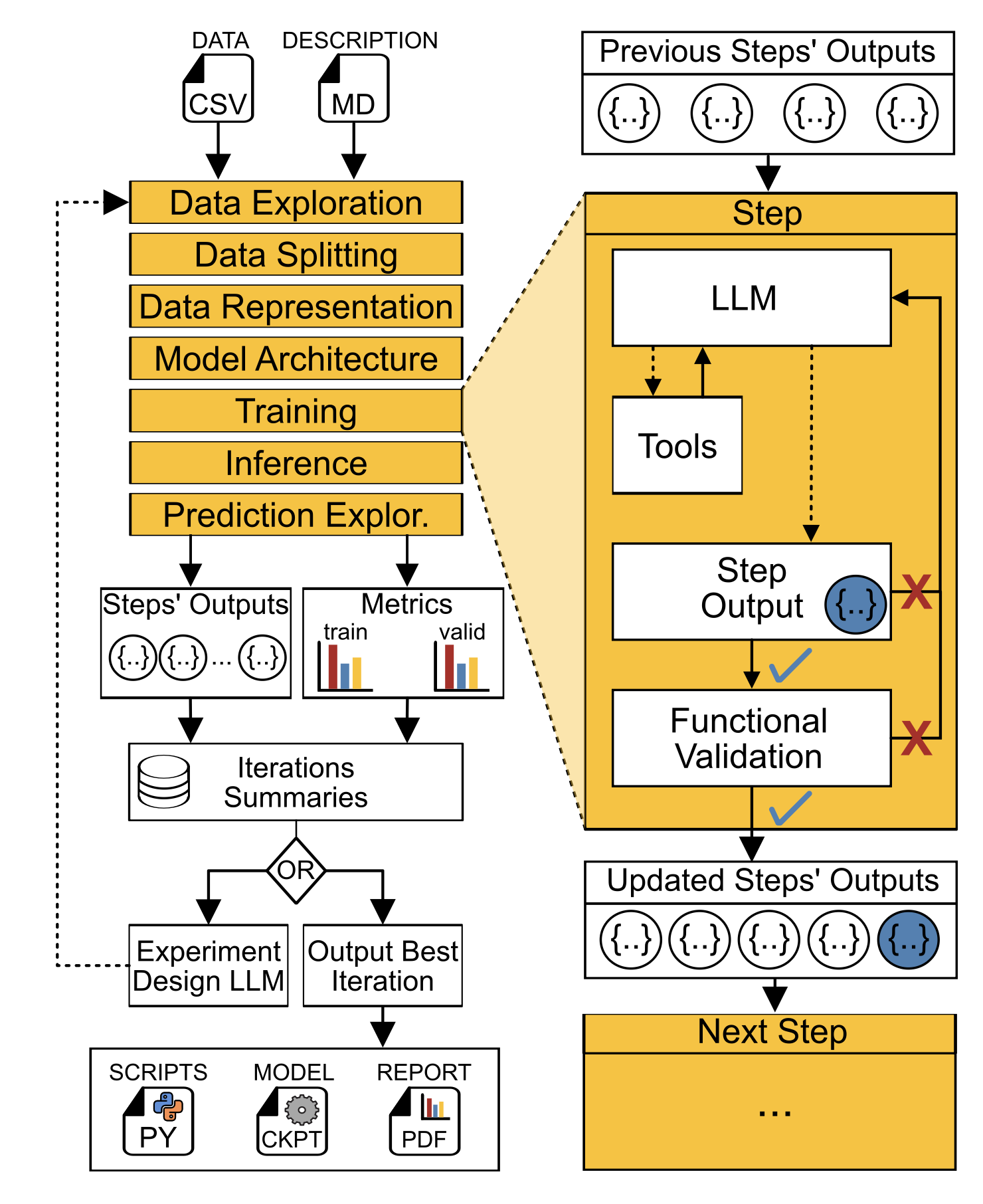
- Input is a folder-based dataset split + optional data description
- Agentomics autonomously experiments with various ML models and strategies
- Output is a trained model ready for inference and a detailed PDF report summarizing the development process and achieved metrics
For more details see: link to published paper
Quick Start
Install Docker, then:
pip install agentomics
Set at least one supported provider credential. For example: OPENROUTER_API_KEY or OPENAI_API_KEY or ANTHROPIC_API_KEY
export OPENROUTER_API_KEY=...
Download an example dataset into ./datasets
To see all available examples add the --list option
agentomics-download-dataset
Start an Agentomics run and follow instructions
agentomics-run
Recommended model: gpt-5.1-codex-max
Outputs are saved to outputs/<agent_id>/, including PDF reports in outputs/<agent_id>/reports/pdf.
See Installation, Datasets, CLI Options, and Running Inference for details.
API Calls
Agentomics can be run via:
- your local Codex subscription via
codex login - a supported provider API key such as OpenRouter, OpenAI, Anthropic, or a configured OpenAI-compatible provider
- local Ollama models for offline/private runs
Documentation
For more details visit https://biogemt.github.io/agentomics-ml/
Key Features
- Generic: Agentomics can use folder-based inputs for classification and regression tasks.
- Secure: Agents execute code securely in Docker with read-only mounts to your file system and are only allowed to write in a Docker Volume.
- Reproducible: Outputs include models, scripts, and conda environments needed to run inference or re-train models with one bash command.
- Trustworthy: If you provide a test set, Agentomics fully abstracts LLMs from accessing it, allowing you to rely on programmaticly computed and reported test set metrics.
- Various LLM providers: OpenAI, OpenRouter, or local models via Ollama
- Reliability: Thanks to our functional validators, Agentomics creates a working model 100% of the time (when using recommended settings).
- Supplementary materials: Give the agent dataset-specific papers, helper scripts, and foundation-model guidance. See the supplementary materials documentation.
Run Output Structure Example
Each completed run is written to outputs/<agent_id>/. The key paths are:
outputs/<agent_id>/
├── best_iteration_snapshot/
│   ├── model_training/
│   │   ├── train.py
│   │   └── training_artifacts/
│   ├── model_inference/
│   │   └── inference.py
│   └── runtime_info/
│       └── environment.yml
├── run/
│   ├── shared/
│   │   ├── config.json
│   │   └── splits/
│   └── iteration_*/
└── reports/
    ├── markdown/
    └── pdf/
Use best_iteration_snapshot/ for inference or re-training. run/ keeps the
full iterative workspace, and reports/ contains the human-readable summaries.
Roadmap
Agentomics is in active development. We welcome any raised Issues and suggestions. You can also Email Us.
Features coming soon:
- Better local model support and configuration
- Remote GPU support for GCP
Citation
If you use Agentomics in your work, please cite:
Martinek et al. (2026). Agentomics: An Agentic System that Autonomously Develops Novel State-of-the-Art Solutions for Biomedical Machine Learning Tasks. Bioinformatics (https://doi.org/10.1093/bioinformatics/btag250)
License
MIT. See LICENSE.
1 maintainer

Metadata
1 maintainer
Release files for agentomics 1.2.0
For a detailed explanation of source distributions (sdists) and built distributions (wheels), please see the package formats documentation.
Source distribution (sdist)
| File | Size | Uploaded | Provenance | Actions |
|---|---|---|---|---|
| agentomics-1.2.0.tar.gz | 78.9 kB | With provenance | Details for agentomics-1.2.0.tar.gz |
Built distribution (wheel)
| File | Interpreter | ABI | Platform | Actions Reset |
|---|---|---|---|---|
| agentomics-1.2.0-py3-none-any.whl | Python 3 | none | any | Details for agentomics-1.2.0-py3-none-any.whl |
Total release size: 181.1 kB
Release files / agentomics-1.2.0.tar.gz
| Download URL | agentomics-1.2.0.tar.gz |
|---|---|
| Size | 78.9 kB |
| Tags | Source |
|
SHA-256 checksum How to use checksums |
dc65846d0bb45126a28d6b858bc4181fa1d8467ac40c02402c727ec450c13cd6
|
|
BLAKE2b-256 checksum How to use checksums |
623323bd1e07538074eb8c5b7c9bef9c56f15256cd1558d60eb3422f9208e2a2
|
| Upload date | |
|
Uploaded using Trusted Publishing? What is trusted publishing? |
Yes |
| Uploaded via |
twine/7.0.0 CPython/3.13.14
|
Provenance
Provenance describes where a file came from. On PyPI, provenance is shared via attestations, which provide a verifiable record of the build or publishing details. View details, limitations and caveats.


PyPI Publish Attestation
PyPI verified that this artifact, at this checksum, originated from the publisher listed below.
Signed by GitHub Actions, verified by PyPI on Oct 20, 2026.
Transparency logRelease files / agentomics-1.2.0-py3-none-any.whl
| Download URL | agentomics-1.2.0-py3-none-any.whl |
|---|---|
| Size | 102.2 kB |
| Tags | Python 3 |
|
SHA-256 checksum How to use checksums |
977f6a1f637a9c7b7ccd1e7f640407c5fd75ca3c65374ddb4631a01923941c06
|
|
BLAKE2b-256 checksum How to use checksums |
df1dea9f98c0ff1913f08a81d64132ac1a84033a5ad57c2a7a566cac67fe2d72
|
| Upload date | |
|
Uploaded using Trusted Publishing? What is trusted publishing? |
Yes |
| Uploaded via |
twine/7.0.0 CPython/3.13.14
|
Provenance
Provenance describes where a file came from. On PyPI, provenance is shared via attestations, which provide a verifiable record of the build or publishing details. View details, limitations and caveats.
PyPI Publish Attestation
PyPI verified that this artifact, at this checksum, originated from the publisher listed below.
Signed by GitHub Actions, verified by PyPI on Oct 20, 2026.
Transparency logSecurity for agentomics 1.2.0
Provenance
Provenance describes where a file came from. On PyPI, provenance is shared via attestations, which provide a verifiable record of the build or publishing details. View details, limitations and caveats.
Full provenance
Both files in this release have been uploaded with provenance metadata.
Attestation for agentomics-1.2.0.tar.gz
PyPI Publish Attestation
PyPI verified that this artifact, at this checksum, originated from the publisher listed below.
Signed by GitHub Actions, verified by PyPI on Oct 20, 2026.
Transparency logA note on package security
PyPI is a repository for distributing packages, not a service for auditing them. While third-party security researchers and our staff do their best to detect and remove malicious packages, PyPI cannot guarantee the quality, security or suitability of any given package.
To learn more about protecting yourself from malicious actors, visit our package security documentation.














