
Local-first visual debugger for multi-agent AI systems

Project description
agentradar
Local-first visual debugger for multi-agent AI systems.

Drop one import into any Python AI pipeline and get a live dashboard - graph, tokens, time travel, failures - no cloud, no setup.
Demo

Dashboard views
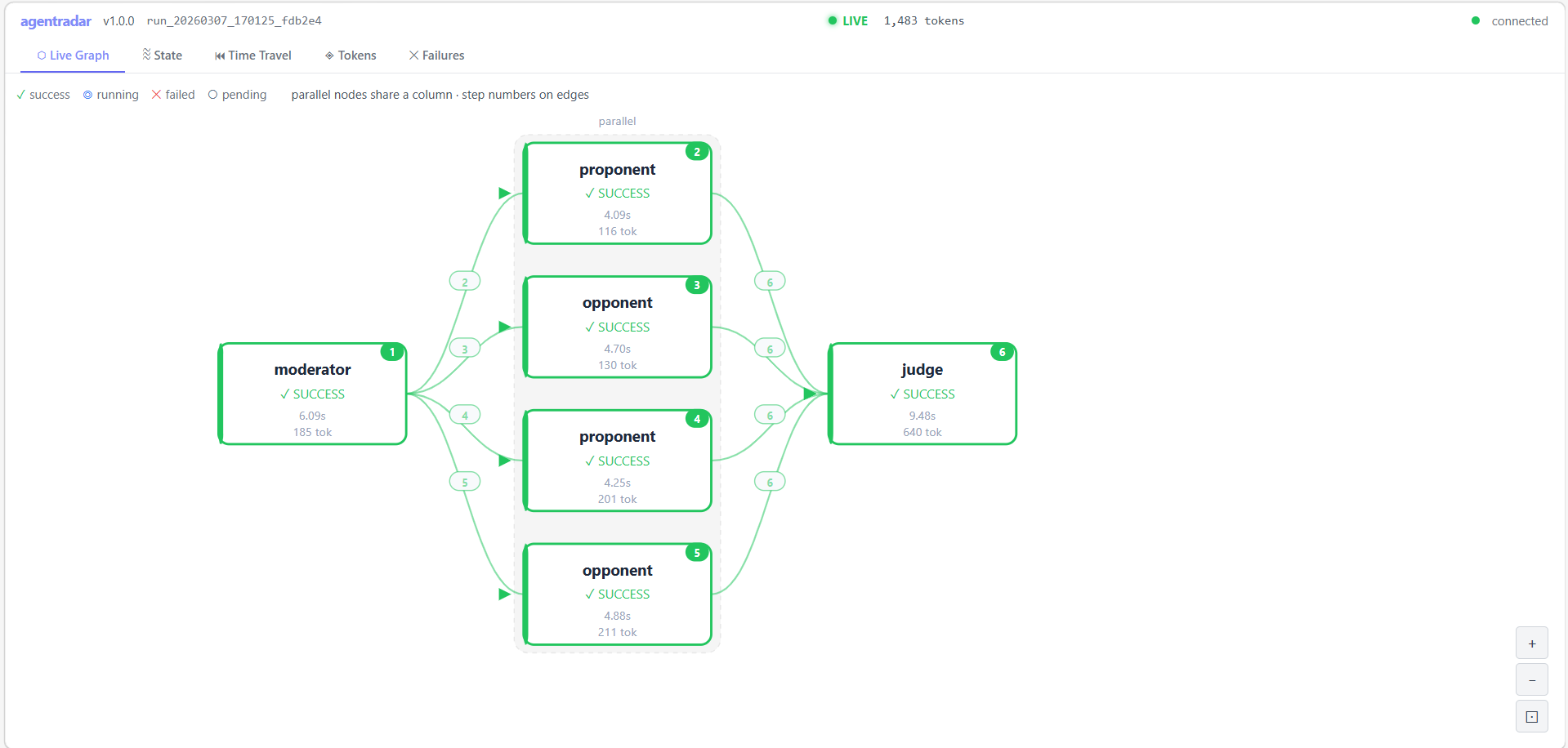
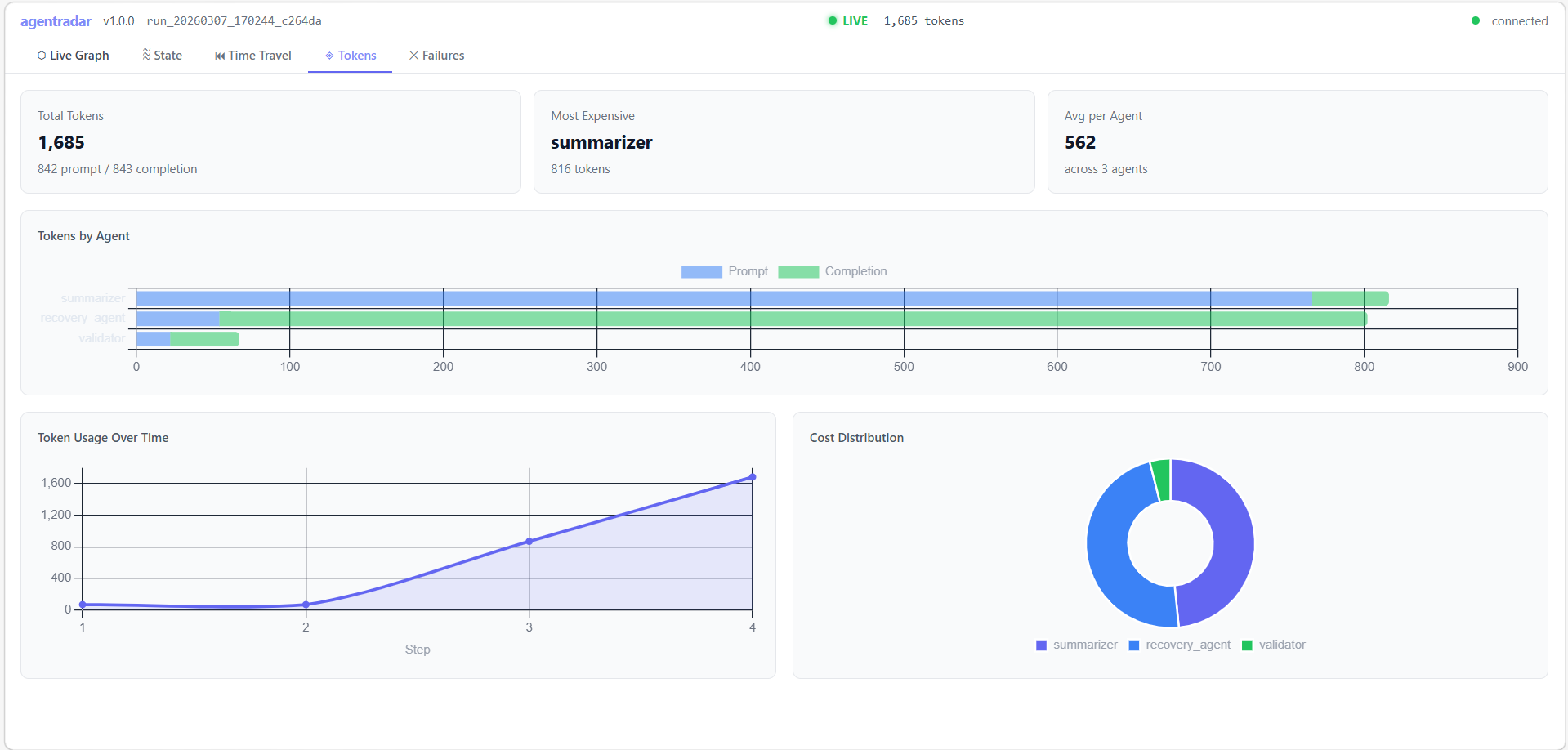
| Live Graph | Tokens |
|---|---|
 |
 |
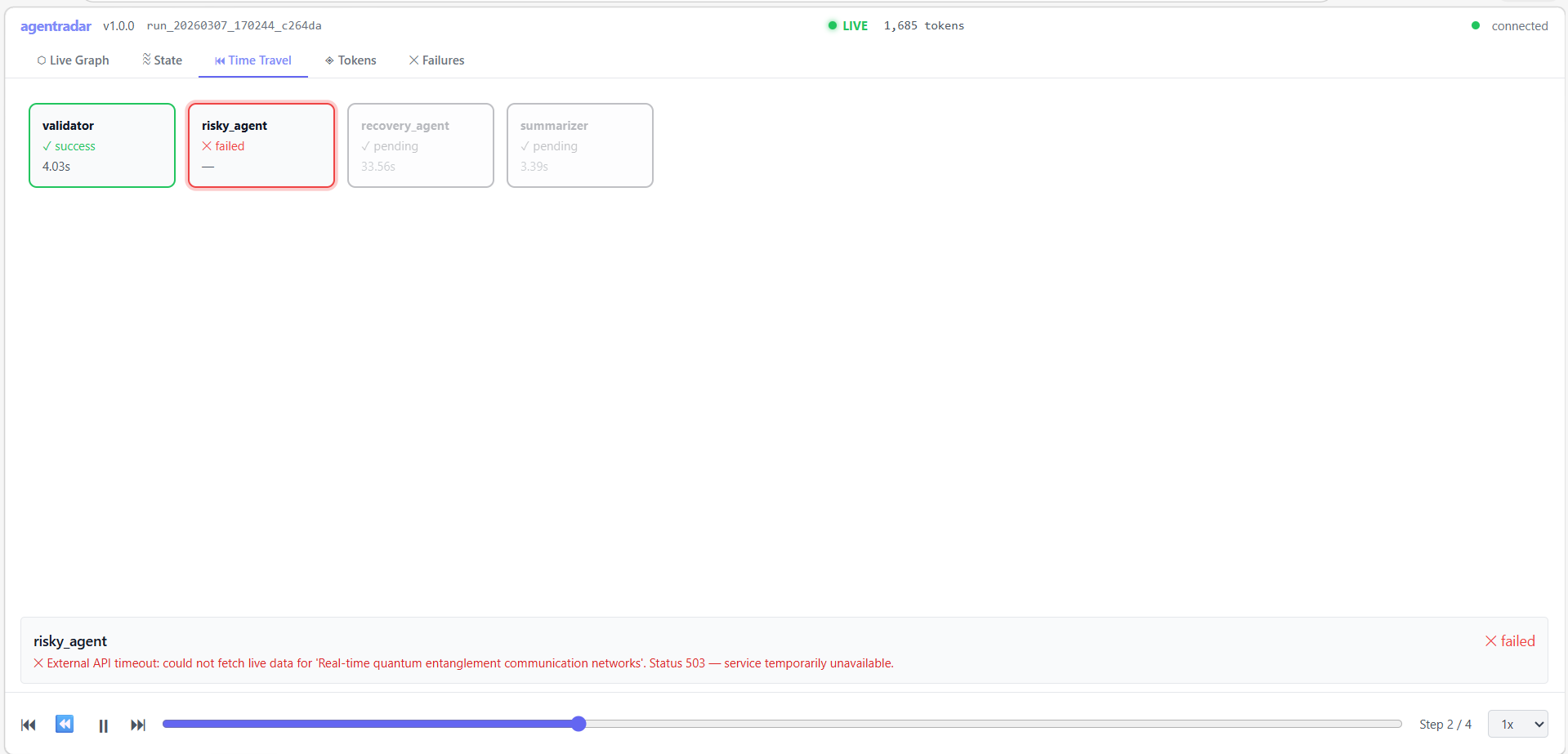
| Time Travel | Failures |
|---|---|
 |
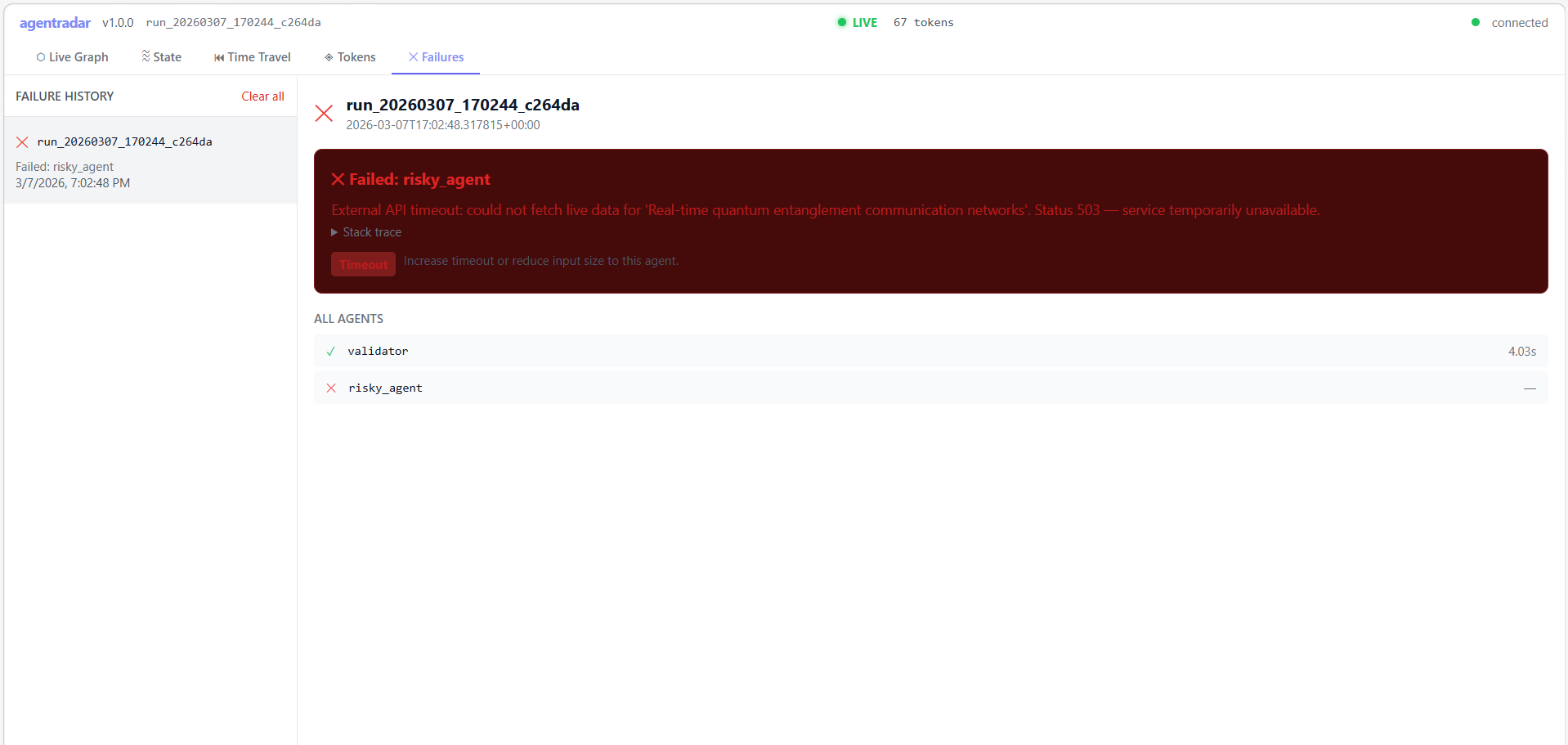 |
| Tab | What you see |
|---|---|
| Live Graph | DAG of agents as they run - nodes light up green/red in real time |
| State | Every step's input/output with diff vs previous step |
| Time Travel | Scrub back through the run like a video timeline |
| Tokens | Bar chart per agent + cumulative line + donut breakdown |
| Failures | Auto-saved error runs with full traceback, updated live |
Install
Via pip
pip install agentradar
Via git clone
git clone https://github.com/yossefaymanzedan/agentradar.git
cd agentradar
pip install -e .
Quickstart
import agentradar # server starts on :7111, browser opens automatically
The @radar decorator
For custom pipelines (no framework), use @radar for explicit tracing:
from agentradar import radar, reset_run

@radar(tag="researcher")
def researcher(topic: str) -> str:
    ...

@radar(tag="writer", llm_input=["researcher"])
def writer(notes: str) -> str:
    ...

reset_run()
notes = researcher("quantum computing")
article = writer(notes)
llm_input=["tag"] draws an edge from researcher -> writer in the graph.
Pipeline patterns
Sequential chain
Each agent declares its upstream with llm_input=["previous_tag"]:
@radar(tag="researcher")
def researcher(topic): ...

@radar(tag="writer", llm_input=["researcher"])
def writer(notes): ...

@radar(tag="editor", llm_input=["writer"])
def editor(draft): ...
Graph: researcher -> writer -> editor
Fan-out (parallel agents)
Define a coordinator with no llm_input. Children declare llm_input=["coordinator_tag"].
The library auto-spawns all children in parallel - no asyncio.gather needed:
@radar(tag="coordinator")
async def coordinator(query: str):
    pass  # library spawns children, returns [result_a, result_b, result_c]

@radar(tag="fetch_a", llm_input=["coordinator"])
async def fetch_a(query: str) -> str: ...

@radar(tag="fetch_b", llm_input=["coordinator"])
async def fetch_b(query: str) -> str: ...
results = await coordinator(query) # -> [fetch_a result, fetch_b result]
Graph: coordinator -> fetch_a, fetch_b (parallel band)
Fan-in (merge point)
Declare multiple parents - edges are drawn from all of them:
@radar(tag="aggregator", llm_input=["fetch_a", "fetch_b", "fetch_c"])
async def aggregator(results: list) -> str: ...
Graph: fetch_a, fetch_b, fetch_c -> aggregator
Full fan-out + fan-in
@radar(tag="coordinator")
async def coordinator(query): pass

@radar(tag="fetch_a", llm_input=["coordinator"])
async def fetch_a(query): ...

@radar(tag="fetch_b", llm_input=["coordinator"])
async def fetch_b(query): ...

@radar(tag="aggregator", llm_input=["fetch_a", "fetch_b"])
async def aggregator(results): ...

async def main():
    reset_run()
    results = await coordinator(query)   # auto-spawns fetch_a + fetch_b
    summary = await aggregator(results)  # merge point, draws edges from both
@radar decorator parameters
| Parameter | Type | Description |
|---|---|---|
tag |
str |
Identifier for this agent. Used to draw edges and auto-spawn children. |
llm_input |
list[str] |
Upstream tags - draws edges and marks parent agents. Single parent = auto-spawn candidate. |
notes |
str |
Freeform annotation shown in the dashboard inspector panel. |
Token tracking
agentradar automatically captures token usage from LangChain (BaseChatModel.invoke / ainvoke) with no extra code. Prompt tokens, completion tokens, and total are shown per agent in the Tokens tab.
For other libraries, return a dict with a tokens key:
@radar(tag="my_agent")
def my_agent(prompt):
    response = my_llm.call(prompt)
    return {
        "content": response.text,
        "tokens": {"prompt": 120, "completion": 80, "total": 200}
    }
Multi-run across a session
Call reset_run() before each pipeline execution to start a fresh run:
from agentradar import reset_run

reset_run()
result = await my_pipeline(input)
Without reset_run(), all agent calls accumulate into the same run.
Configuration
import agentradar
agentradar.config(
    port=7111,           # dashboard port (auto-increments if taken)
    open_browser=True,   # open browser on start
)
Or suppress server start entirely (for CI/tests):
AGENT_TRACE_NO_SERVER=1 python your_script.py
Examples
| File | Pattern |
|---|---|
examples/01_single_agent.py |
Single agent baseline |
examples/02_sequential_chain.py |
4-step linear chain (research -> write -> edit -> publish) |
examples/03_parallel_agents.py |
Fan-out coordinator + fan-in aggregator |
examples/04_error_handling.py |
Error capture, fallback chains, failure history |
examples/05_nested_agents.py |
Deep nested agent calls |
examples/06_rag_pipeline.py |
RAG: 3 parallel retrievers -> reranker -> answer |
examples/07_code_review_crew.py |
3 specialist reviewers in parallel |
examples/08_debate_agents.py |
Multi-round debate with judge |
examples/09_self_healing_pipeline.py |
Retry loop with fallback |
How it works
import agentradarstarts a FastAPI + WebSocket server on a background thread- The
@radardecorator emitsagent_start/agent_end/agent_errorevents into a thread-safe queue - The server drains the queue and broadcasts events over WebSocket to the browser
- The React dashboard renders the live DAG, state diffs, token charts, and failure history in real time
- All runs are stored as
.agtracefiles in~/.agentradar/for offline replay
No cloud. No API keys. No data leaves your machine.
Contributing
Contributions are welcome. Please open an issue first to discuss what you'd like to change.
git clone https://github.com/yossefaymanzedan/agentradar.git
cd agentradar
pip install -e ".[dev]"
License
MIT - Yossef Ayman Zedan
Release history Release notifications | RSS feed

Download files
Download the file for your platform. If you're not sure which to choose, learn more about installing packages.
Source Distribution
Built Distribution
Filter files by name, interpreter, ABI, and platform.
If you're not sure about the file name format, learn more about wheel file names.
Copy a direct link to the current filters
File details
Details for the file agentradar-1.0.4.tar.gz.
File metadata
- Download URL: agentradar-1.0.4.tar.gz
- Upload date:
- Size: 311.8 kB
- Tags: Source
- Uploaded using Trusted Publishing? No
- Uploaded via: twine/6.2.0 CPython/3.11.9
File hashes
| Algorithm | Hash digest | |
|---|---|---|
| SHA256 |
90e9e8db1166871c2a298665b144e469158531da16586048022ad2741a094858
|
|
| MD5 |
2171cc472794bf973eeb64cedb11c737
|
|
| BLAKE2b-256 |
de51e049a5b1e09d250f7d108d47cfeeba7e8df2dc5ff23c85b2557375f473ac
|
File details
Details for the file agentradar-1.0.4-py3-none-any.whl.
File metadata
- Download URL: agentradar-1.0.4-py3-none-any.whl
- Upload date:
- Size: 61.4 kB
- Tags: Python 3
- Uploaded using Trusted Publishing? No
- Uploaded via: twine/6.2.0 CPython/3.11.9
File hashes
| Algorithm | Hash digest | |
|---|---|---|
| SHA256 |
245772bd2526961f7eed790ecf9528b17b271b6edc6bae38e60ab271112b31eb
|
|
| MD5 |
9f2edcf1faeb6672b9c5b1fe2424829a
|
|
| BLAKE2b-256 |
4fc63461466dadaa6b9b2fe3da4368495045a1680e647656d49f2a1764449e08
|






