
AgentRubric
Trajectory-level evaluation for LLM agents. Zero dependencies, five metrics, one score.
📦 Live on PyPI: pypi.org/project/agentrubric —
pip install agentrubric
Current tools (LangSmith, Langfuse, etc.) give you logging. AgentRubric gives you scores .
When an LLM agent runs, it produces a trajectory — a sequence of thoughts, tool calls, observations, and a final answer. Knowing whether that trajectory was actually correct is hard: Did it call the right tools? With the right arguments? Did it wander in loops? Did it finish the task at all? AgentRubric answers all of that with a single evaluate() call.
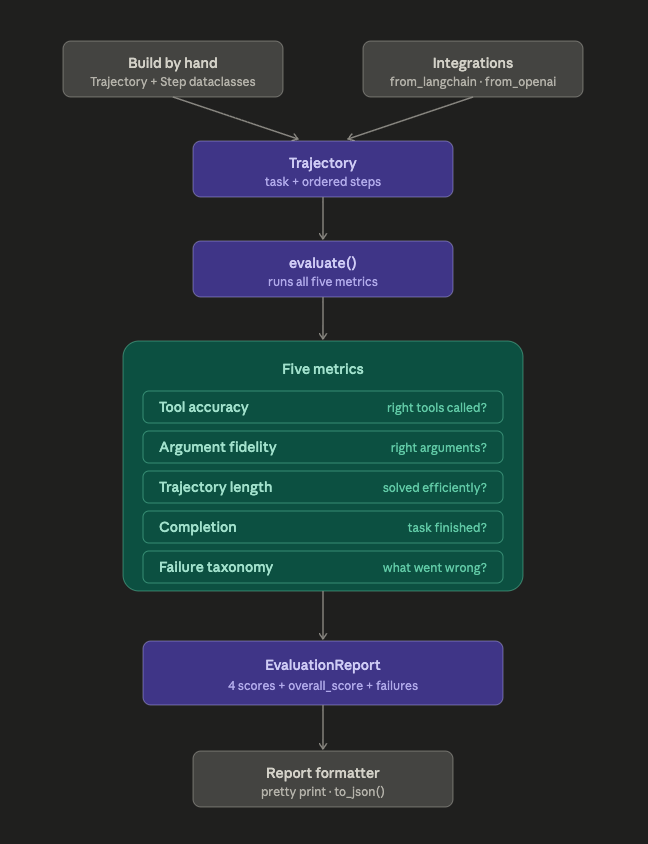
trajectory (list of steps)
        │
        ▼
   AgentRubric.evaluate()
        │
        ▼
EvaluationReport
  ├─ tool_accuracy_score      — did it call the right tools?
  ├─ argument_fidelity_score  — did it call them with the right arguments?
  ├─ trajectory_length_score  — did it solve the task efficiently?
  ├─ completion_score         — did it actually finish the task?
  └─ failure_taxonomy         — what went wrong, categorised
Install
pip install agentrubric
Zero required dependencies. Optional extras for framework integrations:
pip install agentrubric[langchain]   # LangChain agent parsing
pip install agentrubric[openai]      # OpenAI function-calling parsing
Then say hello:
agentrubric
Quickstart
from agentrubric import Trajectory, Step, evaluate

trajectory = Trajectory(
    task="Find the latest JAX release and summarize the changelog",
    steps=[
        Step(step_type="thought", content="I need to search for JAX releases"),
        Step(step_type="tool_call", content="", tool_name="search",
             tool_args={"query": "JAX latest release"}),
        Step(step_type="observation", content="JAX 0.4.30 released on July 2026..."),
        Step(step_type="final_answer",
             content="The latest JAX release is 0.4.30, released July 2026."),
    ],
    final_answer="The latest JAX release is 0.4.30, released July 2026.",
)

report = evaluate(
    trajectory=trajectory,
    expected_tools=["search"],
    expected_calls=[{"tool_name": "search", "expected_args": {"query": "JAX latest release"}}],
    optimal_steps=4,
    completion_keywords=["JAX", "release"],
)

print(report)
print(report.overall_score)   # 0.9-ish
print(report.failures)        # []
AgentRubric Evaluation Report
========================================
  Overall Score         : 0.93
  Tool Accuracy         : 1.00
  Argument Fidelity     : 0.70
  Trajectory Efficiency : 1.00
  Completion            : 1.00

  No failures detected.
========================================
Export to JSON for dashboards, CI gates, or logging pipelines:
report.to_json()
Run it yourself: python examples/basic_evaluation.py
The five metrics
| Metric | Question it answers | Signal |
|---|---|---|
| Tool Accuracy | Did the agent call the tools it was supposed to? | expected_tools matched against tools actually called |
| Argument Fidelity | Were those tools called with the right arguments? | exact + fuzzy match against expected_calls |
| Trajectory Length | Did it solve the task efficiently? | optimal_steps / actual_steps, capped at 1.0 |
| Completion | Did it actually finish? | binary, or keyword coverage of the final answer |
| Failure Taxonomy | When it broke, why? | WRONG_TOOL, MISSING_TOOL, BAD_ARGS, LOOP, NO_COMPLETION, HALLUCINATED_TOOL |
overall_score is a weighted average: 0.3 × tool_accuracy + 0.3 × argument_fidelity + 0.2 × trajectory_length + 0.2 × completion.
Framework integrations
Already using LangChain or OpenAI function calling? Don't hand-build trajectories — parse them straight out of the agent's own output.
LangChain
from agentrubric.integrations.langchain import from_langchain

result = agent_executor.invoke({"input": task})
trajectory = from_langchain(result, task=task)
report = evaluate(trajectory, expected_tools=["search"])
OpenAI function calling
from agentrubric.integrations.openai import from_openai_messages

trajectory = from_openai_messages(messages, task=task)
report = evaluate(trajectory, expected_tools=["search"])
Design principles
- Zero required dependencies. A library that requires nothing to install is a library people actually install. LangChain/OpenAI support is opt-in via extras.
- Framework-agnostic core.
TrajectoryandStepare plain dataclasses — build them from any agent framework, or by hand. - Scores, not logs. AgentRubric doesn't replace your tracing tool; it turns a trajectory you already captured into a number you can gate CI on.
Roadmap
- YAML/JSON case files so expectations don't have to live inline in Python
- Configurable metric weights instead of the fixed 30/30/20/20 split
- More framework integrations beyond LangChain and OpenAI
Development
pip install -e ".[dev]"
pytest
License
MIT
1 maintainer

Metadata
1 maintainer
Release files for agentrubric 0.1.2
For a detailed explanation of source distributions (sdists) and built distributions (wheels), please see the package formats documentation.
Source distribution (sdist)
| File | Size | Uploaded | Provenance | Actions |
|---|---|---|---|---|
| agentrubric-0.1.2.tar.gz | 12.0 kB | Without provenance | Details for agentrubric-0.1.2.tar.gz |
Built distribution (wheel)
| File | Interpreter | ABI | Platform | Actions Reset |
|---|---|---|---|---|
| agentrubric-0.1.2-py3-none-any.whl | Python 3 | none | any | Details for agentrubric-0.1.2-py3-none-any.whl |
Total release size: 24.7 kB
Release files / agentrubric-0.1.2.tar.gz
| Download URL | agentrubric-0.1.2.tar.gz |
|---|---|
| Size | 12.0 kB |
| Tags | Source |
|
SHA-256 checksum How to use checksums |
a3cd276e92432f94262dee9cbbca25745a6d0155e240fa864ec4a3f741cc5e2e
|
|
BLAKE2b-256 checksum How to use checksums |
9d65437c7600363d54e2a75fa799e98e38c0252001819d9c5ed61cf89728b120
|
| Upload date | |
|
Uploaded using Trusted Publishing? What is trusted publishing? |
No |
| Uploaded via |
twine/7.0.0 CPython/3.11.14
|
Release files / agentrubric-0.1.2-py3-none-any.whl
| Download URL | agentrubric-0.1.2-py3-none-any.whl |
|---|---|
| Size | 12.7 kB |
| Tags | Python 3 |
|
SHA-256 checksum How to use checksums |
01c161f0287e4e9c263f82d54c9590f55830bc0ace69c3e6ffb486829fb215e6
|
|
BLAKE2b-256 checksum How to use checksums |
9cc1178d6187a311ae68d5b5215ff288639895fdbcc6b03293ba0768274c032e
|
| Upload date | |
|
Uploaded using Trusted Publishing? What is trusted publishing? |
No |
| Uploaded via |
twine/7.0.0 CPython/3.11.14
|
Security for agentrubric 0.1.2
Provenance
Provenance describes where a file came from. On PyPI, provenance is shared via attestations, which provide a verifiable record of the build or publishing details. View details, limitations and caveats.
No provenance found
None of the files in this release were uploaded with provenance metadata.
A note on package security
PyPI is a repository for distributing packages, not a service for auditing them. While third-party security researchers and our staff do their best to detect and remove malicious packages, PyPI cannot guarantee the quality, security or suitability of any given package.
To learn more about protecting yourself from malicious actors, visit our package security documentation.














