
agents_Inc
A corporate org chart for AI agents: you ask, the session you talk to dispatches a Lead model, and the Lead runs cheaper Worker models. The aim is more checked work from the AI subscriptions you already pay for.







Table of Contents
- Status & Roadmap
- Why it exists
- Installation
- Quick start
- How it works
- Limitations
- Documentation
- Citation and license
1. Status & Roadmap
Version 0.3.0. The project is experimental and pre-MVP. The governed path (WORKERBEES_GOVERNANCE) is off by default. Changes per release are in the CHANGELOG. The build plan and cut line are in docs/PLAN-MVP.md. Open work is tracked in the issues.
2. Why it exists
Delegated model work can look done while it is wrong. A flat pool of agents has no way to catch that. agents_Inc borrows a corporate org chart. The CEO is you. The CoS (chief of staff) is the session you talk to. A Lead manages one run, and a Worker reports to a Lead.
Cheap models take routine work, and costlier models manage. An author never grades its own work: the Lead checks what its Workers report before anything moves up. Savings are not yet measured, so none are claimed (docs/PLAN-MVP.md).
3. Installation
Requirements: Python 3.10 or later, Bash 3.2 or later, jq, and the Claude Code CLI signed in to an Anthropic subscription. The Codex CLI is optional; when present, it serves the Codex rungs and cross-vendor review.
pip install agents-inc
agents-inc install     # skills ship in the package; no checkout needed
agents-inc doctor      # first line prints READY when the install works
Restart Claude Code (and Codex, if used) after the install. agents-inc install --without-codex skips Codex on purpose. To install from a git checkout instead, pass --source <checkout>. Optional Gemini, Mistral and OpenRouter keys, the setup decision tree and key storage rules are in docs/START-HERE.md.
4. Quick start
Name your models in plain English. The ladder decides who manages whom, and the rest fills in. You do not hand-pick every model or write JSON.
Write the request to the CoS as <task>. <models>., for example:
"Fix the parser. opus, haiku."
The higher rung manages and the lower rung reports to it, so opus is the Lead and haiku is its Worker. Defaults fill the rest: effort medium, gates derived from the task, and the home repo from the consumer's AGENTS.md. Each extra word, such as an effort level, overrides one default.
| Rung | Claude | Codex | Role |
|---|---|---|---|
| Executive | fable | astra | Final say, irreversible acts, conflicting results |
| Orchestrator | opus | sol | Decompose, dispatch, plan |
| Workhorse | sonnet | terra | Normal coding, research, synthesis |
| Grunt | haiku | luna | Classify, extract, summarize; free Gemini, Mistral and OpenRouter models enter only here |
The CoS then runs one command. It renders the prompt, lints it, snapshots the tree, launches the delegate and checks the report:
agents-inc dispatch --slots slots.json --model sonnet --dry-run   # drop --dry-run to launch
agents-inc models chain supervisor=opus                            # change the default REPORTING CHAIN
Every dispatch prompt carries a REPORTING CHAIN line derived from the ladder, and every launched dispatch writes one dispatched row to the ledger. Codex delegates can write to --cwd by default, the same as a Claude subagent; the slot CODEX_WRITE: no makes one read-only. A worked slots file is in skills/workerbee/slots.md.
Two more entry points need no dispatch. PYTHONPATH=. python3 tools/governance_demo.py --fake, run from a checkout, shows routing, policy checks and ledger records with no provider keys. @haiku <question> inside any Claude Code session sends one side question to a cheaper model before the session model runs (docs/at-route/AT-ROUTE.md).
5. How it works
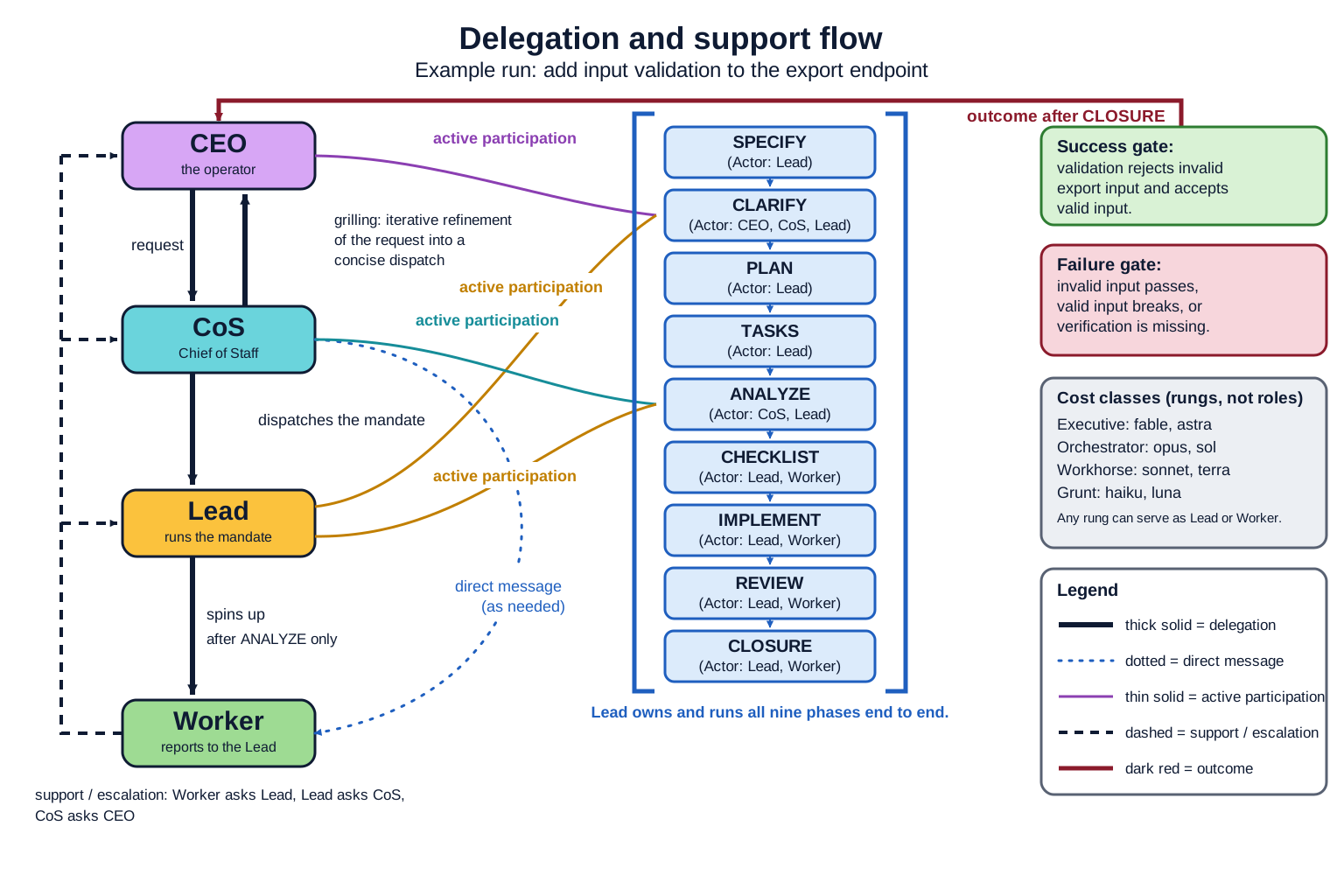
- Routing. A router picks the vendor and rung for each task from a written policy (agents_inc/routing.json). Rung names are cost classes, not job titles; the reporting chain sets the role.
- Grilling and speckit. The CoS grills you one question at a time until the request is sharp, then a speckit pipeline gates it through spec, plan, tasks and review.
- Verification. A deterministic verifier checks cited claims with no model call. A reviewer from a different vendor then checks the meaning. A Worker's own PASS never decides acceptance.
- Ledger. An append-only JSONL and SQLite ledger records every dispatch, return, review and acceptance decision.
- Models. Each Codex alias is pinned to one slug.
agents-inc modelsreports drift. Model sync promotes new Codex slugs inapproveorautomode and skips pinned aliases.
The full description, including the delegation limits, the 14-element prompt contract, the verification flow and the comparison with other tools, is in docs/HOW-IT-WORKS.md.
6. Limitations
- Cost savings and accuracy against a baseline are not measured. Passing local tests show that the code behaves as written, not that it is reliable in production.
- The governed path is off by default, so a fresh install does not run the enforced cross-vendor review.
- Cross-vendor review catches disagreement between models. It does not catch a blind spot that both vendors share.
- Deterministic checks cover what a script can express, such as a file, a quote or an exit code. They do not replace human judgment on scope or design.
- Free-model capacity varies: a probe on 2026-09-29 found 429 or capacity errors on several free models (docs/BENCH.md). Artifacts stay local; remote publication (Bindle Backend B) is not built.
7. Documentation
| File | Reader |
|---|---|
| docs/START-HERE.md | New users: setup, providers, keys, first job |
| docs/HOW-IT-WORKS.md | Operators and agents: dispatch, verification, comparison, HTTP bridge |
| docs/EXTENDING.md | Adding a vendor, model, task class or domain |
| docs/DECISIONS.md | Binding rulings, with rationale and evidence |
| CONTEXT.md | Glossary: CEO, CoS, Lead, Worker, Mandate, Home repo |
| skills/workerbee/QUICKREF.md | Short form of the dispatch rules |
| docs/RELEASING.md | Release runbook |
8. Citation and license
The DOI for all versions is 10.5281/zenodo.22670100. GitHub's "Cite this repository" button reads CITATION.cff.
agents_Inc is licensed under the PolyForm Small Business License 1.0.0, with one added term that forbids use for AI or machine-learning training. The full terms are in LICENSE.
1 maintainer

Metadata
1 maintainer
Release files for agents-inc 0.3.0
For a detailed explanation of source distributions (sdists) and built distributions (wheels), please see the package formats documentation.
Source distribution (sdist)
| File | Size | Uploaded | |
|---|---|---|---|
| agents_inc-0.3.0.tar.gz | 298.8 kB | Details |
Built distribution (wheel)
| File | Interpreter | ABI | Platform | Reset |
|---|---|---|---|---|
| agents_inc-0.3.0-py3-none-any.whl | Python 3 | none | any | Details |
Total release size: 628.5 kB
Release files / agents_inc-0.3.0.tar.gz
| Download URL | agents_inc-0.3.0.tar.gz |
|---|---|
| Size | 298.8 kB |
| Tags | Source |
|
SHA-256 checksum How to use checksums |
62b22f3f9896f02e55a7a31487e68fc43cfe3089dd6f3fb2422044fe50bab29f
|
|
BLAKE2b-256 checksum How to use checksums |
ed2fcd32bde9444c4b2375d52f8b0f88e70c318adf0c576e7559b2f0e4ab3829
|
| Upload date | |
|
Uploaded using Trusted Publishing? What is trusted publishing? |
Yes |
| Uploaded via |
twine/7.0.0 CPython/3.13.14
|
Provenance
Provenance describes where a file came from. On PyPI, provenance is shared via attestations, which provide a verifiable record of the build or publishing details. View details, limitations and caveats.


PyPI Publish Attestation
PyPI verified that this artifact, at this checksum, originated from the publisher listed below.
Signed by GitHub Actions, verified by PyPI on Oct 10, 2026.
Transparency logRelease files / agents_inc-0.3.0-py3-none-any.whl
| Download URL | agents_inc-0.3.0-py3-none-any.whl |
|---|---|
| Size | 329.8 kB |
| Tags | Python 3 |
|
SHA-256 checksum How to use checksums |
ed9db38ae046be5403674e16b1de42a3f84c934919291e966c43c1ec0cc4657e
|
|
BLAKE2b-256 checksum How to use checksums |
3d103c3519d3a5e03d74fa9986c3356429472f920f85c32f7bd98e64f75fbca6
|
| Upload date | |
|
Uploaded using Trusted Publishing? What is trusted publishing? |
Yes |
| Uploaded via |
twine/7.0.0 CPython/3.13.14
|
Provenance
Provenance describes where a file came from. On PyPI, provenance is shared via attestations, which provide a verifiable record of the build or publishing details. View details, limitations and caveats.
PyPI Publish Attestation
PyPI verified that this artifact, at this checksum, originated from the publisher listed below.
Signed by GitHub Actions, verified by PyPI on Oct 10, 2026.
Transparency log













