
🦑 AgentSquid
    🦑 AGENT
    ██████╗ ██████╗ ██╗   ██╗██╗██████╗
   ██╔════╝██╔═══██╗██║   ██║██║██╔══██╗
   ╚█████╗ ██║   ██║██║   ██║██║██║  ██║
    ╚═══██╗██║▄▄ ██║██║   ██║██║██║  ██║
   ██████╔╝╚██████╔╝╚██████╔╝██║██████╔╝
   ╚═════╝  ╚══▀▀═╝  ╚═════╝ ╚═╝╚═════╝
Quick Start
- Install at least one supported CLI and check whether you can use it (/login):
| Backend | CLI | Install |
|---|---|---|
| Claude Code | claude |
curl -fsSL https://claude.ai/install.sh | bash |
| OpenAI Codex | codex |
curl -fsSL https://chatgpt.com/codex/install.sh | sh |
| Cursor Agent | cursor-agent |
curl -fsS https://cursor.com/install | bash |
| OpenCode | opencode |
curl -fsSL https://opencode.ai/install | bash |
| Pi | pi |
curl -fsSL https://pi.dev/install.sh | sh |
| Ollama (optional, local models) | ollama |
curl -fsSL https://ollama.com/install.sh | sh |
- Install and run AgentSquid!
curl -fsSL https://agentsquid.ai/install.sh | bash
- Open in your browser:
http://127.0.0.1:8000
Create agents in the UI. An agent is a named config:
agent name (@agent) = harness (Claude Code) + provider (Claude) + model (claude-sonnet-5) + working directory (CLAUDE.md, etc.)
The Squid Manifesto: EVERY. TOKEN. COUNTS!
- COUNT every token, every prompt!
- UNIFY your subscriptions, free tiers, and local models into one workplace.
- SHARE context explicitly across models, topics, sessions; clear sessions without fear!
- PARALLELIZE your prompts, no more waiting!
- INVOKE other agents only when you need it; #code@agent>@review!
Your Local Coding Agents, Unified
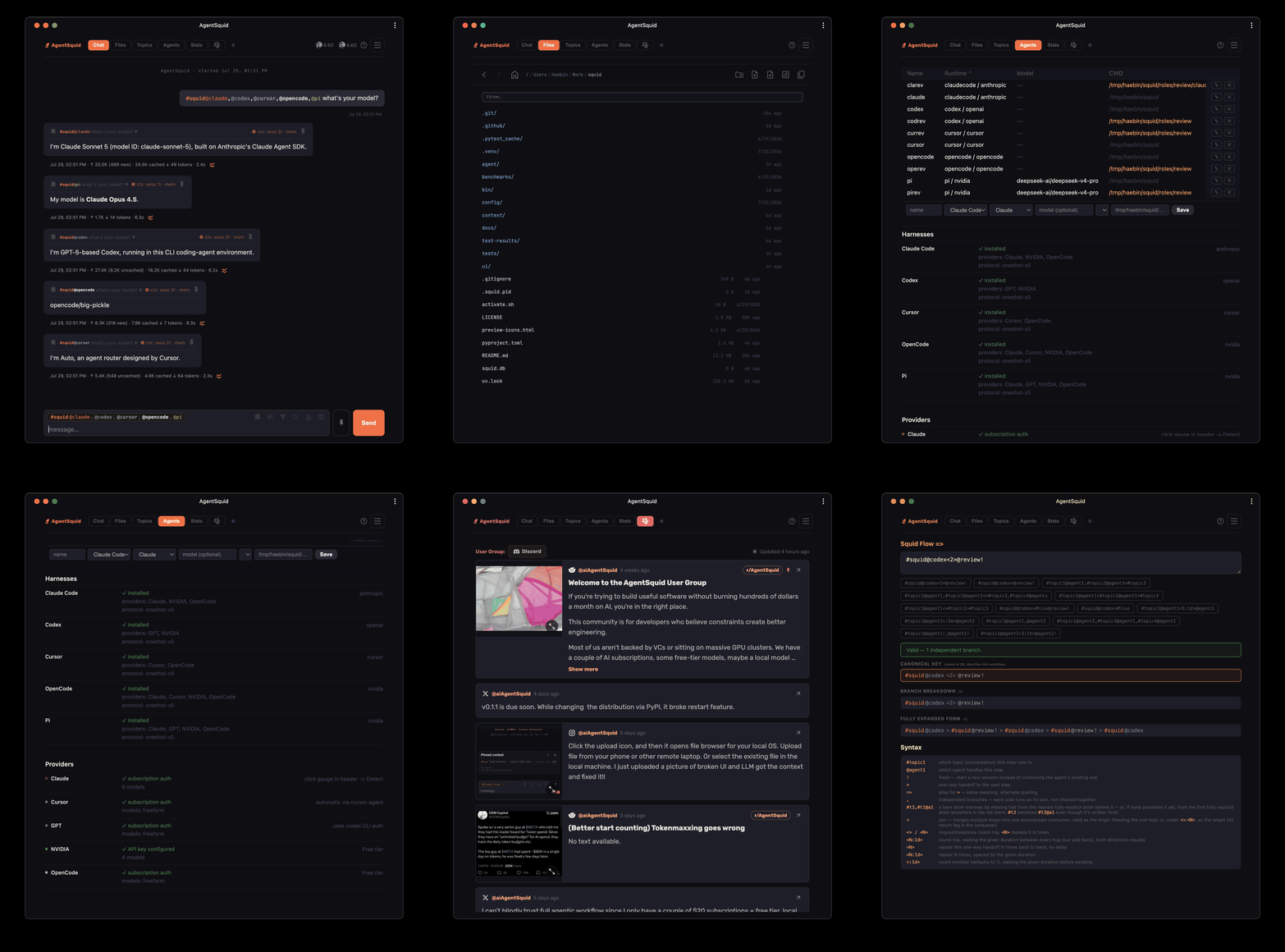
Agent-Squid is a meta harness orchestrator which lets you run Claude Code, OpenAI Codex, Cursor Agent, OpenCode, Pi coding agents with multiple providers, such as, Claude, GPT, Cursor, OpenCode, NVIDIA, DeepSeek, local LLMs via one browser UI. Your agents still run on your own machine, with your repo, shell tools, credentials, and native CLI sessions. Squid gives those sessions names, history, queues, controls, and phone/tablet access.
Use it when your workflow has become a wall of unnamed terminal tabs or you need to use multiple coding agents; a couple of $20 agents alongside a free coding agent.
#launch@claude write the release notes
#launch@codex! review the diff for regressions
#bug@cursor reproduce the auth failure
#ops@opencode summarize the incident notes
#research@pi compare the implementation options
NOTE: These topics are sticky. Once you are in the topic, no need to type it. :)
Why
CLI agents are useful, but the workflow gets messy quickly:
- You have ten Claude Code terminals open and cannot remember which one is doing what.
- A terminal closes or the machine reboots, and reviving the right session becomes a hunt through resume pickers, session IDs, cwd-sensitive history, and shell scrollback.
- Long-running sessions grow, drift, stall, and need compaction or reset but afraid to lose details.
- There is no way to select responses as context for the next new session, so you have to tell it again.
- Different agent CLIs have different commands, resume flags, slash commands, output formats, and UI assumptions.
- Token usage is usually hidden in the flow instead of attached clearly to each prompt and response.
- You want to do couch coding, but /remote doesn't cut it because not optimized for mobile.
Squid turns those local agents into named, durable lanes you can control from a single chat thread with filter support.
Topics and agents are not a rigid setup step. You can create a new #topic the moment you type it, switch agents with @agent, and clean up old workstreams when they are done. Squid treats tags as the UI for your agent work: lightweight enough to create dynamically, durable enough to recover later, and visible enough that you are not guessing which terminal was doing what.
What You Get
- Named agent lanes:
#topic@agentgives every workstream a durable identity. - Dynamic tags: create topics as you type, reuse sticky agents, filter by tag, and delete stale topics when the work is done.
- Native resumable sessions: Squid tracks session handles while the CLI owns its real context.
- Parallel work: different topics and agents run independently.
- Adhoc (Goldfish) mode:
#topic@agent!runs a fresh one-off job immediately without polluting the main session. You can add the adhoc output to session context easily. (merging context) - Session vs. limited-context comparison: compare a session lane against an adhoc prompt that includes only the last N exchanges.
- Live progress bubble: watch queued state, tool/status output, and partial response progress while the CLI is working.
- Auto-compaction hint: alerts you to /clear the session if it's stale or too many turns.
- Context pin: pin a useful answer and inject it into another session or adhoc turn.
- Context bookmark: bookmark a useful answer and use it later for context.
- Process controls: stop one process from the UI, stop by command, stop a topic, drain queues, clear sessions, and compact/reset context.
- History and filtering: scan past work by topic, agent, or adhoc lane.
- Analytics: review usage by time, topic, or agent, plus live process state.
- Per-prompt usage: every completed prompt can show input, output, cache, reasoning, cost, duration, and quota signals when the backend exposes them.
- Phone/tablet access: lie on the couch while your local machine keeps coding.
Basic Usage
| Syntax | Meaning |
|---|---|
#topic@agent message |
Continue that topic/agent session |
#topic@agent! message |
Run a parallel adhoc turn with no session history |
#topic@agent!3 message |
Run adhoc with only the last 3 exchanges (normal, searched, filtered) as context |
/stop |
Stop the current process scope |
/stopall |
Stop and drain the current topic |
/clear |
Create new session |
/f, /filter |
Filter history to the current topic/agent lane |
/s, /search |
Search history to the current topic/agent lane |
/remote |
Show QR code for mobile/tablet access via Tailscale |
Session turns are queued per #topic@agent for the tasks with order matters. Adhoc ! turns are independent and run immediately.
This makes comparison easy. Ask the session with #topic@agent, then ask a limited-context version with #topic@agent!3, #topic@agent!1, or #topic@agent!. You can see whether the long session is helping, whether stale context is hurting, and how much token usage each path costs.
Tags are created dynamically. If you send #release@claude ..., Squid creates or updates the release topic and remembers claude as its sticky agent. Later, #release ... continues that lane without retyping the agent. Topic autocomplete lets you browse existing tags, and old topics can be hidden or deleted when they are no longer useful.
While an agent is running, Squid shows progress in a thought bubble instead of leaving you staring at a frozen terminal. You can see queue position, status output, tool activity, and streamed partial content. If the job is going in the wrong direction, stop it from the bubble’s UI control or type /stop, /stopall, or deq just like you would use CLI control commands, but with clearer scope and feedback.
After completion, the response carries usage metadata. Instead of guessing what a turn cost, you can inspect tokens, cache reads/writes, reasoning tokens where available, duration, cost, and quota deltas. The analytics view rolls this up by time, topic, and agent so you can see which lanes are expensive and which models are doing the most work.
Couch Coding With Tailscale
Squid is most useful when your local machine can keep working while you are away from the desk.
Tailscale is a good fit for this. Its Personal plan is free for non-commercial personal use, and it creates a private WireGuard-based network across your own devices. Your phone, tablet, laptop, Mac mini, and workstation can talk inside the tailnet without opening a public port.
Squid always binds to 127.0.0.1, it never exposes itself directly on the network. Starting squid automatically configures two tailscale serve rules if Tailscale is installed, and prints both URLs to the console:
agentsquid start   # run in the background and configure tailscale serve
agentsquid         # run in the foreground for debugging
agentsquid is up -> http://127.0.0.1:8000
  https://<machine-name>.<tailnet>.ts.net/
  http://<tailscale-ip>:8000/
Two different URLs work, for two different reasons:
https://<machine-name>.<tailnet>.ts.net/— the default HTTPS port (443), so no port in the URL. This needs MagicDNS enabled on your tailnet to resolve; squid checks this at startup and warns in the printed URL if MagicDNS looks disabled. The full domain is required here — the short hostname alone (https://<machine-name>/) won't work because Tailscale's TLS cert is scoped to*.ts.netand browsers enforce an exact match.http://<tailscale-ip>:<port>/— reachable by IP even without MagicDNS. Under the hood this is atailscale serve --tcp=<port>raw TCP forward, not--http:tailscale serve --httproutes by Host header even for plain HTTP, so hitting the IP directly (Host: <ip>:<port>) matches no rule and gets Tailscale's own 404 before squid ever sees the request.--tcpforwards at the TCP layer with no Host matching, so it works by IP.https://<tailscale-ip>:<port>/still won't work — Tailscale's cert only covers the*.ts.netdomain, not the IP, so TLS validation fails regardless of which rule serves it. The traffic is still WireGuard-encrypted at the tailnet layer either way — this isn't sending anything in the clear over the internet.
Type /remote in the chat to get a QR code with the HTTPS domain URL —
point your phone camera at it to open squid in one tap:
https://<machine-name>.<tailnet>.ts.net/
Reaching other local services over the tailnet too
If this machine also runs other local servers — an Ollama
or oMLX instance for local model inference, for example — you can give each
of them the same one-tap, no-VPN-on-the-client remote access squid gets,
from your phone or any other device on the tailnet, without setting up
anything beyond Tailscale itself. tailscale serve supports multiple
concurrent rules at different ports on the same node, so this doesn't touch
or compete with squid's own rule at 443 — each service gets its own port.
Example — Ollama, which listens on 11434 by default:
ollama serve                                            # already running as a background service after install, usually
tailscale serve --bg --https=11434 127.0.0.1:11434
Now https://<machine-name>.<tailnet>.ts.net:11434/ reaches Ollama's API
from any device on the tailnet, same as squid's URL reaches squid.
The pattern is the same for any other local server — substitute whatever port it actually listens on:
tailscale serve --bg --https=<their-port> 127.0.0.1:<their-port>
https://<machine-name>.<tailnet>.ts.net:<their-port>/
Useful for hitting a local model server from your phone or another machine on the tailnet without exposing it to the public internet or opening a router port.
How Squid Is Different
Squid is not another general AI chat app. Open WebUI and LibreChat are broad self-hosted chat platforms for many providers, RAG, plugins, users, memory, and web search.
Squid is narrower: it controls real local coding-agent CLIs and preserves their session behavior.
Most chat UIs send messages to a model API and render text back. Even when they support tools or agents, the chat app is usually the runtime. Squid is different: the runtime is still the local CLI agent. Claude Code, Codex, Cursor Agent, OpenCode, and Pi are the process doing the work on your machine. Squid is the interactive control layer around those processes.
That difference matters:
- Real CLI sessions, not copied chat history: Squid uses the agent’s native session instead of pretending to be the agent with a replayed transcript.
- Working-directory awareness: sessions are tied to the cwd where the CLI actually runs, which matters for local project context and resume behavior. You can change it to your local home to inherit all the settings. (note: this will burn a bit more tokens for additional context)
- Process ownership: Squid can show live processes, kill the exact running job, drain queued jobs, and recover after disconnects.
- Topic and agent lanes:
#topic@agentis closer to a named terminal workspace than a chat room. You can easily filter it to look like a chat room. - Progress while work happens: the thought bubble surfaces status, queued state, tool activity, and partial output before the final answer lands.
- UI plus command control: click to stop a specific run, or type commands like
/stop,/stopall,/clear,/compact, and/filter. - Analytics attached to real work: token usage is tied to each prompt and can be rolled up by topic, agent, or time.
- Built-in context experiments: compare a native resumed session against an adhoc turn with only selected recent context.
- Local machine as the backend: your Mac mini or workstation stays the execution environment, so the agent has the same filesystem, shell, credentials, and installed tools it would have in a terminal.
| Category | Examples | Squid's difference |
|---|---|---|
| Self-hosted AI chat | Open WebUI, LibreChat | Squid runs local CLI coding agents instead of replacing them with a provider chat UI. |
| Single-agent CLIs | Claude Code, Codex CLI, Cursor Agent, OpenCode, Pi | Squid gives them shared browser/mobile UI, topics, queues, history, controls, and analytics. |
| IDE agents | Cursor, Cline, VS Code Copilot | Squid is editor-agnostic and works even when the IDE is not open. |
| Terminal pair programmers | Aider, OpenCode | Squid is an orchestration layer, not a coding engine. |
Use the agent directly when one terminal is enough. Use Squid when you want several local agents, named sessions, mobile access, process control, recoverable long-running work, and analytics that explain what each lane is costing you.
Architecture
Browser / phone / tablet
        |
        | HTTP + SSE
        v
FastAPI Squid server
        |
        +-- SQLite history, stats, topics, session handles
        |
        +-- TopicDispatcher
              |
              +-- FIFO worker per #topic@agent session lane
              +-- ephemeral worker per adhoc ! turn
        |
        +-- local CLI subprocesses
              claude / codex / cursor-agent / opencode / pi
The CLI owns the real conversation context. Squid stores history, stats, topics, active session IDs, cwd locks, and UI state needed to make the workflow manageable. Session turns use native resume. Adhoc turns build an explicit limited-context prompt, which makes the two modes easy to compare.
Good Fit
Squid is a good fit if:
- You run multiple coding-agent terminals at once.
- You want to recover and operate sessions by name.
- You use a local Mac mini, workstation, or always-on machine for agent work.
- You want phone/tablet control without moving execution to the cloud.
- You compare or combine several agent CLIs.
- You want to compare full-session context against limited-history prompts.
- You care about token usage, cost, cache behavior, and per-topic or per-agent analytics.
It may be overkill if:
- You only ever use one agent in one terminal.
- You want a hosted team chat product.
- You want Squid to be the coding agent itself.
1 maintainer

Metadata
1 maintainer
Release files for agentsquid 0.1.5
For a detailed explanation of source distributions (sdists) and built distributions (wheels), please see the package formats documentation.
Source distribution (sdist)
| File | Size | Uploaded | Provenance | |
|---|---|---|---|---|
| agentsquid-0.1.5.tar.gz | 3.0 MB | With provenance | Details |
Built distribution (wheel)
| File | Interpreter | ABI | Platform | Reset |
|---|---|---|---|---|
| agentsquid-0.1.5-py3-none-any.whl | Python 3 | none | any | Details |
Total release size: 5.4 MB
Release files / agentsquid-0.1.5.tar.gz
| Download URL | agentsquid-0.1.5.tar.gz |
|---|---|
| Size | 3.0 MB |
| Tags | Source |
|
SHA-256 checksum How to use checksums |
e6e6f632627668be5c688a4db39f226d3328afc5f5af542969202206a0483293
|
|
BLAKE2b-256 checksum How to use checksums |
dc51871b005e5cec9c23d540db5cb21beb37c0b4d32f5af0a18c8caf63afc176
|
| Upload date | |
|
Uploaded using Trusted Publishing? What is trusted publishing? |
Yes |
| Uploaded via |
twine/7.0.0 CPython/3.13.14
|
Provenance
Provenance describes where a file came from. On PyPI, provenance is shared via attestations, which provide a verifiable record of the build or publishing details. View details, limitations and caveats.


PyPI Publish Attestation
PyPI verified that this artifact, at this checksum, originated from the publisher listed below.
Signed by GitHub Actions, verified by PyPI on Aug 28, 2026.
Transparency logRelease files / agentsquid-0.1.5-py3-none-any.whl
| Download URL | agentsquid-0.1.5-py3-none-any.whl |
|---|---|
| Size | 2.4 MB |
| Tags | Python 3 |
|
SHA-256 checksum How to use checksums |
1184170dd2718d205762b1b9f6db3cc88bf5ee62a5037e78beae9474ba43818f
|
|
BLAKE2b-256 checksum How to use checksums |
ae1a9a4512444d2ab29c3a8fa5479429eb27955091a6eebcc757b0c5fc11fb19
|
| Upload date | |
|
Uploaded using Trusted Publishing? What is trusted publishing? |
Yes |
| Uploaded via |
twine/7.0.0 CPython/3.13.14
|
Provenance
Provenance describes where a file came from. On PyPI, provenance is shared via attestations, which provide a verifiable record of the build or publishing details. View details, limitations and caveats.
PyPI Publish Attestation
PyPI verified that this artifact, at this checksum, originated from the publisher listed below.
Signed by GitHub Actions, verified by PyPI on Aug 28, 2026.
Transparency logSecurity for agentsquid 0.1.5
Provenance
Provenance describes where a file came from. On PyPI, provenance is shared via attestations, which provide a verifiable record of the build or publishing details. View details, limitations and caveats.
Full provenance
All 2 files in this release have been uploaded with provenance metadata.
Attestation for agentsquid-0.1.5.tar.gz
PyPI Publish Attestation
PyPI verified that this artifact, at this checksum, originated from the publisher listed below.
Signed by GitHub Actions, verified by PyPI on Aug 28, 2026.
Transparency logA note on package security
PyPI is a repository for distributing packages, not a service for auditing them. While third-party security researchers and our staff do their best to detect and remove malicious packages, PyPI cannot guarantee the quality, security or suitability of any given package.
To learn more about protecting yourself from malicious actors, visit our package security documentation.














