
agrobr
Brazilian agricultural data in one line of code
⚠️ agrobr 2.0 has breaking changes. Before upgrading, read the summary of what breaks in the migration guide. To stay on the 1.x series for now: pip install "agrobr<2".










Python infrastructure for Brazilian agricultural data with a semantic layer over 41 public sources — market prices, production and crop seasons, foreign trade, rural credit, climate, environmental monitoring, land registries and regulatory data.
Brazil is one of the world's largest agricultural producers, but its public data is scattered across dozens of government portals, each with its own format, encoding and quirks. agrobr turns all of that into clean, validated DataFrames.
v2.0.0 — 55 datasets | 90 versioned contracts | validation evidence scoped to each increment | parameter validation before network calls | per-source golden tests
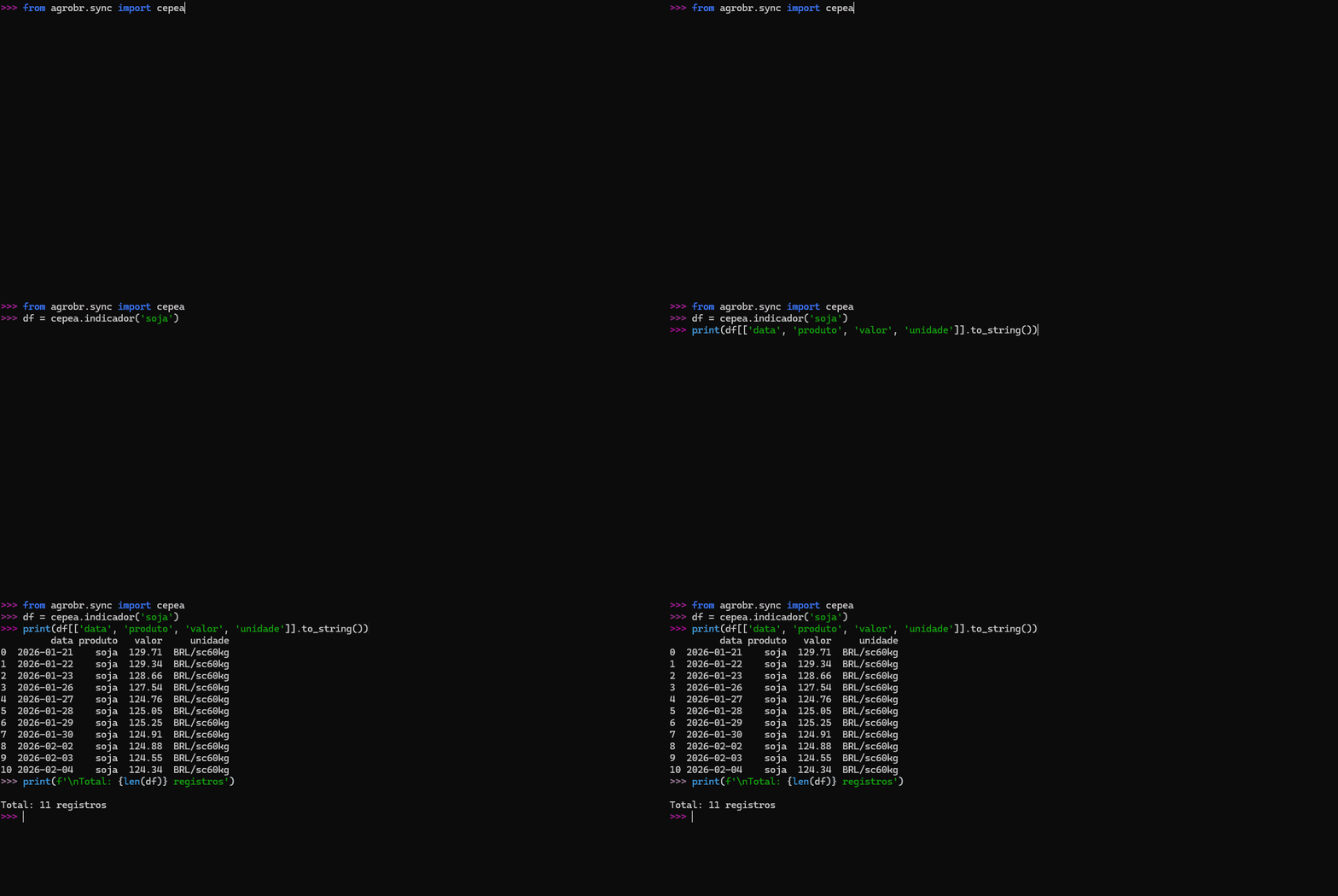
Demo
Installation
pip install agrobr
With optional extras:
pip install agrobr[pdf]             # pdfplumber for ANDA, ANEC, UNICA (biweekly report), Rio Verde, the Lista Suja PDF route and INCRA quilombola case progress
pip install agrobr[polars]          # Polars support
pip install agrobr[browser]         # Playwright (optional, for JS-heavy sources)
pip install agrobr[bigquery]        # Base dos Dados (BCB/SICOR fallback)
pip install agrobr[geo]             # GeoPandas — enables _geo variants (PRODES, DETER, SICAR, FUNAI, ICMBio, CNUC, IBGE municipal mesh and urbanized areas, INCRA, IBAMA, fire hotspots, MapBiomas Alerta, ANA, SFB, EMBRAPA Soils, INCRA land registry)
pip install agrobr[all]             # All optional runtime integrations
CONAB crop surveys and supply/demand balances use HTTP first; Playwright and Chromium are an optional transport fallback:
pip install agrobr[browser]
python -m playwright install chromium
Docker
docker build -t agrobr .
docker run -it --rm agrobr
>>> from agrobr.sync import cepea
>>> df = cepea.indicador('soja', inicio='2024-01-01')
# CLI
docker run --rm agrobr agrobr cepea indicador boi

# Persist cache between runs
docker run -it --rm -v agrobr-cache:/home/agrobr/.agrobr agrobr

# With additional extras (EXTRAS overrides the "browser,pdf" default)
docker build --build-arg EXTRAS="browser,pdf,polars" -t agrobr:extras .

# Run a local script
docker run --rm -v "$(pwd)":/work agrobr python /work/analysis.py
The default image ships Playwright + Chromium and pdfplumber. See the Docker guide for additional extras.
Usage by category
The examples below use the async form. For the equivalent without async/await, see Sync mode. Functions returning DataFrames accept as_polars=True and return_meta=True (provenance); _geo variants return GeoDataFrames and accept only return_meta.
Note on naming: function and parameter names follow Brazilian Portuguese domain terms (
indicador= indicator,safra= crop season,produto= product,inicio/fim= start/end,ano= year,mes= month,uf= state code). They are part of the public API and stay stable.
Prices and markets
CEPEA (daily spot), B3 (agricultural futures), IMEA (Mato Grosso), CONAB CEASA/PROHORT (wholesale produce), ANP Diesel.
from agrobr import cepea

# CEPEA daily indicators — soybean, corn, coffee, cattle, wheat, cotton, rice, etc.
df = await cepea.indicador('soja', inicio='2024-01-01')
ultimo = await cepea.ultimo('soja')
print(f"Soybean: R$ {ultimo.valor}/60kg bag on {ultimo.data}")

print(await cepea.produtos())       # 22 products available
print(await cepea.pracas('soja'))   # trading locations per product
| Source | Flagship function | Doc |
|---|---|---|
| B3 agri futures | b3.ajustes(data="13/02/2025"), b3.posicoes_abertas(data=...), b3.historico(contrato="boi", inicio=..., fim=...) |
docs/sources/b3.md |
| CFTC COT fund positioning (Chicago/NY) | cftc.cot("soja", inicio="2026-05-01") |
docs/sources/cftc.md |
| IMEA Mato Grosso | imea.cotacoes("soja", safra="24/25") |
docs/sources/imea.md |
| CONAB CEASA | conab.ceasa_precos(produto="tomate", ceasa="SAO PAULO") |
docs/sources/conab_ceasa.md |
| ANP Diesel | alt.anp_diesel.precos_diesel(uf="MT"), alt.anp_diesel.vendas_diesel(uf="MT") |
docs/sources/anp_diesel.md |
Production and crop seasons
CONAB (crop surveys, supply/demand balance, production costs, historical series, planting/harvest progress), IBGE (PAM, LSPA, PPM, slaughter, PEVS, milk, GDP, agricultural census), DERAL, USDA PSD, ABIOVE, ANEC, UNICA, Rio Verde.
from agrobr import conab, ibge

# CONAB — current season + supply/demand balance
df = await conab.safras('soja', safra='2024/25')
df = await conab.balanco('soja')
df = await conab.serie_historica('soja', ano_inicio=2010, ano_fim=2024)
df = await conab.progresso_safra(produto='Soja', uf='MT', operacao='Colheita')
catalogo = await conab.catalogo_custos("soja")
planilha = catalogo["planilha"].max()
contextos = await conab.catalogo_custos("soja", planilha=planilha)
mt = contextos[contextos["uf"].eq("MT") & contextos["status"].eq("identified")]
aba = mt.sort_values("ano_referencia")["aba"].iloc[-1]
df = await conab.custo_producao("soja", uf="MT", planilha=planilha, aba=aba)

# IBGE — Municipal Agricultural Production (annual)
df = await ibge.pam('soja', ano=2023, nivel='uf')
df = await ibge.pam('cafe', ano=2023, nivel='municipio', uf='MG')
df = await ibge.lspa('soja', ano=2024, mes=6)        # monthly systematic survey
df = await ibge.ppm('bovino', ano=2023)               # municipal livestock
df = await ibge.abate('frango', trimestre='202303', uf='PR')

# Agricultural Census — 1995/2006/2017 + historical series 1920-2006 + 1985 municipal
df = await ibge.censo_agro('efetivo_rebanho')
df = await ibge.censo_agro_historico('estabelecimentos_area')
temas_1985 = await ibge.temas_censo_agro_municipal_1985()
Local package, one row per PDF cell. agrobr extracted the numbers of the 53 themes (tables 67 to 119 of the IBGE's 28 state volumes) and ships them in agrobr/data/censo_1985/: queries do not use the network. valor is filled only when the cell was confirmed by the printed sums (municipality → microregion → mesoregion → state); valor_lido always carries the reading, and status gives the confidence level, with the precision measured against blind oracles. See the contract.
| Source | Flagship function | Doc |
|---|---|---|
| IBGE PEVS | ibge.silvicultura('madeira_tora', ano=2023), ibge.extracao_vegetal('acai', ano=2023) |
docs/sources/ibge.md |
| IBGE Milk | ibge.leite_trimestral(trimestre='202303', uf='MG') |
docs/sources/ibge.md |
| IBGE Agri GDP | ibge.pib_agro(trimestre='202501', setor='agropecuaria') |
docs/sources/ibge.md |
| DERAL Paraná crop conditions | deral.condicao_lavouras('soja') |
docs/sources/deral.md |
| USDA PSD international | usda.psd('soja', country='BR', market_year=2024) (requires AGROBR_USDA_API_KEY) |
docs/sources/usda.md |
| ABIOVE soybean complex | abiove.exportacao(ano=2024, produto='grao') |
docs/sources/abiove.md |
| ANEC weekly shipments | anec.embarques(ano=2026), anec.destinos(ano=2026) |
docs/sources/anec.md |
| UNICA Center-South sugarcane crush | unica.moagem_quinzenal('cana'), unica.safra_resumo(), unica.producao_historica('acucar') |
docs/sources/unica.md |
| Rio Verde cultivar trials (MT) | rio_verde.ensaio_soja(safra='2025/2026') |
docs/sources/rio_verde.md |
Trade and logistics
ComexStat (Brazil), UN Comtrade (bilateral worldwide), ANTAQ (ports), ANTT (highway toll traffic).
from agrobr import comexstat, comtrade

# Brazilian exports/imports by NCM code and state, monthly
df = await comexstat.exportacao('soja', ano=2024, agregacao='mensal')
df = await comexstat.importacao('fertilizantes', ano=2024)

# Worldwide bilateral trade (UN Comtrade)
df = await comtrade.comercio('soja', reporter='BR')
df = await comtrade.trade_mirror('soja', reporter='BR')   # exporter/importer cross-validation
| Source | Flagship function | Doc |
|---|---|---|
| ANTAQ ports | antaq.movimentacao(ano=2024) |
docs/sources/antaq.md |
| ANTT toll traffic | alt.antt_pedagio.fluxo_pedagio(ano=2024), alt.antt_pedagio.pracas_pedagio(uf='SP') |
docs/sources/antt_pedagio.md |
Credit, FX and insurance
BCB — Brazil's central bank (SICOR + SGS + PTAX + Focus), MAPA PSR.
from agrobr import bcb, alt

# BCB SICOR — rural credit
df = await bcb.credito_rural('soja', safra='2024/25')
df = await bcb.credito_rural('soja', safra='2024/25', programa='Pronamp')

# BCB SGS — time series (Selic rate, IPCA inflation, agri PPI, FX, etc.)
df = await bcb.sgs('selic', ultimos=12)
df = await bcb.sgs('ipa_agricola', inicio='01/01/2020')
df = await bcb.sgs('pib_agropecuaria')                    # also: ipca, igpm, cdi, tjlp, dolar_ptax_venda...

# BCB PTAX — official USD/BRL rate
df = await bcb.ptax(inicio='01/01/2024', fim='31/12/2024')

# BCB Focus — market expectations survey
df = await bcb.focus('PIB Agropecuária')

# MAPA PSR — rural insurance policies and claims
df = await alt.mapa_psr.apolices(produto='soja', ano=2023)
df = await alt.mapa_psr.sinistros(produto='soja', uf='MT')
Climate and water
NASA POWER (global climatology), INMET (Brazilian weather stations, requires token), ANA/SNIRH (hydrography, irrigation).
from agrobr import nasa_power, inmet, ana

# NASA POWER — climatology by point or state (no auth)
df = await nasa_power.clima_uf('MT', ano=2024)
df = await nasa_power.clima_ponto(-12.6, -56.1, '2024-01-01', '2024-12-31')

# INMET — observational stations (requires AGROBR_INMET_TOKEN)
df = await inmet.estacao('A001', '2024-01-01', '2024-01-31')
df = await inmet.clima_uf('SP', ano=2024)

# ANA/SNIRH — center-pivot irrigation by state
df = await ana.pivos_irrigacao(uf='MT')
gdf = await ana.pivos_irrigacao_geo(uf='MT')   # requires agrobr[geo]
The INMET observational API raises
SourceUnavailableErrorwithout a token. Set it withexport AGROBR_INMET_TOKEN=your_token. For tokenless climate data, use NASA POWER.
Environmental
Fire hotspots (INPE), deforestation (PRODES + DETER), MapBiomas (land cover/transitions), MapBiomas Alerta, IBAMA (embargoes), ICMBio and CNUC (protected areas), SFB (public forests).
from agrobr import queimadas, desmatamento, mapbiomas

# Fire hotspots by satellite (6 biomes, 13 satellites)
df = await queimadas.focos(ano=2024, mes=9, uf='MT', bioma='Amazonia')

# Deforestation — PRODES (annual consolidated) + DETER (near-real-time alerts)
df = await desmatamento.prodes(bioma='Cerrado', ano=2022, uf='MT')
df = await desmatamento.deter(
    bioma='Amazônia', uf='PA',
    inicio='2024-01-01', fim='2024-06-30',
)

# MapBiomas — land use and land cover (1985-present)
df = await mapbiomas.cobertura(uf='MT', ano=2022)
df = await mapbiomas.transicao(uf='PA')
df = await mapbiomas.cobertura(nivel='municipio', municipio='5107925', ano=2025)

# Geo variants (require agrobr[geo])
gdf = await desmatamento.prodes_geo(bioma='Cerrado', ano=2022, uf='MT')
gdf = await queimadas.focos_geo(ano=2024, mes=9, uf='MT')
| Source | Flagship function | Doc |
|---|---|---|
| MapBiomas Alerta | mapbiomas_alerta.alertas(inicio='2024-01-01') (requires AGROBR_MAPBIOMAS_ALERTA_TOKEN) |
docs/sources/mapbiomas_alerta.md |
| IBAMA embargoes | ibama.embargos(uf='PA') |
docs/sources/ibama.md |
| ICMBio federal protected areas | icmbio.ucs(uf='AM', grupo='PI') |
docs/sources/icmbio.md |
| CNUC protected areas (federal, state, municipal, private reserves) | cnuc.ucs(uf='SE', esfera='municipal') |
docs/sources/cnuc.md |
| SFB public forests | sfb.cnfp(uf='AM'), sfb.concessoes(uf='AM'), sfb.ifn_conglomerados(uf='MT') |
docs/sources/sfb.md |
Land registries
SICAR (rural environmental registry), INCRA land registry (SIGEF/SNCI/settlements), FUNAI (indigenous lands), INCRA (quilombola territories), EMBRAPA Soils (PronaSolos + SiBCS).
from agrobr import alt, acervo_fundiario, funai, incra, embrapa_solos

# SICAR — rural environmental registry (rural properties by state)
df = await alt.sicar.imoveis('DF')
df = await alt.sicar.resumo('MT', municipio='Sorriso')

# INCRA land registry — certified parcels and settlements
df = await acervo_fundiario.sigef('MT')
df = await acervo_fundiario.snci('PA')
df = await acervo_fundiario.assentamentos(uf='PA')

# FUNAI — indigenous lands
df = await funai.terras_indigenas(uf='AM', fase='Regularizada')

# INCRA — quilombola territories
df = await incra.quilombolas(uf='BA')

# EMBRAPA Soils — PronaSolos soil profiles + SiBCS soil map
df = await embrapa_solos.perfis(uf='SP')
df = await embrapa_solos.mapa_solos(ordem='LATOSSOLO')

# Geo variants (require agrobr[geo])
gdf = await alt.sicar.imoveis_geo('DF')
gdf = await funai.terras_indigenas_geo(uf='AM')
gdf = await acervo_fundiario.sigef_geo('MT')
gdf = await embrapa_solos.mapa_solos_geo(ordem='LATOSSOLO')
Inputs and regulatory
ANDA (fertilizers), Agrofit (registered pesticides), RNC (plant cultivars), Lista Suja (slave labor registry), ZARC (climate risk zoning).
from agrobr import anda, defensivos, rnc, lista_suja, zarc

# ANDA — fertilizer deliveries (requires agrobr[pdf])
df = await anda.entregas(ano=2024)

# Agrofit — pesticides registered in Brazil
df = await defensivos.formulados(ingrediente_ativo='glifosato')
df = await defensivos.tecnicos(titular='Bayer')
df = await defensivos.autorizacoes(cultura='soja')

# RNC/CultivarWeb — current registered and protected cultivars
df = await rnc.registradas(especie='Soja')
df = await rnc.protegidas(titular='Embrapa')

# Lista Suja — employers caught using slave-like labor
df = await lista_suja.empregadores(uf='PA')

# ZARC — agricultural climate risk zoning (planting windows)
df = await zarc.zoneamento(produto='soja', uf='MT')
print(zarc.culturas())   # 107 crops (annual, perennial and legacy labels)
Semantic layer — datasets
Use datasets for normalized data with tracked provenance. Automatic fallback applies where a dataset has compatible alternative sources configured; datasets with a single source use that source exclusively.
from agrobr import datasets

# Daily price (CEPEA → fallback)
df = await datasets.preco_diario('soja')

# Annual production (IBGE PAM → CONAB)
df = await datasets.producao_anual('soja', ano=2023)

# Current season estimate (CONAB → IBGE LSPA)
df = await datasets.estimativa_safra('soja', safra='2024/25')

# Rural credit (BCB SICOR → BigQuery via basedosdados)
df = await datasets.credito_rural('soja', safra='2024/25')

# Climate (INMET → NASA POWER)
df = await datasets.clima(uf='SP', ano=2024)

# With provenance: meta includes which source was used and which were attempted
df, meta = await datasets.preco_diario('soja', return_meta=True)
print(meta.selected_source, meta.attempted_sources, meta.contract_version)

# List all available datasets
print(datasets.list_datasets())
55 datasets available. See the full list below.
Reproducibility — snapshots and deterministic mode
Snapshots export data as parquet for reproducible analyses — papers, audits and CI pipelines.
from agrobr import datasets
from agrobr.snapshots import create_snapshot, list_snapshots, delete_snapshot

# Create a snapshot (saves current data under ~/.agrobr/snapshots/; CONAB and IBGE go to the network)
info = await create_snapshot("2025-Q4")
info = await create_snapshot(sources=["cepea", "conab"])

# List and remove
for s in list_snapshots():
    print(s.name, s.file_count, f"{s.size_bytes/1024/1024:.1f} MB")
delete_snapshot("2025-Q4")

# Deterministic mode — pins the reference date; only preco_diario reads the local cache, with no network
async with datasets.deterministic("2025-12-31"):
    df = await datasets.preco_diario("soja")
Deterministic mode does not read snapshots: it pins the reference date. Only preco_diario honors it, reading the local
cache, with no network, up to that date (without the product in the cache, it raises SourceUnavailableError). Other
datasets either reject the context before the network or query the current source and warn, in validation_warnings
and with a UserWarning, that the data is not that date's. See the
snapshots guide.
Via CLI:
agrobr snapshot create 2025-Q4 --sources cepea,conab,ibge
agrobr snapshot list
agrobr snapshot delete 2025-Q4
Sync mode
from agrobr.sync import cepea, conab, ibge, datasets, alt

# Same API, no async/await
df = cepea.indicador('soja', inicio='2024-01-01')
df = conab.safras('soja', safra='2024/25')
df = ibge.pam('soja', ano=2023)
df = datasets.preco_diario('soja')
df = alt.sicar.imoveis('DF')
Every top-level source plus alt is available under agrobr.sync with the same signatures at runtime. Type checkers and editors do not see them, because the mirror is dynamic and returns Any; for typed code, use the async API.
Polars support
df = await cepea.indicador('soja', as_polars=True)
df = await datasets.preco_diario('soja', as_polars=True)
df = await ibge.pam('soja', ano=2023, as_polars=True)
Supported across the source APIs and datasets, except the _geo variants (GeoDataFrame).
CLI
# Sources
agrobr cepea indicador soja --ultimo
agrobr cepea indicador milho --inicio 2024-01-01 --formato csv
agrobr conab safras soja --safra 2024/25
agrobr conab balanco milho
agrobr ibge pam soja --ano 2023 --nivel uf
agrobr ibge lspa milho --ano 2024 --mes 6

# Diagnostics and configuration
agrobr health
agrobr health --source cepea --deep
agrobr doctor --verbose
agrobr config show

# Snapshots
agrobr snapshot create 2025-Q4 --sources cepea,conab,ibge
agrobr snapshot list
Available datasets
| Dataset | Description | Sources |
|---|---|---|
cotacoes_cambio |
PTAX quotes by currency and bulletin | BCB |
expectativas_mercado |
Annual and monthly BCB Focus expectations | BCB |
moedas_cambio |
Current PTAX currency catalogue | BCB |
precos_diesel |
ANP weekly prices and explicit monthly aggregates | ANP |
unidades_conservacao |
Federal, state and municipal conservation units, including private reserves, from CNUC | CNUC/MMA |
unidades_conservacao_federais |
Federal conservation-unit attributes | ICMBio |
abate_trimestral |
Cattle, hog and poultry slaughter by state | IBGE |
autorizacoes_defensivos |
Use authorizations preserving published multiplicity | Agrofit/MAPA |
balanco |
Supply/demand balance | CONAB |
cadastro_rural |
Rural environmental registry (properties by state) | SICAR/GeoServer WFS |
censo_agropecuario |
Agricultural census 1995/2006/2017 (11 themes) | IBGE |
censo_agropecuario_historico |
Census historical series 1920-2006 (9 themes) | IBGE SIDRA |
censo_agropecuario_legado |
1995/96 census — 6 legacy themes (FTP) | IBGE FTP |
censo_agropecuario_municipal_1985 |
1985 census — 53 themes, one row per PDF cell, valor only when confirmed by the printed sums |
IBGE PDFs |
clima |
Monthly/daily climate data by state or station | INMET → NASA POWER |
comercio_internacional |
Bilateral international trade by HS code | UN Comtrade |
comparacao_anual_anec |
Monthly comparison between explicit years by report edition | ANEC |
composicao_defensivos |
Components and concentrations by family and registration | Agrofit/MAPA |
condicao_lavouras |
Weekly crop conditions in Paraná | DERAL |
credito_rural |
Rural credit by crop (program, insurance, modality) | BCB/SICOR → BigQuery |
cultivares_protegidas |
Protected cultivars by application, preserving conditional end-date text | CultivarWeb/SNPC |
cultivares_registradas |
Registered cultivars with exact textual registration IDs | CultivarWeb/RNC |
custo_producao |
Production costs | CONAB |
custo_sociobiodiversidade |
Sociobiodiversity costs in published units | CONAB |
defensivos_formulados |
Formulated products by registration | Agrofit/MAPA |
defensivos_tecnicos |
Technical products by registration | Agrofit/MAPA |
desmatamento |
PRODES/DETER deforestation — consolidated + alerts | INPE TerraBrasilis |
destinos_anec |
Cumulative destination shares with period and edition | ANEC |
embarques_anec |
Weekly shipments by port (soybean, meal, corn, DDGS, sorghum, wheat) | ANEC |
embarques_mensais_anec |
Monthly volumes and estimate ranges by report edition | ANEC |
empregadores_lista_suja |
Current national MTE employer registry; not restricted to agriculture | MTE / Lista Suja |
estimativa_safra |
Current season estimates | CONAB → IBGE LSPA |
exportacao |
Agricultural exports | ComexStat → ABIOVE |
extrativismo_vegetal |
Non-timber forest products (açaí, Brazil nut, yerba mate) | IBGE PEVS |
fertilizante |
Fertilizer deliveries | ANDA |
futuros_agricolas |
B3 agricultural futures (settlements, history, open interest) | B3 |
importacao |
Agricultural imports | ComexStat |
leite_industrial |
Quarterly milk intake and processing by state | IBGE |
movimentacao_portuaria |
Port cargo throughput (bulk, general, container) | ANTAQ |
oferta_demanda_global |
Global commodity supply/demand | USDA PSD |
pecuaria_municipal |
Municipal livestock (herds and animal products) | IBGE PPM |
pib_agro |
Agricultural GDP by sector and quarter | IBGE SIDRA |
posicionamento_fundos |
Weekly trader positioning in Chicago/NY agri futures (COT) | CFTC |
preco_atacado |
Wholesale produce prices at CEASA hubs | CONAB CEASA/PROHORT |
preco_diario |
Daily spot prices | CEPEA |
producao_acucar_etanol |
Sugar, cane and corn ethanol and ATR by season and state | CONAB |
producao_anual |
Consolidated annual production | IBGE PAM → CONAB |
progresso_safra |
Weekly planting/harvest progress | CONAB |
queimadas |
Satellite fire hotspots (6 biomes) | INPE |
seguro_rural |
Rural insurance policies and claims | MAPA PSR |
serie_historica_safra |
Crop historical series — 45 products, coverage varies by crop | CONAB |
series_economicas |
Economic time series by SGS code or alias, date range and latest observations | BCB SGS |
silvicultura |
Forestry production (eucalyptus, pine, charcoal) | IBGE PEVS |
uso_do_solo |
Annual land use and cover by state/municipality | MapBiomas |
zoneamento_agricola |
Agricultural climate risk zoning (ZARC) | MAPA/Embrapa |
The Lista Suja dataset reuses the current MTE publication and its CSV/PDF routes, without a historical snapshot or a second institutional source.
The four Agrofit datasets reuse the single defensivos source and its existing contracts. They have no fallback to another source.
The two cultivar datasets expose the current RNC/SNPC exports with exact ID filters, a 24-hour raw acquisition cache, and source provenance. For example, await datasets.cultivares_registradas(nr_registro='42039', return_meta=True). Protected cultivars retain the published end-date text in termino_protecao_texto; conditional protection is not converted to an invented date. These datasets do not provide historical snapshots.
Supported sources
Availability is monitored automatically. Run agrobr health to check locally (or agrobr health --source <name> --deep for a source-specific check with parsing).
| Source | Data | Golden Test | Status |
|---|---|---|---|
| CEPEA | Price indicators (22 products) | ✅ | Working |
| CONAB | Crop surveys, supply/demand, costs, historical series, weekly progress, CEASA wholesale prices | ✅ | Working |
| IBGE | PAM, LSPA, PPM, slaughter, PEVS, milk, GDP, agricultural census (1995-96/2006/2017 + historical series) | ✅ | Municipal 1985 census from the local package (valor only when confirmed); other routes operational |
| NASA POWER | Daily/monthly climatology (0.5° grid) | ✅ | Working |
| BCB/SICOR | Rural credit by crop + SGS series + PTAX + Focus | ✅¹ | Working |
| ComexStat | Exports and imports by NCM code/state | ✅¹ | Working |
| ANDA | Fertilizer deliveries | ✅ | Working |
| ABIOVE | Soybean complex exports (volume/revenue) | ✅ | Working |
| ANEC | Weekly shipments by port (soybean, meal, corn, DDGS, sorghum, wheat) | ✅ | Working |
| USDA PSD | International estimates (production/supply/demand) | ✅¹ | Working |
| IMEA | Mato Grosso quotes and indicators | ✅ | Working |
| DERAL | Paraná crop conditions | ✅ | Working |
| INMET | Weather (600+ stations) | ✅¹ | Requires AGROBR_INMET_TOKEN |
| Notícias Agrícolas | Quotes (CEPEA fallback, internal use) | ✅¹ | Working |
| Fire hotspots/INPE | Satellite fire detection (6 biomes, 13 satellites) | ✅ | Working |
| Deforestation PRODES/DETER | Consolidated deforestation + alerts (TerraBrasilis WFS) | ✅ | Working |
| MapBiomas | Land use and cover (1985-present), state and municipality level | ✅ | Working |
| B3 Agri Futures | Daily settlements + open interest (7 agri contracts) | ✅ | Working |
| UN Comtrade | Bilateral trade + trade mirror (~200 countries, HS codes) | ✅¹ | Working |
| ANTAQ | Port cargo throughput (bulk, general, container) | ⚠️ | Source offline since 2026-06-23 |
| ANP Diesel | Retail prices + diesel volumes by state/municipality | ✅ | Working |
| MAPA PSR | Rural insurance policies and claims (2006+, 27 states) | ✅ | Working |
| ANTT | Toll plaza vehicle traffic (2010+, 200+ plazas) | ✅ | Working |
| SICAR | Rural environmental registry — properties by state (7.4M+ records, WFS) | ✅ | Working |
| ZARC | Climate risk zoning (planting windows by municipality/crop/soil) | ✅ | Working |
| Agrofit/MAPA | Registered pesticides — formulations, authorizations, technical products (~8K) | ✅ | Working |
| MapBiomas Alerta | Deforestation alerts via GraphQL (500K+ alerts) | ✅ | Requires AGROBR_MAPBIOMAS_ALERTA_TOKEN |
| Lista Suja | Current MTE employer registry, CSV/TXT with PDF alternative | ✅ | Working |
| ANA/SNIRH | Hydrography, center-pivot irrigation, water demand/availability (ArcGIS REST) | ✅ | Working |
| SFB | Public forests (CNFP), forest concessions, national forest inventory (ArcGIS REST) | ✅ | Working (IFN offline since 2026-09-02) |
| FUNAI | Indigenous lands (WFS) — 665 territories, state/phase/bbox filters | ✅ | Working |
| IBAMA | Environmental embargoes (open-data CSV + WKT geometries) — ~116K records, daily update, state/bbox filter | ✅ | Working |
| ICMBio | Federal protected areas (WFS) — 347 units | ✅ | Working |
| CNUC | Federal, state and municipal protected areas, including private reserves (WFS) — 3,450 units | ✅ | Working |
| INCRA | Quilombola territories (WFS) — ~426 territories | ✅ | Working |
| INCRA land registry | SIGEF certified parcels (27 states) + SNCI (27 states) + settlements — shapefile ZIP | ✅ | Working |
| RNC/CultivarWeb | Current registered and protected cultivars; exact IDs and published end-date text — MAPA/SNPC | ✅ | Working |
| EMBRAPA Soils | PronaSolos soil profiles (34K+ horizons from ~9K points) + SiBCS soil map (2.8K polygons) | ✅ | Working |
| Fundação Rio Verde | Soybean cultivar trials in MT — 2023/24 to 2025/26 seasons, up to 4 planting dates (PDF) | ✅ | Working |
| CFTC COT | Weekly trader positioning — managed money, producers, swaps (12 agri contracts, 2006+) | ✅ | Working |
| UNICA | Center-South sugarcane crush, sugar/ethanol production, mix and ATR (biweekly PDF + historical XLSX) | ✅ | Working |
¹ Golden test with synthetic data —
needs_real_datafor validation against the live API.Several sources have restrictive or gray-area licenses — CEPEA and EMBRAPA Soils
nc, UN Comtraderestrito, and IMEA/Notícias Agrícolas/B3/ABIOVE/ANDA/ANEC/UNICA/Fundação Rio Verde/CONAB CEASA-PROHORTzona_cinza. They emitwarnings.warnon first call. See docs/licenses.md for the full table.
Contracts & Schemas
Every dataset has a formal contract with automatic validation. JSON schemas are generated under agrobr/schemas/:
from agrobr.contracts import get_contract, list_contracts, validate_dataset

# List registered contracts
list_contracts()

# Inspect a contract
contract = get_contract("preco_diario")
print(contract.primary_key)   # ['data', 'produto']
print(contract.to_json())     # full JSON schema

# Explicit validation (automatic on every fetch)
validate_dataset(df, "preco_diario")  # raises ContractViolationError
Global guarantees: stable column names (additions only), types only widen (int→float ok, float→int never), ISO-8601 dates, breaking changes only on major versions. See docs/contracts/ for per-dataset details.
Cross-source normalization
Helpers to standardize data across sources:
from agrobr.normalize import (
    normalizar_cultura, municipio_para_ibge, coordenada_para_municipio,
    normalizar_uf, normalizar_safra,
)

normalizar_cultura("Soja em Grão")        # "soja"
normalizar_cultura("milho 2ª safra")      # "milho_2"
normalizar_cultura("coffee")              # "cafe"

municipio_para_ibge("Sorriso", "MT")      # 5107925
municipio_para_ibge("SAO PAULO", "SP")    # 3550308

coordenada_para_municipio(-12.74, -55.68)
# {'codigo_ibge': 5107925, 'nome': 'Sorriso', 'uf': 'MT'}

normalizar_uf("São Paulo")                # "SP"
normalizar_safra("24/25")                 # "2024/25"
5,571 IBGE municipalities with centroids (offline reverse geocoding), 43 canonical crops, 27 states. Data from the IBGE Localities and Meshes APIs (free to use).
Highlights
- Golden tests with reference fixtures per source — automated validation against real or documented synthetic data
- Full HTTP resilience — centralized retry in every client, 429 handling, Retry-After
- Validation by increment — recorded test scope, public-call evidence and limitations; scalability benchmarks cover memory, volume and async behavior
- Semantic layer — standardized datasets with tracked provenance and fallback where alternative sources are configured
- Formal contracts — versioned schemas with automatic validation, primary keys and constraints
- JSON schemas exported under
agrobr/schemas/ - Deterministic mode + snapshots — reproducibility for papers and audits (deterministic mode in
preco_diario; CEPEA/CONAB/IBGE snapshots) - Cross-source normalization — IBGE municipalities, crops, states, crop seasons standardized
- Async-first with a sync wrapper for pipelines (Airflow, Prefect, Dagster)
- pandas + polars support across the APIs and datasets (except the
_geovariants, which return GeoDataFrames) - Validation — Pydantic v2 + statistical sanity checks + layout fingerprinting
- CEPEA cache with smart TTL (local DuckDB, expires at 6pm official CEPEA time)
- Multi-channel alerts (Slack, Discord, Email)
- Full CLI for debugging and automation
How it works
agrobr is a fetch + normalize library, not a storage framework. Every call goes to the source (with retry, layout fingerprinting and contract validation). There is no automatic history accumulation:
- CEPEA indicator cache — the only source with a persistent local cache. DuckDB with smart TTL: expires at 6pm (official CEPEA publish time), avoiding redundant calls during the day.
- Optional snapshots — you create them explicitly via
create_snapshot()for reproducibility. - Permanent history is the consumer's responsibility — historical APIs expose the observations currently published for a requested range. A single agrobr call may acquire several resources; BCB SGS splits long ranges into calendar blocks. This does not reconstruct earlier revisions. To retain successive publications, use a scheduler + parquet (next section).
Keeping data up to date
To accumulate history or run scheduled collection, integrate with Airflow, Prefect or Dagster using the sync API:
from datetime import date

# Airflow task
@task
def extract_daily_soybean():
    from agrobr.sync import datasets
    df = datasets.preco_diario("soja")
    df.to_parquet(f"/data/soja/{date.today()}.parquet")
See the pipelines guide and the async ergonomics guide.
Documentation
- Quickstart
- Datasets — contracts and guarantees
- Sources — all 41 sources documented
- Public API and reference
- Resilience
- Porting — guide for porting agrobr to R, Julia or other languages
Contributing
Contributions are welcome! See CONTRIBUTING.md for details.
Data licenses
Important: agrobr itself is MIT-licensed, but the data it accesses belongs to the respective sources and carries their own licenses. CEPEA/ESALQ data, for example, is CC BY-NC 4.0 (commercial use requires authorization). See docs/licenses.md for the full table of sources, licenses and classifications.
License
MIT — see LICENSE for details.
1 maintainer

Metadata
1 maintainer
Release files for agrobr 2.0.0
For a detailed explanation of source distributions (sdists) and built distributions (wheels), please see the package formats documentation.
Source distribution (sdist)
| File | Size | Uploaded | Provenance | Actions |
|---|---|---|---|---|
| agrobr-2.0.0.tar.gz | 10.3 MB | With provenance | Details for agrobr-2.0.0.tar.gz |
Built distribution (wheel)
| File | Interpreter | ABI | Platform | Actions Reset |
|---|---|---|---|---|
| agrobr-2.0.0-py3-none-any.whl | Python 3 | none | any | Details for agrobr-2.0.0-py3-none-any.whl |
Total release size: 20.8 MB
Release files / agrobr-2.0.0.tar.gz
| Download URL | agrobr-2.0.0.tar.gz |
|---|---|
| Size | 10.3 MB |
| Tags | Source |
|
SHA-256 checksum How to use checksums |
17c7284b809aad545f9fb3d0b3a755fe2b9bcf0adef90e3a56c557dc89ffce8e
|
|
BLAKE2b-256 checksum How to use checksums |
409759a99eb2ba9ce00c70452fa12f8fb0433250b2215bdc361594a1821d7eb1
|
| Upload date | |
|
Uploaded using Trusted Publishing? What is trusted publishing? |
Yes |
| Uploaded via |
twine/7.0.0 CPython/3.13.14
|
Provenance
Provenance describes where a file came from. On PyPI, provenance is shared via attestations, which provide a verifiable record of the build or publishing details. View details, limitations and caveats.


PyPI Publish Attestation
PyPI verified that this artifact, at this checksum, originated from the publisher listed below.
Signed by GitHub Actions, verified by PyPI on Oct 10, 2026.
Transparency logRelease files / agrobr-2.0.0-py3-none-any.whl
| Download URL | agrobr-2.0.0-py3-none-any.whl |
|---|---|
| Size | 10.5 MB |
| Tags | Python 3 |
|
SHA-256 checksum How to use checksums |
18510c6597c84b8427637b1fed207d83f1f6d04f26e44832d00302b9965654ce
|
|
BLAKE2b-256 checksum How to use checksums |
d2cc7a1847cad9ae2249ec7a81ff9fe3ca09ba48223f7f1c1882c1734483a3c0
|
| Upload date | |
|
Uploaded using Trusted Publishing? What is trusted publishing? |
Yes |
| Uploaded via |
twine/7.0.0 CPython/3.13.14
|
Provenance
Provenance describes where a file came from. On PyPI, provenance is shared via attestations, which provide a verifiable record of the build or publishing details. View details, limitations and caveats.
PyPI Publish Attestation
PyPI verified that this artifact, at this checksum, originated from the publisher listed below.
Signed by GitHub Actions, verified by PyPI on Oct 10, 2026.
Transparency logSecurity for agrobr 2.0.0
Provenance
Provenance describes where a file came from. On PyPI, provenance is shared via attestations, which provide a verifiable record of the build or publishing details. View details, limitations and caveats.
Full provenance
Both files in this release have been uploaded with provenance metadata.
Attestation for agrobr-2.0.0.tar.gz
PyPI Publish Attestation
PyPI verified that this artifact, at this checksum, originated from the publisher listed below.
Signed by GitHub Actions, verified by PyPI on Oct 10, 2026.
Transparency logA note on package security
PyPI is a repository for distributing packages, not a service for auditing them. While third-party security researchers and our staff do their best to detect and remove malicious packages, PyPI cannot guarantee the quality, security or suitability of any given package.
To learn more about protecting yourself from malicious actors, visit our package security documentation.














