
ahocorapy - Pure python ahocorasick implementation
Verified details
These details have been verified by PyPIProject links
GitHub Statistics
Maintainers


Project description






ahocorapy - Fast Many-Keyword Search in Pure Python
ahocorapy is a pure python implementation of the Aho-Corasick Algorithm. Given a list of keywords one can check if at least one of the keywords exist in a given text in linear time.
Comparison:
Why another Aho-Corasick implementation?
We started working on this in the beginning of 2016. Our requirements included unicode support combined with python2.7. That was impossible with C-extension based libraries (like pyahocorasick). Pure python libraries were very slow or unusable due to memory explosion. Since then another pure python library was released py-aho-corasick. The repository also contains some discussion about different implementations. There is also acora, but it includes the note ('current construction algorithm is not suitable for really large sets of keywords') which really was the case the last time I tested, because RAM ran out quickly.
Differences
-
Compared to pyahocorasick our library supports unicode in python 2.7 just like py-aho-corasick. We don't use any C-Extension so the library is not platform dependant.
-
On top of the standard Aho-Corasick longest suffix search, we also perform a shortcutting routine in the end, so that our lookup is fast while, the setup takes longer. During set up we go through the states and directly add transitions that are "offered" by the longest suffix or their longest suffixes. This leads to faster lookup times, because in the end we only have to follow simple transitions and don't have to perform any additional suffix lookup. It also leads to a bigger memory footprint, because the number of transitions is higher, because they are all included explicitely and not implicitely hidden by suffix pointers.
-
We added a small tool that helps you visualize the resulting graph. This may help understanding the algorithm, if you'd like. See below.
-
Fully pickleable (pythons built-in de-/serialization). ahocorapy uses a non-recursive custom implementation for de-/serialization so that even huge keyword trees can be pickled.
Performance
I compared the two libraries mentioned above with ahocorapy, using a 50,000 keywords long list and two input texts:
- sparse: 34,198 characters of text that contain exactly one keyword. This resembles searching ordinary text for a set of names.
- dense: 85,578 characters built by concatenating keywords, containing 6,207 matches. This measures the other extreme, where almost every position is part of a match.
The setup process was run once per library and each search was run 100 times. The following results are in seconds (not averaged for the lookup).
You can perform this test yourself using python tests/ahocorapy_performance_test.py. (Except for the pure python variant of
pyahocorasick. It's not published on pypi, so those numbers were taken by importing the pure python code from the
pyahocorasick repo at etc/py/pyahocorasick.py.)
The pure python libraries were additionally run with pypy.
These are the results:
| Library (Variant) | Setup (1x) | Search sparse (100x) | Search dense (100x) |
|---|---|---|---|
| ahocorapy* | 0.19s | 0.02s | 0.42s |
| ahocorapy (run with pypy)* | 0.23s | 0.01s | 0.28s |
| pyahocorasick* | 0.02s | 0.02s | 0.08s |
| pyahocorasick (run with pypy)* | 0.03s | 0.03s | 0.15s |
| pyahocorasick (pure python variant in github repo)* | 0.10s | 0.21s | 0.69s |
| pyahocorasick (pure python variant, run with pypy)* | 0.18s | 0.07s | 0.30s |
| py_aho_corasick* | 0.34s | 2.05s | 2.48s |
| py_aho_corasick (run with pypy)* | 0.45s | 1.00s | 1.19s |
On sparse text ahocorapy is on par with the pyahocorasick C-Extension on CPython, and faster than it on pypy. This is possible because during setup ahocorapy precomputes the matches to report per state and a regex character class of all symbols that keywords can start with, which the search loop then uses to skip over stretches of text that cannot contain a keyword start at C speed. On match-dense text the C-Extension is still clearly faster. Setup takes longer than with pyahocorasick due to the suffix shortcutting and match precomputation described above. Compared to the other pure python libraries ahocorapy is the fastest in every discipline.
* Specs
CPU: Apple M4 Pro
OS: macOS 26.5.2 (Darwin 25.5.0)
CPython: 3.14.5
pypy: PyPy 7.3.23 (Python 3.11.15) with GCC Apple LLVM 21.0.0 (clang-2100.0.123.102)
Library versions: ahocorapy 1.8.0, pyahocorasick 2.3.1, py_aho_corasick 1.1.0
Date tested: 2026-07-21
Basic Usage:
Installation
pip install ahocorapy
Creation of the Search Tree
from ahocorapy.keywordtree import KeywordTree
kwtree = KeywordTree(case_insensitive=True)
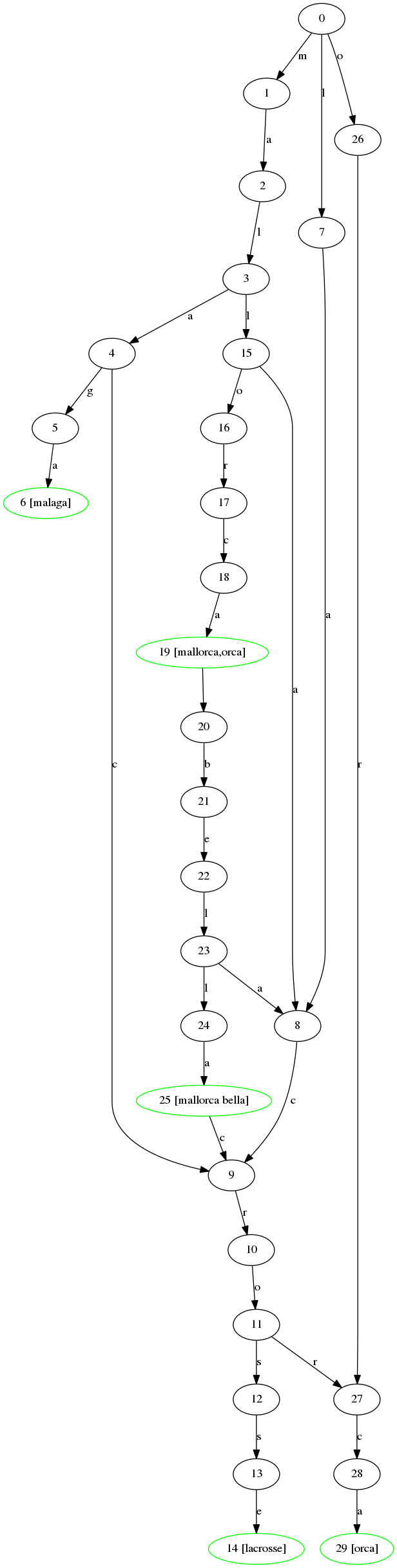
kwtree.add('malaga')
kwtree.add('lacrosse')
kwtree.add('mallorca')
kwtree.add('mallorca bella')
kwtree.add('orca')
kwtree.finalize()
Searching
result = kwtree.search('My favorite islands are malaga and sylt.')
print(result)
Prints :
('malaga', 24)
The search_all method returns a generator for all keywords found, or None if there is none.
results = kwtree.search_all('malheur on mallorca bellacrosse')
for result in results:
    print(result)
Prints :
('mallorca', 11)
('orca', 15)
('mallorca bella', 11)
('lacrosse', 23)
Arbitrary Sequences of Arbitrary Symbols
ahocorapy is not limited to strings. Keywords and search input can be any sequence of hashable symbols. Internally the tree never assumes anything about the symbols beyond that they can be used as dictionary keys, so it works with tuples of integers, byte values, lists of tokens and more.
The only requirements are:
- Each symbol (an element of the sequence) must be hashable.
- Each keyword and the search input must be an iterable that also
supports
len()(needed to compute match start indices). Strings, tuples, lists and bytes all qualify.
For example, using tuples of integers as keywords:
from ahocorapy.keywordtree import KeywordTree
kwtree = KeywordTree()
kwtree.add((1, 2, 3))
kwtree.add((2, 3, 4))
kwtree.finalize()

result = kwtree.search((9, 1, 2, 3, 4, 8))
print(result)
Prints:
((1, 2, 3), 1)
Using lists of string tokens enables word-level (instead of character-level) matching:
kwtree = KeywordTree()
kwtree.add(['hello', 'world'])
kwtree.finalize()

result = kwtree.search(['say', 'hello', 'world', 'now'])
print(result)
Prints:
(['hello', 'world'], 1)
A note on bytes: in Python 3 iterating over a bytes object yields integers,
whereas in Python 2 bytes is an alias for str and yields 1-character
strings. Matching works in both cases, but the symbol type differs between the
two Python versions.
The case_insensitive=True option is string-specific (it calls .lower() on
keywords and input) and therefore only applies when your symbols are strings.
Thread Safety
The construction of the tree is currently NOT thread safe. That means adding shouldn't be called multiple times concurrently. Behavior is undefined.
After finalize is called you can use the search functionality on the same tree from multiple threads at the same time. So that part is thread safe.
Drawing Graph
You can print the underlying graph with the Visualizer class. This feature requires a working pygraphviz library installed.
from ahocorapy_visualizer.visualizer import Visualizer
visualizer = Visualizer()
visualizer.draw('readme_example.png', kwtree)
The resulting .png of the graph looks like this:
Project details
Verified details
These details have been verified by PyPIProject links
GitHub Statistics
Maintainers
Release history Release notifications | RSS feed


Download files
Download the file for your platform. If you're not sure which to choose, learn more about installing packages.
Source Distribution
Built Distribution
Filter files by name, interpreter, ABI, and platform.
If you're not sure about the file name format, learn more about wheel file names.
Copy a direct link to the current filters
File details
Details for the file ahocorapy-1.8.0.tar.gz.
File metadata
- Download URL: ahocorapy-1.8.0.tar.gz
- Upload date:
- Size: 13.8 kB
- Tags: Source
- Uploaded using Trusted Publishing? Yes
- Uploaded via: twine/6.1.0 CPython/3.13.14
File hashes
| Algorithm | Hash digest | |
|---|---|---|
| SHA256 |
931c05a90318fce3000baa0a0400f57934bb30b2ce54a6fff8b5a017812950aa
|
|
| MD5 |
d9662d7e6c6fe7237e793b267dc9a93c
|
|
| BLAKE2b-256 |
19b10dcfd841383d33e6e05a0a60da14109008bbf7f5ca2d4d6582430916492a
|
Provenance
The following attestation bundles were made for ahocorapy-1.8.0.tar.gz:
Publisher:
publish.yml on FrederikP/ahocorapy
-
Statement:
-
Statement type:
https://in-toto.io/Statement/v1 -
Predicate type:
https://docs.pypi.org/attestations/publish/v1 -
Subject name:
ahocorapy-1.8.0.tar.gz -
Subject digest:
931c05a90318fce3000baa0a0400f57934bb30b2ce54a6fff8b5a017812950aa - Sigstore transparency entry: 2211947024
- Sigstore integration time:
-
Permalink:
FrederikP/ahocorapy@410e4d7ae2464014f40e3a8f2b3d19640529ae03 -
Branch / Tag:
refs/tags/1.8.0 - Owner: https://github.com/FrederikP
-
Access:
public
-
Token Issuer:
https://token.actions.githubusercontent.com -
Runner Environment:
github-hosted -
Publication workflow:
publish.yml@410e4d7ae2464014f40e3a8f2b3d19640529ae03 -
Trigger Event:
release
-
Statement type:
File details
Details for the file ahocorapy-1.8.0-py2.py3-none-any.whl.
File metadata
- Download URL: ahocorapy-1.8.0-py2.py3-none-any.whl
- Upload date:
- Size: 10.6 kB
- Tags: Python 2, Python 3
- Uploaded using Trusted Publishing? Yes
- Uploaded via: twine/6.1.0 CPython/3.13.14
File hashes
| Algorithm | Hash digest | |
|---|---|---|
| SHA256 |
787bb3c7bcf3b9ba87371ad53e5aac626c65c57ab2c67701bff9a813eb01d9e1
|
|
| MD5 |
7ede61354529642228e62985273d8e1a
|
|
| BLAKE2b-256 |
8527d64eeec1361b27ca28a661d94505e89b35185182ee1a3851638b94887e17
|
Provenance
The following attestation bundles were made for ahocorapy-1.8.0-py2.py3-none-any.whl:
Publisher:
publish.yml on FrederikP/ahocorapy
-
Statement:
-
Statement type:
https://in-toto.io/Statement/v1 -
Predicate type:
https://docs.pypi.org/attestations/publish/v1 -
Subject name:
ahocorapy-1.8.0-py2.py3-none-any.whl -
Subject digest:
787bb3c7bcf3b9ba87371ad53e5aac626c65c57ab2c67701bff9a813eb01d9e1 - Sigstore transparency entry: 2211947066
- Sigstore integration time:
-
Permalink:
FrederikP/ahocorapy@410e4d7ae2464014f40e3a8f2b3d19640529ae03 -
Branch / Tag:
refs/tags/1.8.0 - Owner: https://github.com/FrederikP
-
Access:
public
-
Token Issuer:
https://token.actions.githubusercontent.com -
Runner Environment:
github-hosted -
Publication workflow:
publish.yml@410e4d7ae2464014f40e3a8f2b3d19640529ae03 -
Trigger Event:
release
-
Statement type:






