
AIActGuard
EU AI Act compliance middleware for agentic AI
Drop-in, not a rewrite. Every open-source agent framework is well-served at the orchestration layer. None of them log a decision, gate a high-risk action, or draft the paperwork Articles 12–14 ask for — that gap is what this fills, as a decorator/callback around the agent you already have.



Install · Quickstart · Why this exists · Module roadmap · Audit prioritization & drift diagnostics · Scope · Running the tests · Contributing
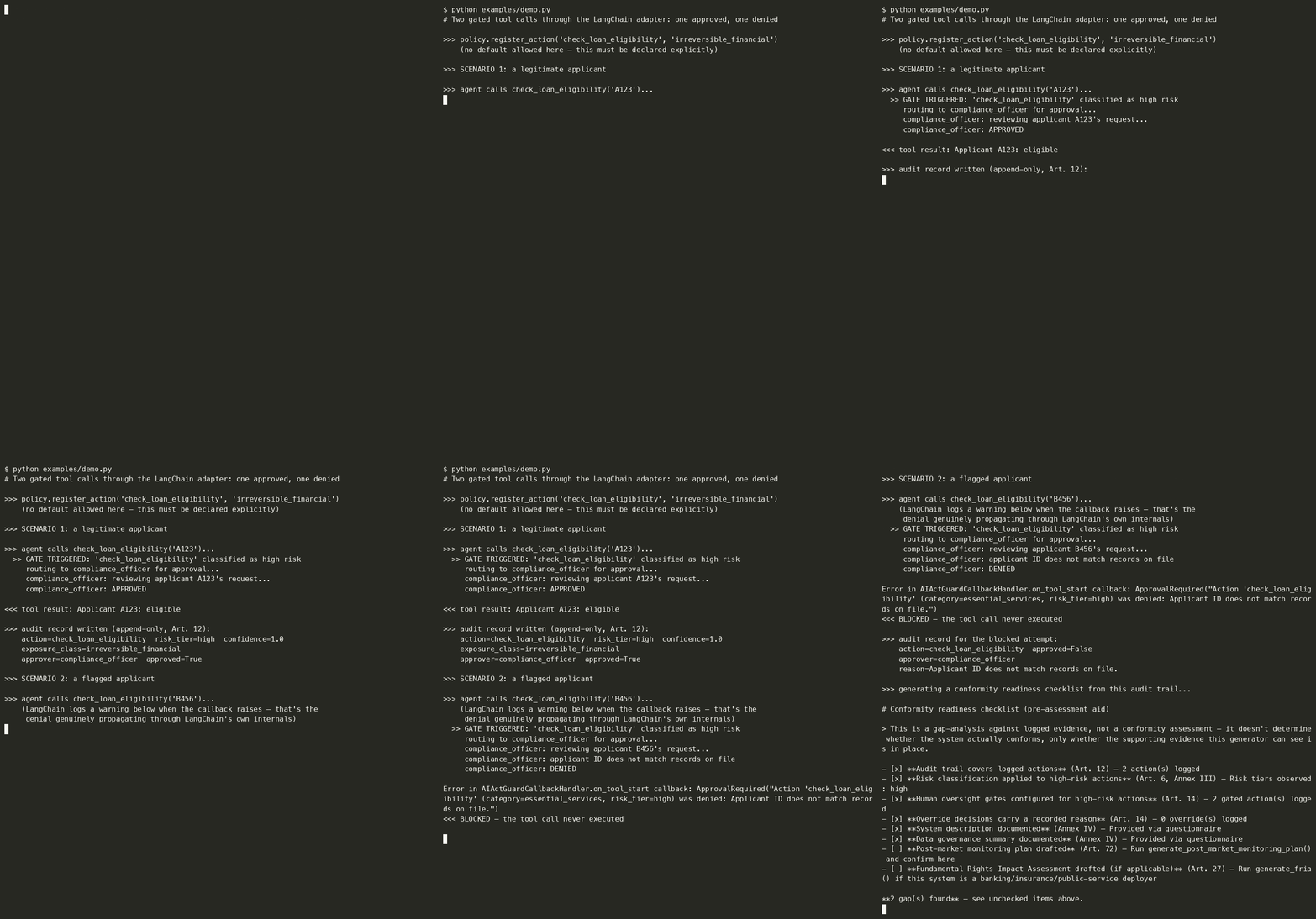
Recorded from examples/demo.py — real code, real gate decisions (one approval, one denial), real audit records, real report generated from both. The denial scenario shows LangChain's own internal warning when the callback raises — that's the block genuinely propagating through LangChain's real machinery, not this script claiming it worked. Two things are staged for the recording, not faked: the pacing between lines, and the approvers — canned functions playing the reviewer's role so the recording doesn't sit waiting on a keypress, not a live human typing an answer. See examples/langchain_quickstart.py for the input()-driven version an actual reviewer would use.
Install
pip install aiactguard[langchain]
Other extras: crewai, claude-agent-sdk, langgraph, autogen, openai-agents, postgres (for PostgresAuditStore), audit-priority (for the audit prioritization & drift diagnostics module) — mix and match, e.g. pip install aiactguard[langgraph,postgres].
Verify it installed correctly:
python -c "from aiactguard import watch; print('aiactguard OK')"
Quickstart
from aiactguard.adapters.langchain_adapter import AIActGuardCallbackHandler
from aiactguard.core.approval import ApprovalContext, ApprovalDecision


def compliance_officer(ctx: ApprovalContext) -> ApprovalDecision:
    approved = input(f"Approve {ctx.action} ({ctx.risk_tier.value})? [y/N] ").lower() == "y"
    return ApprovalDecision(approved=approved, approver_id="compliance_officer")


guard = AIActGuardCallbackHandler(
    category="essential_services",
    approvers=[compliance_officer],  # an escalation chain — add more to route to a fallback
)

agent_executor.invoke({"input": "..."}, config={"callbacks": [guard]})
See examples/ for full runnable examples: LangChain, CrewAI, Claude Agent SDK, LangGraph (using LangGraph's own interrupt() for human-in-the-loop), AutoGen, OpenAI Agents SDK, the framework-agnostic @watch decorator with an escalation chain + override, generating all five Phase 2 compliance reports from an audit trail, running the red-team scenario harness, a fairness scan, drafting an incident report + GPAI transparency card, composite-system risk aggregation, NIST/ISO mappings, using the Postgres storage backend, a worked community plugin, the script that recorded the demo above, and audit prioritization + the drift diagnostic report.
Why this exists
The agentic AI ecosystem is saturated at the orchestration layer — LangChain, CrewAI, AutoGen, and the rest all do that job well. None of them were built to satisfy Article 12 (audit trails), Article 13 (explainability), or Article 14 (human oversight), because that isn't what they're for. AIActGuard sits alongside whichever of those you already run, not in place of it.
flowchart LR
    A["Your agent<br/>(LangChain / CrewAI / ...)"] --> B["AIActGuard adapter<br/>or @watch"]
    B --> C{"Risk classifier<br/>+ policy-as-code"}
    C -->|"below gate threshold"| D["Action runs"]
    C -->|"gated"| E["Approver chain"]
    E -->|"approved"| D
    E -->|"denied"| F["Blocked — never runs"]
    D --> G[("Audit trail<br/>SQLite / Postgres")]
    F --> G
    G --> H["Report generators<br/>(checklist, FRIA, incident report, ...)"]
Every module drafts, flags, tests, or logs something concrete. None of them certify compliance on their own — that's a legal determination. See Scope below for the explicit boundary.
Module roadmap
All 19 modules from the original project plan are built.
Core (Phase 1)
| # | Module | Article(s) | What it does |
|---|---|---|---|
| 1 | Risk classification engine | Art. 6, Annex III | Tags each agent action/tool call against EU AI Act risk tiers using a configurable taxonomy across all eight Annex III high-risk categories |
| 2 | Immutable audit trail | Art. 12 | Every decision, tool call, input/output, model version, and timestamp logged to an append-only store — SQLite by default, Postgres for production |
| 3 | Human-in-the-loop approval gates | Art. 14 | Configurable interrupt points that pause execution before a high-risk action fires, with an escalation chain of approvers and reasoned-override logging |
| 4 | Explainability capture | Art. 13 | Structures the agent's chain-of-thought/tool-selection rationale into an auditor-readable format |
| 5 | Framework adapters | — | LangChain, CrewAI, Claude Agent SDK, LangGraph, AutoGen, OpenAI Agents SDK — all 6 |
| 6 | Policy-as-code | — | YAML rules defining what counts as high-risk for a given org and what triggers a human gate |
Documentation & assessment tooling (Phase 2)
| # | Module | Article(s) | What it does |
|---|---|---|---|
| 7 | Technical documentation generator | Art. 11, Annex IV | Auto-drafts the Annex IV technical file from audit logs + a guided questionnaire |
| 8 | Conformity readiness checklist | Art. 43 | Gap-analysis against Annex IV/VI requirements — a pre-assessment aid, not the assessment itself |
| 9 | FRIA template generator | Art. 27 | Pre-fills a Fundamental Rights Impact Assessment draft from risk classification and deployment context |
| 10 | Post-market monitoring plan generator | Art. 72 | Monitoring plan template scaffolded from risk tier and logged incident categories |
| 11 | EU database registration data prep | Art. 71 | Auto-compiles the metadata the Art. 71 registration form requires — filing stays manual |
Robustness & incident tooling (Phase 3)
| # | Module | Article(s) | What it does |
|---|---|---|---|
| 12 | Adversarial/red-team test harness | Art. 15 | Runs prompt-injection, jailbreak, and edge-case scenarios against your agent — heuristic detection, not semantic judgment |
| 13 | Bias & fairness scan | Art. 10 | Statistical checks on agent decisions across a caller-supplied protected-characteristic proxy, at runtime |
| 14 | Serious incident report drafter | Art. 73 | Turns a flagged incident into a structured draft for human review before filing |
| 15 | GPAI transparency card generator | Art. 53 | Auto-generates a model transparency summary from config + usage patterns |
Multi-agent & multi-standard extensions (Phase 4 — differentiators)
| # | Module | What it does |
|---|---|---|
| 16 | Composite-system risk aggregation | Flags when multiple individually low-risk agents, composed into a pipeline, cross into high-risk territory as a system |
| 17 | NIST AI RMF mapping layer | Maps audit/risk data to NIST AI RMF's Govern/Map/Measure/Manage functions |
| 18 | ISO/IEC 42001 mapping layer | Maps the same data to ISO 42001 AI management system clauses |
| 19 | Plugin architecture for community modules | Defined interface for jurisdiction- or industry-specific community modules |
Audit prioritization & drift diagnostics
Additional scope beyond the 19 modules above, contributed from the user's own research on adaptively-routed agent systems (paper forthcoming — no citation added yet since it isn't posted).
The research's core statistical method is an anytime-valid confidence sequence over a bin's true violation rate, built from accumulating human audit findings. The research itself also describes using that method to automatically stop requiring approval for certain actions once the statistics say a context is safe enough. AIActGuard deliberately does not implement that part — every gate here always defers to a human, with no exception. What's built instead is the same statistical method repurposed for two things that never remove a human from a decision:
aiactguard.audit_priority— ranks pending/completed audit records by how statistically uncertain the evidence still is for their confidence bin, so a compliance reviewer works down a prioritized list instead of reviewing randomly or chronologically. A bin nobody's reviewed yet ranks at the top by default; a bin with enough accumulated evidence of being safe ranks lower automatically as that evidence comes in.aiactguard.reports.drift_diagnostic— a monitoring report (not a gate) decomposing where "silent risk mass" concentrates across confidence bins, and checking whether the agent shows an elevated preference for high-exposure actions specifically in bins the classifier tends to miss.
Both require ground-truth findings from actual human review (aiactguard.audit_priority.findings.AuditFindingStore) to produce anything beyond "not enough evidence yet" — see examples/audit_priority_demo.py for a full worked example. Requires pip install aiactguard[audit-priority].
Scope
Running the tests
git clone https://github.com/NavikkumarModi/AIActGuard.git
cd AIActGuard
python3 -m venv .venv
.venv/bin/pip install -e ".[langchain,crewai,claude-agent-sdk,langgraph,autogen,openai-agents,postgres,dev]"
.venv/bin/pytest -q
# 117 passed
tests/test_postgres_store.py needs a reachable Postgres database (AIACTGUARD_TEST_POSTGRES_DSN, defaults to postgresql:///aiactguard_test) — it skips cleanly if none is available rather than failing the suite; CI runs a real Postgres service so it's exercised there either way. See CONTRIBUTING.md for the full setup and design principles.
Contributing
Contributions are welcome, especially jurisdiction- or industry-specific modules. Open an issue to discuss before submitting a large PR.
Writing a plugin: implement aiactguard.plugins.Plugin — a name, a description, and a generate(logger, *, questionnaire=None, **kwargs) -> str method (the same shape every built-in report/mapping already has). See examples/plugins/example_gxp_plugin.py for a worked example. To publish one for others to auto-discover, register it under the aiactguard.plugins entry-point group in your own package's pyproject.toml:
[project.entry-points."aiactguard.plugins"]
gxp = "aiactguard_gxp_plugin:plugin"
Callers pick it up with aiactguard.plugins.discover_entry_points().
License
MIT — see LICENSE.
1 maintainer

Metadata
1 maintainer
Release files for aiactguard 0.1.6
For a detailed explanation of source distributions (sdists) and built distributions (wheels), please see the package formats documentation.
Source distribution (sdist)
| File | Size | Uploaded | |
|---|---|---|---|
| aiactguard-0.1.6.tar.gz | 292.7 kB | Details |
Built distribution (wheel)
| File | Interpreter | ABI | Platform | Reset |
|---|---|---|---|---|
| aiactguard-0.1.6-py3-none-any.whl | Python 3 | none | any | Details |
Total release size: 356.9 kB
Release files / aiactguard-0.1.6.tar.gz
| Download URL | aiactguard-0.1.6.tar.gz |
|---|---|
| Size | 292.7 kB |
| Tags | Source |
|
SHA-256 checksum How to use checksums |
a7bf21b55ff597e2c7fe441bc4751652a355c4c67cd46b4eb8f428389a06aa2b
|
|
BLAKE2b-256 checksum How to use checksums |
53a8cac4e2b1b4ac9ea46364e80631972c36ece4936fdbfb535e75adb1b321bd
|
| Upload date | |
|
Uploaded using Trusted Publishing? What is trusted publishing? |
Yes |
| Uploaded via |
twine/7.0.0 CPython/3.13.14
|
Provenance
Provenance describes where a file came from. On PyPI, provenance is shared via attestations, which provide a verifiable record of the build or publishing details. View details, limitations and caveats.


PyPI Publish Attestation
PyPI verified that this artifact, at this checksum, originated from the publisher listed below.
Signed by GitHub Actions, verified by PyPI on Aug 25, 2026.
Transparency logRelease files / aiactguard-0.1.6-py3-none-any.whl
| Download URL | aiactguard-0.1.6-py3-none-any.whl |
|---|---|
| Size | 64.2 kB |
| Tags | Python 3 |
|
SHA-256 checksum How to use checksums |
2d63cb28a7b3fd1ba0b46bff0b9f7028791c8df90b46b09a2d24f1e345f07312
|
|
BLAKE2b-256 checksum How to use checksums |
14668f4e070f160f202aa6a579554802582b5cca450c77c9bbaebe6928a6c23d
|
| Upload date | |
|
Uploaded using Trusted Publishing? What is trusted publishing? |
Yes |
| Uploaded via |
twine/7.0.0 CPython/3.13.14
|
Provenance
Provenance describes where a file came from. On PyPI, provenance is shared via attestations, which provide a verifiable record of the build or publishing details. View details, limitations and caveats.
PyPI Publish Attestation
PyPI verified that this artifact, at this checksum, originated from the publisher listed below.
Signed by GitHub Actions, verified by PyPI on Aug 25, 2026.
Transparency log













