
CRUSADERS: A Dynamic Human-Machine Collaboration Framework
Design, run and evaluate Human-Machine Collaboration frameworks — without fighting your infra.
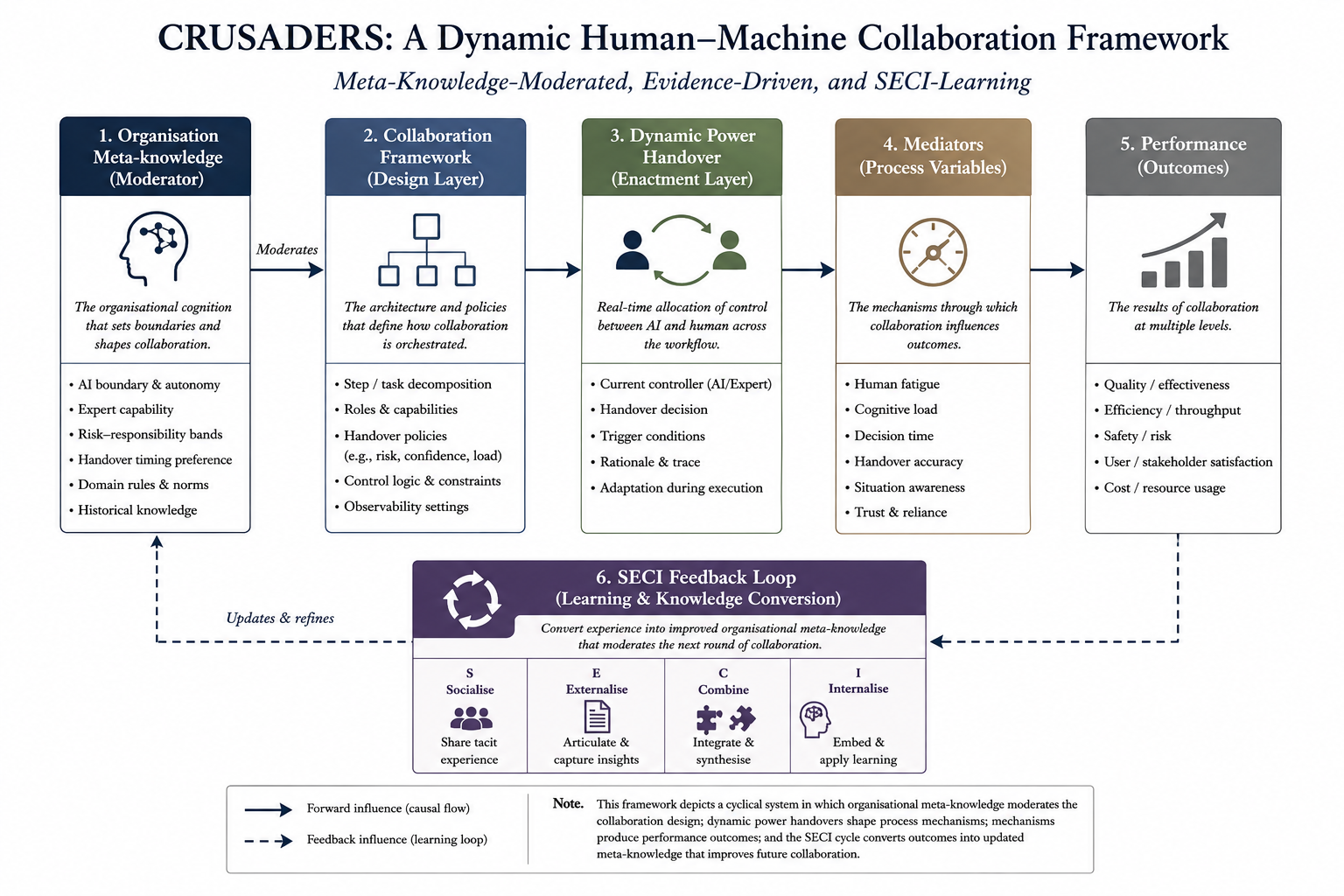
Crusaders is a Python scaffold for teams that build, measure and iteratively improve who does what between AI systems and human experts. It turns the abstract idea of "human-machine collaboration" into something you can prototype in an afternoon, run through a simulation, grade on real metrics, and evolve — all while staying true to one simple mechanism: dynamic power handover.
Why another framework?
Most "AI orchestration" tools ask you to wire an LLM into a pipeline. That is not the hard part. The hard part is deciding who is in control at every step, knowing whether that decision was a good one, and turning the evidence into a better policy next week.
Crusaders answers three questions explicitly:
- Who controls each step? You define the handover logic (policies or a custom subclass). We run the choreography.
- Did it work? We measure the process variables that actually mediate outcomes — human fatigue, cognitive load, decision time, handover accuracy — and the outcomes themselves: quality, efficiency, safety.
- What do we know now? A built-in SECI feedback loop converts observed performance into updated organisational meta-knowledge that moderates the next round of collaboration.
It is not a workflow engine, not a chatbot SDK, and not a lock-in. It is a measuring tape and a workshop for your collaboration design.
What's inside
| Layer | Pieces | You control |
|---|---|---|
| Meta-knowledge | OrganizationalMetaknowledge, risk-responsibility bands |
The moderator: AI boundary, expert capability, handover timing |
| Framework | HMCFramework base + HandoverDecision |
Your dynamic power handover logic |
| Policies | Risk gate, confidence, load-aware, composite, always-AI/expert | Reusable handover rules, moderated by meta-knowledge |
| Actors | RuleBasedAI, SimulatedExpert, OpenAIAdapter |
Drop in a real LLM or a live human client |
| Mediators | Fatigue, cognitive load, decision time, handover accuracy | Add your own process variables |
| Performance | Quality, efficiency, safety | Add your own DVs |
| Feedback | SECIEngine (socialise / externalise / combine / internalise) |
Tune the learning rate, add your own rules |
| Observability | Trace recorder, JSON + Markdown reports | Export to your own pipelines |
Quick start
pip install aicrusaders
Run a full scenario end-to-end:
from crusaders import SimulationRunner, SECIEngine
from crusaders.scenarios import healthcare_triage

report = SimulationRunner(healthcare_triage.framework(), seed=3).evaluate_tasks(
    healthcare_triage.tasks()
)
print(report.to_markdown())

update = SECIEngine(healthcare_triage.default_metaknowledge()).run(report)
updated = update.apply(healthcare_triage.default_metaknowledge())
print("new AI boundary:", updated.ai_boundary)
Or grab a ready-made demo with the CLI:
crusaders-demo
Design your own framework in 4 moves
1. Describe the work
from crusaders import StepSpec, TaskSpec

task = (
    TaskSpec("loan-1", "Auto loan underwriting")
    .add_step(StepSpec("extract", "Extract applicant data", complexity=0.3, risk=0.2))
    .add_step(StepSpec("approve", "Decision memo", complexity=0.7, risk=0.8))
)
2. Pick a framework — compose or subclass
The fastest path: compose built-in policies into a plain HMCFramework:
from crusaders import HMCFramework
from crusaders.policies import CompositePolicy, ConfidencePolicy, RiskGatePolicy

framework = HMCFramework(
    name="my-review-framework",
    policies=[
        CompositePolicy([
            RiskGatePolicy(base_threshold=0.5),
            ConfidencePolicy(floor=0.4),
        ])
    ],
)
The most expressive path: subclass and write the handover rule yourself.
from crusaders import HMCFramework, HandoverDecision, Role

class MyFramework(HMCFramework):
    def decide_handover(self, step, session):
        # your own logic: risk, fatigue, confidence, anything
        if step.step.risk > 0.6 and session.current_controller is Role.AI:
            return HandoverDecision(Role.EXPERT, reason="high risk")
        return HandoverDecision(session.current_controller)
3. Grade it
report = SimulationRunner(framework, seed=7).evaluate_repeated(task, n_runs=20)
report.to_json("loan-report.json")
print(report.to_markdown())
4. Learn from it
update = SECIEngine(metaknowledge, learning_rate=0.2).run(report)
framework.metaknowledge = update.apply(framework.metaknowledge)  # next round is moderated
Built-in scenarios
Three opinionated, runnable case studies — start from any of them.
| Scenario | Handover philosophy | Highlights |
|---|---|---|
healthcare_triage |
Human-in-the-loop safety net | Risk-gated escalation, expert owns red flags |
financial_underwriting |
Confidence-driven delegation | Composite policy, expert owns judgement calls |
code_review |
Efficiency-driven, load-aware | AI-first, engineers join for critical files |
python -c "from crusaders.scenarios import code_review; print(code_review.framework().name)"
Plug in a real LLM (or a real human)
Both sides of the handover are protocols. Swap the rule-based actors for anything:
from crusaders import OpenAIAdapter

ai = OpenAIAdapter()  # reads USER_LLM_API_KEY / USER_LLM_BASE_URL / USER_LLM_MODEL
report = SimulationRunner(framework).evaluate_tasks(tasks, ai=ai)
Or implement AIModel / Expert yourself — a single method, act(step, session),
so wiring in your internal model or a live operator UI takes minutes.
Why the metrics look the way they do
Every framework run produces an EvaluationReport with two metric families:
- Mediators (process) — fatigue, cognitive load, decision time, handover accuracy. These are the variables your handover design actually moves.
- Performance (outcomes) — quality (pass rate), efficiency (time vs ideal, including handover overhead), safety (risk-weighted accountability). These are what your organisation ultimately cares about.
The SECI engine reads both, distils lessons, and patches the meta-knowledge
(AI boundary, expert session limits, handover cost budget) so the next run of your
framework is moderated by what actually happened. See docs/theory.md for the
details and the notation.
Development
git clone https://github.com/NoahIsARider/Crusaders.git
cd crusaders
pip install -e ".[dev]"
pytest
Everything is deterministic given a seed, so your experiments are reproducible.
Roadmap
- Live human-in-the-loop driver (wait-for-operator expert adapter)
- Chart exports for mediator time-series
- A/B comparison runner for framework variants
- Statistical significance helpers for repeated runs
License
Apache-2.0. Go build something that works better for the humans on the loop.
1 maintainer

Download files
Download the file for your platform. If you're not sure which to choose, learn more about installing packages.
Source Distribution
Built Distribution
Filter files by name, interpreter, ABI, and platform.
If you're not sure about the file name format, learn more about wheel file names.
Copy a direct link to the current filters
File details
Details for the file aicrusaders-0.2.0.tar.gz.
File metadata
- Download URL: aicrusaders-0.2.0.tar.gz
- Upload date:
- Size: 33.8 kB
- Tags: Source
- Uploaded using Trusted Publishing? Yes
- Uploaded via: twine/7.0.0 CPython/3.13.14
File hashes
| Algorithm | Hash digest | |
|---|---|---|
| SHA256 |
d75cfbd687203f2870bbaab65bd8649af1ccf053e53c5dc49795aa569bf88471
|
|
| MD5 |
d0dae64277911b17cca3e43c68dbf1e5
|
|
| BLAKE2b-256 |
31ddaad32db672ce656eab68e432fc97b4d1cbfbb6f8b9d358765018c38d8828
|
Provenance
The following attestation bundles were made for aicrusaders-0.2.0.tar.gz:
Publisher:
workflow.yml on NoahIsARider/Crusaders
-
Statement:
-
Statement type:
https://in-toto.io/Statement/v1 -
Predicate type:
https://docs.pypi.org/attestations/publish/v1 -
Subject name:
aicrusaders-0.2.0.tar.gz -
Subject digest:
d75cfbd687203f2870bbaab65bd8649af1ccf053e53c5dc49795aa569bf88471 - Sigstore transparency entry: 2430757530
- Sigstore integration time:
-
Permalink:
NoahIsARider/Crusaders@7a7c4c7574b3efa5e78aedcb9dbb300cf42dcc0e -
Branch / Tag:
refs/tags/v0.2.0 - Owner: https://github.com/NoahIsARider
-
Access:
public
-
Token Issuer:
https://token.actions.githubusercontent.com -
Runner Environment:
github-hosted -
Publication workflow:
workflow.yml@7a7c4c7574b3efa5e78aedcb9dbb300cf42dcc0e -
Trigger Event:
push
-
Statement type:
File details
Details for the file aicrusaders-0.2.0-py3-none-any.whl.
File metadata
- Download URL: aicrusaders-0.2.0-py3-none-any.whl
- Upload date:
- Size: 34.9 kB
- Tags: Python 3
- Uploaded using Trusted Publishing? Yes
- Uploaded via: twine/7.0.0 CPython/3.13.14
File hashes
| Algorithm | Hash digest | |
|---|---|---|
| SHA256 |
e1d771aee9345d94fafff975cadba40fb6ab15db8cd0cafac16ce28991e6d342
|
|
| MD5 |
2ccb6f14e6fa851b171e7c8026f4acbd
|
|
| BLAKE2b-256 |
e7b26bc5fce481276a329f19e78ba270736170eb85cabd5842c847d30d9140d8
|
Provenance
The following attestation bundles were made for aicrusaders-0.2.0-py3-none-any.whl:
Publisher:
workflow.yml on NoahIsARider/Crusaders
-
Statement:
-
Statement type:
https://in-toto.io/Statement/v1 -
Predicate type:
https://docs.pypi.org/attestations/publish/v1 -
Subject name:
aicrusaders-0.2.0-py3-none-any.whl -
Subject digest:
e1d771aee9345d94fafff975cadba40fb6ab15db8cd0cafac16ce28991e6d342 - Sigstore transparency entry: 2430757740
- Sigstore integration time:
-
Permalink:
NoahIsARider/Crusaders@7a7c4c7574b3efa5e78aedcb9dbb300cf42dcc0e -
Branch / Tag:
refs/tags/v0.2.0 - Owner: https://github.com/NoahIsARider
-
Access:
public
-
Token Issuer:
https://token.actions.githubusercontent.com -
Runner Environment:
github-hosted -
Publication workflow:
workflow.yml@7a7c4c7574b3efa5e78aedcb9dbb300cf42dcc0e -
Trigger Event:
push
-
Statement type:







