
aigov-redact — Privacy Gateway for LLMs and AI Agents
One-line pitch: Stop sending sensitive data to LLMs. Replace PII, secrets, and business-critical entities with reversible opaque tokens — then restore them from the model's response.
aigov-redact is a lightweight, local-first privacy gateway for AI/GenAI. It sits between your application and any LLM API (OpenAI, Claude, Gemini, self-hosted) as a policy-driven firewall: it detects sensitive data, protects it before it reaches the model, and restores it afterward — all reversible, auditable, and zero-trust.
Think of it as one product with two entry points:
| Classic Redaction | Privacy Gateway (v0.2.0) | |
|---|---|---|
| Use case | One-shot redaction before an API call | Reversible pseudonymization: protect → LLM → resolve |
| API | redact(), detect(), mask() |
PrivacyGateway().protect()/resolve() |
| Output | {PLACEHOLDER} (non-reversible) |
<TYPE_8hex> tokens you can map back |
| Policies | Compliance profiles (HIPAA/PCI/GDPR) | strict / enterprise / permissive + custom rules |
| When | Strip & forget | Protect, send, then restore originals |
from aigov_redact import PrivacyGateway

# ── Reversible Privacy Gateway: protect → LLM → resolve ────────────
gateway = PrivacyGateway(policy="enterprise")

session = gateway.protect(
    "Reliance Industries sold Product-X to Tata for ₹48.5 Cr"
)
print(session.text)
# → "<ENTITY_a7f2b1c3> sold <ENTITY_9e1d4f08> to <ENTITY_2c8a7b5e> for ₹48.5 Cr"
#    (PII/entities tokenized; numbers & dates preserved by default)

# Safe to send to OpenAI / Claude / Gemini:
# response = client.chat.completions.create(messages=[{"role":"user","content":session.text}])

# Restore original values from LLM output
print(session.resolve("The price of <ENTITY_a7f2b1c3> is strong."))
# → "The price of Reliance Industries is strong."
aigov-redact check prompt.txt               # detect PII before sending to LLM
aigov-redact redact prompt.txt              # redact before API call
aigov-redact audit requests.log             # scan LLM API logs for PII leaks
aigov-redact audit requests.log --audit-log pii-leaks.csv  # persistent audit trail
Why aigov-redact for LLM Workflows?
Data privacy is the #1 enterprise concern for LLM adoption. When you send prompts to OpenAI, Anthropic, Google, or any LLM provider, you're sending whatever data is in that prompt — including accidentally included PII.
| Risk | Example | Consequence |
|---|---|---|
| Employee PII in support prompts | "My SSN is 123-45-6789, what benefits do I get?" | GDPR/CCPA violation |
| Customer data in RAG context | "John Smith (john@acme.com) has balance $50k" | Data breach via model |
| API keys in code prompts | "Why does my sk-abc... key fail?" | Credential leak |
| Medical data in summarization | "Patient Jane Doe, ICD-10: F32.9" | HIPAA violation |
| Governance gap | "No audit trail of what PII was sent to LLMs" | SOC 2 / ISO 27001 failure |
aigov-redact sits between your application and the LLM — a privacy firewall that strips PII before it reaches the API.
- Privacy Gateway —
protect()renders sensitive text safe for LLMs,resolve()restores it from the model's response. Reversible, end-to-end. - Reversible pseudonymization — Tokenize any entity (PII, customers, products, sales) with HMAC-based opaque tokens (
<TYPE_8hex>), backed by a date-scoped, in-memory mapping vault. - Policy engine — Pre-built
strict/enterprise/permissivepolicies, plus custom rules for entities, numbers, and dates. Numbers & dates are preserved by default; opt into scaling/shifting. - Classic redaction — One-shot
redact()/detect()/mask()with 5 modes (replace, mask, hash, remove, custom) for "strip & forget" workflows. - Comprehensive — 55 built-in patterns across 4 confidence tiers with checksum validation (incl. Azure OpenAI, Claude, PASSWORD, API keys, secrets).
- Governance-ready — Every redaction is auditable. Prove to regulators that PII never reached the LLM.
- Local-first — No data leaves your machine. No API calls. No telemetry. Zero trust.
- Lightweight — Pure Python. Zero heavy dependencies. <1ms per prompt.
- Audit-ready — Structured CSV audit logs for SOC 2 / GDPR / HIPAA / ISO 27001 compliance.
Architecture
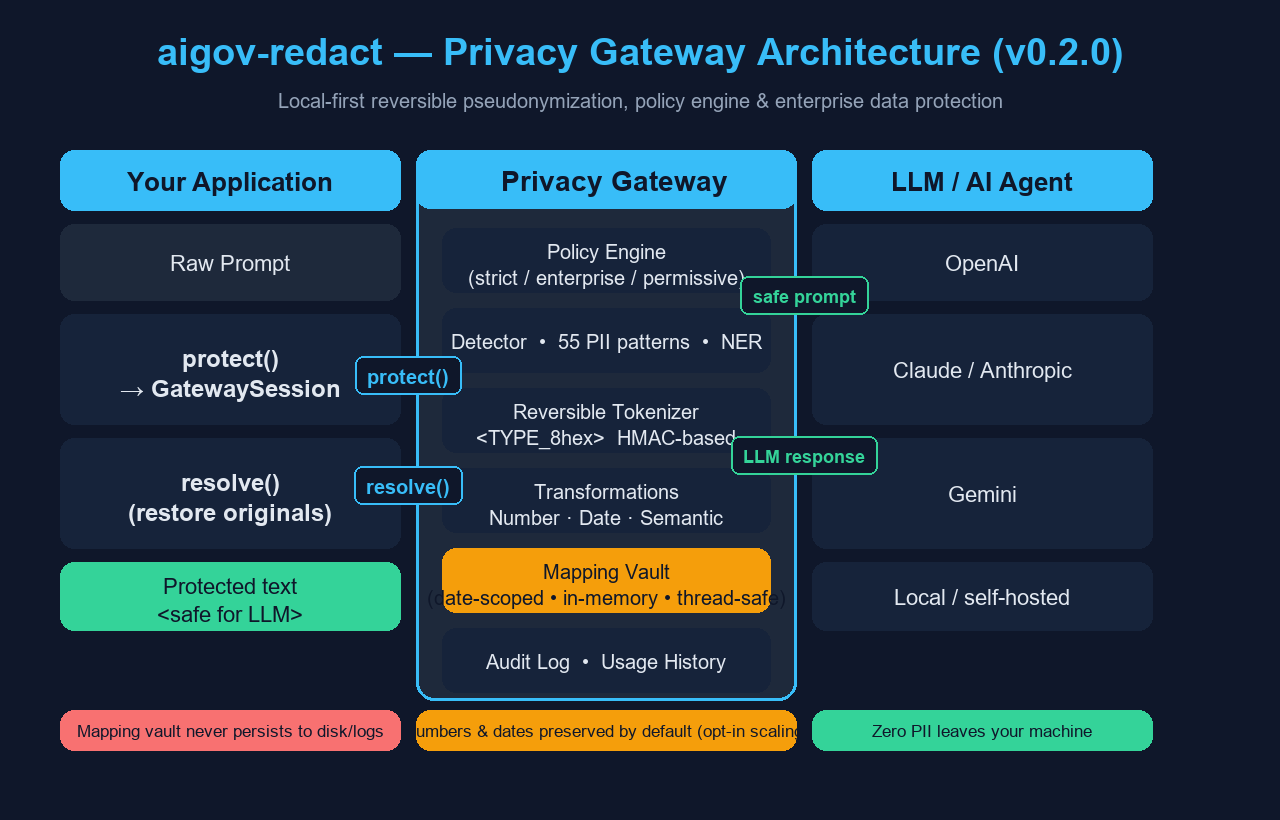
The gateway sits between your application and the LLM as a privacy firewall:
- Policy Engine decides what to do with each detected entity (tokenize, block, preserve, mask, ...)
- Detector finds PII, secrets, and custom entities across 55 patterns (plus optional NER)
- Reversible Tokenizer replaces values with opaque, HMAC-based tokens
- Mapping Vault keeps the token↔original mapping in memory (date-scoped, never persisted)
- Audit Log records what was protected for compliance
Numbers and dates are preserved by default; scaling/shifting is opt-in via policy rules.
Quick Start
Installation
pip install aigov-redact
With optional NER support (names, locations, organizations):
pip install aigov-redact[ner]
python -m spacy download en_core_web_sm
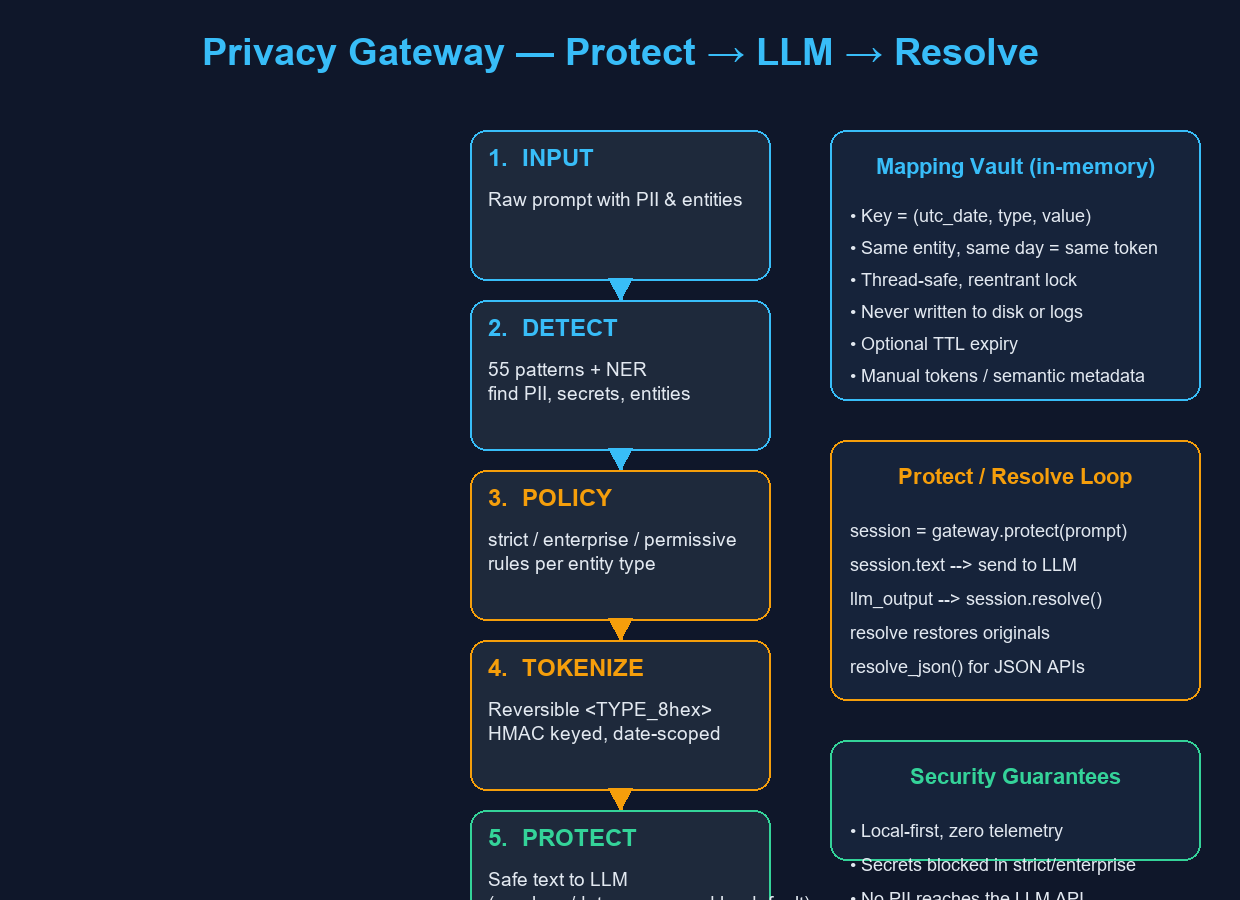
Privacy Gateway — Protect → LLM → Resolve
The centerpiece of v0.2.0. Wrap LLM calls with reversible pseudonymization:
from aigov_redact import PrivacyGateway

gateway = PrivacyGateway(policy="enterprise")

# Protect before the LLM call
session = gateway.protect(
    "John (john@acme.com) of Reliance Industries quoted ₹48.5 Cr for Product-X"
)
print(session.text)
# → "<EMAIL_a7f2b1c3> (<EMAIL_a7f2b1c3>) of <ENTITY_9e1d4f08> quoted ₹48.5 Cr for <ENTITY_2c8a7b5e>"

# Send session.text to the LLM, then restore the response
llm_output = "The price of <ENTITY_9e1d4f08> is competitive."
print(session.resolve(llm_output))
# → "The price of Reliance Industries is competitive."
What's protected by default:
- PII entities (email, SSN, phone, cards, DOB, ...) → tokenized
- Secrets & API keys → blocked (raise an error) or tokenized
- Numbers & dates → preserved by default (turn on scaling/shifting explicitly)
Python Library — LLM-First Examples
from aigov_redact import redact, detect, mask  # ← aigov-redact

# ── Before sending to OpenAI / Claude / Gemini ──────────────────────
prompt = "My email is john@gmail.com and SSN is 123-45-6789"
safe_prompt = redact(prompt).text  # ← aigov-redact
# → "My email is {EMAIL} and SSN is {SSN}"

# Now safe to send: response = openai.chat.completions.create(...)

# ── Detect what PII would be exposed before deciding ────────────────
result = detect("My SSN is 123-45-6789")  # ← aigov-redact
for entity in result.entities:
    print(f"{entity.type} at pos {entity.start}-{entity.end}: {entity.confidence}")
# → SSN at pos 7-18: 0.98

# ── Mask PII (no original shape visible) ───────────────────────────
result = mask("SSN: 123-45-6789", char="*")  # ← aigov-redact
print(result.text)
# → "SSN: ***********"

# ── Hash for deterministic tracking across turns ────────────────────
result = redact("Email: user@test.com", mode="hash")  # ← aigov-redact
print(result.text)
# → "Email: <EMAIL_a1b2c3d4>"

# ── Remove entirely ─────────────────────────────────────────────────
result = redact("Email: user@test.com", mode="remove")  # ← aigov-redact
print(result.text)
# → "Email: "
CLI — LLM Pipeline Integration
# Check prompts for PII before API calls (exit 1 if found)
aigov-redact check prompt.txt

# JSON output for automated pipelines
aigov-redact check prompt.txt --json

# Redact in-place (backup as .bak)
aigov-redact redact prompt.txt

# Redact to stdout (pipe directly to LLM API)
cat prompt.txt | aigov-redact redact --stdin | your-llm-client

# Audit production LLM logs for accidental PII leaks
aigov-redact audit /var/log/llm/requests.log

# CI/CD: fail if any PII found in logs
aigov-redact audit requests.log --fail-on-pii

# Use custom config
aigov-redact check prompt.txt --config .aigov-redact-config
Usage History
Every call — whether from the Python library or the CLI — is automatically logged. No setup needed.
Where history is stored:
~/.aigov-redact/history.jsonl— user home directory (always)./.aigov-redact/history.jsonl— current working directory (always)- Custom path via
history_pathconfig key orhistory_pathparameter
Each record includes source ("library", "cli", or "stdin") and file_path so you can distinguish how calls were made.
from aigov_redact import redact, detect  # ← aigov-redact

# These are auto-logged to ~/.aigov-redact/history.jsonl AND ./.aigov-redact/history.jsonl
redact("Email: user@test.com")       # ← aigov-redact  (logged as "redact", source="library")
detect("SSN: 123-45-6789")           # ← aigov-redact  (logged as "check", source="library")
mask("Phone: 555-123-4567")          # ← aigov-redact  (logged as "redact" with mode=mask)

# Or use a custom history path
detect("test@email.com", history_path="/path/to/custom.jsonl")  # ← aigov-redact
# Show aggregated usage stats and recent runs
aigov-redact history

# Show last 10 runs
aigov-redact history --limit 10

# Use custom history path from config
aigov-redact history --config .aigov-redact-config
Example output:
Total runs: 24

Runs by command:
  audit: 5
  check: 12
  redact: 7

Entity types detected (top):
  EMAIL: 18
  SSN: 6
  PHONE: 3

Recent runs:
  2026-05-23T10:15:30  check    stdin  count=0  []
  2026-05-23T10:16:00  redact   cli    count=2  [EMAIL, SSN]
  2026-05-23T10:17:00  audit    cli    count=5  [EMAIL, SSN, PHONE, API_KEY]
LLM Integration Patterns
1. Sanitize Prompts Before OpenAI Calls
from openai import OpenAI
from aigov_redact import redact  # ← aigov-redact

client = OpenAI()

def safe_completion(prompt: str, **kwargs):
    """Redact PII before sending to OpenAI, return redacted + response."""
    result = redact(prompt)  # ← aigov-redact
    response = client.chat.completions.create(
        messages=[{"role": "user", "content": result.text}],
        **kwargs
    )
    return result.text, response.choices[0].message.content

# Usage
safe_prompt, response = safe_completion(
    "My SSN is 123-45-6789, what benefits can I claim?"
)
print(safe_prompt)   # "My SSN is {SSN}, what benefits can I claim?"
print(response)      # LLM response (never saw the real SSN)
2. AI Governance & Audit Trail — Prove Compliance
from aigov_redact import redact  # ← aigov-redact
import json
from datetime import datetime, timezone

class GovernedLLMClient:
    """Wrap any LLM call with PII redaction + audit trail."""

    def __init__(self, audit_path: str = "pii-governance-log.csv"):
        self.audit_path = audit_path
        self._session_id = datetime.now(timezone.utc).strftime("%Y%m%d-%H%M%S")

    def send(self, prompt: str, llm_callable):
        """Redact PII, log audit entry, then call the LLM."""
        result = redact(prompt)  # ← aigov-redact

        # ── Governance: record every PII entity for compliance ──────
for entity in result.entities:
            record = {
                "session": self._session_id,
                "timestamp": datetime.now(timezone.utc).isoformat(),
                "type": entity.type,
                "confidence": entity.confidence,
                "severity": entity.severity,
                "value_hash": entity.hash if hasattr(entity, "hash") else "",
                "start": entity.start,
                "end": entity.end,
            }
            with open(self.audit_path, "a") as f:
                f.write(json.dumps(record) + "\n")

        # ── Send only redacted text to the LLM ──────────────────────
        return llm_callable(result.text)

# Usage
client = GovernedLLMClient()
response = client.send(
    "My SSN is 123-45-6789, what benefits do I get?",
    lambda text: openai.chat.completions.create(messages=[{"role": "user", "content": text}])
)
# pii-governance-log.csv now contains:
# {"session": "20260523-101530", "timestamp": "2026-05-23T10:15:30", "type": "SSN", "confidence": 0.98, "severity": "critical", ...}
For SOC 2 / ISO 27001 auditors: export your governance log and demonstrate that every PII entity was detected, hashed, and redacted before reaching the LLM provider. No PII stored in plaintext — only SHA-256 hashes for deduplication.
3. Sanitize Before Anthropic Claude
import anthropic
from aigov_redact import redact  # ← aigov-redact

client = anthropic.Anthropic()

prompt = "Patient Jane Doe, DOB 1990-01-15, needs medication review."
safe = redact(prompt, ner_enabled=True)  # ← aigov-redact  NER catches "Jane Doe" as PERSON

message = client.messages.create(
    model="claude-3-opus-20240229",
    max_tokens=1024,
    messages=[{"role": "user", "content": safe.text}]
)
# Claude sees: "Patient {PERSON}, DOB {DOB}, needs medication review."
4. RAG Pipeline — Redact Before Embedding
from aigov_redact import redact  # ← aigov-redact

class SafeRAGPipeline:
    def __init__(self, embedder, vector_store):
        self.embedder = embedder
        self.vector_store = vector_store

    def ingest(self, documents: list[str]):
        safe_docs = [redact(doc, mode="replace").text for doc in documents]  # ← aigov-redact
        embeddings = self.embedder.embed_documents(safe_docs)
        self.vector_store.add(embeddings, safe_docs)

    def query(self, question: str) -> str:
        safe_q = redact(question).text  # ← aigov-redact
        results = self.vector_store.similarity_search(safe_q)
        return " ".join(results)

# No PII ever reaches the embedding model or vector database
pipeline = SafeRAGPipeline(embedder, vector_store)
pipeline.ingest(["John Doe's email is john@acme.com, balance $50k"])
5. LangChain Integration
from langchain_core.messages import HumanMessage
from aigov_redact import redact  # ← aigov-redact

def redact_messages(messages):
    """Redact PII from all human messages in a LangChain chain."""
    for msg in messages:
        if isinstance(msg, HumanMessage):
            result = redact(msg.content)  # ← aigov-redact
            msg.content = result.text
    return messages

# Use before any LangChain model call
messages = [HumanMessage(content="My email is john@gmail.com")]
safe_messages = redact_messages(messages)
# llm.invoke(safe_messages)
6. Streaming — Redact Before Tokenization
from aigov_redact import redact  # ← aigov-redact

def stream_safe(prompt: str, llm_stream):
    """Redact prompt, stream LLM response."""
    safe = redact(prompt).text  # ← aigov-redact
    yield from llm_stream(safe)

# for chunk in stream_safe("My SSN is 123-45-6789", openai_stream):
#     print(chunk, end="")
7. Batch Dataset Preparation for Fine-Tuning
from aigov_redact import redact  # ← aigov-redact
import json

with open("training_data.jsonl") as f, open("safe_training_data.jsonl", "w") as out:
    for line in f:
        record = json.loads(line)
        record["prompt"] = redact(record["prompt"]).text  # ← aigov-redact
        record["completion"] = redact(record["completion"]).text  # ← aigov-redact
        out.write(json.dumps(record) + "\n")
Supported PII Types (55 patterns)
Tier 1 — High Confidence (checksum/rigorous validation)
| Type | Description | Confidence | Validation |
|---|---|---|---|
EMAIL |
Email address (RFC 5322 loose) | 0.95 | Format validation |
SSN |
US Social Security Number | 0.98 | Area/group/serial rules |
CREDIT_CARD |
Credit/debit card number | 0.98 | Luhn algorithm |
IBAN |
International Bank Account Number | 0.98 | MOD-97 checksum |
AADHAAR |
India Aadhaar number (12-digit) | 0.90 | Verhoeff checksum |
PAN_INDIA |
India Permanent Account Number | 0.90 | Format validation |
ITIN |
US Individual Taxpayer ID | 0.95 | Format + prefix rules |
EIN |
US Employer Identification Number | 0.95 | Format validation |
UK_NHS |
UK National Health Service Number | 0.90 | Modulus-11 checksum |
AU_TFN |
Australian Tax File Number | 0.85 | Modulus-11 algorithm |
ROUTING_NUMBER |
US ABA Routing Number | 0.80 | Check digit |
PRIVATE_KEY |
Private key in PEM format | 0.95 | Header detection |
Tier 2 — Medium-High Confidence (format validation)
| Type | Description | Confidence | Validation |
|---|---|---|---|
PHONE_US |
US phone number (10-digit NANP) | 0.95 | Area/exchange validation |
PHONE_INTL |
International phone number | 0.85 | + prefix |
US_PASSPORT |
US Passport number (9-digit) | 0.70 | Format |
DRIVERS_LICENSE |
US Driver's License (multi-state) | 0.70 | Format (CA, NY, TX, FL, IL, OH, PA) |
UK_NINO |
UK National Insurance Number | 0.90 | Prefix/suffix rules |
CA_SIN |
Canadian Social Insurance Number | 0.85 | Luhn check |
AU_MEDICARE |
Australian Medicare number | 0.85 | Checksum |
BR_CPF |
Brazilian CPF | 0.85 | Modulus-11 |
BR_CNPJ |
Brazilian CNPJ | 0.85 | Modulus-11 |
CN_ID |
China ID card number | 0.85 | Weighted sum |
JP_MYNUMBER |
Japan My Number | 0.75 | 12-digit format |
CRYPTO_WALLET |
Cryptocurrency wallet (BTC/ETH) | 0.90 | Format validation |
Tier 3 — Medium Confidence (shape-based)
| Type | Description | Confidence |
|---|---|---|
IPV4 |
IPv4 address | 0.70 |
IPV6 |
IPv6 address | 0.70 |
API_KEY |
API key / secret token | 0.95 |
AWS_SECRET_KEY |
AWS Secret Access Key (40-char base64) | 0.80 |
URL_CREDENTIALS |
URL with embedded credentials | 0.98 |
BANK_ACCOUNT |
US Bank Account number | 0.60 |
MAC_ADDRESS |
MAC address | 0.70 |
JWT_TOKEN |
JSON Web Token | 0.85 |
UK_POSTCODE |
UK Postcode | 0.75 |
ZIP_CODE |
US ZIP code | 0.60 |
VIN |
Vehicle Identification Number | 0.70 |
DEA_NUMBER |
US DEA Registration | 0.80 |
MEDICAL_RECORD |
Medical Record Number | 0.80 |
AZURE_CONNECTION_STRING |
Azure Storage connection string with AccountKey | 0.80 |
TELEGRAM_BOT_TOKEN |
Telegram Bot Token (numeric:secret) | 0.95 |
DISCORD_BOT_TOKEN |
Discord Bot Token (3 base64 segments) | 0.85 |
HASHICORP_TF_TOKEN |
HashiCorp Terraform Cloud token (atlasv1) | 0.90 |
Tier 4 — Low-Medium Confidence (context-dependent)
| Type | Description | Confidence |
|---|---|---|
STREET_ADDRESS |
US street address | 0.55 |
USERNAME |
@mention or user pattern | 0.50 |
COOKIE |
Session cookie / auth token | 0.70 |
USER_AGENT |
Browser User-Agent string | 0.60 |
LAT_LONG |
GPS coordinates | 0.60 |
DEVICE_ID |
UDID / IMEI / IMSI / IDFA | 0.75 |
ICD_CODE |
ICD-9 / ICD-10 diagnosis code | 0.50 |
DATE_OF_BIRTH |
Date of birth (multiple formats) | 0.45 |
HEX_TOKEN_32 |
32-char hex (Datadog, Twilio Auth) | 0.50 |
Configuration
aigov-redact supports a .aigov-redact-config file (auto-discovered from the current working directory via Path.cwd()), or you can specify one via --config.
Note: Config discovery uses the current working directory, not the script's location. If you launch your script from a different directory (e.g., VS Code terminal), pass the path explicitly:
from aigov_redact.config import find_config, load_config, parse_custom_patterns
from pathlib import Path

# Find config relative to this script, not cwd
cfg_path = find_config(str(Path(__file__).parent))
cfg = load_config(cfg_path)
custom = parse_custom_patterns(cfg)

result = redact(text, custom_patterns=custom,
                excluded_patterns=cfg.get("excluded_patterns"))
Note:
allowlistin the config file is reserved for future use and is not yet implemented.
JSON Config (default)
{
  "pii_types": {
    "enabled": null,
    "disabled": ["IPV4", "IPV6", "MAC_ADDRESS", "LAT_LONG", "ZIP_CODE"]
  },
  "custom_patterns": [
    {
      "name": "EMP_ID",
      "description": "Internal employee ID",
      "pattern": "EMP-\\d{6}",
      "confidence": 0.95,
      "placeholder": "{EMP_ID}",
      "severity": "high"
    }
  ],
  "allowlist": [],
  "excluded_patterns": ["example\\.com", "mycompany\\.org"],
  "placeholder_style": "type",
  "mask_char": "*",
  "ner_enabled": false,
  "backup": true,
  "audit_log": "aigov-redact-audit.log",
  "history_path": "/custom/path/history.jsonl"
}
Compliance Profiles
Define named profiles in your config that override top-level settings. Profile keys (enabled, disabled, placeholder_style, ner_enabled, mask_char) override the matching top-level keys when the profile is active.
{
  "compliance_profiles": {
    "hipaa": {
      "enabled": ["SSN", "PHONE_US", "PHONE_INTL", "EMAIL", "DEA_NUMBER", "MEDICAL_RECORD", "ICD_CODE", "DATE_OF_BIRTH", "UK_NHS"],
      "disabled": ["CREDIT_CARD", "CRYPTO_WALLET", "IPV4", "IPV6", "LAT_LONG", "ZIP_CODE"],
      "placeholder_style": "type",
      "ner_enabled": true,
      "mask_char": "*"
    },
    "pci_dss": {
      "enabled": ["CREDIT_CARD", "CRYPTO_WALLET", "SSN", "ITIN", "EIN", "BANK_ACCOUNT", "ROUTING_NUMBER"],
      "placeholder_style": "hash",
      "ner_enabled": false
    },
    "gdpr": {
      "enabled": ["EMAIL", "PHONE_US", "PHONE_INTL", "IPV4", "STREET_ADDRESS", "DATE_OF_BIRTH", "USERNAME", "LAT_LONG", "DEVICE_ID"],
      "disabled": ["SSN", "CREDIT_CARD", "DEA_NUMBER", "ICD_CODE", "MEDICAL_RECORD"],
      "ner_enabled": true
    }
  },
  "compliance_profile": "hipaa"
}
Set "compliance_profile" in the config to activate a profile, or pass it via CLI:
aigov-redact check file.txt --compliance-profile hipaa
aigov-redact redact file.txt --compliance-profile pci_dss
aigov-redact audit requests.log --compliance-profile gdpr
from aigov_redact import redact, detect

text = "Email john@test.com, SSN 123-45-6789, card 4111-1111-1111-1111"

# ── HIPAA: medical focus ──────────────────────────────────────────
safe = redact(text, compliance_profile="hipaa")  # ← aigov-redact
# → "Email {EMAIL}, SSN {SSN}, card 4111-1111-1111-1111"
# Note: CREDIT_CARD is disabled in HIPAA mode, so it passes through

# ── PCI DSS: financial focus, hash placeholders ───────────────────
safe = redact(text, compliance_profile="pci_dss")  # ← aigov-redact
# → "Email john@test.com, SSN {SSN}, card <CREDIT_CARD_a1b2c3d4>"
# Note: EMAIL is disabled, CREDIT_CARD gets hash placeholder

# ── GDPR: personal data focus, NER enabled ────────────────────────
safe = redact(text, compliance_profile="gdpr")  # ← aigov-redact
# → "Email {EMAIL}, SSN 123-45-6789, card 4111-1111-1111-1111"
# Note: SSN and CREDIT_CARD are disabled in GDPR mode

# ── Detect with profile ───────────────────────────────────────────
result = detect(text, compliance_profile="hipaa")  # ← aigov-redact
print([e.type for e in result.entities])
# → ['EMAIL', 'SSN']   (CREDIT_CARD excluded by HIPAA profile)

# ── Override profile from config programmatically ─────────────────
from aigov_redact.config import load_config
cfg = load_config(".aigov-redact-config")
cfg["compliance_profile"] = "pci_dss"
safe = redact(text, compliance_profile="pci_dss")  # ← aigov-redact
How profiles help:
- HIPAA — only medical-relevant types (SSN, DEA, ICD, DOB). Ignores crypto wallets, IPs — reduces noise. NER enabled to catch patient names
- PCI DSS — focuses on cards + wallets. Hash placeholders let you track duplicates without exposing numbers. Email and addresses pass through
- GDPR — covers personal data (email, phone, address, DOB, IP). Enables NER to catch names. Financial data passes through
When a profile is active, its settings merge into the top-level config — enabled replaces pii_types.enabled, placeholder_style overrides the default, ner_enabled toggles NER, etc. Audit logs also include the profile name so you can prove which compliance mode was active.
YAML Config
aigov-redact supports YAML config files when PyYAML is installed:
pip install aigov-redact[yaml]
pii_types:
  disabled:
    - IPV4
    - IPV6
placeholder_style: type
ner_enabled: false
custom_patterns:
  - name: EMP_ID
    pattern: "EMP-\\d{6}"
    confidence: 0.9
    placeholder: "{EMP_ID}"
    severity: high
pyproject.toml Config
You can also embed aigov-redact config in your pyproject.toml:
[tool.aigov-redact]
placeholder_style = "hash"
ner_enabled = false
Redaction Modes
| Mode | Description | Example |
|---|---|---|
replace (default) |
Replace with {TYPE} placeholder |
{EMAIL} |
mask |
Replace with uniform mask chars | *************** |
hash |
Replace with <TYPE_hash> token |
<EMAIL_a1b2c3d4> |
remove |
Delete PII entirely | `` |
custom |
Replace with custom string | [REDACTED] |
redact(text, mode="replace")
redact(text, mode="mask", mask_char="#")
redact(text, mode="hash")
redact(text, mode="remove")
redact(text, mode="custom", custom_placeholder="[REDACTED]")
aigov-redact redact file.txt --mode mask
aigov-redact redact file.txt --mode hash
aigov-redact redact file.txt --mode remove
aigov-redact redact file.txt --mode custom --custom-placeholder "[REDACTED]"
Audit Logging — Governance & Compliance Evidence
The audit command generates a structured log of all PII found, suitable for compliance reporting and CI/CD integration. Use this to prove to auditors (SOC 2, ISO 27001, GDPR, HIPAA) that PII never reached your LLM provider.
AI Governance best practice: enable audit logging in your .aigov-redact-config and schedule nightly aigov-redact audit scans. The resulting CSV serves as your evidentiary record for data privacy controls — every PII detection is timestamped, hashed, and classified by type and severity.
Audit Entry Format (CSV)
timestamp,filename,line,column,type,value_hash,confidence,severity
2026-05-23T10:15:30Z,requests.log,1,12,EMAIL,ff8d9819fc0e12bf,0.95,high
2026-05-23T10:15:30Z,requests.log,2,10,SSN,01a54629efb95228,0.98,critical
Audit Formats
# Human-readable table (default)
aigov-redact audit requests.log

# JSON output (machine-readable)
aigov-redact audit requests.log --format json

# Summary statistics only
aigov-redact audit requests.log --format summary

# Persistent audit log (appended across runs)
aigov-redact audit requests.log --audit-log aigov-redact-audit.log

# Fail CI pipeline if PII is detected
aigov-redact audit requests.log --fail-on-pii
NER Integration (Optional)
For detecting names, locations, and organizations, aigov-redact can use Microsoft Presidio with spaCy:
pip install aigov-redact[ner]
python -m spacy download en_core_web_sm
from aigov_redact import redact  # ← aigov-redact

# NER catches PERSON, LOCATION, ORGANIZATION
result = redact("John Smith lives in New York and works at Acme Corp.", ner_enabled=True)  # ← aigov-redact
print(result.text)
# → "{PERSON} lives in {LOCATION} and works at {ORGANIZATION}."
aigov-redact check file.txt --ner
aigov-redact redact file.txt --ner
Note: NER requires a spaCy model (~50 MB). Performance is 50-200ms vs <1ms for regex-only.
Privacy Gateway API (v0.2.0)
PrivacyGateway(policy=..., reversible=..., replacements=...)
The main entry point for reversible pseudonymization and enterprise data protection.
| Parameter | Type | Default | Description |
|---|---|---|---|
policy |
Policy | str |
"default" |
Pre-built policy name ("strict", "enterprise", "permissive", "default") or a custom Policy object |
reversible |
bool | None |
None |
When True, generate reversible tokens. Defaults to the policy's reversible setting |
replacements |
dict | str | None |
None |
Manual entity→token mapping (dict), YAML file path, or list of dicts. When None, tokens are auto-generated via HMAC |
patterns |
str | list[dict] | None |
None |
YAML file path or inline list of custom pattern definitions |
enabled_types |
list[str] | None |
None |
Only detect these PII types |
disabled_types |
list[str] | None |
None |
Skip these PII types |
custom_patterns |
list[PIIDefinition] | None |
None |
Additional custom PII patterns |
excluded_patterns |
list[str] | None |
None |
Regex patterns to exclude |
gateway.protect(text, task=None) → GatewaySession
| Attribute / Method | Description |
|---|---|
.text |
The protected text, safe for LLM consumption |
.original |
The original unprotected text |
.mapping |
dict[token → original_value] |
.resolve(llm_output) |
Restore original values in LLM output (including reversed numbers/dates) |
.resolve_json(dict) |
Restore original values in a JSON response |
Token formats:
- Auto-generated (HMAC, deterministic within UTC date):
<TYPE_8hex>e.g.<EMAIL_a7f2b1c3> - Custom entities:
<ENTITY_8hex> - Manual: whatever you provide (e.g.
<CUSTOMER_A>)
Policies
Pre-built policies, all customizable:
strict— Tokenize PII, block secrets (API keys, passwords, private keys, JWTs). Reversible tokens.enterprise— Tokenize PII, block secrets, semantic abstraction metadata. Balanced privacy level. Reversible.permissive— Only block secrets; preserve everything else. Non-reversible.default— Redact all entity types with reversible tokens (whenreversible=True).
Numbers and dates are preserved by default in all policies. To enable number scaling or date shifting, add explicit rules:
from aigov_redact import Policy, EntityRule, NumberRule, DateRule, Action

policy = Policy(
    entity_rules={
        "EMAIL": EntityRule(entity_type="EMAIL", action=Action.REDACT),
    },
    number_rules={
        "currency": NumberRule(numeric_type="currency", action=Action.SCALE,
                               mode="scale", factor=1.5),
    },
    date_rule=DateRule(action=Action.SCALE, mode="shift", shift_days=173),
)
gateway = PrivacyGateway(policy=policy)
Custom Entity Definitions
Define your own sensitive entities via replacements (dict, YAML, or list):
# Manual tokens
gateway = PrivacyGateway(replacements={
    "Reliance Industries": "<CUSTOMER_A>",
    "Tata Consultancy": "<CUSTOMER_B>",
})

# Semantic metadata (enterprise data protection)
gateway = PrivacyGateway(replacements={
    "Reliance Industries": {
        "token": "<CUST_REL>",
        "semantic": {"industry": "Conglomerate", "region": "India"},
    }
})
Mapping Vault
The MappingVault stores entity→token mappings in memory only — never to disk or logs — with automatic scope.
from aigov_redact import MappingVault

vault = MappingVault()                    # date-scoped (default): same entity, same UTC date = same token
vault = MappingVault(scope="session")     # session-scoped: each vault gets unique tokens
vault = MappingVault(ttl=3600)            # expire mappings after 1 hour

token = vault.register("EMAIL", "john@example.com")  # → <EMAIL_a7f2b1c3>
vault.resolve(token)                                 # → "john@example.com"
Number & Date Transformation
Transformers for analytical data protection, reversible when a vault is supplied.
from aigov_redact import NumberTransformer, DateTransformer, MappingVault

vault = MappingVault()
nums = NumberTransformer(vault)
dates = DateTransformer(vault)

safe_num = nums.scale("₹48.5 Cr", 1.37)     # → "₹66.44 Cr"
nums.reverse(safe_num)                       # → "₹48.5 Cr"

safe_date = dates.shift("DOB: 1990-01-15", 173)
dates.reverse(safe_date)                     # → "DOB: 1990-01-15"
API Reference
redact(text, ...) → RedactResult
| Parameter | Type | Default | Description |
|---|---|---|---|
text |
str |
required | Input text to redact |
mode |
str |
"replace" |
Redaction mode: replace, mask, hash, remove, custom |
enabled_types |
list[str] | None |
None |
Only detect these types (None = all enabled) |
disabled_types |
list[str] | None |
None |
Skip these types |
custom_patterns |
list[PIIDefinition] | None |
None |
Additional custom patterns |
excluded_patterns |
list[str] | None |
None |
Regex patterns to exclude |
ner_enabled |
bool |
False |
Enable Presidio NER detection |
mask_char |
str |
"*" |
Character for mask mode |
custom_placeholder |
str |
"{PII}" |
Placeholder for custom mode |
history_path |
str | None |
None |
Custom path for usage history log |
file_path |
str | None |
None |
Source file path (recorded in history) |
source |
str | None |
None |
Call source ("library", "cli", "stdin") |
Returns: RedactResult with fields:
text: str— redacted textentities: list[PIIEntity]— detected entitiesmode: str— redaction mode usedmapping: dict[str, str] | None— token → original value (populated in reversible mode)risk_score: float | None— optional risk scorerisk_details: dict | None— optional risk breakdown
detect(text, ...) → DetectionResult
Same parameters as redact (minus mode-specific ones).
Returns: DetectionResult with fields:
text: str— original textentities: list[PIIEntity]— detected entitiescount: int— number of entities
mask(text, char="*", ...) → RedactResult
Shortcut for redact(text, mode="mask", mask_char=char, ...).
Models
PIIEntity
| Field | Type | Description |
|---|---|---|
type |
str |
PII type (e.g., "EMAIL", "SSN") |
text |
str |
Matched text |
start |
int |
Start position in text |
end |
int |
End position in text |
confidence |
float |
Detection confidence (0-1) |
severity |
str |
"low", "medium", "high", or "critical" |
Policy
| Field | Type | Description |
|---|---|---|
name |
str |
Policy name |
entity_rules |
dict[str, EntityRule] |
Per-entity-type actions |
number_rules |
dict[str, NumberRule] |
Numeric transformations (off by default) |
date_rule |
DateRule | None |
Date transformation (off by default) |
failure_mode |
str |
"fail_open" or "fail_closed" |
reversible |
bool |
Whether tokens are reversible |
privacy_level |
str |
"strict", "balanced", or "analytical" |
Action enum
allow, redact, tokenize, mask, hash, remove, block, preserve, abstract, scale, audit
EntityRule, NumberRule, DateRule
EntityRule(entity_type, action, abstract_fields=None, replacement_token=None)NumberRule(numeric_type, action, mode="preserve" | "scale" | "range", factor=None, ...)DateRule(action, mode="preserve" | "shift", shift_days=None)
Use Cases — LLM & GenAI Focus
1. LLM Prompt Sanitization (OpenAI / Claude / Gemini / Local)
from aigov_redact import redact  # ← aigov-redact

# Before sending ANY prompt to an LLM, redact PII
prompt = f"""User context:
Name: Jane Doe
Email: jane@company.com
Phone: +1-555-987-6543
Insurance: 123-45-6789

Question: What is my coverage limit?"""

safe = redact(prompt, mode="replace")  # ← aigov-redact
print(safe.text)
# → "User context:
#     Name: {EMAIL}
#     Email: {EMAIL}
#     Phone: {PHONE}
#     Insurance: {SSN}
#
#     Question: What is my coverage limit?"

# Now safe to send to any LLM provider
# openai_response = openai.chat.completions.create(messages=[{"role": "user", "content": safe.text}])
# claude_response = anthropic.Anthropic().messages.create(messages=[{"role": "user", "content": safe.text}])
2. AI Governance & Audit Trail — SOC 2 / ISO 27001 Evidence
from aigov_redact import redact, detect  # ← aigov-redact
import json, csv
from datetime import datetime, timezone

# ── Governance workflow: detect, redact, log every PII encounter ────
prompts = [
    "My SSN is 123-45-6789, what benefits do I get?",
    "Email me at jane@acme.com with the results",
]

governance_log = []
for i, prompt in enumerate(prompts):
    # 1. Detect what PII is present
    result = detect(prompt)  # ← aigov-redact
    # 2. Redact before LLM call
    safe = redact(prompt)  # ← aigov-redact
    # 3. Log every entity for compliance evidence
    for e in result.entities:
        governance_log.append({
            "session_id": f"session-{i:04d}",
            "timestamp": datetime.now(timezone.utc).isoformat(),
            "type": e.type,
            "confidence": e.confidence,
            "severity": e.severity,
            "start": e.start,
            "end": e.end,
        })
    # 4. Safe to call LLM: llm.invoke(safe.text)

# Export for auditor review — proves no PII reached the LLM
with open("pii-governance-evidence.csv", "w", newline="") as f:
    writer = csv.DictWriter(f, fieldnames=governance_log[0].keys())
    writer.writeheader()
    writer.writerows(governance_log)
What auditors see in pii-governance-evidence.csv:
session_id,timestamp,type,confidence,severity,start,end
session-0000,2026-05-23T10:15:30,SSN,0.98,critical,6,17
session-0001,2026-05-23T10:15:31,EMAIL,0.95,high,12,24
Show them this file as proof that every PII entity was detected and redacted before reaching the LLM. No plaintext storage — only type and confidence for compliance mapping.
3. API Key Detection — Prevent Credential Leak to LLMs
from aigov_redact import redact, detect  # ← aigov-redact

# Developers accidentally paste API keys into prompts. Catch them.
code_prompt = """Why does my API key fail?
sk-abc123def456ghi789jklmno"""

result = detect(code_prompt)  # ← aigov-redact
for e in result.entities:
    if e.type == "API_KEY":
        print(f"WARNING: API key detected! ({e.confidence})")
        # → WARNING: API key detected! (0.95)

safe = redact(code_prompt)  # ← aigov-redact
print(safe.text)
# → "Why does my API key fail?
#     {API_KEY}"
4. CI/CD Pipeline — PII Gate Before LLM Deployment
# .github/workflows/pii-check.yml
name: PII Check
on: [deploy]
jobs:
  pii-gate:
    runs-on: ubuntu-latest
    steps:
      - uses: actions/checkout@v4
      - run: pip install aigov-redact
      - name: Scan logs for PII before deploying LLM app
        run: |
          aigov-redact audit logs/production.log --fail-on-pii --format json
          if [ $? -eq 1 ]; then
            echo "PII LEAK DETECTED — deployment blocked"
            exit 1
          fi
5. Production LLM Log Audit
# Find accidental PII leaks in your LLM request logs
aigov-redact audit /var/log/llm-gateway/requests.log --format summary

# Daily compliance scan for SOC 2 / HIPAA
0 2 * * * aigov-redact audit /var/log/llm/requests.log --format json > reports/pii-$(date +\%Y\%m\%d).json

# With automatic audit trail
aigov-redact audit requests.log --audit-log pii-leaks.csv
6. LLM Training Data Sanitization
from aigov_redact import redact  # ← aigov-redact
import json

# Sanitize entire fine-tuning datasets before training
with open("train.jsonl") as f, open("train_clean.jsonl", "w") as out:
    for line in f:
        record = json.loads(line)
        record["prompt"] = redact(record["prompt"]).text  # ← aigov-redact
        record["completion"] = redact(record["completion"]).text  # ← aigov-redact
        out.write(json.dumps(record) + "\n")
7. Custom PII Detection for Internal Tools
from aigov_redact import redact  # ← aigov-redact
from aigov_redact.patterns import PIIDefinition  # ← aigov-redact
import re

# Add your company's internal identifiers
employee_id = PIIDefinition(  # ← aigov-redact
    name="EMP_ID",
    regex=re.compile(r"EMP-\d{6}"),
    confidence=0.95,
    severity="medium",
    placeholder="{EMP_ID}",
)

result = redact("Employee EMP-123456 reported an issue", custom_patterns=[employee_id])  # ← aigov-redact
print(result.text)
# → "Employee {EMP_ID} reported an issue"
8. Multi-Turn Conversation — Consistent Redaction
from aigov_redact import redact  # ← aigov-redact

class SafeConversation:
    def __init__(self):
        self.history = []

    def add_message(self, role: str, content: str):
        safe = redact(content, mode="hash")  # ← aigov-redact
        self.history.append({"role": role, "content": safe.text})

    def get_context(self) -> list[dict]:
        return self.history

# PII is consistently hashed across turns
chat = SafeConversation()
chat.add_message("user", "My email is jane@test.com")
chat.add_message("assistant", "Thanks jane@test.com")
chat.add_message("user", "Actually it's jane@new.com")
# All three emails map to <EMAIL_hash1>, <EMAIL_hash1>, <EMAIL_hash2>
9. Healthcare LLM — HIPAA Compliance
from aigov_redact import redact  # ← aigov-redact

hipaa_prompt = """Patient: John Smith
MRN: MRN-12345
DOB: 1985-07-20
ICD-10: I10 (hypertension), E11.9 (type 2 diabetes)
Phone: 555-123-4567"""

safe = redact(hipaa_prompt)  # ← aigov-redact
print(safe.text)
# → "Patient: {EMAIL}   ← Actually detected by NER if enabled
#     DOB: {DOB}
#     ICD-10: {ICD_CODE}, {ICD_CODE}
#     Phone: {PHONE}
#     MRN: {MEDICAL_RECORD}"
10. LangChain / LlamaIndex Guard
# Drop-in guard for any LangChain chain
from aigov_redact import redact  # ← aigov-redact
from langchain_core.messages import HumanMessage, AIMessage

def guard_llm_input(messages):
    for m in messages:
        if isinstance(m, HumanMessage):
            result = redact(m.content)  # ← aigov-redact
            m.content = result.text
    return messages

# Use in your chain
# chain = RunnablePassthrough.assign(messages=guard_llm_input) | model | parser
Development
Setup
git clone https://github.com/shashi3070/aigov-redact
cd aigov-redact
pip install -e ".[dev]"
Test
pytest tests/ -v --cov=src/aigov_redact
Lint
ruff check src/ tests/
Build
python -m build
twine upload dist/*
Performance
For typical LLM prompts (under 2KB), aigov-redact processes in <1ms with regex-only mode. With NER enabled, expect 50-200ms per call (dominated by spaCy model loading).
Changelog
See CHANGELOG.md.
License
MIT
1 maintainer

Metadata
1 maintainer
Release files for aigov-redact 0.2.1
For a detailed explanation of source distributions (sdists) and built distributions (wheels), please see the package formats documentation.
Source distribution (sdist)
| File | Size | Uploaded | Provenance | |
|---|---|---|---|---|
| aigov_redact-0.2.1.tar.gz | 84.7 kB | Without provenance | Details |
Built distribution (wheel)
| File | Interpreter | ABI | Platform | Reset |
|---|---|---|---|---|
| aigov_redact-0.2.1-py3-none-any.whl | Python 3 | none | any | Details |
Total release size: 132.4 kB
Release files / aigov_redact-0.2.1.tar.gz
| Download URL | aigov_redact-0.2.1.tar.gz |
|---|---|
| Size | 84.7 kB |
| Tags | Source |
|
SHA-256 checksum How to use checksums |
21816758915dabadbbec8a3bd4ec48c51008045312eab0ea2830c8d63c5316c4
|
|
BLAKE2b-256 checksum How to use checksums |
7d4de3a0268f495c7fc2168babb9bd5e2f24d5b8364acf50e3d01e48bd67ec8b
|
| Upload date | |
|
Uploaded using Trusted Publishing? What is trusted publishing? |
No |
| Uploaded via |
twine/6.2.0 CPython/3.11.3
|
Release files / aigov_redact-0.2.1-py3-none-any.whl
| Download URL | aigov_redact-0.2.1-py3-none-any.whl |
|---|---|
| Size | 47.7 kB |
| Tags | Python 3 |
|
SHA-256 checksum How to use checksums |
73f738ab1afdc4810ca991678392d0f2df63e8a5666494aeb1a03f6a54af5cbe
|
|
BLAKE2b-256 checksum How to use checksums |
d8fee6c66fa0ba5ea3cdfe4ae46298f2f3dee05d94fd04d60b32a0e9883f8d73
|
| Upload date | |
|
Uploaded using Trusted Publishing? What is trusted publishing? |
No |
| Uploaded via |
twine/6.2.0 CPython/3.11.3
|
Security for aigov-redact 0.2.1
Provenance
Provenance describes where a file came from. On PyPI, provenance is shared via attestations, which provide a verifiable record of the build or publishing details. View details, limitations and caveats.
No provenance found
None of the files in this release were uploaded with provenance metadata.
A note on package security
PyPI is a repository for distributing packages, not a service for auditing them. While third-party security researchers and our staff do their best to detect and remove malicious packages, PyPI cannot guarantee the quality, security or suitability of any given package.
To learn more about protecting yourself from malicious actors, visit our package security documentation.














