
AInotate
Annotated screenshots for AI agents. Show, don't describe.
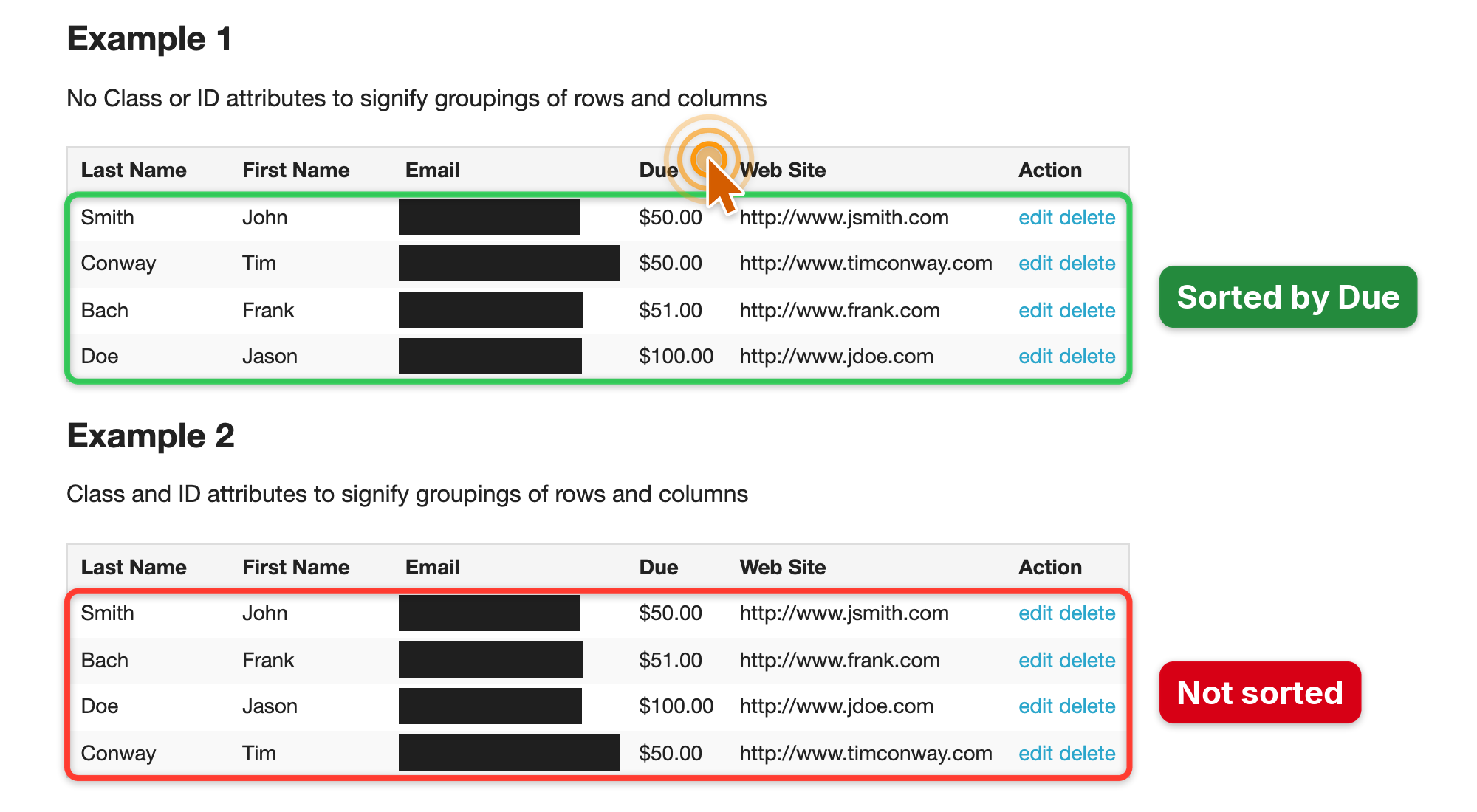
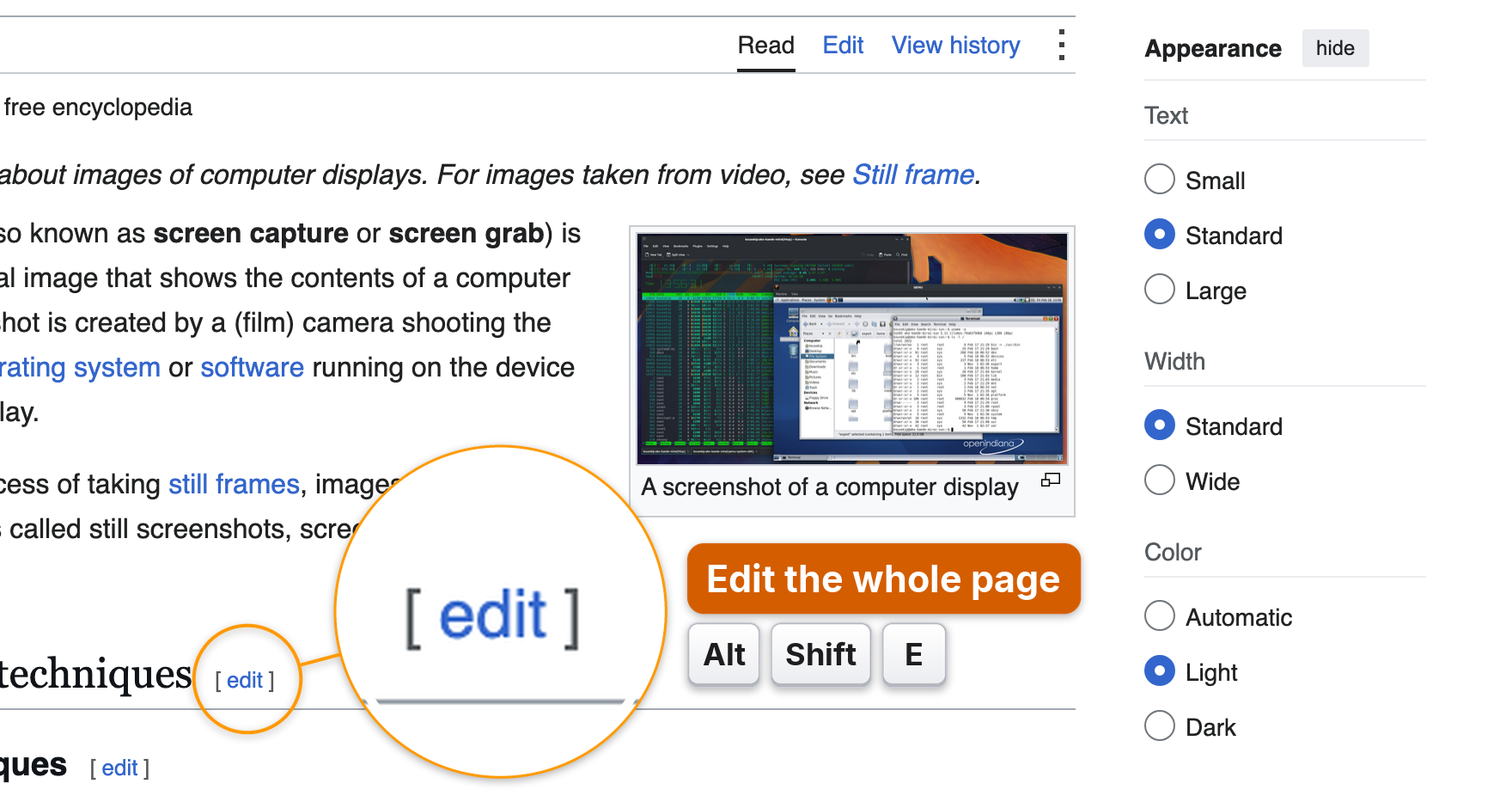
AInotate turns a web page, a window or any screenshot into a clear annotated image: numbered steps, Skitch-style arrows, boxes, labels, a magnifier, keycaps, solid redaction and an optional polished frame. It is built for AI agents that would otherwise write "top right, under the second menu..." in a chat reply, a bug ticket or a how-to guide.
You describe the marks in a small JSON spec. AInotate finds the elements (by text, role or CSS selector on web pages, by OCR on images), places the labels where they cover the least content, redacts secrets and saves the result. The agent then reads the image to check it before sending.
Gallery
Every image below was made with shoot against a public site, in one
call: open the page, find the elements, place the labels, draw, frame.
The specs are in docs/images/specs.
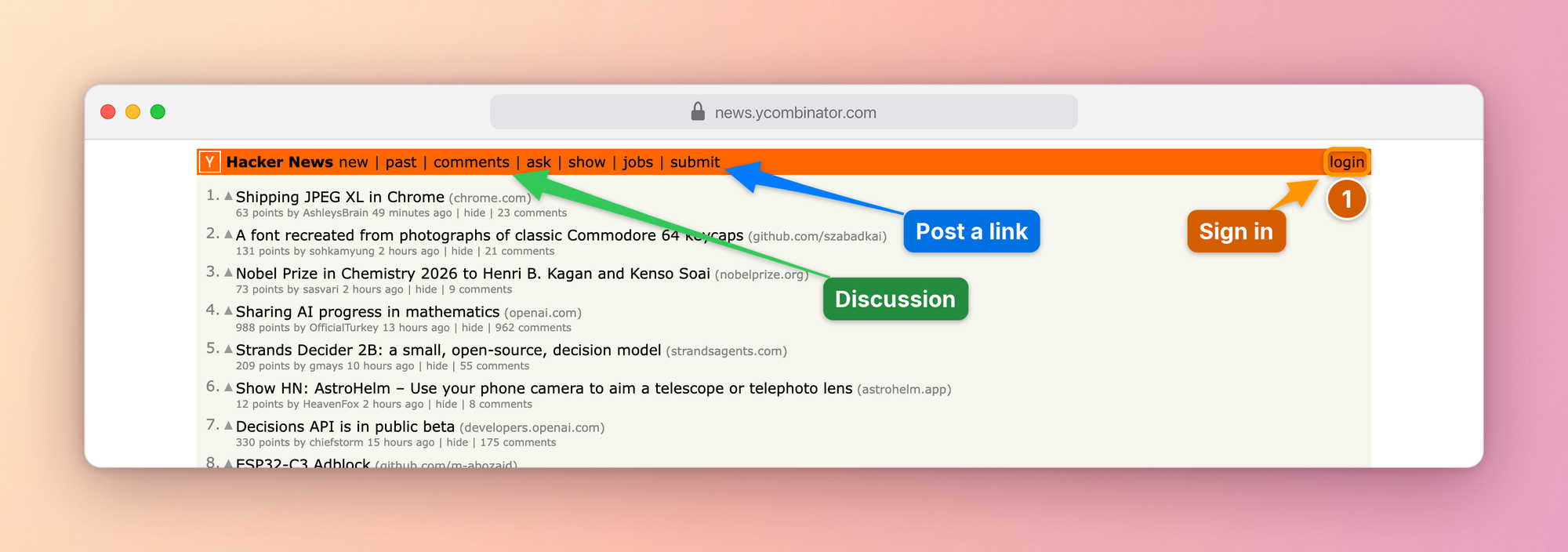
Skitch-style arrows: tapered, with a soft shadow; labels sit in free space and the arrows reach the target
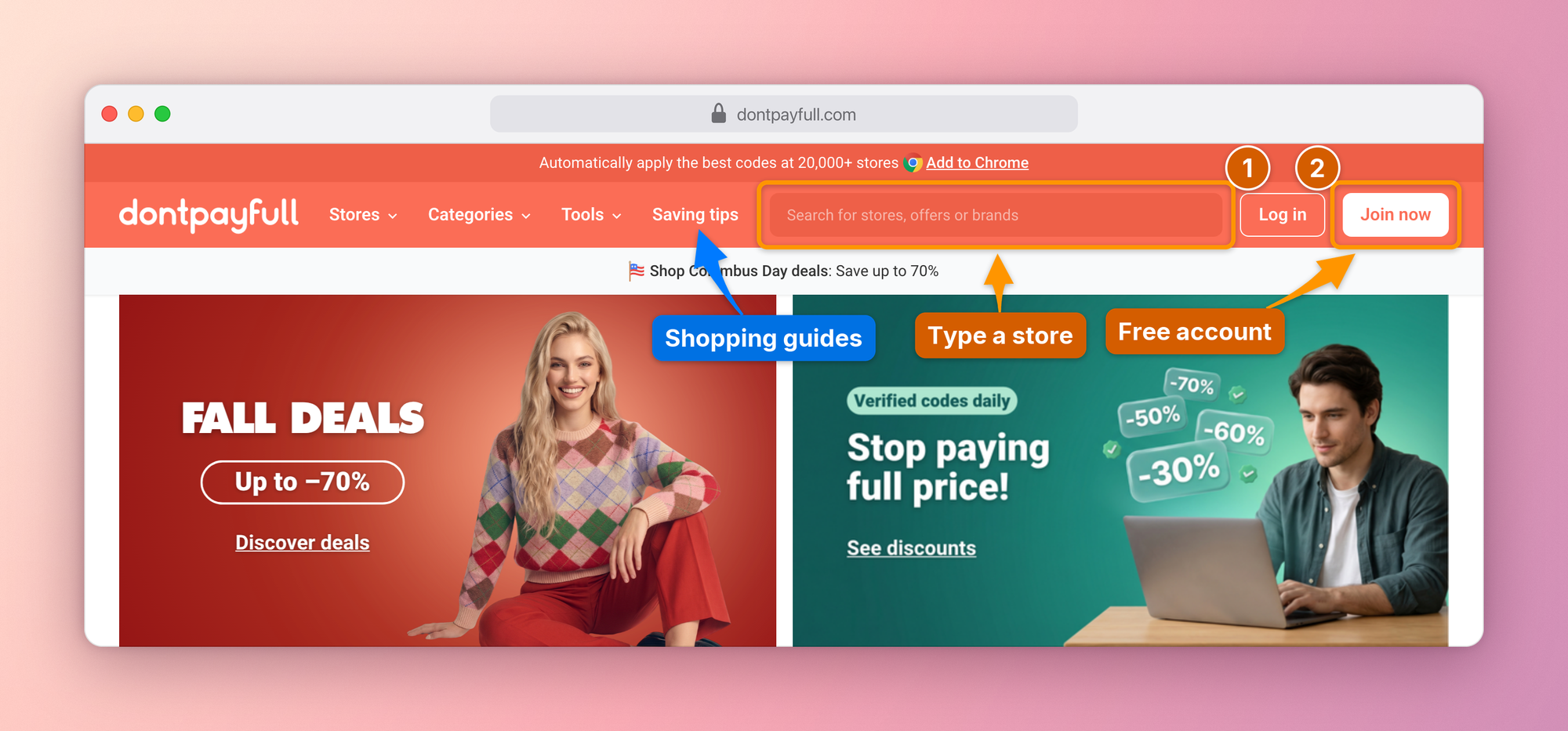 |
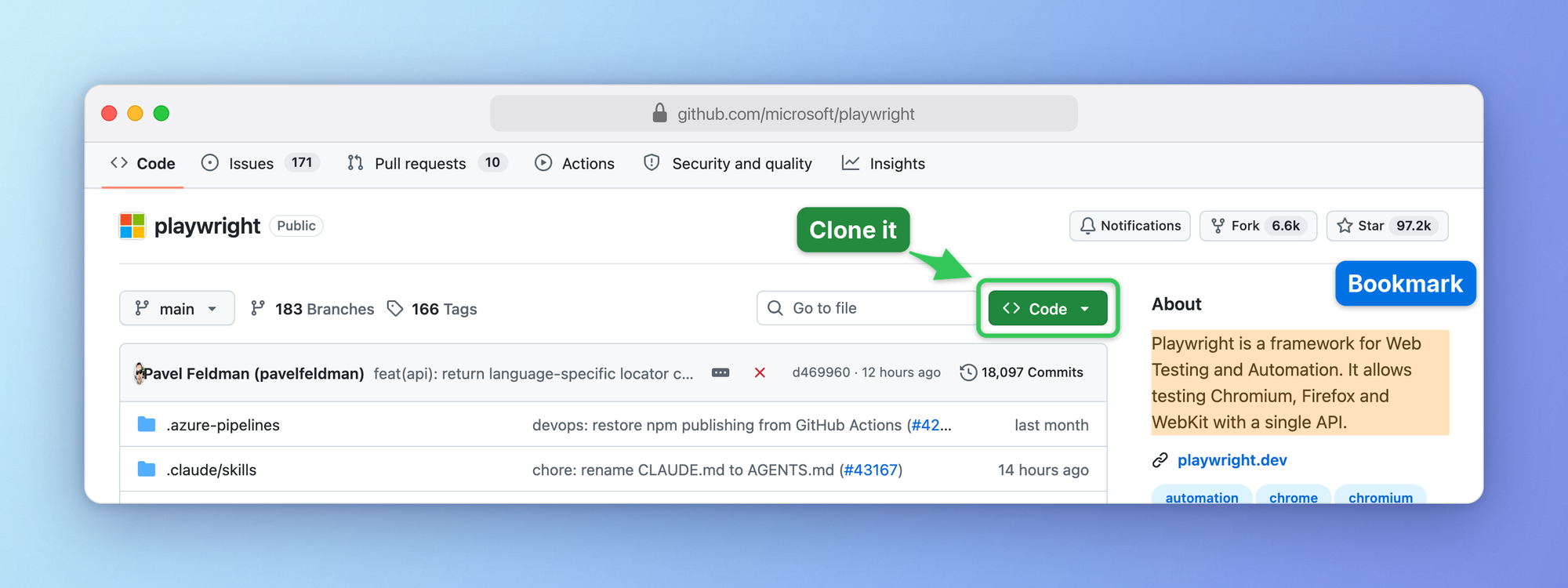 |
| Numbered steps on a busy header | Box, arrow and highlight on GitHub |
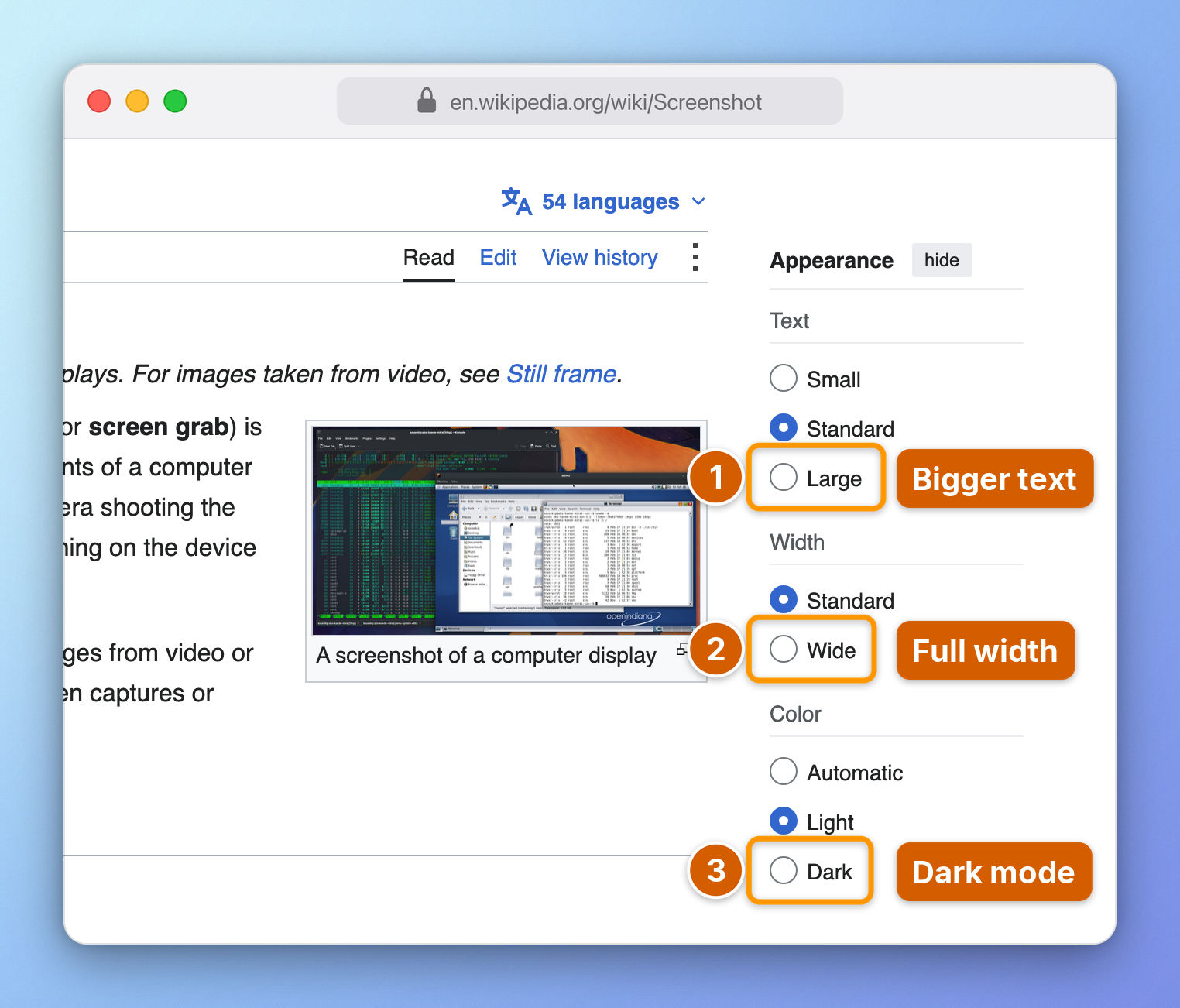 |
 |
| Step-by-step guide with browser chrome and a gradient frame | Bug report, emails redacted automatically by the privacy scan |
 |
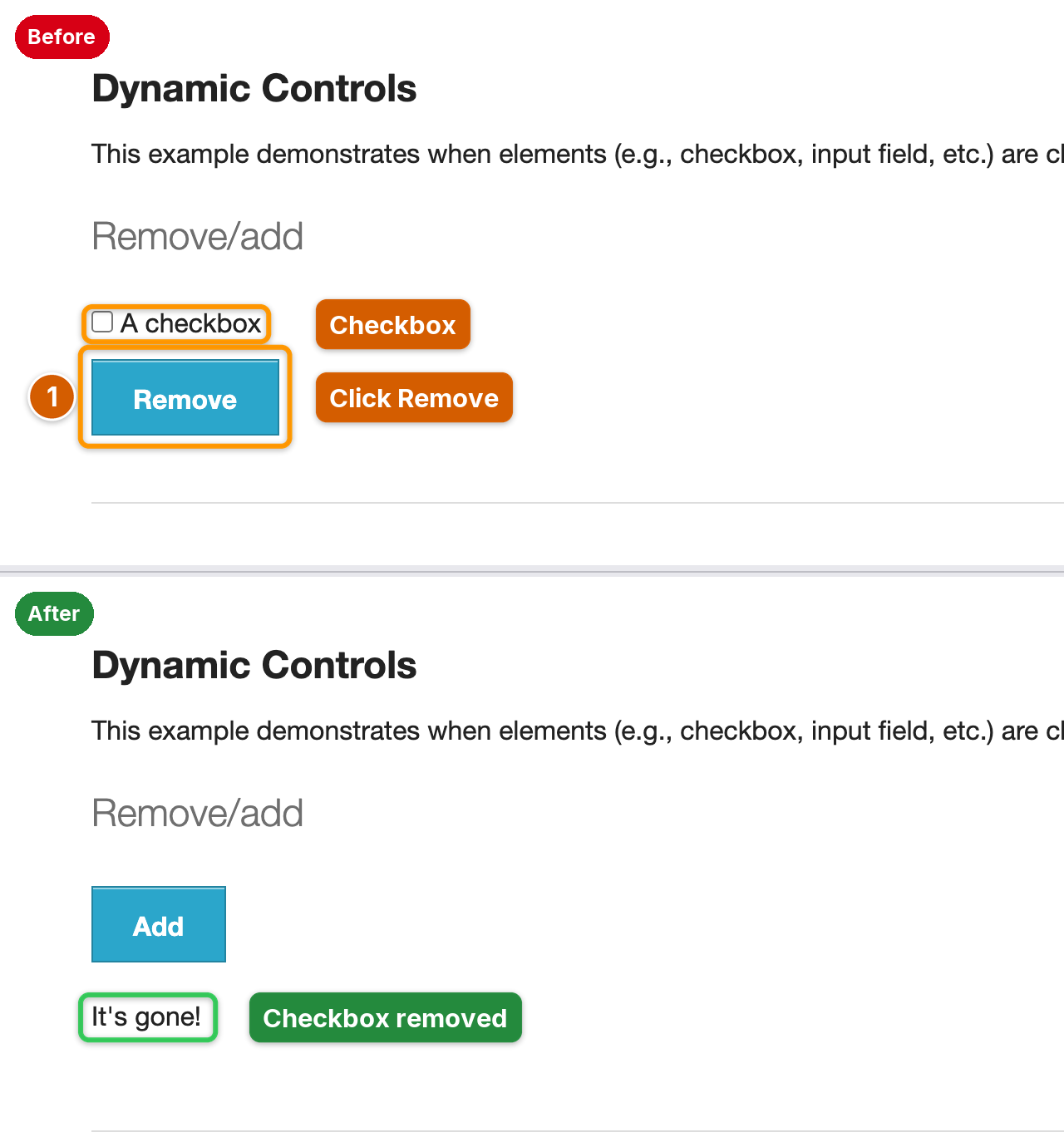 |
| Magnifier and keycaps for tiny controls and shortcuts | Before / after plate from two shots |
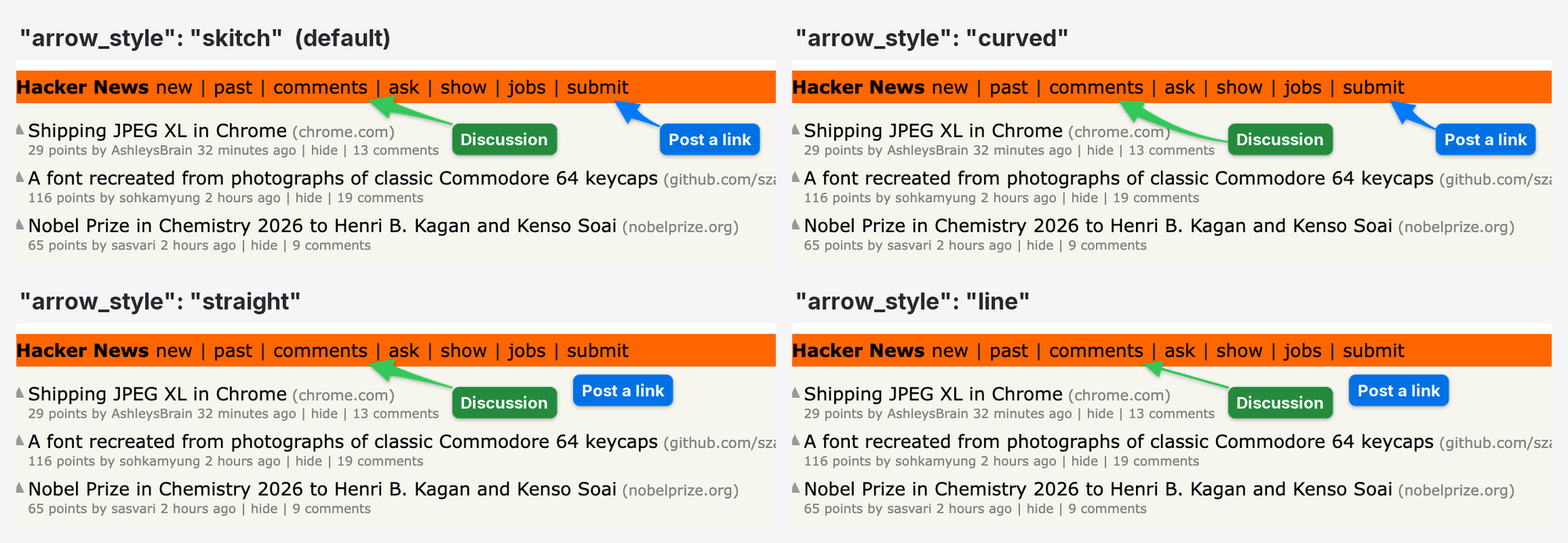
Four arrow styles: skitch (default: straight when the way is clear, a gentle bend when it is long and diagonal, a curve around text), curved, straight, line
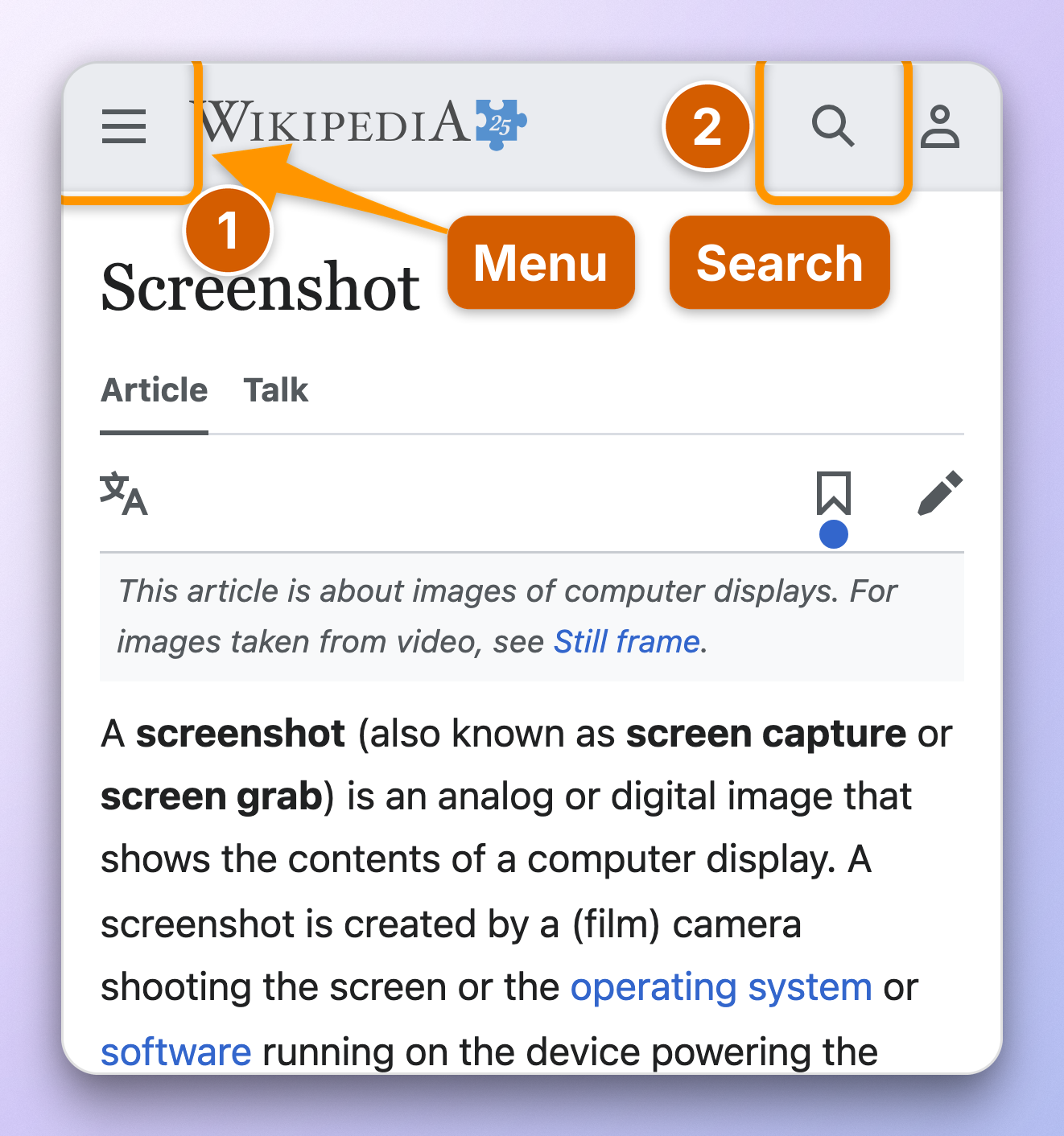
Phone preset: mobile viewport, touch and user agent
Labels that stay off the content

A label dropped at a fixed spot next to its target usually lands on the text the reader needs. AInotate places every label itself:
- It maps the page content first (text, icons, lines, images) and tries hundreds of spots per label. Empty space near the target wins; a spot over text is used only when the frame has no free room.
- Arrows are priced too: a long arrow, or one that crosses text, another label or another mark, loses to a shorter, cleaner one. When the straight path crosses text, the arrow curves around it.
- All labels are planned together, so the first one cannot take the only clean spot a later one needs.
- Step badges sit on the corner of their box that covers the least.
The image is never enlarged to make room. If a label still has to cover
something, AInotate says so in a warning, and label_at pins a label
exactly where you want it.
Quickstart (30 seconds)
AInotate needs Python 3.10+:
pipx install "ainotate[all]"   # or: uv tool install "ainotate[all]"
ainotate doctor                # checks everything, prints exact fixes
doctor tells you the one command that downloads Chromium for web
capture. Then save this as hn.json:
{"url": "https://news.ycombinator.com",
 "frame": {"chrome": "browser"},
 "marks": [
  {"type": "step", "n": 1, "target": {"text": "new", "exact": true},
   "label": "Newest"},
  {"type": "step", "n": 2, "target": {"text": "login"},
   "label": "Sign in"}]}
ainotate shoot hn.json --draft # temp file; drop --draft to save
The output path is printed on stdout. Final images go to
~/Pictures/AInotate unless you configure another folder.
Features
- Marks: numbered
step,box,arrow,clickripple,keys(keycaps),magnify(loupe),highlight,spotlight,text, solidredact, and decorativeblur/pixelate. - Placement that reads well: labels go to free space near their target and are planned together; arrows are tapered Skitch-style shapes with a soft shadow that curve around text (see Labels that stay off the content). Warnings for overlapping labels, crossing arrows, more than 6 marks or labels over 4 words.
- Web capture in one call:
ainotate shootopens a page (laptop, wide or phone preset), runs actions (click, fill, wait, scroll), measures each target, redacts, annotates and saves. - Any browser: its own Playwright Chromium, Firefox or WebKit, or attach over CDP to a Chromium you already use and are logged into (Chrome, Edge, Brave, Arc, BrowserOS). The preset is applied to that one tab and restored afterwards.
- Any image:
locatefinds text by OCR (Apple Vision, Windows OCR or Tesseract);gridandzoomlocate icons at full resolution. Screen, window and clipboard capture are built in. - Frames: gradient backgrounds (auto from the screenshot, or presets), rounded corners, shadow, browser or window chrome, social aspect ratios.
- Sharing: guides in Markdown, HTML and PDF; before/after plates; APNG and GIF animations; copy to the clipboard.
- Strict specs: a typo stops the run with a list of every problem instead of saving a wrong or unredacted image. Clear exit codes.
- Diacritics: bundled Inter font, so Romanian, German, French and other Latin-script labels render correctly everywhere.
For AI agents
Skill. skill/SKILL.md is an agent skill (Claude Code
and other agents that read SKILL.md). Copy or link the skill folder
into your agent's skills directory as ainotate. It teaches the workflow:
pick a source, locate exact rects, annotate, read the image to verify,
deliver. References cover the full spec, every browser surface an agent
may have (Playwright MCP, Chrome DevTools MCP, Claude in Chrome, CDP) and
the MCP server.
MCP server. ainotate mcp exposes the same operations to Claude
Desktop and any MCP client. Each tool returns JSON plus a small preview
image so the model can check its work. Claude Desktop config:
{"mcpServers": {
  "ainotate": {"command": "ainotate", "args": ["mcp"]}}}
Paths for macOS and Windows, permissions and the tool list: skill/references/mcp.md.
Python. The same pipeline is importable:
from ainotate.shoot import shoot
res = shoot({"url": "https://en.wikipedia.org/wiki/Screenshot",
             "marks": [{"type": "box",
                        "target": {"text": "View history"},
                        "label": "Past edits"}]}, draft=True)
print(res.paths[0], res.redactions)
Privacy
- Redaction is solid.
redactpaints an opaque block. AInotate never uses blur to hide data: blur and pixelation can be reversed.blurandpixelateexist only to de-emphasize clutter, and a mark flagged"sensitive": trueis refused for them. - Automatic redaction is on for web shots.
shootscans the live page (text and input values) for emails, phone numbers, card numbers, IBANs, API keys, tokens, JWTs, password and personal-data fields, and blacks them out. On images it runs on OCR when you pass--privacy auto. You can allow-list your own addresses or add regexes. - It is best-effort. Detection misses things: text drawn in images or canvas, unusual formats, data split across elements, embedded frames from other sites (reported, not redacted). Always look at the image before you share it. The skill makes this check mandatory for agents.
- Local. Capture, OCR and rendering run on your machine. AInotate makes no network requests of its own beyond loading the pages you ask it to capture.
Platform support
| macOS | Windows | Linux | |
|---|---|---|---|
| Annotate, frames, export | verified | experimental | experimental |
| Web capture (Playwright, CDP) | verified | experimental | experimental |
| Screen and window capture | verified | experimental | experimental (X11) |
OCR (locate, text targets) |
verified (Vision) | experimental (Windows OCR) | experimental (Tesseract) |
| Clipboard | verified | experimental | experimental |
| MCP server | verified | experimental | experimental |
Experimental means implemented and unit-tested with mocks, not yet verified on real Windows or Linux machines. Reports are welcome.
Exit codes
0 ok, 1 cannot save, 2 invalid spec or usage, 3 cannot draw
(no room for a label, rect outside the image), 4 capture failed or an
optional dependency is missing, 5 a text target is ambiguous, 6 a
target was not found. Messages say what to fix.
License
AInotate is free software under the GNU Affero General Public License v3.0 or later. If you run a modified AInotate as a network service, the AGPL requires you to offer its source to the users of that service.
Bundled and derived third-party work (the Inter font, arrow proportions from Arrowshot, a label-placement idea from github/awesome-copilot) and dependency licenses are listed in NOTICE.
1 maintainer

Metadata
1 maintainer
Release files for ainotate 0.1.0
For a detailed explanation of source distributions (sdists) and built distributions (wheels), please see the package formats documentation.
Source distribution (sdist)
| File | Size | Uploaded | |
|---|---|---|---|
| ainotate-0.1.0.tar.gz | 5.9 MB | Details |
Built distribution (wheel)
| File | Interpreter | ABI | Platform | Reset |
|---|---|---|---|---|
| ainotate-0.1.0-py3-none-any.whl | Python 3 | none | any | Details |
Total release size: 6.3 MB
Release files / ainotate-0.1.0.tar.gz
| Download URL | ainotate-0.1.0.tar.gz |
|---|---|
| Size | 5.9 MB |
| Tags | Source |
|
SHA-256 checksum How to use checksums |
46b79914ac1dc3b186e2e6d0c1eb3e08880b03bfb93fb9f9f89b5dc21a304b19
|
|
BLAKE2b-256 checksum How to use checksums |
9146435c3c232716a4770b26dac5b089e8eafd45be38eb3b28c7234e64aa5465
|
| Upload date | |
|
Uploaded using Trusted Publishing? What is trusted publishing? |
Yes |
| Uploaded via |
twine/7.0.0 CPython/3.13.14
|
Provenance
Provenance describes where a file came from. On PyPI, provenance is shared via attestations, which provide a verifiable record of the build or publishing details. View details, limitations and caveats.


PyPI Publish Attestation
PyPI verified that this artifact, at this checksum, originated from the publisher listed below.
Signed by GitHub Actions, verified by PyPI on Oct 7, 2026.
Transparency logRelease files / ainotate-0.1.0-py3-none-any.whl
| Download URL | ainotate-0.1.0-py3-none-any.whl |
|---|---|
| Size | 374.1 kB |
| Tags | Python 3 |
|
SHA-256 checksum How to use checksums |
f9c50fa29ef4f73942886e01c854d17fad1cef6ce1e8fcccc7f0a1c84eae74dd
|
|
BLAKE2b-256 checksum How to use checksums |
4ada6c10cbfc1401b0cb3f2204a6a662855d72bf2e71688df5ad3d7082ef5d74
|
| Upload date | |
|
Uploaded using Trusted Publishing? What is trusted publishing? |
Yes |
| Uploaded via |
twine/7.0.0 CPython/3.13.14
|
Provenance
Provenance describes where a file came from. On PyPI, provenance is shared via attestations, which provide a verifiable record of the build or publishing details. View details, limitations and caveats.
PyPI Publish Attestation
PyPI verified that this artifact, at this checksum, originated from the publisher listed below.
Signed by GitHub Actions, verified by PyPI on Oct 7, 2026.
Transparency log













