

Non-intrusive monitoring for Python asyncio.
Detects, pinpoints, and logs blocking IO and CPU calls that freeze your event loop.




Features
- Production-Safe & Low Overhead: Leverages Python's
sys.audithooks for minimal runtime overhead, making it safe for production use - Works with asyncio and uvloop: Compatible with both standard asyncio and uvloop event loops out of the box
- Blocking I/O Detection: Automatically detects blocking I/O calls (file operations, network calls, subprocess, etc.) in your async code
- Stack Trace Capture: Captures full stack traces to pinpoint exactly where blocking calls originate
- CPU Stack Sampling: A lightweight watchdog samples the loop thread during CPU-bound slices, so
cpu_blockingevents carry stack attribution too — on by default, no profiler needed - Severity Scoring: Assigns severity scores to blocking events to help prioritize fixes
- Callback-based Events: Register callbacks to handle slow task events however you need (logging, metrics, alerts)
- Dynamic Controls: Enable/disable monitoring at runtime, useful for gradual rollout or debugging sessions
- Exception Raising: Optionally raise exceptions on high-severity blocking I/O for strict enforcement during development
How It Works
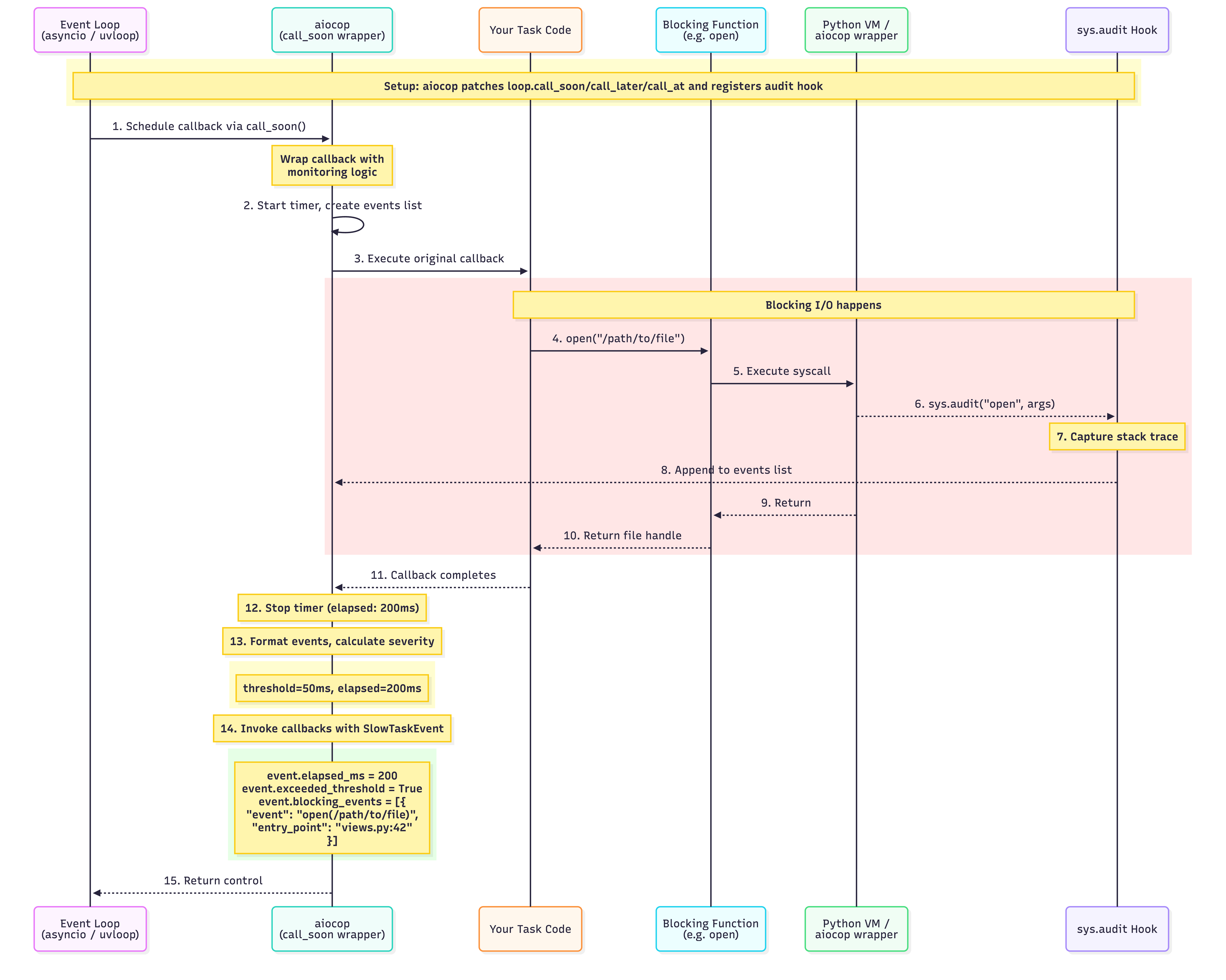
aiocop wraps the event loop's scheduling methods (call_soon, call_later, etc.) and uses Python's sys.audit hooks to detect blocking calls. This approach works with both standard asyncio and uvloop. When your code calls a blocking function like open(), the audit event is captured along with the full stack trace—letting you know exactly where the problem is.
Why aiocop?
aiocop was built to solve specific production constraints that existing approaches didn't quite fit.
vs. Heavy Monkey-Patching (e.g., blockbuster): Many excellent tools rely on extensive monkey-patching of standard library logic to detect blocking calls. While effective, this approach can sometimes conflict with other libraries that instrument code (like APMs). aiocop prioritizes native sys.audit hooks, using minimal wrappers only where necessary to emit audit events. This significantly reduces the risk of conflicts with other instrumentation tools.
vs. asyncio Debug Mode: Python's built-in debug mode is invaluable during development. However, it can be heavy on logs and performance, making it impractical to leave on in high-traffic production environments. aiocop is designed to be "always-on" safe.
| Feature | Heavy Monkey-Patching Tools | asyncio Debug Mode | aiocop |
|---|---|---|---|
| Detection Method | Extensive Wrappers | Event Loop Instrumentation | sys.audit Hooks + Minimal Wrappers |
| Interference Risk | Medium (can conflict with APMs) | None | None |
| Production Overhead | Low-Medium | High | Very Low (~13μs/task) |
| Stack Traces | Yes | No (timing only) | Yes |
| Runtime Control | Varies | Flag at startup | Dynamic on/off |
| uvloop Support | Varies | No | Yes |
Performance
aiocop adds approximately 13 microseconds of overhead per async task:
| Scenario | Overhead | Impact on 50ms Request |
|---|---|---|
| Pure async (no blocking I/O) | ~1 us | 0.002% |
| Light blocking (os.stat) | ~14 us | 0.03% |
| Moderate blocking (file read) | ~12 us | 0.02% |
| Realistic HTTP handler | ~22 us | 0.04% |
For typical web applications, this means less than 0.05% overhead.
Run the benchmark yourself: python benchmarks/run_benchmark.py
Installation
pip install aiocop
Quick Start
Copy this into a file and run it - no dependencies needed besides aiocop:
# test_aiocop.py
import asyncio
import aiocop


def on_slow_task(event):
    print(f"SLOW TASK DETECTED: {event.elapsed_ms:.1f}ms")
    print(f"  Severity: {event.severity_level}")
    for evt in event.blocking_events:
        print(f"  - {evt['event']} at {evt['entry_point']}")


async def blocking_task():
    # This synchronous open() will block the loop - aiocop will catch it!
    with open("/dev/null", "w") as f:
        f.write("data")
    await asyncio.sleep(0.1)


async def main():
    aiocop.patch_audit_functions()
    aiocop.start_blocking_io_detection()
    aiocop.detect_slow_tasks(threshold_ms=10, on_slow_task=on_slow_task)
    aiocop.activate()

    await asyncio.gather(blocking_task(), blocking_task())


if __name__ == "__main__":
    asyncio.run(main())
python test_aiocop.py
# Output:
# SLOW TASK DETECTED: 102.3ms
#   Severity: medium
#   - open(/dev/null, w) at test_aiocop.py:14:blocking_task
Usage with ASGI (FastAPI, Starlette, etc.)
# In your ASGI application setup (e.g., main.py or asgi.py)
from contextlib import asynccontextmanager

import aiocop

def setup_monitoring() -> None:
    aiocop.patch_audit_functions()
    aiocop.start_blocking_io_detection(trace_depth=20)
    aiocop.detect_slow_tasks(threshold_ms=30, on_slow_task=log_to_monitoring)

def log_to_monitoring(event: aiocop.SlowTaskEvent) -> None:
    # Send to your monitoring system (Datadog, Prometheus, etc.)
    if event.exceeded_threshold:
        metrics.increment("async.slow_task", tags={
            "severity": event.severity_level,
            "reason": event.reason,
        })
        metrics.gauge("async.slow_task.elapsed_ms", event.elapsed_ms)

# Call setup early in your application lifecycle
setup_monitoring()

# Activate after startup (e.g., in a lifespan handler)
@asynccontextmanager
async def lifespan(app):
    aiocop.activate()  # Start monitoring after startup
    yield
    aiocop.deactivate()
Dynamic Controls
Enable/Disable Monitoring at Runtime
# Pause monitoring
aiocop.deactivate()

# Resume monitoring
aiocop.activate()

# Check if monitoring is active
if aiocop.is_monitoring_active():
    print("Monitoring is running")
Raise Exceptions on High Severity Blocking I/O
Useful during development and testing to catch blocking calls immediately:
# Enable globally for current context
aiocop.enable_raise_on_violations()

# Disable
aiocop.disable_raise_on_violations()

# Or use as a context manager
with aiocop.raise_on_violations():
    await some_operation()  # Will raise HighSeverityBlockingIoException if blocking
CI/CD Integration - Fail Tests on Blocking I/O
Use aiocop in your integration tests to prevent blocking code from being merged:
# conftest.py
import pytest
import aiocop

@pytest.fixture(scope="session", autouse=True)
def setup_aiocop():
    aiocop.patch_audit_functions()
    aiocop.start_blocking_io_detection()
    aiocop.detect_slow_tasks(threshold_ms=50)
    aiocop.activate()

# test_views.py
@pytest.mark.asyncio
async def test_my_async_endpoint(client):
    # Setup code can have blocking I/O (fixtures, test data, etc.)

    # Only the view execution is wrapped - this is what we care about
    with aiocop.raise_on_violations():
        response = await client.get("/api/endpoint")

    # Assertions can have blocking I/O too (DB checks, etc.)
    assert response.status_code == 200
We wrap only the async view (not the entire test) because test setup/teardown often has legitimate blocking code. See Integrations for complete examples.
CPU Stack Sampling
Blocking I/O gets stack attribution from audit events, but a cpu_blocking slice is just Python executing — nothing auditable fires. CPU stack sampling closes that gap: a watchdog daemon thread samples the loop thread's stack while a monitored callback has been running longer than an arming delay, and attaches the aggregated samples to the resulting SlowTaskEvent as cpu_stack_samples.
On by default. detect_slow_tasks() starts it automatically. The arming delay defaults to half the slow-task threshold (and follows it if the threshold changes), so any slice that goes on to violate has been under sampling since its midpoint.
# Disable it:
aiocop.detect_slow_tasks(threshold_ms=30, cpu_sampling=False)

# Customize it — call BEFORE detect_slow_tasks() (the auto-start then steps aside):
aiocop.start_cpu_sampling(interval_ms=5, arm_after_ms=10)
aiocop.detect_slow_tasks(threshold_ms=30)
Reading the result in a callback:
def on_slow_task(event: aiocop.SlowTaskEvent) -> None:
    if event.reason == "cpu_blocking" and event.cpu_stack_samples:
        top = event.cpu_stack_samples[0]
        print(f"CPU-bound slice ({event.elapsed_ms:.1f}ms), hottest stack "
              f"({top['count']} samples): {top['trace']}")
Overhead: the hot path adds two module-global stores per monitored callback (~0.1µs); the watchdog costs well under 1% of a core when idle and captures at most max_samples_per_slice (default 32) stacks per slice — and only for slices that are already frozen. Sampling works on any thread the loop runs on and survives fork() (gunicorn --preload workers restart the watchdog automatically).
Known limitation: a single long-running C call that never releases the GIL starves the watchdog — few samples for a long slice is itself a signal that one C-level call dominated it.
Context Providers
Context providers allow you to capture external context (like tracing spans, request IDs, etc.) that will be passed to your callbacks. The context is captured within the asyncio task's context, ensuring proper propagation of contextvars.
Basic Usage
from typing import Any

def my_context_provider() -> dict[str, Any]:
    return {
        "request_id": get_current_request_id(),
        "user_id": get_current_user_id(),
    }

aiocop.register_context_provider(my_context_provider)

def on_slow_task(event: aiocop.SlowTaskEvent) -> None:
    request_id = event.context.get("request_id")
    print(f"Slow task in request {request_id}: {event.elapsed_ms}ms")
Integration with Datadog
from ddtrace import tracer
from typing import Any

def datadog_context_provider() -> dict[str, Any]:
    return {"datadog_span": tracer.current_span()}

aiocop.register_context_provider(datadog_context_provider)

def log_to_datadog(event: aiocop.SlowTaskEvent) -> None:
    if event.exceeded_threshold is False:
        return

    span = event.context.get("datadog_span")
    if span is None:
        return

    span.set_tag("slow_task.detected", True)
    span.set_metric("slow_task.elapsed_ms", event.elapsed_ms)
    span.set_metric("slow_task.severity_score", event.severity_score)
    span.set_tag("slow_task.severity_level", event.severity_level)
    span.set_tag("slow_task.reason", event.reason)

aiocop.detect_slow_tasks(threshold_ms=30, on_slow_task=log_to_datadog)
Why Context Providers?
When aiocop detects a slow task, the callback is invoked after the task completes. By that time, the original context (like the active tracing span) might no longer be accessible via standard context lookups.
Context providers solve this by capturing the context at the start of each task execution, within the task's own contextvars context. This ensures that:
- Tracing spans are captured before they're closed
- Request-scoped data is available to callbacks
- Any contextvar-based state is properly preserved
Managing Context Providers
# Register a provider
aiocop.register_context_provider(my_provider)

# Unregister a specific provider
aiocop.unregister_context_provider(my_provider)

# Clear all providers
aiocop.clear_context_providers()
Context providers are completely optional. If none are registered, event.context will simply be an empty dict.
Event Types
SlowTaskEvent
Emitted when either:
- Blocking I/O is detected (
reason="io_blocking") - regardless of whether the task exceeded the threshold - Task exceeds threshold but no blocking I/O detected (
reason="cpu_blocking") - indicates CPU-bound blocking
@dataclass(frozen=True)
class SlowTaskEvent:
    elapsed_ms: float        # How long the task took
    threshold_ms: float      # Configured threshold
    exceeded_threshold: bool # True if elapsed > threshold
    severity_score: int      # Aggregate severity (sum of event weights), 0 for cpu_blocking
    severity_level: str      # "low", "medium", or "high"
    reason: str              # "io_blocking" or "cpu_blocking"
    blocking_events: list[BlockingEventInfo]  # List of detected events (empty for cpu_blocking)
    context: dict[str, Any]  # Custom context from context providers (default: {})
    cpu_stack_samples: list[CpuStackSample]   # Aggregated loop-thread stack samples (default: [])
BlockingEventInfo
Information about each blocking event:
class BlockingEventInfo(TypedDict):
    event: str        # e.g., "open(/path/to/file)"
    trace: str        # Stack trace
    entry_point: str  # First frame in the trace
    severity: int     # Weight of this event
CpuStackSample
Aggregated stack sample captured during a CPU-bound slice (see CPU Stack Sampling):
class CpuStackSample(TypedDict):
    trace: str        # Stack trace ("frame <- frame <- ...")
    entry_point: str  # First frame in the trace
    count: int        # How many samples showed this exact stack
Samples are ordered by count descending — the first entry is where the slice most likely spent its CPU time.
Severity Weights
Events are classified by severity:
| Weight | Value | Examples |
|---|---|---|
WEIGHT_HEAVY |
50 | socket.connect, subprocess.Popen, time.sleep, DNS lookups |
WEIGHT_MODERATE |
10 | open(), file mutations, os.listdir |
WEIGHT_LIGHT |
1 | os.stat, fcntl.flock, os.kill |
WEIGHT_TRIVIAL |
0 | os.getcwd, os.path.abspath |
Severity levels are determined by aggregate score:
- high: score >= 50
- medium: score >= 10
- low: score < 10
API Reference
Setup Functions
patch_audit_functions()- Patches stdlib functions to emit audit eventsstart_blocking_io_detection(trace_depth=20)- Registers the audit hookdetect_slow_tasks(threshold_ms=30, on_slow_task=None, cpu_sampling=True)- Patches the event loop; starts CPU stack sampling unless disabledstart_cpu_sampling(interval_ms=10, arm_after_ms=None, idle_interval_ms=None, max_samples_per_slice=32, trace_depth=20)- Start (or pre-configure) CPU stack samplingis_cpu_sampling_started()- Whether the sampling watchdog is runningactivate()/deactivate()- Control monitoring at runtime
Callback Management
register_slow_task_callback(callback)- Add a callbackunregister_slow_task_callback(callback)- Remove a callbackclear_slow_task_callbacks()- Remove all callbacks
Context Provider Management
register_context_provider(provider)- Add a context providerunregister_context_provider(provider)- Remove a context providerclear_context_providers()- Remove all context providers
Raise-on-Violations Controls
enable_raise_on_violations()- Enable for current contextdisable_raise_on_violations()- Disable for current contextis_raise_on_violations_enabled()- Check current stateraise_on_violations()- Context manager
Utility Functions
calculate_io_severity_score(events)- Calculate severity from eventsget_severity_level_from_score(score)- Get "low"/"medium"/"high"format_blocking_event(raw_event)- Format a raw eventget_blocking_events_dict()- Get all monitored events with weightsget_patched_functions()- Get list of patched functions
4 maintainers


Metadata
4 maintainers
Release files for aiocop 1.2.0
For a detailed explanation of source distributions (sdists) and built distributions (wheels), please see the package formats documentation.
Source distribution (sdist)
| File | Size | Uploaded | |
|---|---|---|---|
| aiocop-1.2.0.tar.gz | 1.4 MB | Details |
Built distribution (wheel)
| File | Interpreter | ABI | Platform | Reset |
|---|---|---|---|---|
| aiocop-1.2.0-py3-none-any.whl | Python 3 | none | any | Details |
Total release size: 1.4 MB
Release files / aiocop-1.2.0.tar.gz
| Download URL | aiocop-1.2.0.tar.gz |
|---|---|
| Size | 1.4 MB |
| Tags | Source |
|
SHA-256 checksum How to use checksums |
81a748ed85130cc79520027e24df4d39df154f9b857a8f182c19dc0b37d4155b
|
|
BLAKE2b-256 checksum How to use checksums |
1ae5427c75ab0f5da633d819d13bd7faa13e025d1036d44d994d498b4f421633
|
| Upload date | |
|
Uploaded using Trusted Publishing? What is trusted publishing? |
Yes |
| Uploaded via |
uv/0.12.5 {"installer":{"name":"uv","version":"0.12.5","subcommand":["publish"]},"python":null,"implementation":{"name":null,"version":null},"distro":{"name":"Ubuntu","version":"24.04","id":"noble","libc":null},"system":{"name":null,"release":null},"cpu":null,"openssl_version":null,"setuptools_version":null,"rustc_version":null,"ci":true}
|
Release files / aiocop-1.2.0-py3-none-any.whl
| Download URL | aiocop-1.2.0-py3-none-any.whl |
|---|---|
| Size | 27.5 kB |
| Tags | Python 3 |
|
SHA-256 checksum How to use checksums |
cedea2ccaf150cbc1f7ff767527bfc0fea642ce755bc9cfeeea788c2f8cd0726
|
|
BLAKE2b-256 checksum How to use checksums |
3fa4f8e55f71242c2ba7be1788a1bddc63dfc0bbfc0ed2dceca9788b15e1facd
|
| Upload date | |
|
Uploaded using Trusted Publishing? What is trusted publishing? |
Yes |
| Uploaded via |
uv/0.12.5 {"installer":{"name":"uv","version":"0.12.5","subcommand":["publish"]},"python":null,"implementation":{"name":null,"version":null},"distro":{"name":"Ubuntu","version":"24.04","id":"noble","libc":null},"system":{"name":null,"release":null},"cpu":null,"openssl_version":null,"setuptools_version":null,"rustc_version":null,"ci":true}
|














