
RESTful API service for aiograpi

Project description
aiograpi-rest
RESTful HTTP service that wraps aiograpi (the async fork of instagrapi) so you can call Instagram's private API from any programming language. Run it as a Docker sidecar next to your application; hit it from Node, Go, PHP, Java, C#, Ruby, Swift, Bash — anything that speaks HTTP.
This is the cross-language exit when your stack is not Python and the maintained Instagram libraries in your own language have gone stale or been archived (which, as of 2026, is most of them — see the language-by-language survey on instagrapi.com).
Support chat on Telegram: https://t.me/aiograpi_support (the previous @instagrapi group was restricted by Meta and is no longer maintained)
Why the project was renamed
Renamed from instagrapi-rest to aiograpi-rest in v1.0.0. The old name made
sense while the service wrapped synchronous instagrapi, but the service is now powered by aiograpi, the maintained async fork. The new name is more precise
for package managers, Docker images, OpenAPI clients, and repository discovery:
this project is the REST/HTTP boundary for aiograpi.
aiograpi-rest starts its own semver line at 1.0.0. It is the renamed
successor of instagrapi-rest 3.1.1, not a continuation of the old package name
as 4.0.0.
Why this exists
aiograpi is the actively-maintained async Python wrapper for Instagram's private mobile API (the async fork of instagrapi) — full write surface (post, DM, story), pydantic-typed responses, first-class challenge_required and 2FA handling. If your application is in Python, you import it directly.
If your application is in a different language, your options for Instagram have been narrowing fast. The most-starred libraries on GitHub's instagram-api topic are mostly stale or explicitly archived: the canonical Node/TypeScript client (dilame/instagram-private-api) hasn't shipped a meaningful release since August 2024; the canonical Go client (ahmdrz/goinsta) was archived in 2021; the Swift options are dead. Instagram's surface keeps moving and the per-language wrapper authors largely stopped chasing it.
aiograpi-rest solves that the simple way: run the actively-maintained async Python library (aiograpi) behind an HTTP boundary, and call it from whatever language you actually write your business logic in.
What you still own
This is OSS infrastructure, not a managed service. Self-hosting means you bring:
- Instagram accounts (and the operational headache of keeping them un-banned)
- Residential or mobile proxies (Instagram's anti-abuse system flags datacenter IPs hard)
- Session storage and rotation
- Retry logic when challenges fire mid-script
If those line items sound like work you don't want, the same team behind instagrapi runs HikerAPI as a managed equivalent — same Instagram surface, sessions and proxies handled on our side, called over HTTPS with an API key. It exists precisely because self-hosting aiograpi-rest has real ops cost. Use whichever fits — both paths are first-class.
30-second quick start
Current API version: 1.0.0. Version 1 uses REST-style methods and
slash-separated paths: GET for reads/downloads, POST for login and
creates/uploads, PATCH for state changes, and DELETE for removals.
docker run -d -p 8000:8000 subzeroid/aiograpi-rest
Open http://localhost:8000/docs for the live OpenAPI / Swagger UI.
Get a session id (replace <USERNAME>/<PASSWORD>):
curl -X POST http://localhost:8000/auth/login \
  -H "Content-Type: application/x-www-form-urlencoded" \
  -d "username=<USERNAME>&password=<PASSWORD>"
Fetch a public profile:
curl "http://localhost:8000/user/info/by/username?sessionid=<SESSIONID>&username=instagram"
Calling it from your language
The service is plain HTTP + JSON, so any HTTP client in any language works. Below are the shortest possible call snippets for the most common stacks; full working clients live in ./golang and ./swift.
Node.js / TypeScript:
const r = await fetch(`http://localhost:8000/user/info/by/username?sessionid=${SID}&username=instagram`);
const user = await r.json();
console.log(user.full_name, user.follower_count);
Go (full example: golang/client.go):
resp, _ := http.Get("http://localhost:8000/user/info/by/username?sessionid=" + sid + "&username=instagram")
defer resp.Body.Close()
var user map[string]any
json.NewDecoder(resp.Body).Decode(&user)
PHP:
$user = json_decode(file_get_contents(
  "http://localhost:8000/user/info/by/username?sessionid=$sid&username=instagram"
), true);
Java (with java.net.http.HttpClient):
HttpResponse<String> r = HttpClient.newHttpClient().send(
  HttpRequest.newBuilder(URI.create("http://localhost:8000/user/info/by/username?sessionid=" + sid + "&username=instagram")).build(),
  HttpResponse.BodyHandlers.ofString());
Ruby:
require "net/http"; require "json"
user = JSON.parse(Net::HTTP.get(URI("http://localhost:8000/user/info/by/username?sessionid=#{sid}&username=instagram")))
Swift (full example: swift/client.swift).
For typed client generation in C++, C#, F#, D, Erlang, Elixir, Nim, Haskell, Lisp, Clojure, Julia, R, Kotlin, Scala, OCaml, Crystal, Rust, Objective-C, Visual Basic, .NET, Pascal, Perl, Lua and others, see the Generating client code section below.
Features
- Authorization — login, 2FA, settings management
- Media — info, delete, edit, like, archive
- Video / Photo / IGTV / Reels / Album — upload to feed and story, download
- Story — info, delete, mark as seen, download
- User — followers / following, info, follow / unfollow, remove follower
- Insights — media, account
Installation
Requires Python 3.13 for local installs. Dependencies are declared in pyproject.toml (the legacy requirements.txt is gone).
Install ImageMagick (required for photo upload):
sudo apt install imagemagick
Then comment the strict policy line in /etc/ImageMagick-6/policy.xml:
<!--<policy domain="path" rights="none" pattern="@*"/>-->
Run the prebuilt Docker image:
docker run -p 8000:8000 subzeroid/aiograpi-rest
Or clone and build locally:
git clone https://github.com/subzeroid/aiograpi-rest.git
cd aiograpi-rest
docker build -t aiograpi-rest .
docker run -p 8000:8000 aiograpi-rest
Or use Docker Compose (recommended for local dev):
docker compose up api
Or run without Docker (requires Python 3.13):
python3.13 -m venv .venv
. .venv/bin/activate
python3.13 -m pip install -U pip
python3.13 -m pip install -e ".[test]"
uvicorn main:app --host 0.0.0.0 --port 8000 --reload
Usage
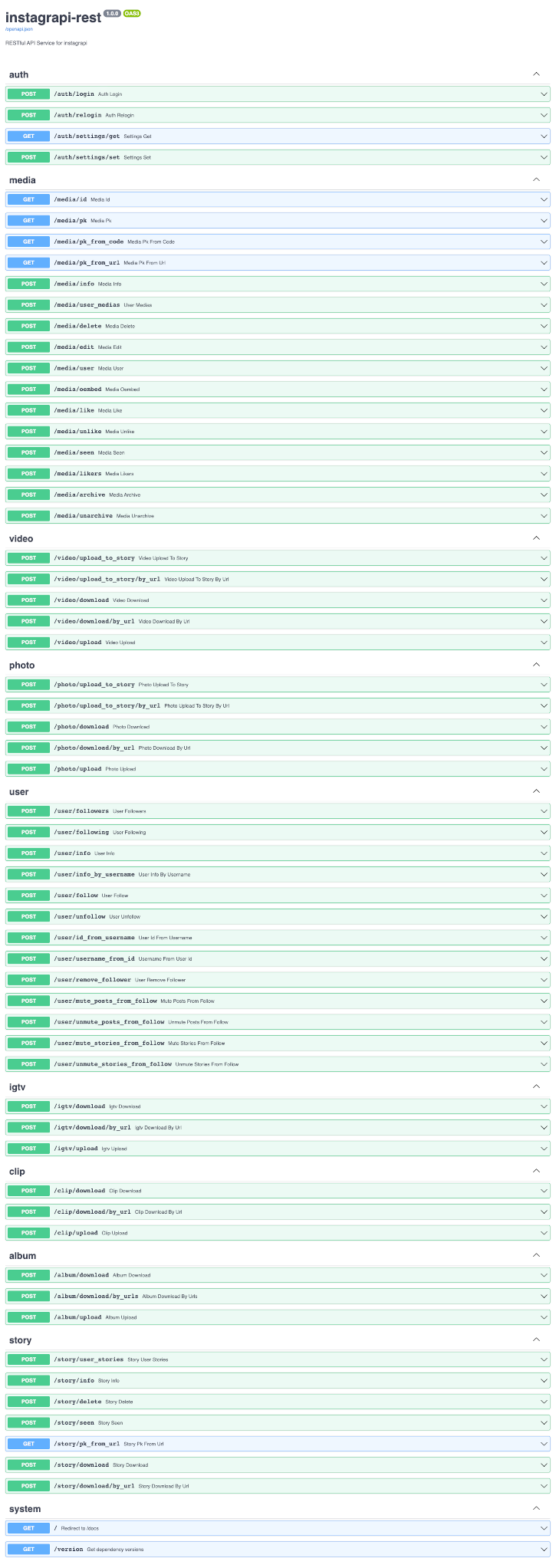
Live API documentation at http://localhost:8000/docs (Swagger UI):
Get a session id
curl -X 'POST' \
  'http://localhost:8000/auth/login' \
  -H 'accept: application/json' \
  -H 'Content-Type: application/x-www-form-urlencoded' \
  -d 'username=<USERNAME>&password=<PASSWORD>&verification_code=<2FA CODE>'
Upload photo
curl -X 'POST' \
  'http://localhost:8000/story/upload' \
  -H 'accept: application/json' \
  -H 'Content-Type: multipart/form-data' \
  -F 'sessionid=<SESSIONID>' \
  -F 'file=@photo.jpeg;type=image/jpeg'
Upload photo by URL
curl -X 'POST' \
  'https://localhost:8000/story/upload/by/url' \
  -H 'accept: application/json' \
  -H 'Content-Type: application/x-www-form-urlencoded' \
  -d 'sessionid=<SESSIONID>&url=https%3A%2F%2Fapi.telegram.org%2Ffile%2Ftest.jpg'
Upload video
curl -X 'POST' \
  'http://localhost:8000/story/upload' \
  -H 'accept: application/json' \
  -H 'Content-Type: multipart/form-data' \
  -F 'sessionid=<SESSIONID>' \
  -F 'file=@video.mp4;type=video/mp4'
Upload video by URL
curl -X 'POST' \
  'https://localhost:8000/story/upload/by/url' \
  -H 'accept: application/json' \
  -H 'Content-Type: application/x-www-form-urlencoded' \
  -d 'sessionid=<SESSIONID>&url=https%3A%2F%2Fapi.telegram.org%2Ffile%2Ftest.MP4'
Generating client code
The service exposes an OpenAPI spec at /openapi.json. Use @openapitools/openapi-generator-cli to generate a typed client in any supported language:
openapi-generator-cli generate -g <language> -i http://localhost:8000/openapi.json --skip-validate-spec
--skip-validate-spec is sometimes needed for transient validator errors.
Operating in production
When you start running this against a real Instagram surface — daily monitoring, multi-account orchestration, anything beyond ad-hoc — you will hit the same friction the Python world hits with instagrapi directly:
- Account bans — Instagram rotates abuse-detection rules; accounts that scraped fine last week get flagged this week.
- Proxy hunting — datacenter IPs are flagged on first contact; you need residential or mobile proxies, and you need to rotate them.
- Sessions — losing a session means re-logging in, which means the
challenge_requiredcycle, which means manual SMS / email retrieval.
aiograpi-rest does not solve any of this — it just gives you HTTP access to the same library that hits the same wall. The honest options when you reach this point are:
- Build the ops layer yourself — proxy pool, account warming, challenge-handler workers. This is real engineering, measured in weeks.
- Use HikerAPI — same Instagram surface as a managed HTTPS endpoint with an API key. Proxies and sessions handled on our side. The two products coexist deliberately: this repo is the OSS path; HikerAPI is the managed path. Pick whichever matches the cost shape you want.
Related
subzeroid/instagrapi— the underlying Python librarysubzeroid/aiograpi— async fork ofinstagrapisubzeroid/hikerapi-mcp— MCP server for HikerAPI (LLM tool surface)- instagrapi.com — guides, integration recipes, error reference
- HikerAPI — managed Instagram API
- LamaTok — managed TikTok API
- DataLikers — Instagram + TikTok cached datasets
Testing
The offline test suite lives under tests/ and runs with pytest.
Run all tests through Docker Compose:
docker compose run --rm api pytest
A single test file:
docker compose run --rm api pytest tests/test_app_system.py
Locally (Python 3.13):
python3.13 -m pytest
Optional live smoke tests against real Instagram accounts are gated by the TEST_ACCOUNTS_URL environment variable and are skipped by default:
TEST_ACCOUNTS_URL="https://example.com/accounts" python3.13 -m pytest tests/live -v
Development
For debugging with the dev server bound:
docker compose run --service-ports api
Release history Release notifications | RSS feed


Download files
Download the file for your platform. If you're not sure which to choose, learn more about installing packages.
Source Distribution
Built Distribution
Filter files by name, interpreter, ABI, and platform.
If you're not sure about the file name format, learn more about wheel file names.
Copy a direct link to the current filters
File details
Details for the file aiograpi_rest-1.0.0.tar.gz.
File metadata
- Download URL: aiograpi_rest-1.0.0.tar.gz
- Upload date:
- Size: 26.2 kB
- Tags: Source
- Uploaded using Trusted Publishing? No
- Uploaded via: twine/6.2.0 CPython/3.13.11
File hashes
| Algorithm | Hash digest | |
|---|---|---|
| SHA256 |
d50695dd2c3284936d36694a587eaaa050068009b3e9ab0eb69430b054634f34
|
|
| MD5 |
5a96ca9fa6cd4d0fe98a2801bd3315f6
|
|
| BLAKE2b-256 |
95d8f5e6a5be372e5873743a89e5cdabdfdbb375d97a6f61bb50d67ca58925c8
|
File details
Details for the file aiograpi_rest-1.0.0-py3-none-any.whl.
File metadata
- Download URL: aiograpi_rest-1.0.0-py3-none-any.whl
- Upload date:
- Size: 21.7 kB
- Tags: Python 3
- Uploaded using Trusted Publishing? No
- Uploaded via: twine/6.2.0 CPython/3.13.11
File hashes
| Algorithm | Hash digest | |
|---|---|---|
| SHA256 |
95bee18b0180d870eccdcb63e55071d69dede6a7675ab3c191f848f721167eea
|
|
| MD5 |
dd892599b9d52da0081e8fd5fcd543ac
|
|
| BLAKE2b-256 |
d74f727acacbed0135ae89353e226b43949aa96debd6786fd48f409f9d927952
|






