
AI Artifact Lifecycle Management from raw data and policies.
Verified details
These details have been verified by PyPIProject links
GitHub Statistics
Maintainers

Project description
Aiterate
AI Artifact Lifecycle Management from raw data and policies.
Aiterate helps teams turn messy source material into production-ready prompts and agent skills. Give it raw data, policies, examples, and priorities; Aiterate creates, optimizes, validates, approves, versions, tracks, and promotes the result.
Manual AI artifact changes do not scale well. Teams lose track of why a prompt or skill changed, which policy or dataset triggered the change, whether old behavior regressed, and which version is safe to promote. Aiterate turns those edits into a repeatable lifecycle with eval checks, regression signals, approvals, and traceable versions.
Why Use Aiterate?
- Create prompts and skills from raw data, examples, policies, and rubrics.
- Import common formats: text, CSV, JSON, YAML, and YML.
- Replace ad hoc AI artifact edits with reproducible optimization runs.
- Optimize artifacts using weighted policy priorities.
- Evaluate artifacts with native checks for policy coverage, JSON shape, similarity, grounding, uncertainty handling, prompt injection, and PII leakage.
- Catch regressions when prompts, policies, data, or target models change.
- Version every accepted prompt or skill.
- Trace which data, policy, provider, and run produced each version.
- Start from an existing baseline prompt/skill or generate one from raw data.
- Use OpenAI, Azure OpenAI, AWS Bedrock, or other providers through LiteLLM.
- Track experiments with MLflow, with optional LangSmith support.
- Compare approved artifacts across model providers using the same prompt and rubric.
- Run locally with SQLite metadata storage, then move to Postgres for production.
Start Here
Use The Product UI
There are two Docker paths:
| Goal | Use |
|---|---|
| Try Aiterate quickly with the UI and API | docker run with the GHCR image |
| Run Aiterate with Postgres, Redis, and MLflow | docker compose using the GHCR image |
The simplest path is the published GHCR image. It includes the backend API and the built React UI in one container.
docker run --rm -p 8000:8000 \
  -v aiterate-data:/app/.aiterate \
  ghcr.io/athiraspillai/aiterate:latest
Open:
http://localhost:8000
The mounted aiterate-data volume keeps run history, project settings, and encrypted UI-saved
credentials across restarts. Users can paste provider keys in the UI once; saved secrets are stored
encrypted server-side and never shown back in full.
This single-container mode is best for trying the UI quickly. It uses local app storage in the mounted Docker volume. It does not start Postgres, Redis, or MLflow.
To run the full local product stack with Postgres, Redis, and MLflow, use Docker Compose. The Compose file still uses the same published GHCR image for Aiterate; it just starts the supporting services beside it:
curl -O https://raw.githubusercontent.com/AthiraSPillai/aiterate/main/docker-compose.release.yml
docker compose -f docker-compose.release.yml up
PowerShell:
Invoke-WebRequest -Uri https://raw.githubusercontent.com/AthiraSPillai/aiterate/main/docker-compose.release.yml -OutFile docker-compose.release.yml
docker compose -f docker-compose.release.yml up
Open:
Aiterate UI: http://localhost:8000
MLflow UI:   http://localhost:5000
When using this Compose stack, keep the Aiterate tracking URI as:
http://mlflow:5000
The API container talks to MLflow over the Compose network, so http://localhost:5000 is for your
browser, while http://mlflow:5000 is for Aiterate inside Docker.
This Compose file does not include provider, GitHub, or Bitbucket secret values. Add those once from the Aiterate UI when needed; they are encrypted in the server-side secret store.
If you are developing Aiterate itself from source, clone the repo and build locally:
git clone https://github.com/AthiraSPillai/aiterate.git
cd aiterate
docker compose up --build
Developer CLI And SDK
Use PyPI when you want the CLI, SDK, or backend-only API in your own environment:
pip install aiterate
Optional provider and tracking integrations:
pip install "aiterate[providers,tracking]"
Postgres-backed production installs:
pip install "aiterate[postgres]"
Managed secrets integrations:
pip install "aiterate[managed-secrets]"
Aiterate supports Python 3.11, 3.12, and 3.13.
Quickstart
5-Minute Demo
Try Aiterate with the built-in sample flow first. You do not need cloud model keys for the first run.
docker run --rm -p 8000:8000 \
  -v aiterate-data:/app/.aiterate \
  ghcr.io/athiraspillai/aiterate:latest
Open http://localhost:8000, then:
- Go to Import context and click Load sample project.
- Review the separated Data / Examples, Policies, and Knowledge Base context.
- Go to Configure models and keep the local/mock setup for a no-key demo, or save a provider credential for OpenAI, Anthropic, Azure OpenAI, AWS Bedrock, or LiteLLM.
- Go to Run optimizer and click Run optimizer.
- Open Review and approve to see score progress, accepted versions, rejected attempts, eval insights, and the best prompt/skill.
- Click Approve best version.
- Use Export to download a promotion package, or configure Create Git PR when your Git token is ready.
What you should see in five minutes:
- a generated or improved prompt/skill from raw source material
- visible train/test split and policy weights
- version progress with scores and diffs
- eval insights showing what worked, what failed, and what to change next
- approval metadata and a promotion package with raw data, policy, knowledge, hashes, and lineage
Prefer the CLI? Install from PyPI and run the same kind of no-key optimization:
pip install aiterate
aiterate optimize \
  --name support-agent \
  --data raw_support_notes.txt \
  --policy policies.yml
Choose A Workflow
Choose the path that fits your audience:
- UI workflow for product, policy, and operations users.
- CLI workflow for developers and automation.
- Notebook/Python workflow for data scientists, AI engineers, and backend-only usage.
All three workflows can create, optimize, version, and trace prompts or agent skills.
UI Workflow
Start the one-container UI:
docker run --rm -p 8000:8000 \
  -v aiterate-data:/app/.aiterate \
  ghcr.io/athiraspillai/aiterate:latest
Open http://localhost:8000. The container serves the built React UI through the FastAPI backend.
For saved credentials and run history, keep the volume mounted.
For the full local stack with Postgres, Redis, and MLflow:
git clone https://github.com/AthiraSPillai/aiterate.git
cd aiterate
docker compose up --build
For active UI development with hot reload, run the web app locally instead:
uvicorn aiterate.api.main:app --reload
cd frontend
npm install
npm run dev
Open the local UI, import context, choose models, and run the optimization. Provider and tracking credentials can be pasted once and saved encrypted server-side. Saved credentials are shown only as configured status and fingerprints, never as full secret values.
The UI supports:
- separate context lanes for Data / Examples, Policies, and Knowledge Base / References
- multi-file upload for text, CSV, JSON, YAML, YML, and Markdown
- automatic context detection and policy extraction from uploaded files
- optional baseline prompt/skill input for existing production artifacts
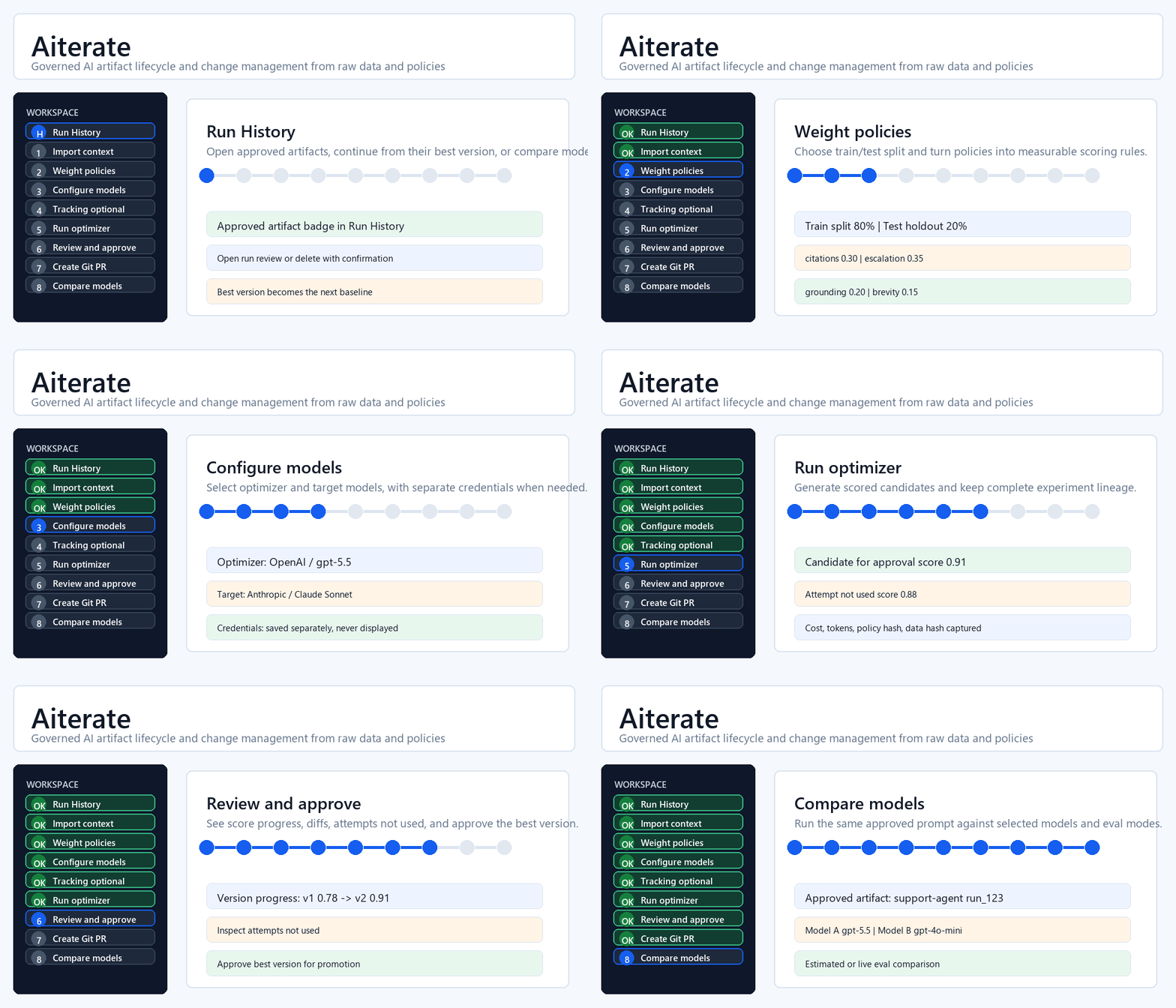
- visible train/test split controls so users know what is optimized and what is held out
- run controls for optimization depth, iterations, promotion threshold, spend cap, and repeatable seed
- optional target-model validation on holdout examples before approval
- policy weight editing, equal weighting, and regression-oriented eval criteria
- native eval checks for regression-sensitive behavior, safety, grounding, and output shape
- separate optimizer and target model selection, with separate credentials when providers differ
- provider readiness testing before a run starts
- optional MLflow/LangSmith tracking, including URI/endpoint, project, and token setup
- Git artifact tracking and promotion PR workflow scaffolding
- per-project Git settings for tracking, remote, PR workflow, and base branch
- GitHub and Bitbucket promotion PR publishing when server credentials are configured
- a Run History dashboard with approved-artifact badges, clickable run details, delete confirmation, and project cleanup
- optimization run results with candidates for approval and attempts not used
- visual version progress with score deltas across accepted versions
- clickable rejected-attempt details with the proposed content, score, gate decision, and diff
- native eval report with pass rate, failed checks, and suggested prompt/skill changes
- manual approval flow for the best version before creating a promotion PR
- model comparison for any approved historical artifact, with live eval mode when provider calls are enabled
- promotion packages that include the approved artifact, run JSON, and metadata for data, policy, raw source snapshots, knowledge sources, model/provider lineage, eval results, accepted versions, rejected attempts, approval, and promotion destination settings
- promotion PRs include human-readable source snapshots plus immutable hash-addressed copies under
aiterate/immutable/sources/<kind>/<sha256>/, with DVC pointer files underaiterate/dvc/<run_id>/
Model comparison can run in two modes. The default offline mode estimates prompt/model fit from the same approved artifact, policy rubric, source data, and selected model profile without provider cost. Enable live eval to call the selected providers on holdout examples before making a final production model decision.
Typical use cases:
- a support prompt needs to change after a policy update, but the team wants to catch citation, escalation, and tone regressions before promotion
- a skill needs to be generated from messy notes and reviewed as a versioned artifact
- platform teams need to compare prompt versions or model targets with the same eval rubric
- teams want to reopen an approved artifact later and compare it across newer or cheaper models
- governance teams need proof of which data, policy, model, and approval produced a prompt
CLI Workflow
Create a raw data file:
Customers ask support agents to summarize account changes, explain policy limits,
and cite the source policy. Responses must be concise and escalate when confidence is low.
Create a policy file:
policies:
  - id: cite_sources
    text: Always cite the policy or dataset section used to answer.
    weight: 0.35
  - id: concise
    text: Keep answers under 180 words unless the user asks for detail.
    weight: 0.20
  - id: escalate_uncertainty
    text: Escalate to a human reviewer when source data is incomplete or contradictory.
    weight: 0.45
Run an optimization:
aiterate optimize --name support-agent --data raw_support_notes.txt --policy policies.yml
If you already have a prompt or skill, use it as the starting baseline:
aiterate optimize --name support-agent --data raw_support_notes.txt --baseline current_prompt.md --policy policies.yml
If --baseline is omitted, Aiterate creates the initial baseline from raw data and
policies. The CLI defaults to a local mock provider so developers can test automation before adding
model credentials.
Create a skill instead of a prompt:
aiterate optimize \
  --name support-skill \
  --kind skill \
  --data raw_support_notes.txt \
  --policy policies.yml
Use a configured provider:
aiterate optimize \
  --name support-agent \
  --provider openai \
  --model gpt-4.1 \
  --data raw_support_notes.txt \
  --policy policies.yml
Run native eval checks in CI or locally:
aiterate eval \
  --artifact prompt.md \
  --data raw_support_notes.txt \
  --policy policies.yml \
  --min-score 0.75
Notebook Or Python Workflow
Use Aiterate directly from a notebook, script, or backend job:
from pathlib import Path

from aiterate.domain import OptimizationRequest, PriorityRule, ProviderConfig, ProviderKind
from aiterate.sdk import AIterateClient

raw_data = Path("raw_support_notes.txt").read_text()

policies = [
    PriorityRule(
        id="cite_sources",
        text="Always cite the policy or dataset section used to answer.",
        weight=0.35,
    ),
    PriorityRule(
        id="concise",
        text="Keep answers under 180 words unless the user asks for detail.",
        weight=0.20,
    ),
    PriorityRule(
        id="escalate_uncertainty",
        text="Escalate to a human reviewer when source data is incomplete or contradictory.",
        weight=0.45,
    ),
]

client = AIterateClient()

run = client.optimize(
    OptimizationRequest(
        name="support-agent",
        raw_data=raw_data,
        policies=policies,
        provider=ProviderConfig(
            kind=ProviderKind.MOCK,
            model="mock-optimizer",
        ),
        iterations=3,
    )
)

print(run.best_version.content)
print(run.best_version.score)
Switch to OpenAI, Azure OpenAI, or AWS Bedrock by changing the provider config:
ProviderConfig(kind=ProviderKind.OPENAI, model="gpt-4.1")
ProviderConfig(kind=ProviderKind.AZURE_OPENAI, model="gpt-4.1", deployment="my-deployment")
ProviderConfig(kind=ProviderKind.AWS_BEDROCK, model="anthropic.claude-3-5-sonnet-20240620-v1:0")
Backend-Only API Workflow
Run the API:
uvicorn aiterate.api.main:app --reload
Submit an optimization request:
curl -X POST http://127.0.0.1:8000/v1/optimize \
  -H "Content-Type: application/json" \
  -d '{
    "name": "support-agent",
    "raw_data": "Support answers must cite sources and escalate uncertainty.",
    "policies": [
      {
        "id": "cite",
        "text": "Always cite sources.",
        "weight": 0.5
      },
      {
        "id": "escalate",
        "text": "Escalate incomplete data.",
        "weight": 0.5
      }
    ],
    "provider": {
      "kind": "mock",
      "model": "mock-optimizer"
    },
    "iterations": 3
  }'
Supported Data Formats
Aiterate accepts plain text plus structured files. The UI separates uploaded material into three roles:
- Data / Examples become training and validation cases for optimization and regression testing.
- Policies become weighted rules, acceptance criteria, and scoring signals.
- Knowledge Base / References become grounding context for the generated artifact.
Structured data can use any of these top-level arrays:
casesexamplesdatarecords
Example JSON:
{
  "cases": [
    {
      "input": "Summarize the refund policy.",
      "expected": "Answer concisely and cite the source."
    }
  ]
}
Example CSV:
input,expected
Summarize the refund policy.,Answer concisely and cite the source.
Data is incomplete.,Escalate uncertainty.
Model Providers
Aiterate supports first-class provider configuration for:
- OpenAI
- Anthropic
- Azure OpenAI
- AWS Bedrock
- LiteLLM-compatible providers
Typical environment variables:
OPENAI_API_KEY=...
ANTHROPIC_API_KEY=...
AZURE_OPENAI_API_KEY=...
AZURE_OPENAI_ENDPOINT=...
AWS_REGION=us-east-1
AWS_PROFILE=...
Tracking
Aiterate can record optimization runs, scores, artifacts, and lineage in MLflow. LangSmith support is available for teams that use it for LLM observability. Tracking is optional in the guided workflow; users can run locally without it and add tracking later.
MLFLOW_TRACKING_URI=http://host.docker.internal:5000
MLFLOW_TRACKING_TOKEN=...
LANGSMITH_ENDPOINT=https://api.smith.langchain.com
LANGSMITH_API_KEY=...
For Docker Compose, http://host.docker.internal:5000 points from the Aiterate API container back
to an MLflow server running on your machine. If MLflow runs as its own Compose or Kubernetes service,
replace it with that service URL.
Background Jobs
For production-style runs, queue optimizer work and process it with the worker:
aiterate migrate
aiterate worker
The API also exposes /v1/optimization-jobs, /v1/jobs/{job_id}, and an admin-only
/v1/jobs/run-next endpoint for controlled worker execution.
Secrets And Integrations
Long-lived keys can be added through the UI in v1. Paste a key once, and the backend stores it in encrypted database-backed secret storage. The secret value is never returned to the browser after save; the UI only shows configured status and a fingerprint.
For production, replace local encrypted storage with a managed secrets provider such as Vault, AWS Secrets Manager, Azure Key Vault, or GCP Secret Manager.
Common backend variables:
OPENAI_API_KEY=...
ANTHROPIC_API_KEY=...
AZURE_OPENAI_API_KEY=...
AZURE_OPENAI_ENDPOINT=...
AWS_PROFILE=...
AWS_REGION=us-east-1
MLFLOW_TRACKING_URI=http://host.docker.internal:5000
LANGSMITH_API_KEY=...
GITHUB_TOKEN=...
GITHUB_APP_ID=...
GITHUB_OAUTH_CLIENT_ID=...
GITHUB_OAUTH_CLIENT_SECRET=...
BITBUCKET_TOKEN=...
BITBUCKET_OAUTH_CLIENT_ID=...
BITBUCKET_OAUTH_CLIENT_SECRET=...
AIT_SECRET_PROVIDER=database
For Git PR publishing, the UI can use browser-based GitHub or Bitbucket OAuth when the OAuth client ID/secret variables are configured. Manual tokens remain available as an encrypted fallback for self-hosted and restricted enterprise environments.
Promotion PRs write the approved artifact, redacted run metadata, source manifest, raw source
snapshots, immutable content-addressed source copies, and DVC pointer files. Aiterate generates
promotion branches automatically with names like aiterate/promote-art-...; users only choose the
PR base branch. The raw snapshots are easy for reviewers to read; the immutable paths and hashes make
it clear which exact data, policies, and knowledge sources produced the approved artifact. Teams with
larger datasets can wire the emitted .dvc files to their own DVC remote or use Git LFS for
aiterate/sources/** and aiterate/immutable/sources/**.
For production, set AIT_SECRET_PROVIDER to vault, aws, azure, or gcp and configure the
matching backend variables. Run database/tracking connections over TLS.
Auth And RBAC
Local development runs with auth disabled. For shared environments, enable bearer-token auth:
AIT_AUTH_ENABLED=true
AIT_ADMIN_API_KEY=<admin-api-key>
AIT_JWT_SECRET=<jwt-signing-secret>
Admin users can save secrets and run worker/admin actions. Editor users can run optimizations, compare models, approve runs, and publish PRs. Viewer users can read runs and job status.
Production Persistence
Aiterate defaults to local SQLite for a fast single-user quickstart. Use Postgres for run history, jobs, audit logs, and encrypted secret metadata in production.
Docker Compose local/self-hosted runs set AIT_AUTO_GENERATE_SECRET_KEY=true by default. On first
start, Aiterate creates a Fernet key in the persisted .aiterate volume and reuses it on later
starts. This avoids first-run setup friction while keeping saved UI credentials encrypted.
AIT_DATABASE_URL=postgresql+psycopg://aiterate:aiterate@localhost:5432/aiterate
AIT_SECRET_KEY=<fernet-key>
AIT_AUTO_GENERATE_SECRET_KEY=false
AIT_TRUST_ENV_PROXY=false
AIT_ENABLE_LOCAL_GIT=false
For production, set AIT_SECRET_KEY yourself or use a managed secret provider. Keep the same key for
the lifetime of saved credentials; changing it prevents existing encrypted credentials from being
decrypted.
By default, native provider calls ignore HTTP_PROXY and HTTPS_PROXY from the host environment so
broken local proxy variables do not cause provider connection failures. Set AIT_TRUST_ENV_PROXY=true
when your enterprise network requires those proxy variables.
Apply migrations before starting production services:
aiterate migrate
Generate a Fernet key:
python -c "from cryptography.fernet import Fernet; print(Fernet.generate_key().decode())"
Local browser draft persistence is not used. Git artifact writes are disabled by default; use the Git PR workflow for promotion.
Status
Aiterate is early open-source software. The package is designed for local experimentation first, with production and enterprise integrations built into the roadmap.
Project details
Verified details
These details have been verified by PyPIProject links
GitHub Statistics
Maintainers
Release history Release notifications | RSS feed


Download files
Download the file for your platform. If you're not sure which to choose, learn more about installing packages.
Source Distribution
Built Distribution
Filter files by name, interpreter, ABI, and platform.
If you're not sure about the file name format, learn more about wheel file names.
Copy a direct link to the current filters
File details
Details for the file aiterate-0.1.2.tar.gz.
File metadata
- Download URL: aiterate-0.1.2.tar.gz
- Upload date:
- Size: 437.6 kB
- Tags: Source
- Uploaded using Trusted Publishing? Yes
- Uploaded via: twine/6.1.0 CPython/3.13.12
File hashes
| Algorithm | Hash digest | |
|---|---|---|
| SHA256 |
f6a03ba02285e7406f1c9742d91d84f98d0dffdc7789fabbc45c5399a8571b11
|
|
| MD5 |
3760e5940b653747a557a0c33d0ce95b
|
|
| BLAKE2b-256 |
0e3c88f117aae5bf64be8bbe5ea029430feef63127b2c15fb1357bb986e7b7a1
|
Provenance
The following attestation bundles were made for aiterate-0.1.2.tar.gz:
Publisher:
publish.yml on AthiraSPillai/aiterate
-
Statement:
-
Statement type:
https://in-toto.io/Statement/v1 -
Predicate type:
https://docs.pypi.org/attestations/publish/v1 -
Subject name:
aiterate-0.1.2.tar.gz -
Subject digest:
f6a03ba02285e7406f1c9742d91d84f98d0dffdc7789fabbc45c5399a8571b11 - Sigstore transparency entry: 1972322576
- Sigstore integration time:
-
Permalink:
AthiraSPillai/aiterate@980114215b75d702fbd450e05b21abff17ce83d2 -
Branch / Tag:
refs/heads/main - Owner: https://github.com/AthiraSPillai
-
Access:
public
-
Token Issuer:
https://token.actions.githubusercontent.com -
Runner Environment:
github-hosted -
Publication workflow:
publish.yml@980114215b75d702fbd450e05b21abff17ce83d2 -
Trigger Event:
workflow_dispatch
-
Statement type:
File details
Details for the file aiterate-0.1.2-py3-none-any.whl.
File metadata
- Download URL: aiterate-0.1.2-py3-none-any.whl
- Upload date:
- Size: 67.8 kB
- Tags: Python 3
- Uploaded using Trusted Publishing? Yes
- Uploaded via: twine/6.1.0 CPython/3.13.12
File hashes
| Algorithm | Hash digest | |
|---|---|---|
| SHA256 |
21e22eab8cc1c3737c9a1bc92b86cdb8c301bb0c22fe15dbedd663bb9e359d90
|
|
| MD5 |
95e1ec392870661a24071fc5a1569005
|
|
| BLAKE2b-256 |
c889ce5403033b19f66a0b04e8a36b3da4dd1d064dfbcd3782c9d32b1dc54f4f
|
Provenance
The following attestation bundles were made for aiterate-0.1.2-py3-none-any.whl:
Publisher:
publish.yml on AthiraSPillai/aiterate
-
Statement:
-
Statement type:
https://in-toto.io/Statement/v1 -
Predicate type:
https://docs.pypi.org/attestations/publish/v1 -
Subject name:
aiterate-0.1.2-py3-none-any.whl -
Subject digest:
21e22eab8cc1c3737c9a1bc92b86cdb8c301bb0c22fe15dbedd663bb9e359d90 - Sigstore transparency entry: 1972322690
- Sigstore integration time:
-
Permalink:
AthiraSPillai/aiterate@980114215b75d702fbd450e05b21abff17ce83d2 -
Branch / Tag:
refs/heads/main - Owner: https://github.com/AthiraSPillai
-
Access:
public
-
Token Issuer:
https://token.actions.githubusercontent.com -
Runner Environment:
github-hosted -
Publication workflow:
publish.yml@980114215b75d702fbd450e05b21abff17ce83d2 -
Trigger Event:
workflow_dispatch
-
Statement type:






