

aiZee
Your AI agent ships hallucinated APIs and secrets.
aiZee blocks them — enforced, not advised.








Read this in Arabic · Changelog · Installer Guide · llms.txt
See it block something
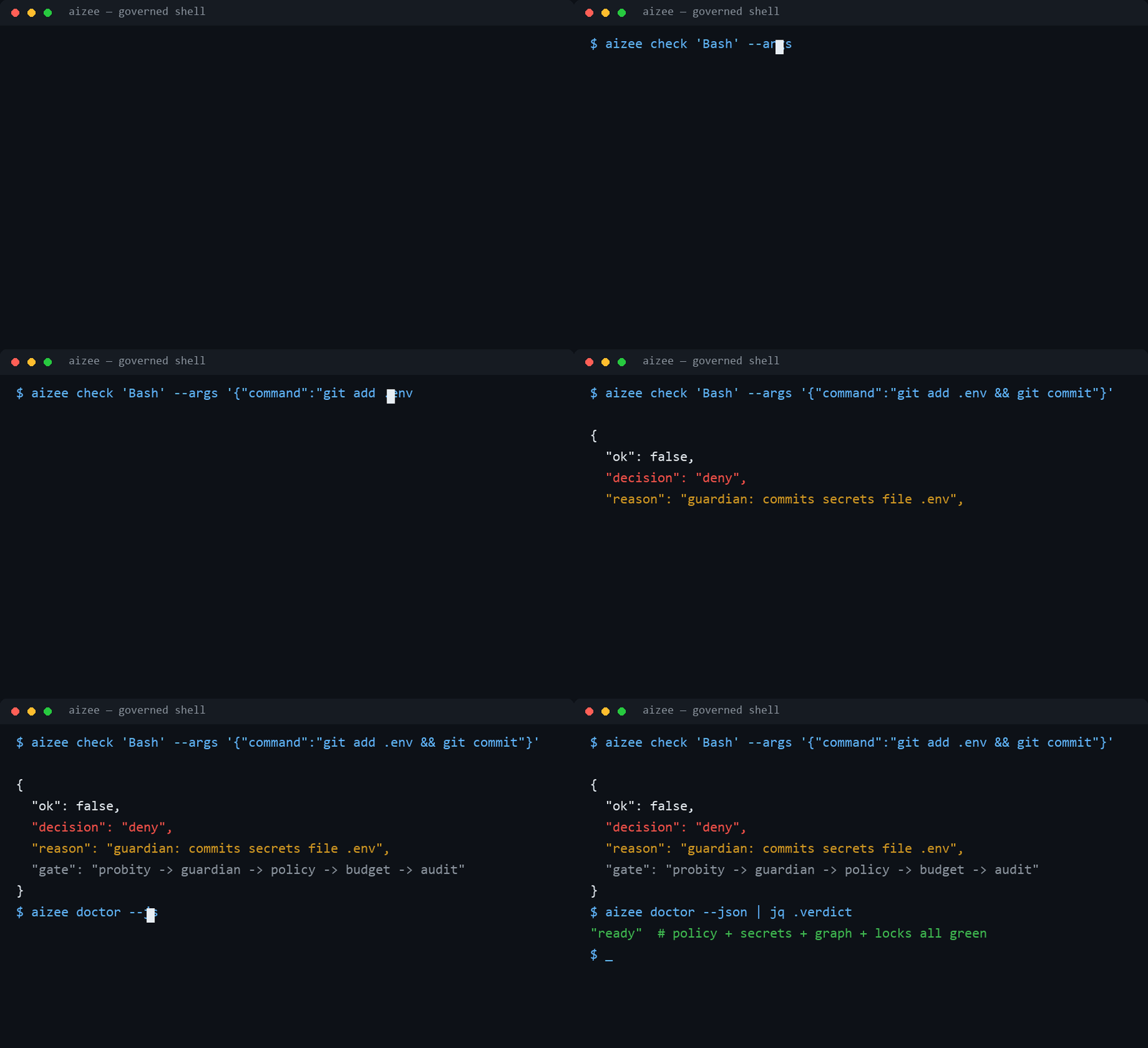
$ aizee check 'Bash' --args '{"command":"git add .env && git commit -m keys"}'
{
  "ok": false,
  "decision": "deny",
  "reason": "guardian: commits secrets file .env"
}

$ aizee doctor --json | jq .verdict
"ready"
Every tool call, LLM request, memory write, and file change flows through
Kernel.act() — Probity → Guardian → Policy → LoopDetector → Budget →
Audit — so a denial is a wall, not a suggestion.
What is aiZee?
A zero-compromise, version-controlled operating system that sits between you and every AI coding assistant — Cursor, Claude, Copilot, Windsurf, Cline, Aider, Devin — enforcing engineering standards, security policies, and architectural discipline on every line of generated code.
The problem it solves: AI assistants hallucinate APIs, forget conventions, ignore security, and silently ship technical debt. aiZee forces them to read from a centralized source of truth before writing a single line — and in v6, every action is verified while it executes, not just documented after.
| Without aiZee | With aiZee |
|---|---|
| Context drift after a few prompts | Rules + personas hard-loaded every session |
| Deprecated packages, silent tech debt | Exact-version tech-stack locked via live MCP docs |
| Raw SQL, missing XSS, weak secrets | OWASP, zero-trust, RBAC enforced by default |
| Random drive-by refactoring | Surgical changes through policy + budget + audit gates |
| Guardrails that exist but aren't on the path | v6: enforcement wired into Kernel.act() + every MCP call |
What's New — Unified Skill Library & BMAD Runtime (v6.8.0+)
The skill surface grew from 155 to 245 skills — the entire agent-skills ecosystem is now vendored, persona-mapped, trigger-enriched (EN+AR), and integrity-locked inside the repo:
- BMAD-METHOD vendored — all ~34 BMAD skills (
bmad-*,bmod-*) live inskills/with the project-local_bmad/runtime (config, scripts, ticket tree). Agents: Mary (analyst), John (PM), Winston (architect), Sally (UX), Sofia (PO), Amelia (dev) — invoked by natural language, no global install needed. - Marketing/growth suite — ~55 skills (seo-audit, ai-seo, cro, ads, cold-email, launch, pricing, paywalls, onboarding, referrals, revops…) with bilingual triggers.
- Lifecycle-aware persona routing —
runtime/lifecycle.pyreads the active BMAD initiative (_bmad/config.toml+_bmad-output/artifacts) and biases persona detection toward the current phase (discovery → PRD → breakdown → architecture → UX → implementation → review → retro). Non-BMAD projects are unaffected (phase=None→ keyword-only routing). - Handoff hints —
detect_multipleemitsnext_persona_hint, the highest-scoring persona outside the selected set, injected into context for smooth cross-domain transitions. - Per-project skill distribution —
scripts/distribute-agent-skills.pyjunctions/hardlinks all 245 skills into.agents/skills(every agent harness: Devin, Claude, Cursor, Codex…) plus.claude/skillsand.devin/skills; nothing stays global, so unrelated sessions stay lean. - Trigger enrichment + lint — imported skills got Arabic glossary
triggers;
scripts/enrich-imported-triggers.py/enrich-bmad-triggers.pyare idempotent and re-runnable after upstream updates. - FINOPS persona fixed — new dedicated
finopsskill replaces the mismatchedperformance-engineermapping. - External deps manifest —
deps.yamldeclares every tool aiZee features need (binaries, pip, git-repos, docker, env);aizee deps check|installverifies and provisions them (see External Tooling).
Full analysis: tech-stack/persona-bmad-review.md.
What's New in v6.7.0 — vercel-labs Adoption Pass
From a survey of all 396 vercel-labs repos (28 deep-studied; report in
vercel-labs-study-2026-11.md):
- Inert plan engine —
aizee plan validate|run|resumeruns callscript-style JSON plans: no eval, all-issues validation, bounded fan-outs/call budgets, suspend/resume that never re-runs settled side effects, auditableplan_hash. - Skill lock + drift —
skills-lock.jsonpins every skill by folder hash (skillFolderHashequivalent);aizee skill lock-checkreports changed/missing/unlocked,lock-updaterebuilds. - Canonical SKILL.md lint — kebab-case dirs, exact
SKILL.md, 500-line progressive-disclosure cap, folded intoaizee skill lint. - MCP tool-surface freeze —
aizee mcp freeze <server> [--check]snapshot-locks tool definitions and detects added/removed/changed tools. - Doc→code drift gate —
aizee check-docsvalidateswiki path#symbol refslinks across docs (lat.md-style). - Offline models.dev catalog —
aizee models --catalog [--query]: 886 models/12 providers vendored snapshot. - Error contract —
AizeeError.scope/public+to_public_dict()redaction for safe MCP/CLI envelopes. - Activation layer — every capability is wired for automatic use, not
just installed: a
Command Surface & Auto-Triggerssection inAGENTS.md(propagated to all agent adapters) + four trigger skills (inert-plan-runner,mcp-surface-integrity,docs-drift-check,skill-lock-integrity) so persona-detection surfaces the right command at the right moment, and event rules fire the gates (post-install → lock-check, MCP change → freeze --check, doc edit → check-docs) without being asked.
What's New in v6.6.0 — Repo-Study Adoption Pass
Adopted from a structured study of google/elephant-goldfish-model,
wotschofsky/domain-digger, and godotengine/godot
(full report in repo-study-2026-11.md):
- Goldfish spec review —
aizee spec review <spec_id|--file> [--preset]plans a fresh-zero-context reviewer pipeline (EGM port): semantic spec/plan split, 5-stage reviewer personas, severity triage + traceability consolidation. Vendored Apache-2.0 rubrics + personas live underresources/; workflow:workflows/65-goldfish-review.md. - Multi-harness skill packaging —
aizee skill link --pack <dir>emits an EGM-style portable bundle: canonicalplugin.jsonplus.claude-plugin/,.codex-plugin/,.cursor-plugin/,.agents/manifests, vendoredskills/,agents/personas, andresources/rubrics. Replacement is fail-closed on non-bundle destinations. - Domain intelligence toolkit —
aizee intel <domain>plus 7 MCP tools (runtime/dns_wire.py+runtime/domain_intel.py, a Python rewrite of domain-digger concepts): wire-format DNS codec, UDP→TCP fallback, iterative authoritative walking, DoH, WHOIS, certificate history, and subdomain enumeration — all bounded and fail-closed. - Skill scenario evals —
eval/skill_scenarios.pyruns static/live behavioral checks (eval/scenarios/goldfish-review.yaml) and feeds the eval harness as askill-scenariosgate. - Godot reference — full engine source pinned under
refs/godot(local-only) +tech-stack/godot-4.mdrecords the verified portable install (4.7.2.stable.official) for the GAME vertical.
What's New in v6.1.0 — Lean Surface
The headline change: the default surface is small and honest. The MCP fleet is reduced to what is actually used, marketing tool modules are gated off instead of deleted, dead code is gone, and installers remove retired files on upgrade.
Lean defaults
- 3 MCP servers by default —
aizee(governance),graphify,context7. The marketing/social/freelance MCP servers are gone from every shipped config. - 46 MCP tools enabled — 7 marketing-domain tool modules (ads, analytics, CRO, email, freelance, SEO, social) still ship but are disabled via
disabledToolModulesinaizee_mcp/config.json. Remove a name to re-enable it. - 31 plugins disabled —
plugins.yamlships themenabled: false; the sandbox blocks the rest.code2video,graphify,context7stay on. - Dead code removed — unused runtime modules (
a2a_server,semantic_search,provider_registry,sql_injection_guard,plugin_system, …) and their tests deleted.
Upgrade hygiene
- Stale-file cleanup —
scripts/stale_files.txtlists retired paths;install.ps1,install.sh, andscripts/update.pydelete them from existing installs while preservingstate/,brain/, and.env. - Unified test tree — all tests live under
tests/{runtime,memory,eval,aizee_mcp,…}. - Design library seeded —
design-library/now ships realDESIGN.mdseeds (editorial, midnight, minimal) soDesignLibraryno longer resolves an empty catalog. Memory.mdself-compaction — kept under its 500-line budget viaaizee memory compact(archive inmemory/archive/).
v6.0.0 recap — Governed Runtime
Enforcement moved onto the execution path in v6.0.0:
runtime/enforcement.py— unified helper: MCP firewall → AgentGateway request checks → execution → gateway response checks → audit. Shared by every call path.Kernel.act()— AgentGateway verdicts (ALLOW / REDACT / BLOCK) now gate real actions; prompt-injection and secret-leak checks apply to prompt-like fields without blocking ordinary file writes.- Outbound MCP —
McpClient(sync + async) andMcpAgentrun the firewall and gateway around every external tool call. - Inbound MCP — the aiZee server's tools keep RBAC and get gateway wrapping.
Detection depth
- Injection detector L1→L3 — 13-technique regex layer + L2 embedding-similarity layer + optional L3 LLM-judge hook. Deterministic/model-free by default.
- Dual-LLM hardening — quarantined worker output is schema-enforced via Pydantic; parse failure is fail-safe.
- MCP 2026-07-28 stateless — per-request
protocolVersionnegotiation +Mcp-Method/Mcp-Nameheader routing (runtime/mcp_protocol.py).
Governance depth
- APL verdicts — policies can now
modify(rewrite payloads, audited) andobserve(log-only) in addition to allow/ask/deny. - Lifecycle hooks —
output.pre_sendandmemory.pre_writephases; hooks can veto or mutate. aizee heal— safe autofix orchestrator (dry-run default,--applywith confirmation, audit tostate/heal.log).- Per-PR budgets — cumulative spend limits keyed by PR id (
AIZEE_PR_ID), on top of session/hour/day windows. - Release gate —
eval/release_gate.pyruns the reliability priority ladder over recorded rollouts; wired intoaizee ci. - Chaos suite —
eval/chaos.pyfault-injection scenarios + error-budget math.
Memory & protocol surfaces
- Bi-temporal memory —
store.as_of(as_of=..., valid_at=...)answers "what did we know then" and "what was true then" separately;pinned, soft-delete with tombstone-time queries, contradiction relations. aizee memory compact—Memory.mdauto-compaction (500-line budget,[PINNED]rescue, archive undermemory/archive/).- Code Mode —
aizee codemodeexecutes sandboxed Python snippets that call MCP tools directly (AST scan + restricted builtins + governed bridge + timeout). aizee bootstrap— materialize a minimal OS root afterpip install aizee(idempotent, dry-run default).- Advisory audits —
aizee task overcheck(over-engineering signals from plan + graph),aizee task curriculum(staged learning plan from tech-stack refs). - Cross-harness handoffs —
aizee memory handoff --to-harness <h>stamps a portableaizee.handoff.v1doc into the scoped vault (brain/handoffs/, fail-closed gitignore guard) so another agent picks up exactly where this one stopped. - Instincts —
aizee memory instinct-*records atomic trigger→action behaviors with confidence 0.3→0.9; observed in ≥2 projects → auto-promotes project→user scope. - MCP supply-chain audit —
aizee security mcpscans discovered MCP configs (JSONC-tolerant) for plaintext/token-shaped secrets inenvandargs, unpinnednpx/uvxpackages, writable command paths, and rug-pull drift vs locked baselines. - Fact-forcing guardrail — recoverable destructive commands (force-push, hard reset) pass only with explicit
{target, rollback}facts; catastrophic ones stay hard-blocked. - Prompt-defense baseline — every materialized harness rules file carries a fixed anti-injection section (identity lock, secret non-disclosure, untrusted external content, unicode-trick suspicion).
Full detail: CHANGELOG.md
Quick Start
Prerequisites
| Requirement | Minimum | Recommended |
|---|---|---|
| Python | 3.10 | 3.12 |
| Git | 2.30+ | Latest |
| OS | Windows 10 / macOS 12 / Ubuntu 22.04 | Latest |
Installation
git clone https://github.com/m3taz-ahmed/aizee.git .ai
cd .ai
Windows — GUI wizard (double-click install.bat or run):
.\install.ps1 -Gui
Windows — CLI:
.\install.ps1
macOS / Linux:
bash install.sh
pip (from GitHub):
pip install "git+https://github.com/m3taz-ahmed/aizee.git"
aizee bootstrap --target ~/.aizee --yes # materialize a minimal OS root
export AIZEE_ROOT=~/.aizee
PyPI publication is planned; until
pip install aizeelands, install from the repo directly as above (thepyproject.tomlis real — it installs cleanly as an editable or git package).
Installer map — the .bat files are thin launchers, not separate installers:
| Entrypoint | Real implementation | Preserves state//brain/ |
|---|---|---|
install.ps1 / install.sh |
The actual installers (copy + in-place modes) | Yes |
install.bat |
→ installer/gui_installer.ps1 |
Yes |
update.bat |
→ scripts/update.py (git pull + post-install) |
Yes |
uninstall.bat |
→ runtime/uninstaller_gui.py (fallback: aizee uninstall) |
n/a |
backup.bat / restore.bat |
→ scripts/backup_brain.py / restore_brain.py |
n/a |
Both install and update run the scripts/stale_files.txt retirement list, so files removed from the repo are deleted from existing installs too.
Verify
aizee doctor # Health check (46 checks)
aizee heal # Diagnose + safe autofixes (dry-run; --apply to fix)
aizee status # Current persona, skills, budget
aizee deps install # Provision external tools declared in deps.yaml
Updating
For an existing install (not a fresh install) — one file does everything:
- Windows: double-click
update.bat - Any OS:
python scripts/update.py --yes
What it does: git fetch → stashes any local edits (recover with git stash pop) → git pull --rebase → post-install hooks + aizee deps check advisory. Your learned data (memory/, state/, brain/, .env) is gitignored and always preserved. Preview first with python scripts/update.py --dry-run.
To jump straight to a specific release: git checkout vX.Y.Z then python scripts/update.py --post-install-only.
External Tooling & Auto-Provisioning
aiZee features sometimes need software that lives outside this repo —
CLI tools, pip packages, media kits, docker images, API keys. All of it is
declared in deps.yaml (44 entries) so nothing is a silent missing
requirement:
aizee deps check # Report every dep: ok / missing / wrong version
aizee deps check --tag video # Filter by group (video, devx, agent, media…)
aizee deps install # Provision everything unsatisfied (per-OS cmds)
aizee deps install --dry-run # Preview commands without running
aizee doctor # deps verdict folded into the health report
install.ps1 / install.sh / scripts/update.py already run
aizee deps check as a post-install hook and offer to install what's
missing — so a fresh clone reaches full capability with one command.
| Category | Examples | Needed for |
|---|---|---|
| Core (bundled) | Python 3.10+, SQLite, pyyaml, pydantic | Everything — zero extra installs |
| DevX CLIs | repomix, code2prompt, oxlint, agent-browser | Context packing, repo→prompt, JS lint, agent browsing |
| Spec/SDD | specify (spec-kit), openspec, spec-kitty, spec-workflow-mcp | Spec-driven development workflows |
| Automation | n8n, super-productivity, gitbutler | Workflow automation, PM, git branches |
| Media kits | cinecode, bang-motion, motion-graphics (~/.aizee/media) |
Video/motion production (optional) |
| ComfyUI | ~/.aizee/media/apps/ComfyUI + custom nodes |
Local image/video generation (optional, GPU) |
| Docker | Docker Desktop + code2video image |
code2video plugin rendering (optional) |
Optional by design: media/video deps are severity: optional — core
governance, personas, skills, memory, and MCP work fully without them.
aizee deps check tells you exactly what each feature is missing and the
one command that fixes it.
Core Architecture
.ai/ # Sovereign root (discovered via AIZEE_ROOT)
├── AGENTS.md # Cross-tool canonical bootloader
├── global-roles.md # 29 personas + operational rules
├── global-workflow.md # Cognitive loading & execution protocol
├── runtime/ # Kernel: policy, budget, audit, 139 governance modules
│ ├── kernel.py # Facade — Probity → Guardian → Policy → Loop → Budget → Audit
│ ├── enforcement.py # Unified firewall+gateway enforcement helper
│ ├── agent_gateway.py # Request/response guardrails (ALLOW/REDACT/BLOCK)
│ ├── injection_detector.py# L1 regex + L2 embeddings + L3 LLM-judge
│ ├── lifecycle.py # BMAD phase detection → persona routing bias
│ ├── codemode/ # Sandboxed code-mode tool execution
│ └── policies/ # default/guardian/probity/mcp_firewall YAMLs
├── memory/ # SQLite + FTS5 + vector, bi-temporal queries
├── aizee_mcp/ # MCP server (46 tools enabled, 3 resources)
├── eval/ # Benchmarks, chaos, reliability, release gate
├── skills/ # 245 persona + lord + BMAD + marketing skills
├── _bmad/ # BMAD runtime (config/scripts — gitignored)
├── .agents/skills # Junction distribution for agent harnesses
├── deps.yaml # External dependency manifest (check/install)
├── workflows/ # 66 trigger-based execution protocols
├── rules/ # Compressed behavioral rules
├── tech-stack/ # 271 version-locked stack references
├── dashboard/ # Web dashboard (Python stdlib HTTP)
├── scripts/ # Installers, validators, MCP wrappers
├── install.ps1 / install.sh # Idempotent OS installer
└── pyproject.toml # Package metadata + quality config
The Six Pillars
1. Persona + Skill Composition
29 personas (ARCH, QA, SEC, DEV, SRE, DATA, ML, MLOPS, FINOPS, DEVOPS, API, FREELANCE, MARKETING, GROWTH, BRAND, EMAIL, SOCIAL, CRO, SALES, etc.) with lord-level domain skills — auto-detected per task, no manual selection needed.
Two routing layers on top of keyword scoring:
- Lifecycle phase bias — when a BMAD initiative is active,
_bmad-output/artifacts reveal the current phase (PRD → architecture → stories → review) andruntime/lifecycle.pybiases selection toward the matching persona (e.g. mid-implementation →DEV, mid-review →QA+ARCH). - Handoff hints — the result carries
next_persona_hint: the strongest persona outside the selected set, so cross-domain tasks ("review the design, then implement") transition cleanly.
aizee persona detect --multi "build a secure docker API with postgres"
# → Primary: ARCH + Secondary: SEC, DEVOPS + Lords: security-lord, cloud-platforms-lord
# + lifecycle_phase / next_persona_hint when a BMAD initiative is active
2. Runtime Governance
Every action passes through the gate pipeline before execution:
Probity → Guardian → Policy → Loop Detector → Budget → Audit
└─ AgentGateway: injection + secret-leak verdicts (v6)
- Policy engine —
allow/ask/deny/modify/observeYAML rules with AST-safe evaluation - MCP firewall — rule-based outbound tool-call gate (deny destructive, ask unknown)
- AgentGateway — prompt/response guardrails on every enforced path
- Budget manager — token/cost/call limits per session/hour/day/week/month and per PR
- Audit logger — SHA-256 hash-chained, Ed25519-signed, tamper-evident trail
- Workflow runner — durable SQLite-backed execution with saga compensation
3. Live Ground-Truth
Context7 MCP fetches current library docs before implementation. Graphify knowledge graph replaces blind grep for codebase navigation.
4. Hybrid Memory
SQLite + FTS5 full-text + optional vector index (SentenceTransformers). Episodic, semantic, factual, procedural layers — now with pinning, soft-delete, contradiction links, HMAC integrity, and bi-temporal as_of queries.
aizee memory ingest # Rebuild index after changes
aizee memory search "docker" # Full-text + vector search
aizee memory compact # Keep Memory.md under its line budget
5. Quality Gates (Zero Defect)
ruff check . # 0 warnings
mypy # Strict typing
aizee test --full # full suite + coverage (fail-under=100)
python eval/harness.py # E2E eval: ruff + mypy + pytest + validate-globals
6. Token Efficiency
Persona detection is local (pure Python, zero LLM tokens). Code Mode replaces tool-call JSON ping-pong with sandboxed snippets that invoke tools directly — materially fewer orchestration tokens on multi-tool tasks.
Runtime Enforcement Map
| Path | Gates applied |
|---|---|
Kernel.act() |
Probity → Guardian → Policy → Loop → Budget → Audit + AgentGateway prompt checks |
Outbound MCP (McpClient, McpAgent, aizee mcp call) |
mcp_firewall → gateway request → execute → gateway response |
Inbound MCP (aizee_mcp tools) |
RBAC + gateway request/response wrap |
Chat (kernel.chat_message) |
prompt_gate → … → output.pre_send hooks |
| Memory writes | memory.pre_write hooks (veto/mutate) + HMAC integrity |
Code Mode (aizee codemode) |
AST sandbox scan + restricted builtins + governed call_tool |
Dashboard
python dashboard/server.py 8080
# → http://127.0.0.1:8080
Dark-first command-center UI: command palette (Ctrl+K), bento-grid metrics, status pills, glass panels. Optional Bearer auth via AIZEE_DASHBOARD_TOKEN.
Tabs: Overview · Memory Explorer · Policy Sandbox · Workflows · Sagas · Chat · Tech Stack · Telemetry · System Health · Audit Logs · Settings
Important — disable MCP servers you don't use. Every enabled MCP server consumes memory and may spawn a subprocess on first tool call. After installation, open Settings → MCP Servers, uncheck what you don't need (Uncheck All then re-check), and Save Changes. The kernel auto-reloads on save.
Settings persist to state/settings.json (gitignored, survives updates). Schema migrations run automatically — old files are backed up.
Key Commands
| Command | Purpose |
|---|---|
aizee doctor [--json] |
Health verdict + ordered Run:/Guidance: fix steps |
aizee heal [--apply] [-y] |
Diagnose + safe auto-fixes (dry-run default) |
aizee check <action> |
Policy verdict for an action |
aizee find "<need>" |
NL search over skills/workflows/tech-stack |
aizee goal "<objective>" |
Map a goal to the best workflow + steps |
aizee config show |
Masked settings snapshot |
aizee config apply <file> --check |
Validate a settings file (no write) |
aizee spec propose|changes|archive |
OpenSpec-style change folders |
aizee gateway init|serve |
Governed LLM proxy (failover + enforcement) |
aizee models |
Model routing catalog (tiers + cost) |
aizee work poll |
Open GitHub issues via gh (pull model) |
aizee skill link |
Install SKILL.md into agent harnesses |
aizee skill lint [--write-index] |
Description lint + trigger-collision detection |
aizee skill scan |
Prompt-injection / exfiltration scan of skills |
aizee hooks install|status |
Wire aiZee hooks into agent harnesses |
aizee abstract [--force] |
Generate L0 .abstract.md tiered summaries |
aizee session from-curl|from-har |
Inspect a captured API auth bundle |
aizee memory compact [--apply] |
Compact Memory.md to its line budget |
aizee codemode --code/--file |
Sandboxed snippet calling MCP tools |
aizee task overcheck |
Over-engineering audit of the active plan |
aizee task curriculum --stack … |
Staged learning plan from tech-stack refs |
aizee bootstrap --target DIR |
Materialize an OS root (post-pip install) |
aizee ci |
Full CI gates incl. reliability release gate |
aizee security scan <path> |
SAST + external scanner orchestration |
aizee deps check|install [ids] |
Verify/provision external deps (deps.yaml) |
aizee skill lock-check|lock-update |
Skill integrity: drift detection / re-lock |
aizee mcp freeze <srv> [--check] |
Snapshot-lock MCP tool surface |
aizee check-docs |
Validate [[file#symbol]] doc references |
aizee spec review <spec> |
Goldfish reviewer-pipeline plan |
aizee intel <domain> |
DNS/WHOIS/certs/subdomain recon |
aizee eval |
Behavioral skill-scenario checks |
aizee persona detect --multi |
Multi-persona + lifecycle phase + hints |
Quality Gates
| Gate | Command | Status |
|---|---|---|
| Lint | ruff check . |
0 warnings |
| Types | mypy |
0 errors (strict) |
| Tests (fast) | aizee test |
fast tier, no coverage |
| Tests (full) | aizee test --full |
full suite, coverage floor 100% |
| Integrity | scripts/validate-globals.py |
1242 files, 0 errors |
| Docs sync | scripts/sync_docs.py --check |
in sync |
| E2E | python eval/harness.py |
all gates pass |
| Release | python eval/release_gate.py |
reliability ladder over rollout evidence |
Tech Stack
- Core: Pure Python 3.10+ (no Node.js required for core OS)
- Memory: SQLite + FTS5 + optional SentenceTransformers vectors
- MCP: FastMCP server, 46 tools enabled by default (7 marketing tool modules ship gated via
disabledToolModules) - Dashboard: Python stdlib HTTP server + SQLite
- Knowledge graph: graphify (optional)
- Dependencies: pyyaml, pydantic, rich, cryptography, numpy, turbovec
How aiZee compares
aiZee is not a skills collection or a process framework — it is the policy layer that governs what any of them may do. The categories compose:
| aiZee | BMAD-METHOD | spec-kit | claude-skills | |
|---|---|---|---|---|
| Category | Governance + agent OS | Agile-ai process | Spec-driven toolkit | Skill library |
| Enforcement | Runtime gates on every action | Process conventions | Spec templates | None (content only) |
| Skills | 245 vendored, hash-locked | ~34 bmad-* |
Templates | 410+ |
| Personas | 29 auto-detected + lifecycle-aware | 6 named agents | — | — |
| Memory | Hybrid SQLite + vectors, bi-temporal | persistent_facts files |
— | — |
| MCP | Server (46 tools) + client firewall | — | — | — |
| Install | pip install aizee |
npx skills add |
uvx specify |
npx skills add |
| Best for | Governing what agents may do | Running the agile-ai lifecycle | Spec-driven workflows | Plug-and-play skills |
They compose, not compete: aiZee can govern BMAD workflows end-to-end (its _bmad/ runtime is detected by runtime/lifecycle.py), ingest skills from any agent-skills repo into its locked library, and enforce policy over spec-kit-driven development.
Contributing
- Fork → feature branch (
feature/*) - Write tests first (AAA pattern, one behavior per test)
- Run
ruff check . && mypy && pytest -q && python eval/harness.py - All gates must pass — no PR without green
- Conventional commits:
type(scope): subject - PR ≤ 400 lines, targeted tests only
Ecosystem & Distribution
aiZee ships its own MCP server and agent-facing skill. The surfaces below make it discoverable to agents and humans — some require maintainer accounts:
| Surface | What it unlocks | Status |
|---|---|---|
PyPI (aizee) |
pip install aizee — the README's install path |
⏳ pending publication |
| Official MCP servers list | Listed in modelcontextprotocol/servers — where Claude/Cursor users discover MCP tools |
⏳ PR needed |
| mcpservers.org / Smithery / Glama | MCP directories with one-click install | ⏳ submission needed |
| awesome-claude-code / awesome-mcp | Curated lists that drive most early stars | ⏳ PR needed |
| GitHub social preview | The image shown when the repo is shared on X/LinkedIn/Discord | ⏳ needs a banner image (1280×640) |
| Demo GIF | The money shot: agent blocked mid-commit | ⏳ record with ScreenToGif/asciinema+agg |
| Show HN · r/ClaudeAI · r/cursor | Launch traffic | ⏳ after the above land |
| Dev.to / Hashnode post | Searchable launch write-up | ⏳ optional |
Everything else (topics, description, release, llms.txt, root SKILL.md,
aizee skill link into agent harnesses) is already shipped.
License
MIT — see LICENSE.
aiZee — The policy layer for AI coding.
Built by Moataz Ahmed
1 maintainer

Metadata
1 maintainer
Release files for aizee 6.8.1
For a detailed explanation of source distributions (sdists) and built distributions (wheels), please see the package formats documentation.
Source distribution (sdist)
| File | Size | Uploaded | Provenance | Actions |
|---|---|---|---|---|
| aizee-6.8.1.tar.gz | 12.1 MB | Without provenance | Details for aizee-6.8.1.tar.gz |
Built distribution (wheel)
| File | Interpreter | ABI | Platform | Actions Reset |
|---|---|---|---|---|
| aizee-6.8.1-py3-none-any.whl | Python 3 | none | any | Details for aizee-6.8.1-py3-none-any.whl |
Total release size: 21.5 MB
Release files / aizee-6.8.1.tar.gz
| Download URL | aizee-6.8.1.tar.gz |
|---|---|
| Size | 12.1 MB |
| Tags | Source |
|
SHA-256 checksum How to use checksums |
6ba76a316bde632545e2a502fa132215ac94ad892bc86ca746b3039078190229
|
|
BLAKE2b-256 checksum How to use checksums |
7fff8f4545773d11934259cc4236e8c6d6da2f3f9e3daec49d14e4a919ec8244
|
| Upload date | |
|
Uploaded using Trusted Publishing? What is trusted publishing? |
No |
| Uploaded via |
uv/0.11.16 {"installer":{"name":"uv","version":"0.11.16","subcommand":["publish"]},"python":null,"implementation":{"name":null,"version":null},"distro":null,"system":{"name":null,"release":null},"cpu":null,"openssl_version":null,"setuptools_version":null,"rustc_version":null,"ci":null}
|
Release files / aizee-6.8.1-py3-none-any.whl
| Download URL | aizee-6.8.1-py3-none-any.whl |
|---|---|
| Size | 9.4 MB |
| Tags | Python 3 |
|
SHA-256 checksum How to use checksums |
fb6ff322a129cc92942e5c62283daa4294edb956de7c9ed884fda37763d5f540
|
|
BLAKE2b-256 checksum How to use checksums |
0c443e77ceae52eaac9baa86fcdea130c0d6d8641d6a96a4d41fc4700a7112f2
|
| Upload date | |
|
Uploaded using Trusted Publishing? What is trusted publishing? |
No |
| Uploaded via |
uv/0.11.16 {"installer":{"name":"uv","version":"0.11.16","subcommand":["publish"]},"python":null,"implementation":{"name":null,"version":null},"distro":null,"system":{"name":null,"release":null},"cpu":null,"openssl_version":null,"setuptools_version":null,"rustc_version":null,"ci":null}
|
Security for aizee 6.8.1
Provenance
Provenance describes where a file came from. On PyPI, provenance is shared via attestations, which provide a verifiable record of the build or publishing details. View details, limitations and caveats.
No provenance found
None of the files in this release were uploaded with provenance metadata.
A note on package security
PyPI is a repository for distributing packages, not a service for auditing them. While third-party security researchers and our staff do their best to detect and remove malicious packages, PyPI cannot guarantee the quality, security or suitability of any given package.
To learn more about protecting yourself from malicious actors, visit our package security documentation.














