
Welcome to our module!
Aja-pose
AJA-pose helps you train, validate and test your animal pose estimation model.
Check out how we have done it in Google Colab.
We have evaluated our model (PCK@0.05) and the mean accuracy for the 23 keypoints for our model is 93.073%
We recommend using at least Nvidia V100 GPU for faster inferencing but T4 GPUs will still work.

Getting Started
git clone https://github.com/Antony-gitau/AJA-pose.git
cd AJA-pose
pip install -e .
Getting our model and the dataset. We have made our model public and can be downloaded here
import urllib.request

# # Get the dataset
url = "https://storage.googleapis.com/figures-gp/animal-kingdom/dataset.zip"
destination = "dataset.zip"

urllib.request.urlretrieve(url, destination)

# Unzip the file
!unzip dataset.zip

# The model file
url = "https://storage.googleapis.com/figures-gp/animal-kingdom/all_animals_no_pretrain_106.pth"
destination = "all_animals_no_pretrain_60.pth"

urllib.request.urlretrieve(url, destination)
Test our model
We require the path to the test images directory and the test.json file in MPII format
from aja_pose import Model

# path to the images directory and annotation in mpii json format
images_directory = '' # Path to the images directory
mpii_json = '' # Path to the test.json file
model_file = 'all_animals_no_pretrain_60.pth' # Path to the model file

# Initialize the class
model = Model()
# Test the model on Protocol 1
model.test(images_directory, protocol='P1', model=model_file)
# Test the model on Protocol 2
model.test(images_directory, protocol='P2', model=model_file)
# Test the model on birds class Protocol 3
model.test(images_directory, protocol='P3', model=model_file, animal_class='bird')
# Test the model on reptiles class Protocol 3
model.test(images_directory, protocol='P3', model=model_file, animal_class='reptile')
# Test the model on mammals class Protocol 3
model.test(images_directory, protocol='P3', model=model_file, animal_class='mammal')
# Test the model on fish class Protocol 3
model.test(images_directory, protocol='P3', model=model_file, animal_class='fish')
# Test the model on amphibian class Protocol 3
model.test(images_directory, protocol='P3', model=model_file, animal_class='amphibian')
You can also start to train your model or pretrain on top of ours
# train a VHR model
train_json = '' # labels for the train set (train.json)
valid_json = '' # Labels for the validation set (test.json)
model_file = '' # A pytorch model file to pretrain on.
model.train(images_directory, train_json, valid_json, pretrained=model_file)

# Train a model on a particular class e.g (Ampibian)
model.train(images_directory, protocol='P3', animal_class='amphibian', model=model_file)
Results
A sanity check on our model.
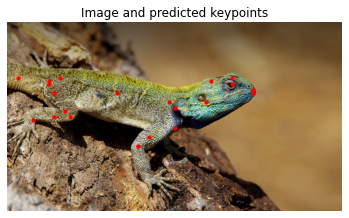
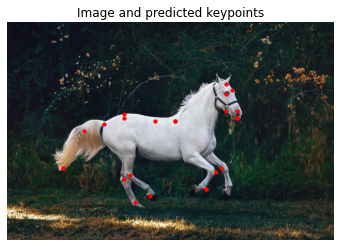
Ground Truth

Predictions

Performance
The performance of our model on the different animal classes is as shown below.
| Animal Class | Samples | Head | Shoulder | Elbow | Wrist | Hip | Knee | Ankle | Mouth | Tail | Mean | |
|---|---|---|---|---|---|---|---|---|---|---|---|---|
| Birds | 1705 | 95.756 | 93.637 | 89.774 | 88.179 | 98.975 | 97.582 | 94.326 | 98.447 | 95.112 | 95.164 | |
| Reptiles | 1209 | 91.538 | 85.291 | 84.662 | 85.587 | 90.457 | 88.097 | 85.239 | 96.723 | 83.925 | 89.553 | |
| Mammals | 1496 | 90.641 | 89.269 | 88.509 | 89.927 | 90.263 | 88.655 | 89.535 | 93.622 | 82.161 | 90.038 | |
| Fish | 918 | 96.468 | 96.249 | 98.643 | 96.058 | 98.403 | 96.743 | 95.775 | 97.564 | 98.256 | 96.467 | |
| Amphibian | 1279 | 98.128 | 94.342 | 97.948 | 98.508 | 95.491 | 94.957 | 94.319 | 98.702 | 99.568 | 95.493 |
The model performance on Protocol 1 and Protocol 2 is as shown below.
| Protocol | Samples | Head | Shoulder | Elbow | Wrist | Hip | Knee | Ankle | Mouth | Tail | Mean | |
|---|---|---|---|---|---|---|---|---|---|---|---|---|
| P1 | 6620 | 94.230 | 91.054 | 90.806 | 90.920 | 94.414 | 93.233 | 92.094 | 96.867 | 92.346 | 93.073 | |
| P2 | 2883 | 88.683 | 75.815 | 80.223 | 81.136 | 85.568 | 83.840 | 82.028 | 94.799 | 72.506 | 83.711 |
3 maintainers


Metadata
3 maintainers
Release files for aja-pose 0.0.1
For a detailed explanation of source distributions (sdists) and built distributions (wheels), please see the package formats documentation.
Source distribution (sdist)
| File | Size | Uploaded | Provenance | Actions |
|---|---|---|---|---|
| aja_pose-0.0.1.tar.gz | 24.0 MB | Without provenance | Details for aja_pose-0.0.1.tar.gz |
Built distribution (wheel)
| File | Interpreter | ABI | Platform | Actions Reset |
|---|---|---|---|---|
| aja_pose-0.0.1-py3-none-any.whl | Python 3 | none | any | Details for aja_pose-0.0.1-py3-none-any.whl |
Total release size: 49.5 MB
Release files / aja_pose-0.0.1.tar.gz
| Download URL | aja_pose-0.0.1.tar.gz |
|---|---|
| Size | 24.0 MB |
| Tags | Source |
|
SHA-256 checksum How to use checksums |
58778af9d50e380c56e04afdf4a1f45c1b3166331be0244e69460538f9815f79
|
|
BLAKE2b-256 checksum How to use checksums |
5750a0a56bf9ed73903072736729051d8fd0b56922717414692fb06e52c5c22e
|
| Upload date | |
|
Uploaded using Trusted Publishing? What is trusted publishing? |
No |
| Uploaded via |
twine/5.0.0 CPython/3.10.12
|
Release files / aja_pose-0.0.1-py3-none-any.whl
| Download URL | aja_pose-0.0.1-py3-none-any.whl |
|---|---|
| Size | 25.5 MB |
| Tags | Python 3 |
|
SHA-256 checksum How to use checksums |
970879e03e08cd49be6349f7641356d8a1fe077a770dfb3cd8e2cfb50fcf8d61
|
|
BLAKE2b-256 checksum How to use checksums |
201e8de7cb6da6561a4f12d6342e4c703ca47304383ed1e058610a0983239874
|
| Upload date | |
|
Uploaded using Trusted Publishing? What is trusted publishing? |
No |
| Uploaded via |
twine/5.0.0 CPython/3.10.12
|
Security for aja-pose 0.0.1
Provenance
Provenance describes where a file came from. On PyPI, provenance is shared via attestations, which provide a verifiable record of the build or publishing details. View details, limitations and caveats.
No provenance found
None of the files in this release were uploaded with provenance metadata.
A note on package security
PyPI is a repository for distributing packages, not a service for auditing them. While third-party security researchers and our staff do their best to detect and remove malicious packages, PyPI cannot guarantee the quality, security or suitability of any given package.
To learn more about protecting yourself from malicious actors, visit our package security documentation.













