







akko-mcp-trino
English · Français
Give your AI agents read-only access to Trino, and nothing more.
akko-mcp-trino is an MCP server for Trino. It lets an agent find the tables and columns that hold what it is looking for, describe a schema or a table, list catalogs, schemas and tables, explain a query and run it, and it refuses every write it is sent: each statement is parsed, and a write anywhere in it is refused before Trino. By default every query runs as the user the agent acts for. The server verifies the user's token, issued for this server, and obtains from the identity provider a separate token for Trino (OAuth 2.0 Token Exchange): the user's own token never leaves the server. Trino's access control (OPA, Ranger, or Trino's own rules) then decides what that user may read. Results are bounded in rows and in time, and every call leaves one audit line.
Upgrading from 0.6? 0.7.0 removes and renames nothing: it adds
search_columnsanddescribe_schema, pages the listings, and gives every error akind. Let the engine's policy readsystem.jdbcandsystem.metadata, which the two new tools read (0.6 advised refusing all ofsystem). KeepMCP_CALL_TIMEOUT_SECONDSat 0 or aboveMCP_SEARCH_RESERVE_SECONDS(2 by default), or the server refuses to start. Atruncatedlisting is no longer the end: read on withnext_offset. Extension authors: one helper changes its signature, and inoauth2mode the guards run on every request that is not discovery, no longer once at start.From 0.5? 0.6.0 changed the defaults: a verified caller is required, and the
jwtmode exchanges the caller's token instead of passing it on. See MIGRATING.md for both.
Understand in five steps
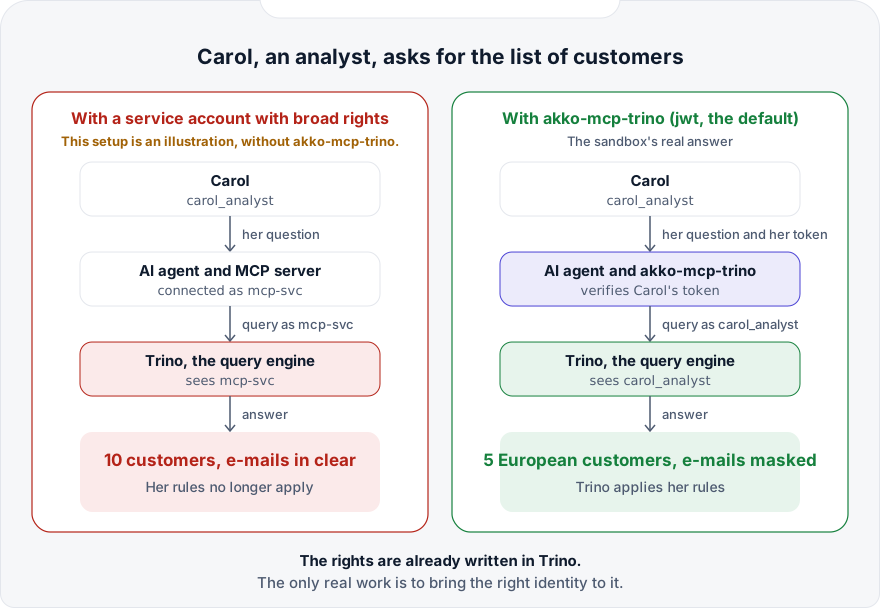
An agent connected through one service account with broad rights reaches Trino under that account, so the rules written for Carol no longer apply. The left panel is an illustration: the sandbox's policy would refuse such an account. akko-mcp-trino brings Carol's own identity to Trino, and the rules Trino already has do the rest.
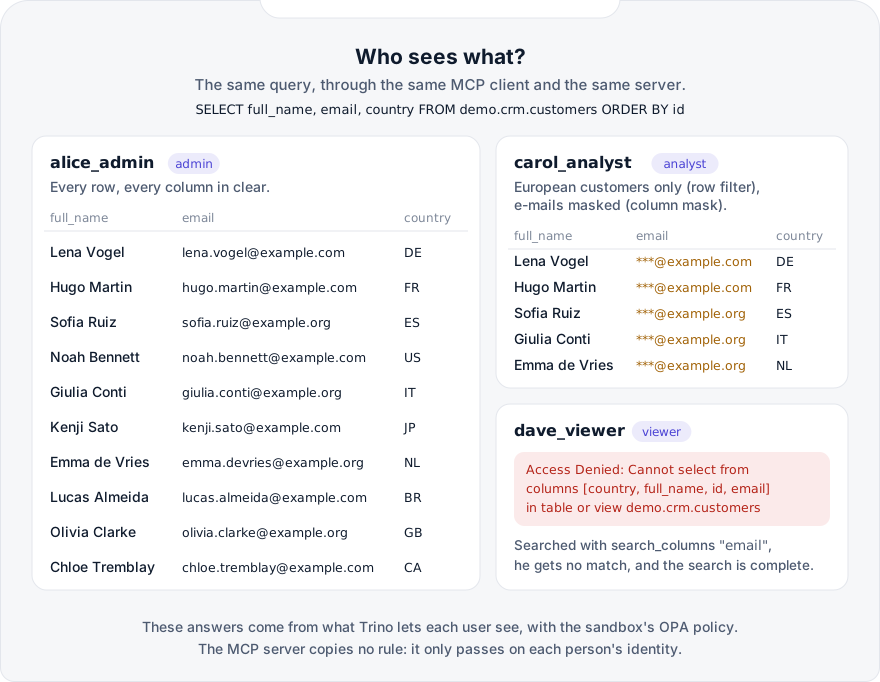
The same query from the three users of the sandbox, through the same MCP client and the same server. Trino answers each of them with the sandbox's OPA policy; the server copies no rule.
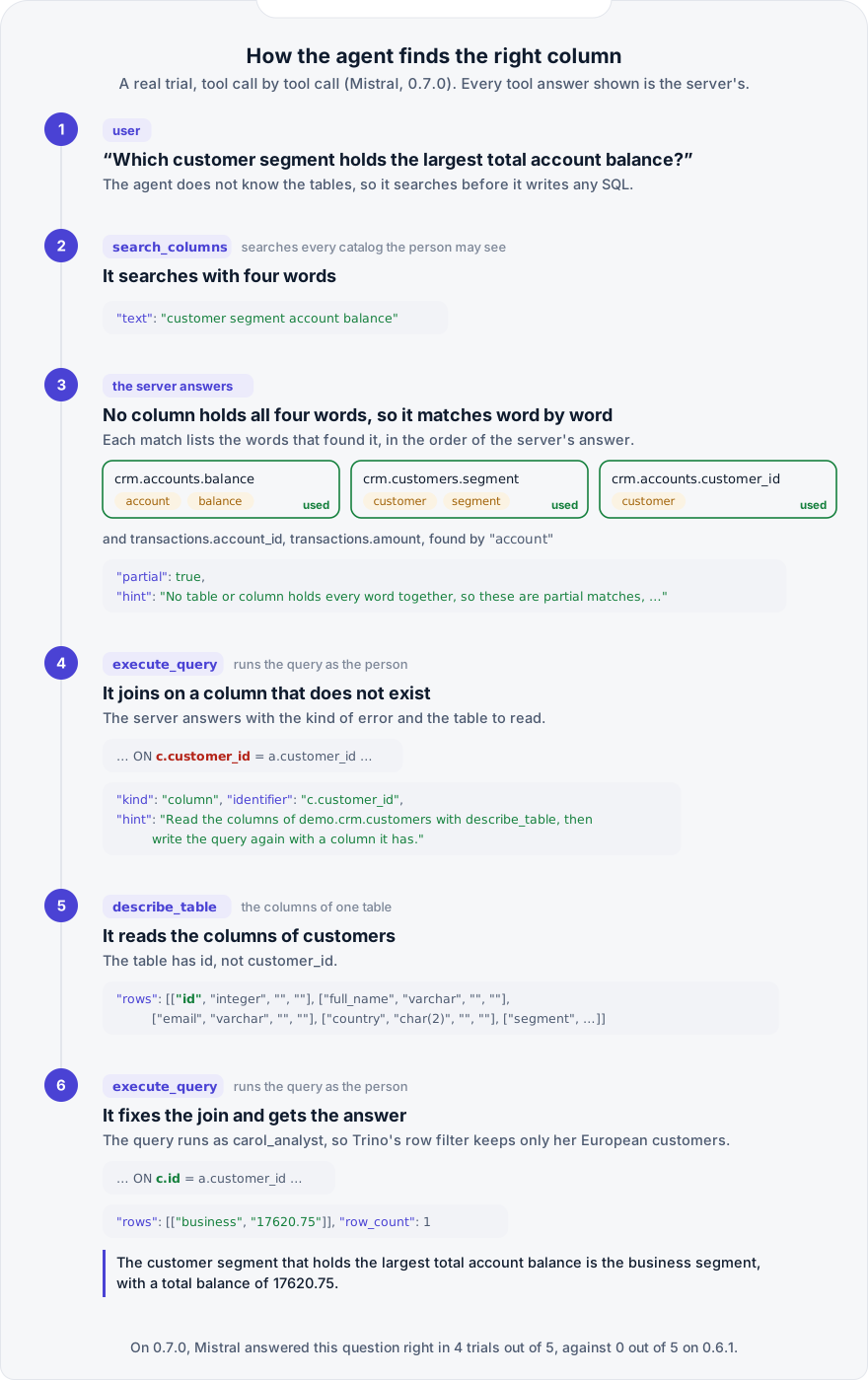
A real trial, tool call by tool call: Mistral on 0.7.0 looks for the segment with the largest balance. The search matches word by word, the error on a wrong join names the table to read, and the agent fixes its join. Every tool answer shown is the server's, replayed in the sandbox.
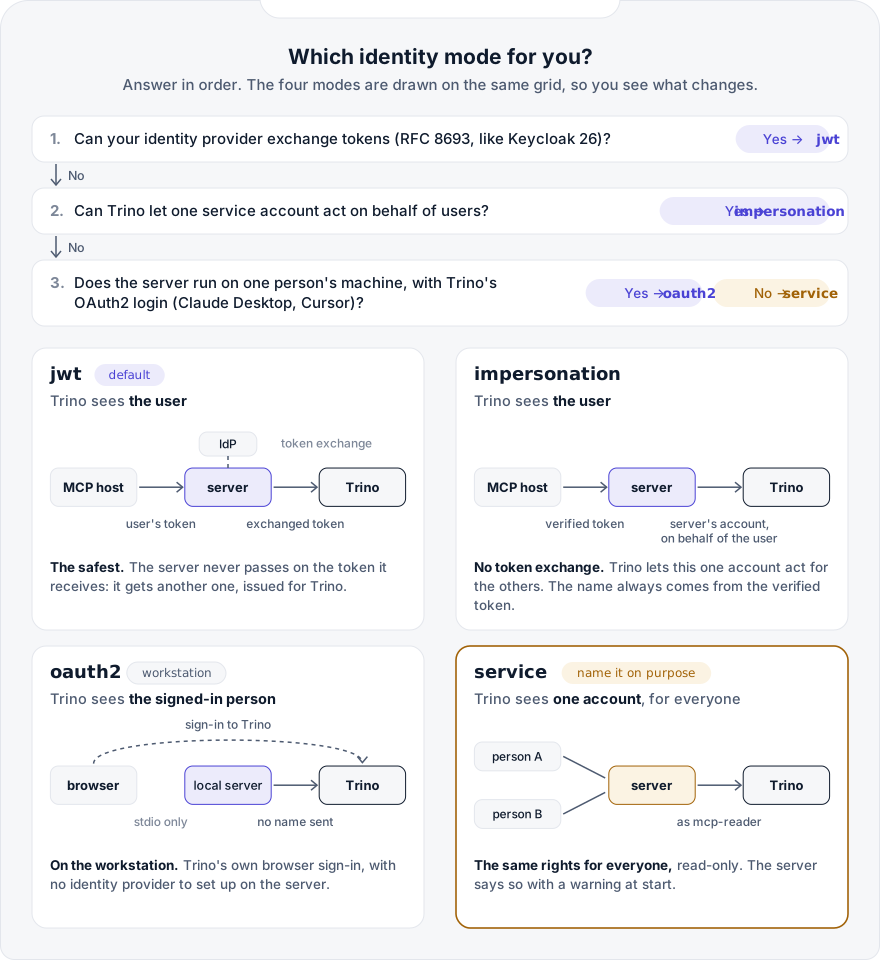
Four identity modes, from the safest to the simplest. jwt is the default; service gives
every caller the same account and is used only when you name it.
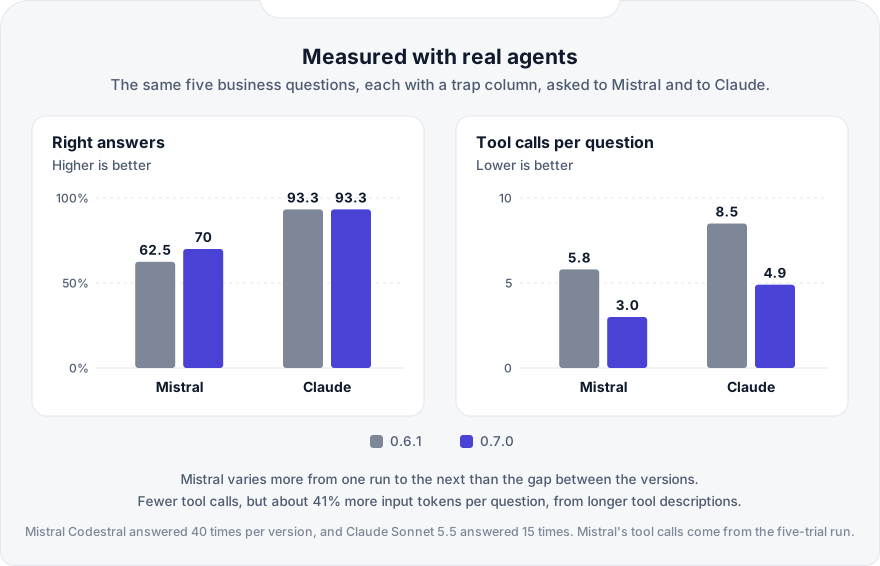
The same five business questions asked to Mistral and to Claude, on 0.6.1 and on 0.7.0. Mistral varies more from one run to the next than the gap between the versions, and 0.7.0 sends about 41% more input tokens per question, because its tool descriptions are longer. The harness and its reports are in akko-sandbox.
The interactive version of these five steps is on akko-ai.com/en/docs/understand (also en français).
Try it in five minutes
The sandbox starts Keycloak, Trino, OPA and the server on your machine, with the three users above:
git clone https://github.com/AKKO-p/akko-sandbox.git
cd akko-sandbox
docker compose up -d --wait
./demo.sh
Why
An agent that reads a lakehouse needs a small, predictable surface: a few tools
whose descriptions a model understands, answers that never run away, and a
guarantee that a prompt injection cannot turn a question into a DROP TABLE
through it. This server is that surface, and nothing else. It does not decide
access: Trino decides for each user with the rules it already has, or, in
service mode, for the one identity you give it.
Highlights
- Read-only by construction, through this server. SQL is parsed into an AST and refused if a write appears anywhere in the tree, CTEs and subqueries included. Table functions (
TABLE(...), such as a JDBC connector'ssystem.query) and thesystemcatalog are refused too, including through a name without a catalog when the session catalog issystem. What a user may do in Trino by other means is Trino's rules: see What read-only covers. - The user's own rights, safe by default. In
jwtmode, the default, the server verifies the caller's token (issued for this server, never for Trino), exchanges it at the identity provider for a token whose audience is Trino (RFC 8693), and Trino runs the query as that user. The caller's token is never passed on. A request without a valid token is refused with401. - A fallback without token exchange. In
impersonationmode the server authenticates to Trino as its own account (password or client certificate) and Trino runs the query as the verified caller, under an impersonation rule only that account has. - One identity, only when named. In
servicemode every query runs asTRINO_USER. It is never chosen by default, and the server says so at start and to every host in its initialization instructions. - Bounded by default. A row cap with a
truncatedflag (100), a time budget per query cancelled in Trino (60 s), a time budget per tool call (120 s). - One audit line per call. Keyed by
X-Request-Id, never the token, never the SQL text: who called which tool, with which outcome, for how long. - Eight tools, annotated with what they can really do:
execute_queryis annotated read-only only whileTRINO_READ_ONLYis true. - A guarded door. Bearer tokens verified against any OIDC provider's JWKS (issuer, audience bound to this server, expiry, clock tolerance), a token issued for Trino refused, protected resource metadata (RFC 9728), a Host header filter.
- Built to be extended without being forked. Tool plugins and extensions are Python packages named at start: identity modes, guards at the door, audit fields, routes, tools. An extension can only refuse what the core allows, never widen it.
- Any MCP host, any model. Cursor, Claude Desktop, VS Code, the Python SDK… Mistral, or any OpenAI-compatible model through the example agent.
- Small and proven. 717 tests at 100 % line and branch coverage, including in-process suites on the real SDK for all three transports, a live run against Keycloak and Trino in CI (
integration/), and a product-neutral guard.
Documentation
- How it works, end to end: akko-ai.com/en/docs/how-it-works (also en français).
- Guide, prerequisites, configuration, examples: akko-ai.com/en/docs/open-source-core (also en français) and akko-ai.com/en/docs/examples.
- Reference, in this repository: this README,
examples/,CHANGELOG.md,MIGRATING.md,CONTRIBUTING.md,SECURITY.md.
Contents
- How it works
- Compatibility
- Prerequisites
- Install and run
- Connect an MCP host
- Use it from an agent
- The tools
- What read-only covers
- Extensions
- What happens on a request
- Configuration
- Operations
- Development
- Design notes
- Contributing
- About AKKO
How it works
flowchart LR
    Host["MCP host<br/>(Cursor, Claude, VS Code, an agent)"]
    IdP["Identity provider<br/>(OIDC, JWKS, token exchange)"]
    Server["akko-mcp-trino"]
    Trino["Trino"]
    Policy["Policy engine<br/>(OPA, Ranger, built-in)"]
    Data[("Data sources")]

    Host -- "1. tool call + Bearer token<br/>(audience: this server)" --> Server
    Server -. "2. verify signature, issuer,<br/>audience, expiry (JWKS)" .-> IdP
    Server -. "3. exchange it for a token<br/>whose audience is Trino (RFC 8693)" .-> IdP
    Server -- "4. read-only SQL, with that token" --> Trino
    Trino -- "5. may this user read this?" --> Policy
    Trino -- "6. rows, as that user may read them" --> Server
    Server -- "7. result" --> Host
    Trino --> Data
The host calls a tool with the user's access token. The server verifies it
(signature against the provider's JWKS, issuer, an audience naming this server,
expiry) and refuses a request without a valid one with 401; a token issued for
Trino is refused too. The server then checks the statement (read-only,
identifiers, table functions, the system catalog) and runs it in Trino under
the identity mode TRINO_IDENTITY_MODE names. Trino asks its policy engine and
returns what that identity may read, bounded in rows and time.
| Mode | Who Trino sees | How Trino knows | When to use it |
|---|---|---|---|
jwt (default) |
the caller | a token for Trino the server obtained by token exchange (RFC 8693); Trino verifies it with its JWT authenticator | the identity provider supports OAuth 2.0 Token Exchange (RFC 8693); tested with Keycloak 26 |
impersonation |
the caller | the server's own account (password or client certificate) asks Trino to run the query as the caller; Trino allows it under an impersonation rule only that account has | the identity provider cannot exchange tokens |
oauth2 |
the local user, checked with SELECT current_user |
Trino's native OAuth2 browser login; the driver caches tokens and reauthenticates | local stdio hosts only, with a Trino coordinator configured for OAuth2 |
service |
TRINO_USER, the same for every caller |
a password, a client certificate, or nothing, locally | only when named: one identity for everyone, announced at start and to every host |
The caller's own token never leaves the server, in any mode: the MCP
authorization specification forbids passing it on ("token passthrough"). The
caller's name comes from their verified token, or from Trino's SELECT current_user
in oauth2, never from an unverified header. The jwt and impersonation modes
refuse to start unless the door requires a valid token. An extension (see
Extensions) may add other identity modes.
Compatibility
| Supported | Tested | |
|---|---|---|
| Python | 3.12, 3.13 | 3.12, 3.13 (CI) |
| Trino | 351 and later; https with the JWT authenticator for jwt, with a password or certificate authenticator and impersonation rules for impersonation, with OAuth2 for oauth2 (stdio); http (local) or https for service |
a recent release with the JWT and certificate authenticators, behind OPA and behind file-based rules, with row filters and column masks |
| Policy engines | OPA (trino-opa), Ranger (Trino plugin), Trino file-based access control |
OPA and file-based rules, with row filters and column masks |
| Identity providers | any OIDC provider publishing a JWKS (the door); OAuth 2.0 Token Exchange, RFC 8693 (jwt mode) |
Keycloak 26 (standard token exchange) |
| MCP | protocol negotiated by the official mcp SDK 2.2 (initialize handshake revisions 2024-11-05 to 2025-11-25, and the stateless 2026-07-28 revision); transports streamable-http, sse and stdio |
all three transports, official SDK client at its default revision, in CI |
| MCP hosts | remote: anything that sends a bearer header; local: any stdio host | Python SDK, the example agent |
| Models | any, the server never talks to a model | Mistral Small 3.2 through OpenRouter, driving the tools |
Prerequisites
| You need | Why | Notes |
|---|---|---|
| Python 3.12 or later | runtime | pip and a virtual environment |
| A reachable Trino coordinator | the engine | any recent version; https for jwt and impersonation, and whenever a secret is sent |
| An OIDC provider with a JWKS endpoint | the door | Keycloak, Entra ID, Okta, Dex… Tokens must carry iss, an aud naming this server, exp, and a subject (preferred_username or sub) |
jwt: token exchange at the provider, and Trino's JWT authenticator |
each user reads with their own rights | a confidential client for this server, allowed to exchange a token issued for it for one whose audience is Trino; http-server.authentication.type=JWT with the provider's JWKS and required-audience set to that audience |
Or impersonation: an account for this server, and an impersonation rule |
each user reads with their own rights, without token exchange | TRINO_USER with TRINO_PASSWORD or a client certificate; a Trino rule letting that account, and only it, impersonate users |
Or service: one Trino identity |
the rights of every caller | TRINO_USER, and TRINO_PASSWORD or a client certificate; give it read rights only on what every caller may read |
| A policy engine deciding for Trino | the governance | OPA (opa.policy.uri), Ranger, or Trino file-based rules |
| An MCP host | the client | Cursor, Claude Desktop, VS Code, or any client built on the mcp SDK |
Optional: a Prometheus to scrape /metrics.
Install and run
pip install akko-mcp-trino        # or: pipx install akko-mcp-trino
uvx akko-mcp-trino --version      # run it without installing, the way most MCP hosts do
Or from source:
git clone https://github.com/AKKO-p/akko-mcp-trino.git
cd akko-mcp-trino
python -m venv .venv && source .venv/bin/activate
pip install -e .
The package installs a Python module (akko_mcp_trino) and a command
(akko-mcp-trino); python -m akko_mcp_trino is the same entrypoint.
Point it at your Trino and your identity provider, then serve. The defaults
are the safe ones: each query runs as the caller (jwt), and a request without
a valid token is refused.
export TRINO_HOST=trino.example.internal
export TRINO_PORT=8443
export TRINO_HTTP_SCHEME=https          # required: a token never travels over http
export TRINO_CATALOG=iceberg

# The door: tokens issued for this server, verified against the provider's JWKS
export MCP_JWKS_URL=https://idp.example.com/realms/data/protocol/openid-connect/certs
export MCP_OIDC_ISSUER=https://idp.example.com/realms/data
export MCP_OIDC_AUDIENCE=akko-mcp        # the audience the provider gives tokens for this server
export MCP_RESOURCE_URL=https://mcp.example.com/mcp   # optional: this server's canonical URL

# A token for Trino, by token exchange (RFC 8693), never the caller's own
export TRINO_TOKEN_EXCHANGE_URL=https://idp.example.com/realms/data/protocol/openid-connect/token
export TRINO_TOKEN_EXCHANGE_CLIENT_ID=akko-mcp
export TRINO_TOKEN_EXCHANGE_CLIENT_SECRET=...
export TRINO_TOKEN_EXCHANGE_AUDIENCE=trino

python -m akko_mcp_trino
Before serving, akko-mcp-trino --check prints the effective configuration
(never a secret), any warning, and exits with 2 if something would refuse to
start; over stdio it checks that MCP_USER_TOKEN is present, not that it is
valid (the real start verifies the token). Then:
INFO:__main__:serving transport=streamable-http port=3000 auth=True strict=True identity=jwt extensions=none
Check it is alive and can reach Trino:
curl -s localhost:3001/health   # {"status":"ok"}       never touches Trino
curl -s localhost:3001/ready    # {"status":"ready"}    jwt: Trino's /v1/info; impersonation and service: a bounded SELECT 1 as the server's account
curl -s localhost:3001/metrics  # Prometheus exposition
Each user with their own rights (jwt, the default)
The caller's token is issued for this server: its audience is
MCP_OIDC_AUDIENCE (or MCP_RESOURCE_URL). The server exchanges it at the
provider for a token whose audience is TRINO_TOKEN_EXCHANGE_AUDIENCE, keeps
that token in memory until shortly before it expires, and sends it to Trino. A
token whose audience is Trino's is refused at the door, and a configuration
that would accept one refuses to start.
On the provider, give this server a confidential client allowed to exchange
tokens, and make Trino's audience available to it. With Keycloak 26: enable
Standard token exchange on the server's client, add an audience mapper for the
Trino client to it, and have the clients of your MCP hosts put the server's
client in the audience of the tokens they get (an audience mapper too). The
integration/ folder holds such a realm, tested on every pull
request.
On the Trino side, http-server.authentication.type=JWT,
http-server.authentication.jwt.key-file set to the provider's JWKS URL,
http-server.authentication.jwt.principal-field naming the same claim the
server reads (preferred_username or sub), and required-issuer and
required-audience pinning the token to your provider and to Trino's audience.
Two users asking the same question then get the answers their own rights allow.
/ready asks Trino's public /v1/info, since there is no identity of the
server's own to query with.
Without token exchange (impersonation)
When the provider cannot exchange tokens, the server reaches Trino as its own account, and Trino runs each query as the verified caller:
export TRINO_IDENTITY_MODE=impersonation
export TRINO_USER=mcp-service
export TRINO_CLIENT_CERT=/certs/mcp-service.crt   # mTLS; or TRINO_PASSWORD over https
export TRINO_CLIENT_KEY=/certs/mcp-service.key
Trino must authenticate that account (the certificate or password authenticator, besides the one your users have) and allow it, and only it, to impersonate users. With file-based access control:
{"impersonation": [{"original_user": "mcp-service", "new_user": ".*", "allow": true}]}
Narrow new_user to the users the agents may act for. Nobody else may
impersonate: a user who sends a header naming someone else is refused by Trino,
and the server never takes the caller's name from a header, only from their
verified token. Keep the account's credential as you would any service
credential: whoever holds it can act as any user the rule allows.
One identity for every caller (service, only when named)
export TRINO_IDENTITY_MODE=service
export TRINO_USER=mcp-reader
export TRINO_PASSWORD=...               # or TRINO_CLIENT_CERT and TRINO_CLIENT_KEY; https only
Every query runs as TRINO_USER, whoever calls: give that identity the rights
every caller of this server may have, no more, and read-only rights only. The
server logs a warning at start, --check prints it, and every host receives it
in the instructions of the MCP initialization. The door stays on by default;
to run without one, locally, set MCP_AUTH_ENABLED=false and
MCP_AUTH_REQUIRED=false too, and the warning says so.
Native browser login (oauth2, stdio only)
With Trino OAuth2 configured, keep your coordinator settings and run:
MCP_TRANSPORT=stdio TRINO_IDENTITY_MODE=oauth2 TRINO_HTTP_SCHEME=https \
MCP_AUTH_ENABLED=false MCP_AUTH_REQUIRED=false python -m akko_mcp_trino
The server sends Trino no user name: Trino runs every query as the user who
signed in, and TRINO_USER is ignored. Startup and discovery (initialize,
ping, tools/list, resources/list, resources/templates/list, prompts/list,
notifications) never log in, so the host does not time out waiting for the browser.
Every other request, a tool call or a resource read, logs in first: the URL is logged
to stderr only, and SELECT current_user must succeed before the request runs; its
result names the admission/audit principal. That is the only query that reaches Trino
without an admitted user. A request the extensions' guards refuse, or one for which
Trino names no user, is answered with an INVALID_REQUEST error that says why.
The first call may time out at the host while the browser login waits; once signed
in, call again. The user Trino names first stays the user of the process until it
exits: a reauthentication by the driver does not change who admission and audit name,
so sign in again as the same user, or restart the server to switch.
HTTP MCP transports are rejected.
MCP_AUTH_REQUIRED=true requires a verified MCP_USER_TOKEN in addition;
false never skips Trino login. The driver reuses tokens and reauthenticates,
with memory caching or optional keyring. --check does not log in.
Container
A Dockerfile ships with the repository (non-root, health check,
OCI labels). The image is published for linux/amd64 and linux/arm64 as
akkoai/akko-mcp-trino and ghcr.io/akko-p/akko-mcp-trino. Run it with the
same environment variables, publishing ports 3000 (MCP) and 3001 (health):
docker run --rm akkoai/akko-mcp-trino:0.7 akko-mcp-trino --version
Connect an MCP host
The host sends the user's access token from the identity provider, issued for
this server; the server verifies it and names the caller in the audit line. A
host that supports MCP authorization finds the provider through the protected
resource metadata the server publishes when MCP_RESOURCE_URL is set.
Cursor, Claude Desktop, VS Code (mcp.json):
{
  "mcpServers": {
    "trino": {
      "url": "http://localhost:3000/mcp",
      "headers": {"Authorization": "Bearer <the user's access token>"}
    }
  }
}
From Python, with the official SDK:
import anyio
from mcp import ClientSession
from mcp.client.streamable_http import create_mcp_http_client, streamable_http_client


async def main(token: str):
    http = create_mcp_http_client(headers={"Authorization": f"Bearer {token}"})
    url = "http://localhost:3000/mcp"
    async with streamable_http_client(url, http_client=http) as (read, write):
        async with ClientSession(read, write) as session:
            await session.initialize()
            result = await session.call_tool("execute_query", {"sql": "SELECT 1"})
            print(result.content[0].text)


anyio.run(main, "<token>")
streamable-http (/mcp) is the default and what current hosts expect. Set
MCP_TRANSPORT=sse for older hosts (/sse); the guard is the same on both.
Local hosts over stdio
Claude Desktop, Cursor and Mistral Vibe can launch the server themselves.
There is no request then, so the caller comes from the environment: the
user's own access token, issued for this server, verified exactly like a bearer
header would be, and bound to the process. Strict mode, the default, refuses to
start without it. Queries run as the user in jwt mode (the token is exchanged
for one for Trino, as over http) and in impersonation mode, and as
TRINO_USER in service mode.
{
  "mcpServers": {
    "trino": {
      "command": "uvx",
      "args": ["akko-mcp-trino"],
      "env": {
        "MCP_TRANSPORT": "stdio",
        "TRINO_HOST": "trino.example.internal", "TRINO_PORT": "8443", "TRINO_HTTP_SCHEME": "https",
        "MCP_JWKS_URL": "https://idp.example.com/realms/data/protocol/openid-connect/certs",
        "MCP_OIDC_ISSUER": "https://idp.example.com/realms/data",
        "MCP_OIDC_AUDIENCE": "akko-mcp",
        "TRINO_TOKEN_EXCHANGE_URL": "https://idp.example.com/realms/data/protocol/openid-connect/token",
        "TRINO_TOKEN_EXCHANGE_CLIENT_ID": "akko-mcp",
        "TRINO_TOKEN_EXCHANGE_CLIENT_SECRET": "...",
        "TRINO_TOKEN_EXCHANGE_AUDIENCE": "trino",
        "MCP_USER_TOKEN": "<the user's access token>"
      }
    }
  }
}
Use it from an agent
examples/agent.py is a complete agent in eighty lines:
any OpenAI-compatible model (Mistral on La Plateforme, through OpenRouter or
LiteLLM; or any other provider), the MCP tools, the user's token. The model
never sees the token; the server receives it on every tool call and verifies it.
pip install akko-mcp-trino openai
export LLM_BASE_URL=https://api.mistral.ai/v1
export LLM_API_KEY=...
export LLM_MODEL=mistral-small-latest
export MCP_URL=http://localhost:3000/mcp
export USER_TOKEN=<the user's access token>
python examples/agent.py "Which catalogs can I see, and what is in them?"
The examples folder has the details.
The tools
| Tool | Arguments | Returns |
|---|---|---|
search_columns |
text, catalog, schema, cursor (all but text optional) |
{"tables": [{"catalog", "schema", "table", "comment"}], "matches": [{"catalog", "schema", "table", "column", "type", "comment"}], "schemas_searched": n, "not_searched": [{"catalog", "schema", "reason"}], "complete": bool, "next_cursor": token or null}: the tables and columns that hold every word of the text. When nothing holds every word, a page of the per-word pass adds "partial": true and gives each row its "words". "hint", a fixed sentence for the agent, comes on such a page (follow next_cursor while there is one) and on a complete search that found nothing |
list_catalogs |
offset (optional, 0 by default) |
{"catalogs": [...], "next_offset": n or null, "truncated": bool}: one page of the catalogs Trino shows |
list_schemas |
catalog, offset (optional) |
{"schemas": [...], "next_offset": n or null, "truncated": bool}: one page of the schemas in that catalog |
list_tables |
catalog, schema, offset (optional) |
{"tables": [...], "next_offset": n or null, "truncated": bool}: one page of the tables and views in that schema |
describe_schema |
catalog, schema, offset (optional) |
{"catalog", "schema", "tables": [{"table", "type", "comment", "columns": [{"column", "type", "comment"}]}], "next_offset": n or null, "shortened": bool}: one page of whole tables, with their comments and columns |
describe_table |
catalog, schema, table, sample_rows (0 to 20) |
columns, types, comments, truncated; a governed sample when asked; what an extension's describers add |
explain_query |
sql |
{"plan": "..."}: how Trino would run a read-only statement, without running it |
execute_query |
sql, max_rows (optional, lower than the server cap) |
{"columns": [...], "rows": [...], "row_count": n, "truncated": bool} |
Every tool runs in Trino through the identity mode, the listing tools
included: metadata is data, and Trino lists only what that identity may see.
Every description is written for a model and says what the tool returns. The
descriptions of describe_table and execute_query also say that a masked
value or a missing row is the access policy, not an error to retry.
Every identifier is validated ([A-Za-z_][A-Za-z0-9_-]*) before it is placed
in SQL. execute_query accepts any SQL Trino accepts, as long as it is a
read: the statement is parsed into an AST and refused if it is more than one
statement, or if an INSERT, UPDATE, DELETE, MERGE, CREATE, DROP,
ALTER, GRANT, CALL or SET appears anywhere in the tree, including
inside a CTE, a subquery, or the statement an EXPLAIN explains. EXPLAIN ANALYZE is refused: it executes what it explains. Table functions and the
system catalog are refused, and so is any SHOW that names system. A name
without a catalog is read in the session catalog (TRINO_CATALOG, system by
default); when that is system, a table without a catalog is refused (a CTE
is not a table), and only SHOW CATALOGS and a SHOW SCHEMAS, SHOW TABLES
or SHOW COLUMNS whose FROM gives the full name, catalog included, get
through. The metadata tools refuse system as a catalog name too, and
list_catalogs does not list it. So set TRINO_CATALOG to a data catalog;
the engine's policy must refuse system too, except reading system.jdbc and
system.metadata (see What read-only covers), the
guard being a second line.
Results are capped at TRINO_MAX_ROWS (100 by default, 1 at least): one row
more is read, so truncated says whether the answer was cut, and the rest of
the query is cancelled in Trino. With
TRINO_QUERY_TIMEOUT_SECONDS (60 s by default), a query that runs longer is
cancelled in Trino and the agent is told so. The budget is
enforced by the server, not set as a session property: a policy engine that
forbids users to set session properties would refuse every query otherwise.
With MCP_CALL_TIMEOUT_SECONDS (120 s by default), a whole tool call has a
time budget, every query it runs included: past it no query starts, the one running is cancelled
(even when the budget ran out before Trino named it), and the agent gets
{"error": "the tool call exceeded its time budget…"}, never what the call had
gathered so far, nor an answer that came past the deadline. A plugin that calls
its own backend bounds that request with
akko_mcp_trino.audit.time_allowed(timeout): its own timeout, or what is left
of the call's budget when that is shorter.
The three listing tools page their answer: a page holds TRINO_MAX_ROWS names,
sorted by name, and next_offset says where the next page starts, or is null
on the last one. The agent calls again with offset=next_offset to read on;
truncated is true exactly when next_offset is not null. Schemas and tables
are paged in Trino (ORDER BY with OFFSET on information_schema.schemata
and information_schema.tables), so Trino decides what each page holds. Catalogs
are read with SHOW CATALOGS, which works even under a policy that refuses all
of system, whole, past the row cap, up to MCP_MAX_CATALOGS (10000 by default),
then paged by the server; system does not count against the bound. Above it
list_catalogs answers an error, never a cut list. list_tables on a schema that
does not exist, or that the caller may not see, answers kind schema ("not found
or not visible", the same for both), never an empty list for a missing or hidden
schema. An offset that is not a whole number from 0 is refused (invalid_argument)
before Trino.
describe_schema gives an agent a schema's context in one call before it writes
SQL: its tables and views, each with its type, its comment and all its columns
(name, type, comment). It pages by tables, in Trino (ORDER BY with OFFSET on
information_schema.tables): a page holds up to MCP_DESCRIBE_SCHEMA_TABLES
tables (20 by default, 100 at most), always whole, and only while their columns add up to
MCP_DESCRIBE_SCHEMA_COLUMNS at most (1000 by default). The first table of a page
always comes whole, however wide; a page that holds fewer tables for the column
budget says so (shortened: true), and next_offset starts the next page at the
table left out. The comments come from system.metadata.table_comments and the
columns from system.jdbc.columns, two views of Trino's system catalog that Trino
filters for each user, read by statements the server builds, never by the agent's
SQL (see What read-only covers). A page costs four
statements: the schema check, the page of table names, one read of the columns, and
the comments of the tables the page keeps. The columns are read once, at most
MCP_DESCRIBE_SCHEMA_COLUMNS plus one rows: the tables that arrive whole within the
budget are kept, the table the budget cuts starts the next page. A first table wider
than the budget is read again alone, by its own query, in parts of
MCP_DESCRIBE_SCHEMA_COLUMNS columns: one statement more per part. The read of the
columns and that of the comments hold one UNION ALL branch per table, each filtered
by equality on the table's name, which Trino pushes down into these views: a page
reads the comments and columns of its own tables, never those of the whole schema (a
list, IN or OR, is not pushed down and would read every table of the schema).
Trino loads the metadata of every table of the page for that read, so a page costs
about the same whether its tables are narrow or wide. A schema
that does not exist and one the caller may not see answer the same error, kind schema; a
visible empty schema answers an empty list. Comments are text the owners of the
data wrote: the tool's description tells the model to read them as data, never as
instructions, and the server never places them in its own MCP instructions.
describe_table stays the tool for sample rows and what extensions add.
search_columns is where an agent starts when it does not know which table holds
what it needs. It takes one word or several from column or table names and comments,
never a value (a date, an amount, a code: values are in the rows, not in the names).
Whitespace and punctuation split the text into words, _ belongs to a word
(customer_id is one word), and each word is looked for ignoring case, lower-cased
one code point at a time as Trino's lower() does. A column matches when every word
appears in its name, its comment, its table's name or its table's comment, and one
word at least in its own name or comment: so "customer segment" finds
customers.segment, and a word found only in a table's name does not list every
column of that table. tables lists, with their comment, the tables whose own name
or comment holds every word and the tables that hold a column listed: "archived
2019" finds a table transactions_2019 commented "Archived transactions" without
its columns, which describe_table then reads. It searches every catalog the caller
sees (system never), one catalog, or one schema. A named schema is checked first:
one that does not exist and one the caller may not see answer the same error, kind
schema, never an empty search said to be complete; a catalog Trino does not know
or refuses answers Trino's error. Each word is one escaped LIKE literal: a word
holds no quote and no %, and its _ is a plain character. A word shorter than
MCP_SEARCH_MIN_LENGTH (3 by default) is ignored, and a text with no word left is
refused and says so, so a letter or two does not read every column. A text of more
than MCP_SEARCH_MAX_WORDS words (8 by default), or with a word longer than
MCP_SEARCH_MAX_WORD_LENGTH characters (64 by default), is refused before Trino is
asked anything, with the bound in the message: each word adds a few LIKE to every
statement. The search reads system.metadata.table_comments and
system.jdbc.columns, which Trino filters for each user, one schema at a time in a
stable order (catalogs, then their schemas, sorted; in a schema its tables, then its
columns). A schema costs two statements, its tables then its columns, which read
system.metadata.table_comments three times and system.jdbc.columns twice in all:
the tables' statement reads the comments for the tables' own text and again for the
columns a table holds, joined to their table's comment, and the columns' statement
reads both views once. On Hive the comment view is the expensive one, a metastore
call per table. Every read filters on the catalog and the schema by equality, which
Trino pushes down to the views, so a catalog of many thousand tables answers schema
by schema. It stays within the call's budget (MCP_CALL_TIMEOUT_SECONDS): before
each schema it keeps MCP_SEARCH_RESERVE_SECONDS (2 by default) in reserve, each
query is stopped in Trino at what is left, and the search then answers what it
searched rather than the call's own error. tables and matches together stop at
the row cap (TRINO_MAX_ROWS). The answer says exactly what was searched:
schemas_searched, not_searched with a reason for each part left (time_budget,
row_cap, or the kind of Trino's error; a schema of null is a whole catalog),
and complete, true only when everything in scope was searched, over every call of
the search. next_cursor resumes the same search where it stopped (that schema and
the rest of its catalog, then every catalog not opened), inside a schema's tables or
columns when the row cap stopped it there. When a search of several words is
complete and nothing holds every word on any page of its chain of cursors, the same
call goes on with a per-word pass: each word alone, by the same rules, over the same
scope, within the same row cap, time budget and rights. Its rows carry words, the
words that found each one, the rows most words found first, and the answer carries
partial: true; one pass reads all the words, two statements per schema as the
first, so it is bounded as the search is. complete, not_searched,
schemas_searched and next_cursor then speak of that pass alone: when it cannot
finish, it says what it left and its cursor resumes it, never complete. A page of
the per-word pass adds hint, a fixed sentence for the agent: while the page has a
next_cursor, that the pass is not finished and to call again with it; on its last
page, that these are partial matches, to pick the right one or search again with one
word from a column or table name, then describe_table. A complete search that found
nothing at all, and the last page of a per-word pass that found nothing on any page,
add the other fixed hint: search
again with one word from a column or table name, never a value, or browse with
list_tables and describe_schema. An agent should not conclude from an empty
search that the data does not exist. A schema, or the schema list of a catalog, that
takes longer than one query may (TRINO_QUERY_TIMEOUT_SECONDS) while the call still
has time is named (time_budget) and skipped: resuming it would stop every later
call at the same place. So is one that takes longer than a whole call, when Trino's
own limit is left in place (TRINO_QUERY_TIMEOUT_SECONDS=0) or is as long as the
call: a call that runs out of time exactly where it resumed, having moved nothing,
skips it, so every call advances. A cursor is refused (invalid_argument) for
another text or scope, for a catalog the caller does not see, or when it was
altered; every cursor the server gives resumes, a schema such as Hive's 2024_sales
included, since a schema in a cursor only ever enters a string literal. Without a
call budget (MCP_CALL_TIMEOUT_SECONDS=0) a search of every catalog would have no
bound: it is refused, a named catalog is searched, and --check warns of it.
--check also warns of MCP_SEARCH_RESERVE_SECONDS=0 with a call budget: a search
may then run to the end of the call, which answers its own time_budget error. The
audit line says how many tables and columns came and whether the search was cut,
never the text, which may be a value. Comments are data, never instructions, as for
describe_schema.
The path an agent is told to follow: search_columns to find where the data
lives, describe_schema (or describe_table for sample rows) to learn the tables
it found, then execute_query. list_catalogs, list_schemas and list_tables
are for browsing, when the agent wants to see what there is rather than find
something; the tool descriptions and examples/agent.py say the same.
The defaults are chosen for an agent, not for a batch job. A question an agent
asks should come back within a minute; a query that needs longer is usually a
full scan the agent should narrow, and the error it gets says so. Two minutes
per call leave room for a tool that runs two or three queries, without letting
an agent's turn hang on one tool. Set either to 0 to remove the limit (the query
then runs as long as Trino's own query.max-execution-time allows); --check
prints both.
execute_query is annotated readOnlyHint: true only while TRINO_READ_ONLY
is true. With TRINO_READ_ONLY=false, its annotations say it may write
(readOnlyHint: false, destructiveHint: true) and so does its description, so
that a host asks for the confirmation it would skip for a read-only tool. The
seven other tools only read, whatever the setting.
Errors come back to the agent as {"error": "...", "kind": "..."}. error is
Trino's whole message; a permission refusal from Trino is an ordinary error, not a
crash. kind says what to do about it, and identifier names the column, table,
schema or catalog when Trino names the one it could not resolve. A column Trino
could not find (COLUMN_NOT_FOUND, named) in execute_query or explain_query
adds hint, which names the table, or each table, of the agent's own statement the
column was written against (c.customer_id names the table aliased c; a column
without a qualifier names every table read, unless the statement has a CTE or a
subquery) and advises describe_table on it. It names only the tables the caller
sees: each candidate, at most four, is looked up in its catalog's
information_schema.tables by equality, as the caller, each part exactly as written
(a quoted part may hold a dot), in what is left of the call minus two seconds, at
most five seconds, so a slow lookup never costs the agent its error; a name without
catalog is looked up in TRINO_CATALOG, and a name without schema (FROM accounts)
gets no advice, a known limit; a hidden table, a refusal, an error or less than two
seconds left means no advice for it; an ambiguous or unnamed column gets no hint,
and a statement the parser cannot read gets none either, never an error of its own:
the name comes from the statement, never from Trino, so it shows nothing the caller
could not already name:
kind |
Meaning |
|---|---|
syntax, column, table, schema, catalog, function, type |
Trino refused the statement; fix that part of it |
permission |
Trino or the identity provider refused the right; report it, do not retry |
invalid_argument |
the server refused an argument (an identifier, an offset, a cursor, a search text out of bounds) before reaching Trino |
read_only |
the statement writes and the server is read-only |
time_budget |
the call ran out of its time budget; narrow the request |
unavailable |
Trino could not answer (internal error, connection lost): the statement is neither valid nor invalid, try again later |
other |
any other error |
The audit line keeps only the error's code (see Audit); it is unchanged.
Adding tools from another package
A product built on this server can add its own tools without forking it. A
package registers a registrar (mcp, client) -> None, or
(mcp, client, tools) -> None, under the entry-point group
akko_mcp_trino.tools and the operator names it in MCP_TOOL_PLUGINS:
[project.entry-points."akko_mcp_trino.tools"]
my-tools = "my_package.tools:register"
from akko_mcp_trino.identity import current_subject


def register(mcp, client):
    @mcp.tool()
    def my_tool(text: str) -> str:
        return client.query("SELECT ...", user=current_subject())
Nothing is loaded that is not named, and an unknown name refuses to start.
Tools added this way go through the same client, hence the same identity mode as
the built-in ones, and every tool a registrar adds through mcp.tool() or
mcp.add_tool() leaves the same audit line, with no change to the plugin.
build_server(extra_tool_registrars=...) does the same from Python.
A registrar with a third argument receives the ToolContext:
tools.tool(title, governed=..., open_world=...) registers a tool with its MCP
annotations, tools.run(sql) queries Trino through the identity mode,
tools.note(...) records what the call did (the SQL it ran, the tables, the
rows, whether they were cut), and tools.add_describer(fn) adds to what
describe_table answers:
import json


def register(mcp, client, tools):
    @tools.tool("Ask the data", governed=True, idempotent=False)
    def ask_data(question: str) -> str:
        answer = my_service.ask(question)  # runs its SQL through tools.run
        tools.note(sql=answer["sql"], tables=answer["tables"], rows=len(answer["rows"]))
        return json.dumps(answer)
What read-only covers
The read-only guard covers what passes through this server: every statement an agent sends is refused if a write appears anywhere in it, before Trino sees it. It is not a guarantee about what a user may do in Trino by other means.
In jwt and impersonation modes, Trino runs each query as the user, with the
rights its policy gives that user. If that policy lets the user write, the user
can still write through any other Trino client (the CLI, a notebook, a BI
tool), with a token for Trino the provider gives them directly. The token the
server obtains by exchange is held in memory and never returned to the agent or
the host, but the user's own rights in Trino are what they are. In service
mode the same holds for TRINO_USER, for whoever holds its credential.
For read-only end to end, make the engine hold the line too:
service: giveTRINO_USERread rights only. With file-based access control,{"catalogs": [{"user": "mcp-reader", "catalog": ".*", "allow": "read-only"}]}; with OPA or Ranger, a policy granting that identitySELECTand nothing else.impersonation: limit the impersonation rule to the users the agents may act for, and, if those users may write elsewhere, give the server's account no rights of its own beyondSELECT 1.jwt: let only this server's client obtain tokens for Trino's audience by exchange, so that a token the agent's host holds never opens Trino; and give the users reached through agents read-only rules on the catalogs agents may reach, in the policy engine. Trino applies the same rules to a query whatever client sent it, so the policy is where a user's rights are read-only for every path, this one included.
The guard stays a second line, not the only one: the engine's policy must
refuse table functions and the system catalog too (see
Design notes), except reading system.jdbc and
system.metadata, which Trino filters for each user, as it does
information_schema: a user sees there only the tables and columns they may see
elsewhere. describe_schema reads system.jdbc.columns and
system.metadata.table_comments, and so does search_columns, by statements the
server builds; a policy that refuses them makes them answer an error that says so,
with no other way tried. The agent's own SQL stays refused on all of system, these
views included.
Set hide-inaccessible-columns=true in Trino's config.properties too. Without it, a
SELECT * over a table with a column the policy hides is refused, and the refusal
names that column; with it, the hidden column is dropped from the result and named
nowhere.
Extensions
A tool plugin adds tools. An extension may add more, around the core and never
in place of it. A package registers a factory (config, env) -> Extension
under the entry-point group akko_mcp_trino.extensions, and the operator names
it in MCP_EXTENSIONS (comma-separated, in order):
[project.entry-points."akko_mcp_trino.extensions"]
my-extension = "my_package.extension:create"
from akko_mcp_trino.extensions import Extension, Refusal


class MyExtension(Extension):
    name = "my-extension"

    def after_auth(self, admission):
        if admission.principal is not None and admission.principal.subject.startswith("svc-"):
            return Refusal("service_accounts_refused", status=403)
        return None


def create(config, env):
    return MyExtension()
Nothing is loaded that is not named. An unknown name refuses to start, and so
does a factory that raises ValueError on a setting it cannot serve; --check
reports both. akko_mcp_trino.extensions.Extension is the base class: every
hook does nothing, so an extension overrides only what it adds.
| Hook | What it adds |
|---|---|
check_lines() |
lines --check prints, never a secret |
identity_modes() |
identity modes by TRINO_IDENTITY_MODE name, each an IdentityMode (describe, connection(user), ping); one named like a core mode (jwt, impersonation, oauth2, service) replaces it |
audiences() |
token audiences accepted besides MCP_OIDC_AUDIENCE and MCP_RESOURCE_URL; never Trino's |
before_auth(admission) |
a refusal before the token is looked at, or None |
after_auth(admission) |
a refusal once the core has verified the token (or found none), or None |
public_documents() |
JSON documents served without a token, by request path; they take precedence over the core's |
challenge(refusal) |
the WWW-Authenticate value of a refusal; it takes precedence over the core's |
routes() |
Starlette routes added to the served app, behind the identity guard |
wrap_audit(audit) |
the audit sink the server writes to, given the one it would write to otherwise |
client_tags() |
client tags of a query run now (X-Trino-Client-Tags) |
describe_table_doc() |
text appended to the description of describe_table |
tool_registrars() |
tool registrars, called like a tool plugin's, before the plugins' |
A guard answers a Refusal(reason, status=401, error="", headers={}, message=""):
the reason goes into X-Reason and the body, error is the RFC 6750 code a
challenge may carry, headers are added to the response (Retry-After), and
message, when set, tells the client in the body what to do. It
reads an Admission: the request headers, the token the request presented, the verified principal
(None before authentication or without a token), stdio (true for a stdio
admission); admission.bind(var, value) sets a context variable for the
duration of the request, reset afterwards. Over stdio a process is admitted
once, at start, except with TRINO_IDENTITY_MODE=oauth2: there the guards run
on every request that is not discovery (see
Native browser login), never at start
or for discovery, and always after Trino named the user, so before_auth
already sees that principal and a binding lasts one request. A guard that
counts sessions, or refuses at start to keep the server from serving, must
account for it.
The rule: an extension can only refuse, never widen. Its guards run around
the core's token verification, never instead of it; strict mode still refuses
a request without a verified identity whatever a guard answers, and the
read-only guard on SQL applies to every query. An identity mode decides who the
server is for Trino, query by query (akko_mcp_trino.trino_client.resolve_identity
picks the mode TRINO_IDENTITY_MODE names among the core's and the extensions',
and refuses an unknown one: there is no fallback to service). A mode that
sends Trino a token for the caller must obtain one for Trino, never forward the
caller's: JwtIdentity.trino_token(bearer) is the hook. A plugin that calls its
own backend for the caller reads the verified bearer with
akko_mcp_trino.identity.current_bearer(), and must exchange it the same way
rather than send it on. Trino decides
what that identity may read.
What happens on a request
sequenceDiagram
    participant H as MCP host
    participant G as Guard (ASGI middleware)
    participant T as Tool
    participant Tr as Trino

    H->>G: POST /mcp  Authorization, X-Request-Id
    G->>G: request id: honoured or generated
    opt an extension's guard before the token
        G-->>H: its refusal  X-Reason
    end
    G->>G: verify JWT (JWKS, iss, aud = this server, exp) → Principal(subject)
    alt no valid token (none, forged, expired, issued for Trino)
        G-->>H: 401  X-Reason: unauthenticated, what to send
    end
    opt an extension's guard after the token
        G-->>H: its refusal  X-Reason
    end
    G->>T: Principal in a ContextVar
    T->>T: validate identifiers · refuse writes
    opt jwt mode, no valid exchanged token in memory
        T->>T: exchange the caller's token at the provider (RFC 8693)
    end
    T->>Tr: SQL as the caller (jwt: exchanged token; impersonation: server account), source
    Tr-->>T: rows (masked, filtered by the policy engine)
    T->>G: audit line {request_id, tool, subject, ok, error, duration_ms}
    G-->>H: result  X-Request-Id
Configuration
Everything is read from the environment. Nothing is hardcoded. An extension reads its own variables from the same environment.
Trino
| Variable | Meaning | Default |
|---|---|---|
TRINO_HOST, TRINO_PORT |
the coordinator | localhost, 8080 |
TRINO_USER |
the server's own Trino account: every query runs as it in service mode; in impersonation mode it authenticates and impersonates the caller; ignored in oauth2 mode |
trino |
TRINO_PASSWORD |
its password, sent by Basic authentication; refused over http; --check says whether one is set, never which |
none |
TRINO_CLIENT_CERT, TRINO_CLIENT_KEY |
a client certificate and its key (PEM paths) the account authenticates with instead (mTLS); https only | none |
TRINO_CATALOG |
session catalog, where a name without a catalog is read; set it to a data catalog (with system, such names are refused) |
system |
TRINO_READ_ONLY |
refuse writes in execute_query |
true |
TRINO_MAX_ROWS |
result cap, 1 at least; one more row is read to say whether the answer was truncated; also the size of one page of a listing |
100 |
MCP_MAX_CATALOGS |
the most catalogs list_catalogs reads before it pages them, system aside, 1 at least; above it the tool answers an error, never a cut list |
10000 |
MCP_DESCRIBE_SCHEMA_TABLES |
the most tables in one page of describe_schema, from 1 to 100: a page reads each of its tables by its own branch, so its cost grows with the page |
20 |
MCP_DESCRIBE_SCHEMA_COLUMNS |
the most columns one page of describe_schema holds in all, 1 at least; the first table of a page comes whole however wide, and a page shortened for this budget says so |
1000 |
MCP_SEARCH_MIN_LENGTH |
the shortest word search_columns searches, 1 at least; shorter words are ignored, and a text with none left is refused |
3 |
MCP_SEARCH_MAX_WORDS |
the most words a text of search_columns may hold, 1 at least; above it the search is refused before Trino |
8 |
MCP_SEARCH_MAX_WORD_LENGTH |
the longest word search_columns takes, not below MCP_SEARCH_MIN_LENGTH; a longer word is refused before Trino |
64 |
MCP_SEARCH_RESERVE_SECONDS |
the seconds of the call's budget search_columns keeps in reserve, so that it answers what it searched before the call runs out; 0 or more, below MCP_CALL_TIMEOUT_SECONDS when that is set; 0 is warned of |
2 |
TRINO_QUERY_TIMEOUT_SECONDS |
time budget of one query: past it, the server cancels the query in Trino; 0 leaves the limit to Trino |
60 |
MCP_CALL_TIMEOUT_SECONDS |
time budget of one tool call, every query of the call included: past it, no query starts, the one running is cancelled and the agent gets an error; 0 sets none |
120 |
TRINO_SOURCE |
the source Trino records for every query (X-Trino-Source) |
the server name |
TRINO_HTTP_SCHEME |
http or https; a password is never sent over http |
http |
TRINO_VERIFY |
TLS verification: true, false, or a path to the CA bundle Trino's TLS chain is checked against |
true |
TRINO_REQUEST_TIMEOUT_SECONDS |
per-request timeout on the Trino client | 30 |
TRINO_IDENTITY_MODE |
who the server is for Trino: jwt (caller, by token exchange), impersonation (caller, impersonated by TRINO_USER), oauth2 (native browser login, stdio only, checked by the first request that is not discovery), or service (TRINO_USER, announced as a warning); all except service require https; jwt and impersonation also require a valid MCP token; an extension may add others, and an unknown mode refuses to start |
jwt |
TRINO_TOKEN_EXCHANGE_URL |
jwt: the provider's token endpoint (https only) |
none (required in jwt) |
TRINO_TOKEN_EXCHANGE_CLIENT_ID, TRINO_TOKEN_EXCHANGE_CLIENT_SECRET |
jwt: this server's confidential client at the provider, sent by Basic authentication; --check never prints the secret |
none (required in jwt) |
TRINO_TOKEN_EXCHANGE_AUDIENCE |
jwt: the audience of the token requested for Trino, the one Trino's required-audience names; never an audience this server accepts |
none (required in jwt) |
TRINO_TOKEN_EXCHANGE_SCOPE |
jwt: scopes to request with it, space-separated |
none |
TRINO_TOKEN_EXCHANGE_VERIFY |
TLS verification of the token endpoint: true, false, or a CA bundle path |
true |
Identity
| Variable | Meaning | Default |
|---|---|---|
MCP_AUTH_ENABLED |
verify the callers' bearer tokens (the door) | true |
MCP_AUTH_REQUIRED |
refuse with 401 a request without a valid token; jwt and impersonation refuse to start without it; in oauth2, an additional MCP token gate, never a switch to disable Trino login |
true |
MCP_JWKS_URL |
the provider's JWKS endpoint | none (required when auth is enabled) |
MCP_OIDC_ISSUER |
the issuer a token must carry | none |
MCP_OIDC_AUDIENCE |
the audience a token must carry: the one the provider gives tokens issued for this server (RFC 8707); never Trino's | none (this or MCP_RESOURCE_URL is required when auth is enabled) |
MCP_RESOURCE_URL |
this server's canonical URL, such as https://mcp.example.com/mcp: accepted as an audience, named in the protected resource metadata the server then publishes (RFC 9728) and in the challenge of a 401 |
none |
MCP_JWT_LEEWAY_SECONDS |
tolerance on exp/nbf/iat for clock drift between the issuer and this server |
30 |
MCP_ALLOWED_HOSTS |
Host header filter (the SDK's DNS rebinding protection): host or host:port entries, comma-separated, host:* for any port (the only wildcard); once the filter is on, a request that carries an Origin header is refused (403); empty serves any Host |
none (off) |
Auth enabled without a JWKS URL, or without an audience of this server's own,
refuses to start: an authentication layer that cannot verify anything must not
pretend to. So does a door that requires a token it cannot verify
(MCP_AUTH_REQUIRED=true with MCP_AUTH_ENABLED=false).
Plugins and extensions
| Variable | Meaning | Default |
|---|---|---|
MCP_TOOL_PLUGINS |
comma-separated names of registrars installed under the entry-point group akko_mcp_trino.tools |
none |
MCP_EXTENSIONS |
comma-separated names of extensions installed under the entry-point group akko_mcp_trino.extensions |
none |
Serving
| Variable | Meaning | Default |
|---|---|---|
MCP_TRANSPORT |
streamable-http, sse or stdio |
streamable-http |
MCP_PORT, MCP_HEALTH_PORT |
listening ports | 3000, 3001 |
MCP_SERVER_NAME |
name announced to hosts | trino-mcp |
MCP_USER_TOKEN |
stdio only: the user's access token, verified like a bearer header | none (required in strict mode) |
Operations
Refusals
Every refusal carries X-Reason and the request id, never the token. The core
refuses with 401 unauthenticated a request without a valid token (none,
forged, expired, or issued for another audience, Trino's included), and says in
the body what to send:
{"error": "unauthenticated", "message": "this server requires a bearer token issued for it by the identity provider: send Authorization: Bearer <access token>"}
When MCP_RESOURCE_URL is set, the server publishes its protected resource
metadata at /.well-known/oauth-protected-resource (and under the path of the
URL, such as /.well-known/oauth-protected-resource/mcp), naming the resource
and MCP_OIDC_ISSUER as its authorization server, and the 401 carries
WWW-Authenticate: Bearer resource_metadata="…", as the MCP authorization
specification asks. An extension's guards add their own reasons; its
documents and challenges take precedence over the core's.
Warnings
A configuration that leaves something open is said three times: as a
WARNING line at start, in --check, and to every MCP host in the
instructions of the initialization. The core warns of service mode and of a
door that does not require a valid token.
Audit
Every response of the MCP endpoint carries X-Request-Id. It is the one the
gateway in front of the server sent, when it is a plain token (letters,
digits, ., _, :, -, at most 128), or one the server generated. A tool
call outside an HTTP request (stdio) gets its own id. Every tool call, a
plugin's included, writes one JSON line to the mcp.audit logger keyed by
that id:
{"request_id":"edge-42","tool":"execute_query","subject":"alice","ok":false,"error":"USER_ERROR:PERMISSION_DENIED","duration_ms":84}
With the default logging configuration, the line comes out prefixed with
INFO:mcp.audit:; a collector that expects pure JSON strips that prefix.
| Field | Meaning |
|---|---|
request_id, tool, subject |
which call, which tool, for whom; the line has no field that could hold the bearer or the SQL text |
ok, error |
the outcome; error is a code, never a message, because a message from Trino may quote a value read from a row (Cannot cast '<value>' to INT): Trino's error type and name for a Trino error (USER_ERROR:INVALID_CAST_ARGUMENT), the class of any other exception (TimeoutError, CallTimeout past the call's budget), the code a tool names for its own refusal (read_only, invalid_argument) or a plugin with note(error=...), else tool_error. The agent reads the whole message |
duration_ms |
how long the call took |
What a call did (the SHA-256 of its SQL, the tables, the rows, whether they
were cut) is kept in its record while it runs (akko_mcp_trino.audit.note);
the core's line does not write it, an extension may (wrap_audit).
Health and metrics
/health on the health port never touches Trino, so a liveness probe cannot
kill the server because Trino is slow. /ready asks the identity mode: in
jwt mode Trino's public /v1/info; in impersonation and service modes, a
bounded SELECT 1 as TRINO_USER, impersonating no one. /metrics exposes mcp_trino_queries_total,
mcp_trino_query_errors_total and mcp_trino_query_duration_seconds.
Development
pip install -e ".[dev]"
ruff check akko_mcp_trino tests examples && ruff format akko_mcp_trino tests examples
ruff check akko_mcp_trino --select D100,D101,D102,D103,D105,D107   # every public name documented
mypy akko_mcp_trino           # the package ships py.typed and type-checks clean
pip-audit                     # no known vulnerability in the dependency tree
bash lint-vendor-neutral.sh   # fails if the package imports anything product-specific
pytest                        # 717 tests; line or branch coverage below 100 % fails the run
integration/run.sh            # live: Keycloak, Trino and three servers in Docker, then removed
python -m build && twine check dist/*
akko-mcp-trino --check        # effective configuration, no secrets; exit 2 if it would not start
tests/test_core_alone.py lists what the core holds (tools, modules,
settings, audit fields) and fails the day something is added unlisted.
Every module in akko_mcp_trino/ has one responsibility and its tests, in
tests/:
| Module | Responsibility |
|---|---|
config.py |
read the environment, neutral defaults |
auth.py |
JWT verification against JWKS, Principal |
identity.py |
the verified caller in a ContextVar |
middleware.py |
the guard: token, request id, the extensions' guards and documents |
extensions.py |
the extension points and their loading |
transport_security.py |
the Host header filter (MCP_ALLOWED_HOSTS) |
audit.py |
the audit line, the request id, the record and the time budget of a call |
sql_guard.py |
identifier validation, read-only decision on the AST |
tools.py, plugins.py |
the eight tools and the ToolContext, loading tool plugins |
trino_client.py |
the Trino connection, the identity modes (jwt, impersonation, oauth2, service in the core) and the time budgets |
token_exchange.py |
OAuth 2.0 Token Exchange (RFC 8693): a token for Trino in exchange for the caller's |
health.py, metrics.py |
/health, /ready and /metrics; the Prometheus counters |
server.py, app.py, __main__.py |
assembly, transport, entrypoint and --check |
The README is tested too: every variable listed here is read by config.py,
and the defaults stated here are the defaults in the code.
Design notes
The guard is a pure ASGI middleware, not BaseHTTPMiddleware. The latter
runs the downstream in a separate task and breaks ContextVar propagation: the
verified caller would never reach the tools.
Mounting is transport-independent. One code path builds the transport app and mounts the guard, whatever the transport. The guard once lived only on the branch the default transport never took; a test now asserts it for both.
Every tool goes through the identity mode, not only execute_query.
Listing catalogs, schemas and tables is reading metadata; a test walks every
tool to check it reaches Trino the same way.
Read-only is decided on the AST, anywhere in the tree. A leading-keyword
check lets WITH w AS (DELETE FROM t) SELECT 1 through. So did a root-node
check, until a live adversarial proof caught it. The guard now walks the whole
tree.
Table functions are refused. TABLE(pg.system.query(query => '...')) parses
as a plain SELECT, yet it sends raw SQL to the source under the connector's
own account, so the engine applies neither row filters nor column masks. The
guard refuses every table function and the system catalog (which shows other
users' SQL in system.runtime.queries). The engine policy must refuse them as
well, system.jdbc and system.metadata aside; the guard is a second line, not
the only one.
No token passthrough. Up to 0.5, jwt mode sent Trino the caller's own
token, once verified. The MCP authorization specification forbids it: a token
issued for one service must not be sent on to another, or that service may
trust a token that was never meant for it (the "confused deputy"). Since 0.6,
the server accepts only tokens whose audience is its own, refuses a token
issued for Trino, and obtains for Trino a token of its own by OAuth 2.0 Token
Exchange (RFC 8693). Where the provider cannot exchange tokens, impersonation
is the explicit fallback; it is never chosen in silence.
The verified identity, never one the caller names. The caller's name always comes from their verified token. A caller sending a header that names a Trino user changes nothing: the server builds its own request to Trino. A password, a token or a client certificate is never sent over plain http, and an identity mode the core does not know refuses to start rather than fall back.
Safe by default. Up to 0.5, the defaults ran every query as TRINO_USER
and served a request without a token. Since 0.6, the default runs every query as
the caller and refuses a request without a valid token; service mode and an
open door are still possible, chosen by name, and announced as warnings. The
row and time budgets have defaults too: unbounded was a choice nobody had made.
An extension can only refuse. Its guards run around the token verification, never instead of it, and the read-only guard applies whatever they answer.
The server does not decide access. Trino does, for each caller or for the configured identity. Putting policy in the server would duplicate, and eventually contradict, what the engine already enforces for every other client.
Contributing
Contributions are welcome: see CONTRIBUTING.md for the ground rules (tests first, 100 % coverage, product-neutral, fail closed) and SECURITY.md for reporting a vulnerability privately. Changes are tracked in CHANGELOG.md.
About AKKO
akko-mcp-trino is built and maintained by AKKO, a French project working on governed access for AI agents to enterprise data, in place, on the engines and identity providers organisations already run.
Maintained by: AKKO (contact@akko-ai.com) · Issues: github.com/AKKO-p/akko-mcp-trino/issues
License
Apache 2.0. See LICENSE.
1 maintainer

Metadata
1 maintainer
Release files for akko-mcp-trino 0.7.0
For a detailed explanation of source distributions (sdists) and built distributions (wheels), please see the package formats documentation.
Source distribution (sdist)
| File | Size | Uploaded | Provenance | Actions |
|---|---|---|---|---|
| akko_mcp_trino-0.7.0.tar.gz | 256.6 kB | Without provenance | Details for akko_mcp_trino-0.7.0.tar.gz |
Built distribution (wheel)
| File | Interpreter | ABI | Platform | Actions Reset |
|---|---|---|---|---|
| akko_mcp_trino-0.7.0-py3-none-any.whl | Python 3 | none | any | Details for akko_mcp_trino-0.7.0-py3-none-any.whl |
Total release size: 359.2 kB
Release files / akko_mcp_trino-0.7.0.tar.gz
| Download URL | akko_mcp_trino-0.7.0.tar.gz |
|---|---|
| Size | 256.6 kB |
| Tags | Source |
|
SHA-256 checksum How to use checksums |
7b784b3e0e53df4bd0ae0b1f7f10510da611f3c4ecb236be9299c140e8b8e1d2
|
|
BLAKE2b-256 checksum How to use checksums |
0cecb268daabc1deca741c1816ce286b03a2392329cf0b4e798fb393bf81c27a
|
| Upload date | |
|
Uploaded using Trusted Publishing? What is trusted publishing? |
No |
| Uploaded via |
twine/7.0.0 CPython/3.13.9
|
Release files / akko_mcp_trino-0.7.0-py3-none-any.whl
| Download URL | akko_mcp_trino-0.7.0-py3-none-any.whl |
|---|---|
| Size | 102.6 kB |
| Tags | Python 3 |
|
SHA-256 checksum How to use checksums |
680aa3bfa256de45142c0abd5b1d4d2a36a161e432aee576413ca4d327abab34
|
|
BLAKE2b-256 checksum How to use checksums |
048db1014684097dacb7a58078f540203cad0363119ca6eda0f852731fe6245f
|
| Upload date | |
|
Uploaded using Trusted Publishing? What is trusted publishing? |
No |
| Uploaded via |
twine/7.0.0 CPython/3.13.9
|
Security for akko-mcp-trino 0.7.0
Provenance
Provenance describes where a file came from. On PyPI, provenance is shared via attestations, which provide a verifiable record of the build or publishing details. View details, limitations and caveats.
No provenance found
None of the files in this release were uploaded with provenance metadata.
A note on package security
PyPI is a repository for distributing packages, not a service for auditing them. While third-party security researchers and our staff do their best to detect and remove malicious packages, PyPI cannot guarantee the quality, security or suitability of any given package.
To learn more about protecting yourself from malicious actors, visit our package security documentation.














