
Linguistically-correct Akshara boundary tokenizer for Brahmic scripts

Project description
IYRA Akshara Tokenizer (IAT)
Linguistically-correct tokenization for Brahmic (Indic) scripts. It has two layers: a rule-based Akshara segmenter that never splits an orthographic syllable, and a trained SentencePiece model on top of it.
Supported Scripts
Rule-based segmentation covers six scripts:
| Script | Languages |
|---|---|
| Devanagari | Hindi, Sanskrit, Marathi |
| Gurmukhi | Punjabi |
| Tamil | Tamil |
| Telugu | Telugu |
| Bengali | Bengali |
| Kannada | Kannada |
Why Akshara instead of BPE?
Byte-level BPE tokenizers split Brahmic text mid-character. A conjunct such as
ज्ञा, or a consonant plus vowel sign such as ਪੰ, is one orthographic syllable
(one Akshara), but BPE sees only UTF-8 bytes and cuts wherever its merges fall.
Captured output below: the same strings through the Qwen3-14B tokenizer and
through this tokenizer's segmenter. Each BPE token is decoded independently; a
� is a token that holds only a fragment of one character's bytes.
| Input | Qwen3-14B BPE tokens | Akshara segments |
|---|---|---|
| ज्ञान (Hindi) | ['ज', '्�', '�', 'ा�', '�'] (5 tokens) |
['ज्ञा', 'न'] (2 units) |
| ਪੰਜਾਬ (Punjabi) | ['ਪ', '�', '�', 'ਜ', '�', '�', 'ਬ'] (7 tokens) |
['ਪੰ', 'ਜਾ', 'ਬ'] (3 units) |
| நியாயம் (Tamil) | ['�', '�', 'ி�', '�', '�', '�', 'ய', 'ம', '்'] (9 tokens) |
['நி', 'யா', 'ய', 'ம்'] (4 units) |
The rule-based segmenter never splits an Akshara: that guarantee is exact, for
every input. At the SentencePiece layer the guarantee is statistical, not
absolute: aksharas too rare for the 16,000-piece vocabulary decompose into
sub-pieces or byte-fallback pieces, measured at 1.86 percent of aksharas overall
on FLORES-200 devtest (0.15 to 3.65 percent by script; see
benchmark_2026_07/results_v1_1.md). The fertility tables below quantify the
efficiency effect corpus-wide.
Pipeline
Two layers: a rule-based Akshara segmenter (pure Unicode rules, no model), then a trained SentencePiece model over the segmented sequence. One real example end to end, with the actual ids from the shipped 16,000-piece v1.1 model:
Unicode text        "न्याय दर्शन"
        |
rule-based akshara segmenter
        |
akshara sequence    ['न्या', 'य', ' ', 'द', 'र्श', 'न']
        |
SentencePiece (16k vocab, byte_fallback)
        |
pieces              ['▁न्या', '▁य', '▁द', '▁र्श', '▁न']
token ids           [1734, 338, 364, 1398, 270]
Model
This release ships one trained SentencePiece model (byte_fallback enabled):
| Model | Vocab | Trained scripts | File |
|---|---|---|---|
| v1.1 (six-script) | 16,000 | all six, with the anusvara fix | akshara_tokenizer/model/akshara_tokenizer_v1_1.model |
An earlier 7,000-vocab model trained on Hindi, Punjabi, and Tamil was the originally filed artifact and is not distributed in this release.
Fertility (verified)
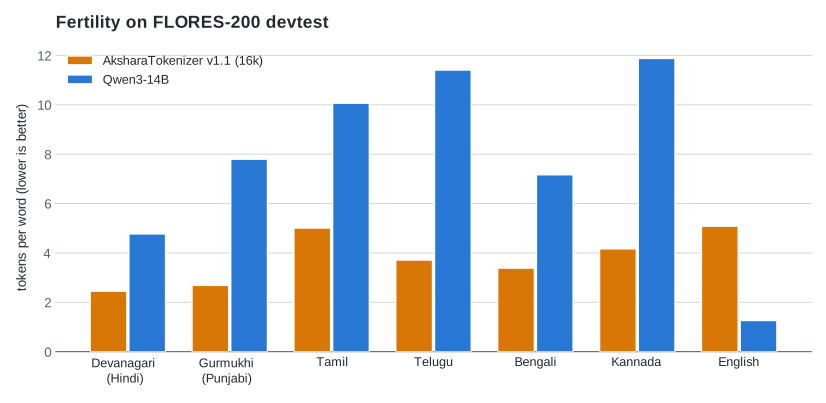
FLORES-200 devtest, tokens per whitespace word (lower is better). Numbers from
benchmark_2026_07/results_v1_1.md.
| Script (language) | v1.1 (16k) | Qwen3-14B |
|---|---|---|
| Devanagari (Hindi) | 2.45 | 4.77 |
| Gurmukhi (Punjabi) | 2.68 | 7.80 |
| Tamil (Tamil) | 5.01 | 10.06 |
| Telugu (Telugu) | 3.71 | 11.41 |
| Bengali (Bengali) | 3.38 | 7.16 |
| Kannada (Kannada) | 4.17 | 11.88 |
| English (info) | 5.08 | 1.26 |
Byte-fallback rate, percent (lower is better):
| Script | v1.1 (16k) |
|---|---|
| Hindi | 0.77 |
| Punjabi | 0.73 |
| Tamil | 0.02 |
| Telugu | 0.08 |
| Bengali | 0.09 |
| Kannada | 0.36 |
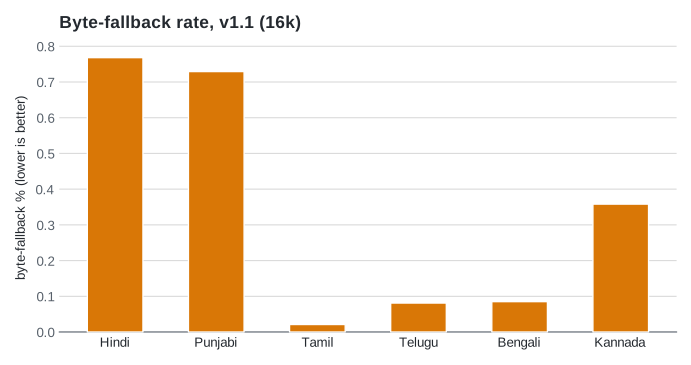
v1.1 fertility is below Qwen3-14B on all six Indic scripts, and its Telugu, Bengali, and Kannada byte-fallback is under 0.4 percent. On English, Qwen3 is more efficient, as expected for an English-centric byte-level BPE.
Both charts are generated from benchmark_2026_07/results_v1_1.csv by
benchmark_2026_07/make_charts_v1_1.py, so they can be reproduced from the
shipped data.
Install
Requires Python >=3.10 (as declared in pyproject.toml).
git clone https://github.com/1322Guru/akshara-tokenizer
cd akshara-tokenizer
pip install .             # rule-based segmenter only
pip install ".[model]"    # includes sentencepiece, needed for the trained model
The base install is all you need for segment_aksharas and count_aksharas.
The model extra is needed to encode with the trained SentencePiece model.
Usage
Rule-based segmentation (no model needed):
from akshara_tokenizer import segment_aksharas, count_aksharas

segment_aksharas("ਨਿਆਯ ਦਰਸ਼ਨ")
# ["ਨਿ", "ਆ", "ਯ", " ", "ਦ", "ਰ", "ਸ਼", "ਨ"]

segment_aksharas("ज्ञान")
# ["ज्ञा", "न"]

count_aksharas("ਪੰਜਾਬ")
# 3
Encoding with the trained model (segment, then SentencePiece):
import sentencepiece as spm
from importlib.resources import files, as_file
from akshara_tokenizer import segment_aksharas

# Load the model from the installed package (works after pip install, no repo path needed)
model_res = files("akshara_tokenizer").joinpath("model", "akshara_tokenizer_v1_1.model")
with as_file(model_res) as model_path:
    sp = spm.SentencePieceProcessor(model_file=str(model_path))

ids = sp.encode(" ".join(segment_aksharas("न्याय दर्शन")))
Akshara Formation Rules
- C + virama + C forms a single conjunct (Devanagari, Telugu, Bengali, Kannada).
- C + vowel sign forms one Akshara.
- C + virama alone is a dead consonant and a complete Akshara.
- An independent vowel is its own Akshara.
- Anusvara, visarga, nukta, addak, tippi, bindi, and candrabindu attach to the preceding Akshara.
- Latin letters, digits, and punctuation are one token each.
Limitations (honest)
- Round-trip is not lossless. The tokenizer is encode-optimized.
decode(encode(text))is not guaranteed to be byte-identical, because Akshara segmentation joins units with spaces and SentencePiece normalizes whitespace. Use it for tokenization and fertility, not for lossless reconstruction. A detokenizer is planned. (Verified: round-trip is not byte-identical for any script in results_v1_1.md.) - Script coverage. Telugu, Bengali, and Kannada are well-supported from v1.1 onward; the earlier 7,000-vocab model covered only Hindi, Punjabi, and Tamil and is not shipped here.
Run Tests
pytest is not part of the base install; get it via the dev extra, then run the suite:
pip install ".[dev]"
python -m pytest tests/ -v
Script-level Notes
| Script | Conjuncts | Notes |
|---|---|---|
| Devanagari | Yes | Standard C + virama + C conjuncts |
| Gurmukhi | No | Virama creates dead consonants; addak doubles the next consonant |
| Tamil | No | Pulli always creates a dead consonant |
| Telugu | Yes | Conjuncts via virama |
| Bengali | Yes | Hasanta conjuncts |
| Kannada | Yes | Conjuncts via virama |
Direction
Akshara-based segmentation is one instance of a more general idea: tokenizing on the orthographic units a writing system is built from, rather than on bytes. The same principle extends to other syllable-block writing systems.
Patent and Copyright
Patent pending: Indian provisional patent application 202611071450. Copyright 2026 Gursimran Singh.
License
Apache License 2.0. See LICENSE and NOTICE.
Release history Release notifications | RSS feed


Download files
Download the file for your platform. If you're not sure which to choose, learn more about installing packages.
Source Distribution
Built Distribution
Filter files by name, interpreter, ABI, and platform.
If you're not sure about the file name format, learn more about wheel file names.
Copy a direct link to the current filters
File details
Details for the file akshara_tokenizer-1.1.0.tar.gz.
File metadata
- Download URL: akshara_tokenizer-1.1.0.tar.gz
- Upload date:
- Size: 391.2 kB
- Tags: Source
- Uploaded using Trusted Publishing? No
- Uploaded via: twine/6.2.0 CPython/3.12.3
File hashes
| Algorithm | Hash digest | |
|---|---|---|
| SHA256 |
8e4c11182a693b33f7a6cf81e80d042fe1b47792a96fe93753ee8204f9ed6fc1
|
|
| MD5 |
38667e727f98e71fbba956980dbd4358
|
|
| BLAKE2b-256 |
9c5609a8b8f972ca83ac13c68193a73caf56de1b5281c6b65622013921b5f884
|
File details
Details for the file akshara_tokenizer-1.1.0-py3-none-any.whl.
File metadata
- Download URL: akshara_tokenizer-1.1.0-py3-none-any.whl
- Upload date:
- Size: 384.6 kB
- Tags: Python 3
- Uploaded using Trusted Publishing? No
- Uploaded via: twine/6.2.0 CPython/3.12.3
File hashes
| Algorithm | Hash digest | |
|---|---|---|
| SHA256 |
7220273e8d204b2bc5a1671fad39d02f2aa883a07e6d29e8395e38f3f6423c20
|
|
| MD5 |
a55c8fbc8b0e06f8f3059296f12be6f0
|
|
| BLAKE2b-256 |
8470359e07b2ded9728e7871bcdf547d7ac11d00ad93ee85b5d83c3ae35c585e
|






