
Alambiq
Alambiq is software that runs computational methods for biotechnology as capabilities.
A campaign, written in YAML or Python, lists steps, and each step runs one capability.
A capability that runs scientific software does so in a pinned engine environment, and one
that needs models or databases declares them as pinned resources. A report is one HTML file;
alambiq run --report PATH writes it. The terms are defined in
Concepts.
Version 0.1.0. The code, documentation and configuration written for
Alambiq are Apache-2.0. Optional software, models and datasets are licensed
under their own terms (LICENSING.md).
Capabilities
Capabilities are grouped in families (alambiq capability list shows the family of
each):
- Characterize: protein inspection, search, alignment, profiles, embeddings, substitution scoring, stability-change prediction, secondary-structure and function-region prediction, protein completion, enzyme candidate retrieval, structure prediction, genomic context.
- Investigate: reactions and routes, thermodynamics, enzyme-panel evaluation of activity prediction, structure comparison and preparation, binding pockets, molecular dynamics, metadynamics, trajectory and replica analysis, relative binding free energy, QM/MM and reaction free energy.
- Engineer: candidate fitting and selection, variant proposal, construct design and assembly, coding-sequence recoding.
- Measure: measurement intake, fits, and the conversion and activity that a batch product target requires.
- Operate: definition of rate parameters from measured kinetics, reaction simulation, fitting, uncertainty propagation, comparison with measurements, output accounting and comparison of input costs.
alambiq capability list
alambiq capability show assay.fit
The first command prints every capability. The second prints the request fields, the
result, the method and the limits of assay.fit.
Reports
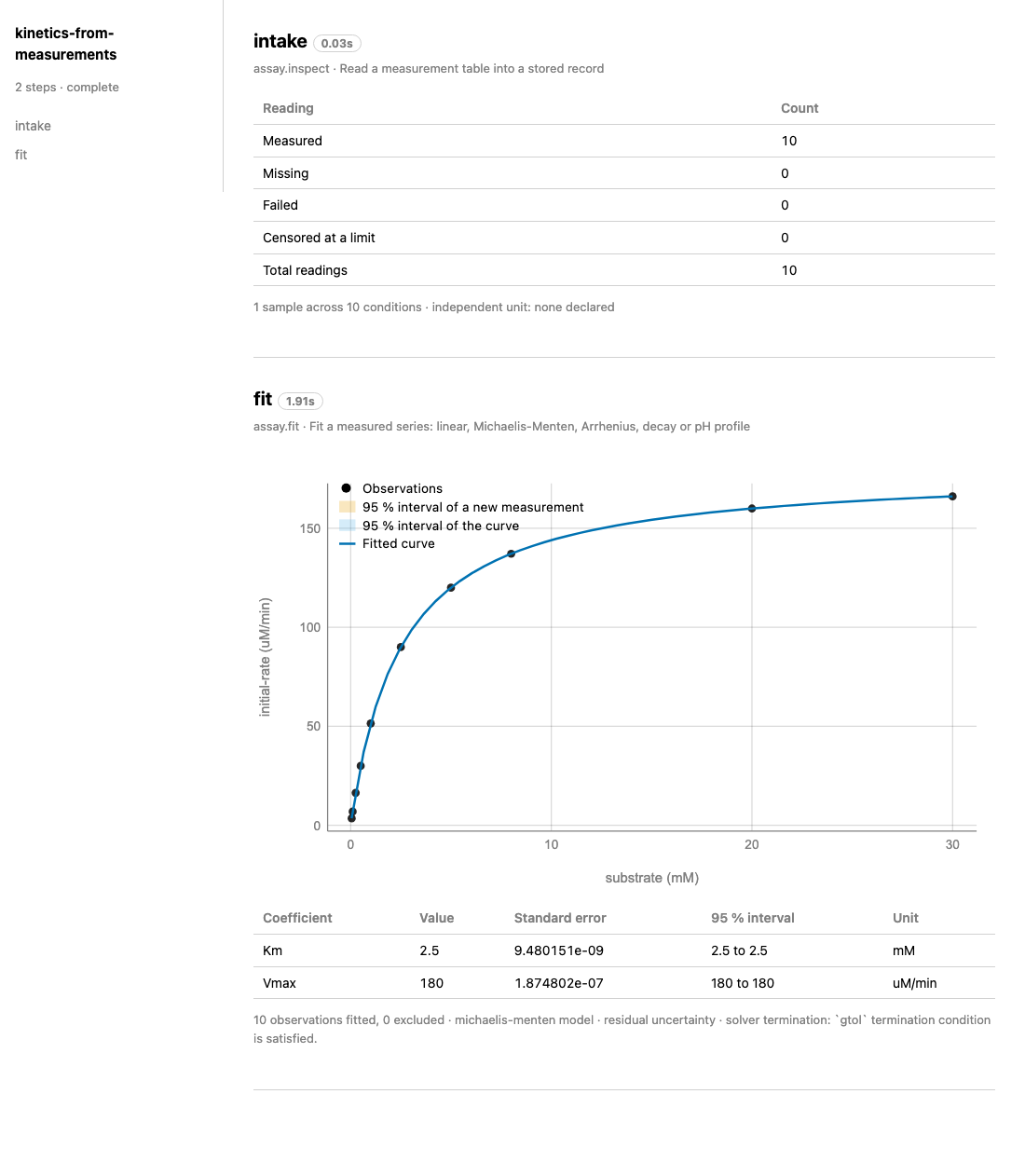
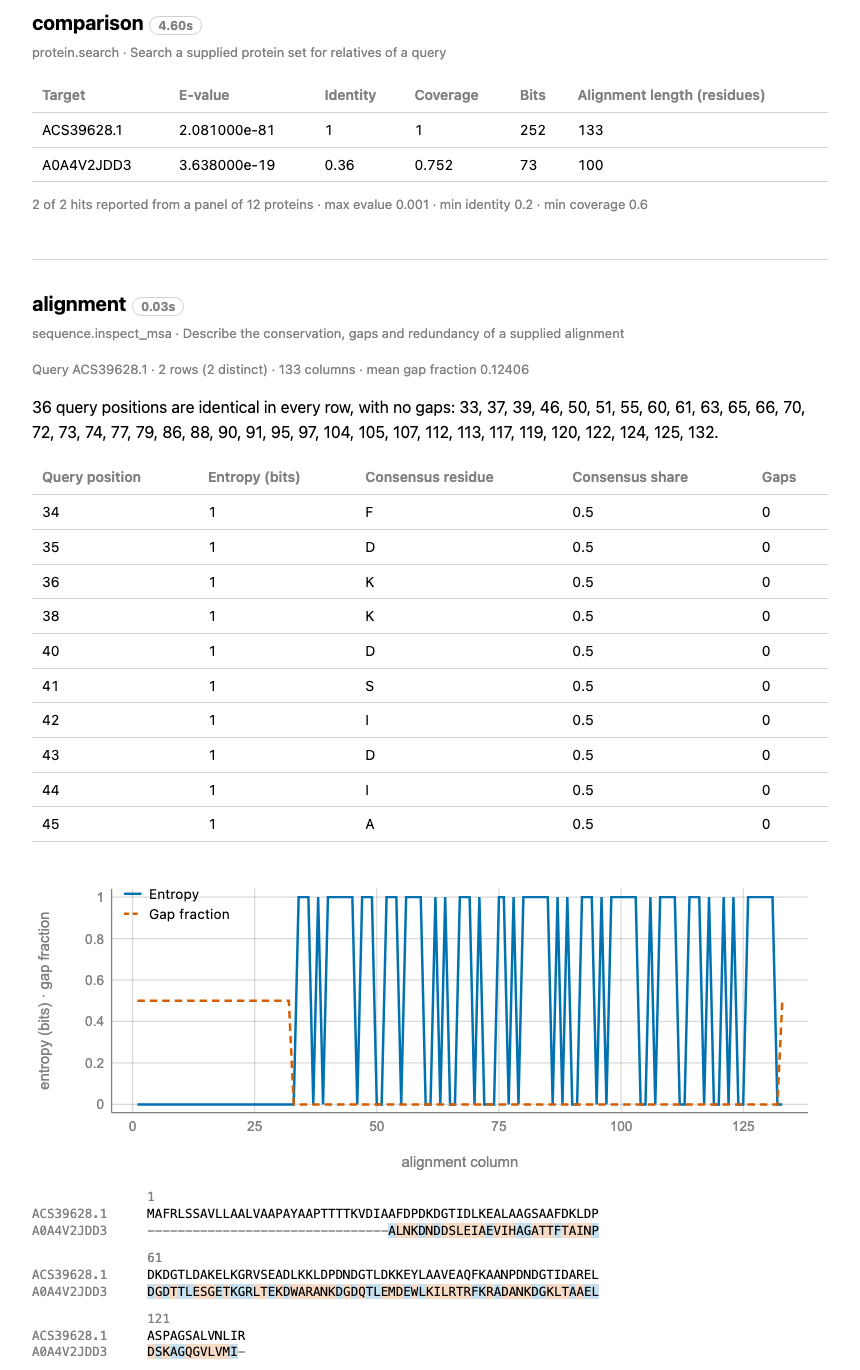
alambiq run --report PATH writes a report: one HTML file that lists each step with its
result. The first image shows the report of
kinetics-from-measurements: a table of the
readings and a Michaelis-Menten fit with the interval of the curve. The second image shows
the search and alignment steps of the report of
lanmodulin-comparison.
Installation
Install the package from PyPI (Python 3.11 or newer). The quantitative extra installs
NumPy, SciPy and scikit-learn:
pipx install "alambiq[quantitative]"
The examples are in the repository. To run one from a clone, install the core in a virtual environment:
python -m venv .venv
.venv/bin/pip install -e ".[quantitative]"
.venv/bin/alambiq run examples/kinetics-from-measurements/campaign.yaml --report report.html
The example fits a Michaelis-Menten curve to a table of 10 initial rates and writes a report.
Each engine environment contains one of the following scientific packages and the Alambiq
engines that call it: MMseqs2, P2Rank, ThermoMPNN, ESM, OpenMM, Boltz-2, OpenFF, OpenFE,
pymbar, PySCF (QM/MM). Each engine environment except the Apple GPU environment of Boltz-2 is available as a
Docker image, and each is available as a native environment
built from a recipe. The installation guide describes both routes and the
pinned resources. alambiq env check reports which engine environments are ready, and
alambiq resource list reports which resources are installed.
Documentation
- Index: the pages by subject.
- Getting started: installation of the core and the first run.
- Installation: extras, engine environments, resources, run directories and platforms.
- Concepts: capabilities, families, campaigns, steps, bindings, presets, requests, results, records, runs, run records, reuse, engine environments, resources and reports.
- Python interface: campaigns and capabilities from Python.
- Examples: worked examples.
- Methods: choosing and reading the capabilities of each method area.
- Reports: the contents of a report.
- Licensing: the licenses of Alambiq and of optional software, models and datasets.
Repository layout
src/alambiq/core: the campaign runner.src/alambiq/capabilities: the capabilities by family, with their scientific computation in functions that tests call directly.src/alambiq/engines: the engines that run inside engine environments.src/alambiq/report: the report writer.environments/: the recipes and verification files of the engine environments, and the Dockerfiles inenvironments/docker.examples/: the runnable examples.tests/core: the test suite (python -m pytest tests/core).
Models, engine environments and databases are installed as described in docs/install.md.
1 maintainer

Metadata
1 maintainer
Release files for alambiq 0.1.0
For a detailed explanation of source distributions (sdists) and built distributions (wheels), please see the package formats documentation.
Source distribution (sdist)
| File | Size | Uploaded | Provenance | Actions |
|---|---|---|---|---|
| alambiq-0.1.0.tar.gz | 3.4 MB | With provenance | Details for alambiq-0.1.0.tar.gz |
Built distribution (wheel)
| File | Interpreter | ABI | Platform | Actions Reset |
|---|---|---|---|---|
| alambiq-0.1.0-py3-none-any.whl | Python 3 | none | any | Details for alambiq-0.1.0-py3-none-any.whl |
Total release size: 4.3 MB
Release files / alambiq-0.1.0.tar.gz
| Download URL | alambiq-0.1.0.tar.gz |
|---|---|
| Size | 3.4 MB |
| Tags | Source |
|
SHA-256 checksum How to use checksums |
c23b73a94a4f8e305eff75ca90a03787cb7bad4dc329d8c562f909a407fa274f
|
|
BLAKE2b-256 checksum How to use checksums |
ba707d1c503fbcabe3829e4c1ba990988be20a707ac9da5f16e4284bf3107734
|
| Upload date | |
|
Uploaded using Trusted Publishing? What is trusted publishing? |
Yes |
| Uploaded via |
twine/7.0.0 CPython/3.13.16
|
Provenance
Provenance describes where a file came from. On PyPI, provenance is shared via attestations, which provide a verifiable record of the build or publishing details. View details, limitations and caveats.


PyPI Publish Attestation
PyPI verified that this artifact, at this checksum, originated from the publisher listed below.
Signed by GitHub Actions, verified by PyPI on Oct 25, 2026.
Transparency logRelease files / alambiq-0.1.0-py3-none-any.whl
| Download URL | alambiq-0.1.0-py3-none-any.whl |
|---|---|
| Size | 814.7 kB |
| Tags | Python 3 |
|
SHA-256 checksum How to use checksums |
dfdde89a731609181cc17a2ced83ed49b86e570d01a1ecf22e7787da43a8e380
|
|
BLAKE2b-256 checksum How to use checksums |
d3b86fd6d324237246fe64b96115a0969d557f3b03568573baadf7cdb93ce55f
|
| Upload date | |
|
Uploaded using Trusted Publishing? What is trusted publishing? |
Yes |
| Uploaded via |
twine/7.0.0 CPython/3.13.16
|
Provenance
Provenance describes where a file came from. On PyPI, provenance is shared via attestations, which provide a verifiable record of the build or publishing details. View details, limitations and caveats.
PyPI Publish Attestation
PyPI verified that this artifact, at this checksum, originated from the publisher listed below.
Signed by GitHub Actions, verified by PyPI on Oct 25, 2026.
Transparency logSecurity for alambiq 0.1.0
Provenance
Provenance describes where a file came from. On PyPI, provenance is shared via attestations, which provide a verifiable record of the build or publishing details. View details, limitations and caveats.
Full provenance
All 2 files in this release have been uploaded with provenance metadata.
Attestation for alambiq-0.1.0.tar.gz
PyPI Publish Attestation
PyPI verified that this artifact, at this checksum, originated from the publisher listed below.
Signed by GitHub Actions, verified by PyPI on Oct 25, 2026.
Transparency logA note on package security
PyPI is a repository for distributing packages, not a service for auditing them. While third-party security researchers and our staff do their best to detect and remove malicious packages, PyPI cannot guarantee the quality, security or suitability of any given package.
To learn more about protecting yourself from malicious actors, visit our package security documentation.














