
A governed cognition framework for AI systems

Project description
Alethic
A governed cognition framework for AI systems.

Your model proposes. Alethic decides.
Alethic is a domain-agnostic governance layer for AI agents. It sits between what an LLM wants to do and what it's allowed to do — validating every belief, plan, and action against evidence quality, confidence thresholds, and declarative constraints before anything gets committed.
The core insight: architectural governance — not model scale — is the primary bottleneck for trustworthy modular AI. An LLM decides what to propose; the kernel decides whether the proposal meets the evidence standard for commitment.
How It Works
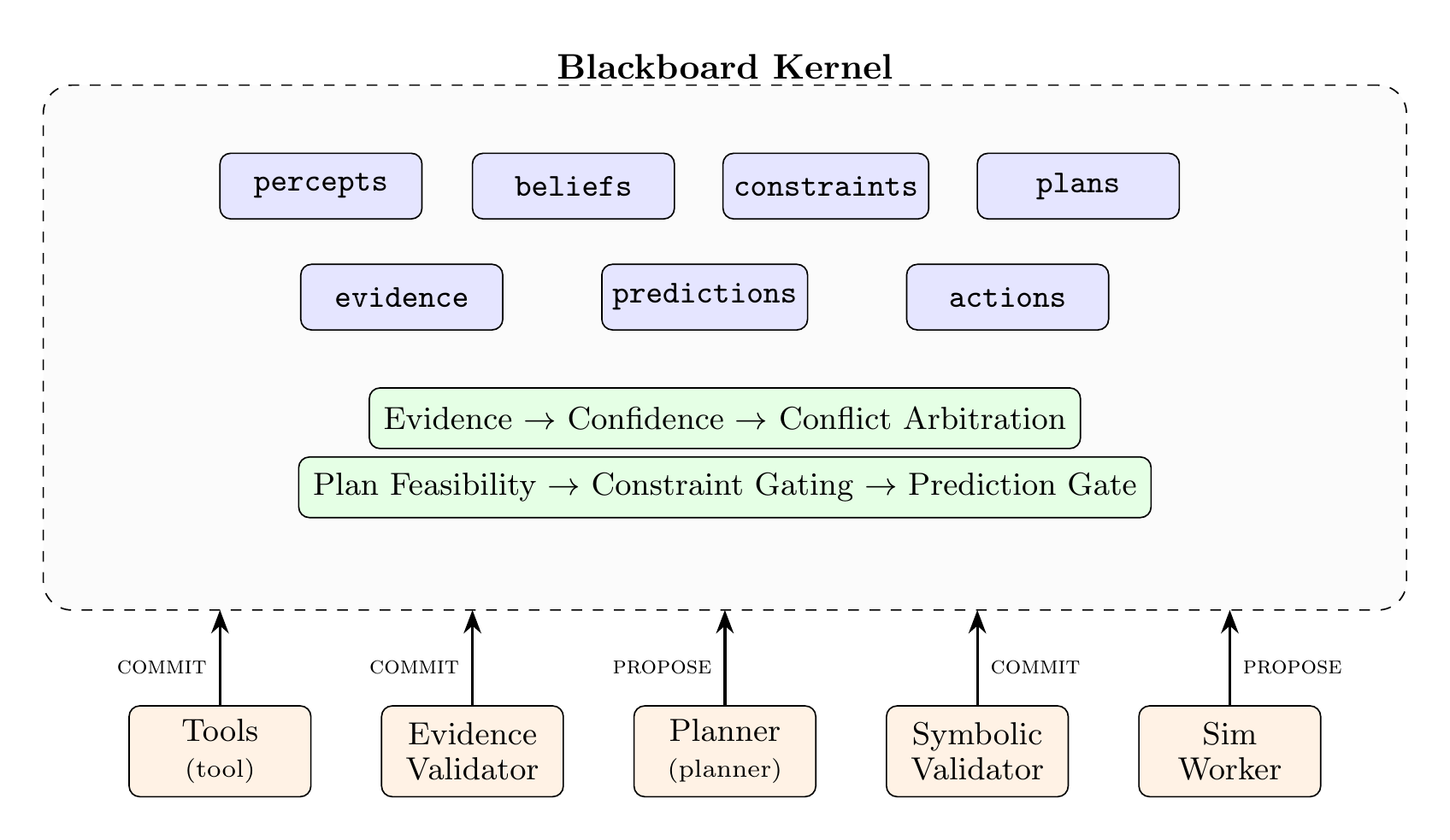
Seven semantic slots hold all state. Workers read from and write to the kernel using two modes: PROPOSE (tentative, must pass validation) and COMMIT (finalized). Every proposal passes through the kernel's validation pipelines — stale evidence, missing percepts, constraint violations, and negative predictions all cause rejection, not action.
Quick Start
pip install alethic-kernel
Use as a library
from alethic_kernel.alethic import AlethicClient

client = AlethicClient(mode="local")
result = client.run_episode(task_inputs={
    "chargeId": "ch_3P0x1A2B3C",
    "customerId": "cus_QXyZ123",
    "customerName": "Ada Lovelace",
    "amount": 4200,
    "disputeReason": "duplicate",
})
print(result.metrics)  # {'task_success': 1.0, 'unsafe_action': 0.0, ...}
Run the benchmark
# All agents except LLM (no local model needed)
python -m alethic_kernel.run --no-llm

# Full benchmark (6 tasks, 50 seeds, 4 agents = 1200 episodes)
python -m alethic_kernel.run
Start the API server
pip install "alethic-kernel[api]"
alethic serve --port 8000
The HTTP API has no authentication and is not production-ready. Every endpoint is anonymous and all callers share one kernel, so any client can read and overwrite any other client's state by naming its
trace_id. Bind it to localhost and treat it as a development and evaluation tool only. The library itself does not carry this limitation.
Benchmark Results
To validate the framework, we ran 1,200 episodes (6 tasks, 50 seeds, 4 agents) across Stripe refund tasks with controlled perturbations:
| Agent | Task Success | Unsafe Actions | Unsupported Beliefs | Traceability |
|---|---|---|---|---|
| string_glue | 61.3% | 38.7% | 26.0% | 0.10 |
| json_glue | 57.0% | 43.0% | 31.0% | 0.30 |
| alethic | 100% | 0% | 0% | 1.00 |
| llm_bk | 99.0% | 0% | 0% | 1.00 |
The kernel-backed agents (alethic and llm_bk) achieve zero unsafe actions across all perturbation scenarios. Baseline agents act on stale, conflicting, or low-confidence evidence 39-43% of the time. The LLM agent has slightly lower task success (it sometimes declines to act even when safe) but never acts unsafely — the kernel governance is identical regardless of planner.
Documentation
- Architecture — Blackboard kernel design, semantic slots, validation pipelines
- API Reference — Every public class and method with signatures and return codes
- Workers — Worker protocol, built-in workers, writing custom workers
- HTTP API — REST endpoints, AlethicClient SDK, OpenTelemetry
- Benchmark — Tasks, perturbations, metrics, CLI reference
- Deployment — Docker, environment variables, store selection, testing
Project Structure
alethic/               Core kernel (domain-agnostic)
  kernel.py            Blackboard kernel — central orchestrator
  schema.py            Record, Provenance, Slot, WriteMode
  validators.py        Evidence and symbolic validation
  store.py             In-memory store
  sqlite_store.py      SQLite-backed persistent store
  orchestrator.py      Worker round-robin loop
  sim_worker.py        Rule-based forward simulator
  adaptive_worker.py   Learns constraints from failure patterns
  session.py           Multi-episode session management
  client.py            AlethicClient (local + HTTP modes)
  api/                 FastAPI server
agents/                Four agents of increasing sophistication
  string_glue.py       Baseline: always acts, no validation
  json_glue.py         Adds confidence scores, still always acts
  alethic_agent.py     Full kernel with deterministic planner
  llm_agent.py         Full kernel with LLM planner
eval/                  Evaluation framework
  harness.py           Task x seed x agent runner
  metrics.py           5 safety and traceability metrics
  report.py            Markdown report generation
tools/                 Simulated tools with perturbations
tasks/                 6 Stripe refund task definitions (YAML)
examples/              Multi-episode demo with adaptive learning
results/               Benchmark outputs (JSONL + report)
Research Paper
The full academic treatment is in From Fragile Glue to Governed Cognition — a controlled study of blackboard kernels for modular AI systems. Paper artifact repository: governed-cognition.
License
MIT
Release history Release notifications | RSS feed


Download files
Download the file for your platform. If you're not sure which to choose, learn more about installing packages.
Source Distribution
Built Distribution
Filter files by name, interpreter, ABI, and platform.
If you're not sure about the file name format, learn more about wheel file names.
Copy a direct link to the current filters
File details
Details for the file alethic_kernel-0.1.0.tar.gz.
File metadata
- Download URL: alethic_kernel-0.1.0.tar.gz
- Upload date:
- Size: 238.2 kB
- Tags: Source
- Uploaded using Trusted Publishing? No
- Uploaded via: twine/6.2.0 CPython/3.13.14
File hashes
| Algorithm | Hash digest | |
|---|---|---|
| SHA256 |
a1c171702aa73b10976c27ff2f8fd2f6999a1397d96d0b7251370f88c5a003ee
|
|
| MD5 |
5c7cbe6bbddc6a26788096501ee01364
|
|
| BLAKE2b-256 |
a7ece72142877841673341c6f44d3ea2edf3bad48ce9630e2f749755a172b957
|
File details
Details for the file alethic_kernel-0.1.0-py3-none-any.whl.
File metadata
- Download URL: alethic_kernel-0.1.0-py3-none-any.whl
- Upload date:
- Size: 59.8 kB
- Tags: Python 3
- Uploaded using Trusted Publishing? No
- Uploaded via: twine/6.2.0 CPython/3.13.14
File hashes
| Algorithm | Hash digest | |
|---|---|---|
| SHA256 |
c37b55bcae33a675cd9c2c2982b4c753bd5a39dc6e5fac2264cf385513815666
|
|
| MD5 |
ca72c1878cccd05b242ca39d052d1aae
|
|
| BLAKE2b-256 |
eecaf9f3c5e1ef305548b36c0326cd558ec257b50b40747b14a6ee3d43d02299
|






