
Accountability layer for AI employees: mandate-anchored daily digests from agent traces.

Project description
Alfred




Accountability layer for AI agents. Every line of an Alfred report is anchored to a trace event ID. The ones that aren't, don't ship.
Try it — 20 seconds, no install, no API key, no webhook
uvx alfred-ai demo # or: pipx run alfred-ai demo
That command prints:
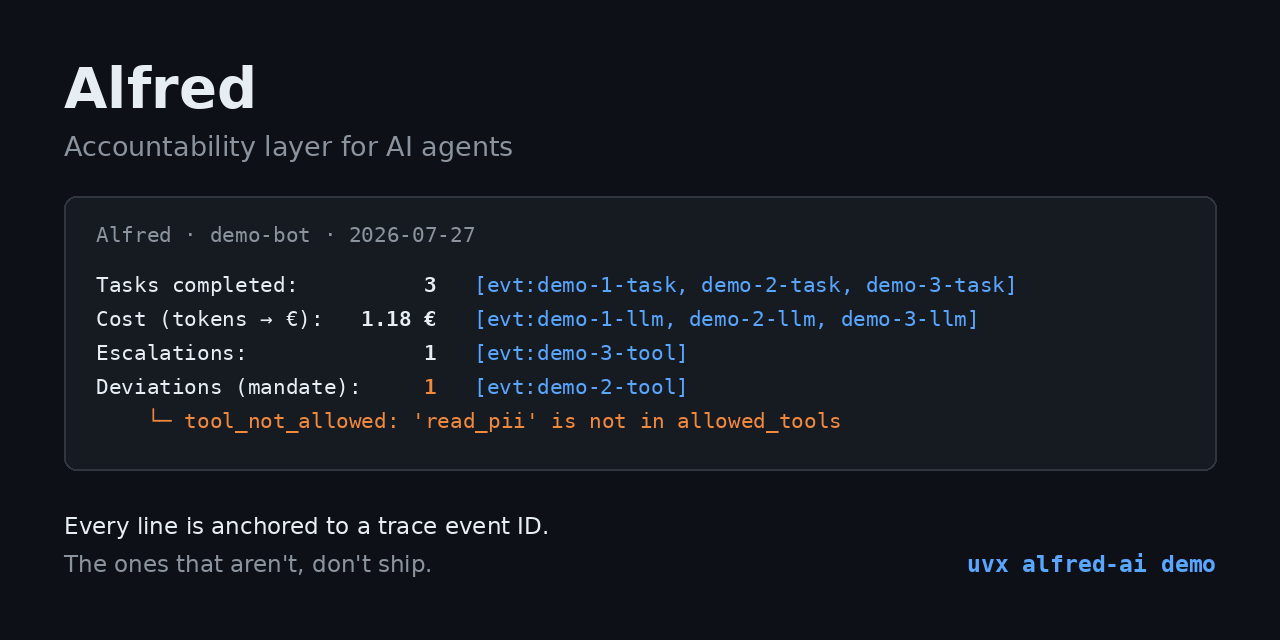
Alfred · demo-bot · 2026-07-27

Tasks completed:               3   [evt:demo-1-task, demo-2-task, demo-3-task]
Cost (tokens → €):        1.18 €   [evt:demo-1-llm, demo-2-llm, demo-3-llm]
Escalations:                   1   [evt:demo-3-tool]
Deviations (mandate):          1   [evt:demo-2-tool] — tool_not_allowed: tool 'read_pii' is not in allowed_tools
An instrumented fake agent emits a real trace; Alfred reads it and catches the one call its mandate forbids. Nothing is mocked, nothing phones home, and the throwaway environment leaves nothing behind.
What is proven, and how
Every claim below is held by a test, named here so you can go read it before believing any of this:
| Claim | Test that fails if it stops being true |
|---|---|
| A report line cannot exist without at least one source event | test_line_requires_at_least_one_event_id |
| A narrated sentence citing an event it wasn't given aborts the run | test_narrate_raises_on_hallucinated_citation |
| An agent declaring its own escalation doesn't get credit for it | test_self_declared_escalation_attribute_no_longer_suppresses_the_deviation |
| A redacted argument never reaches the store, Slack, or the LLM | test_redacted_value_absent_from_store |
| A recorded event cannot be rewritten with different content | test_conflicting_event_does_not_overwrite_the_stored_one |
| The shareable HTML report loads nothing from the network | test_render_html_is_a_self_contained_document |
What Alfred refuses to say
Most agent reports are a summary the agent wrote about itself. Alfred's can't be:
| Situation | A self-reported summary says | Alfred says |
|---|---|---|
| The agent claims it escalated | "Escalated to a human ✅" | Nothing — unless a tool listed in escalation_tools was actually called [evt:…] |
| The agent reports its own cost | "Cost: €0.40" | The cost priced from its own token counts — plus a cost_mismatch deviation if the two disagree |
| The agent answers confidently, but wrong | "47 tasks completed ✅" | 47 — and nothing about whether they were right, because the trace doesn't record that |
The third row is the point: Alfred does not claim what it cannot anchor. A wrong-but-confident answer leaves no signal in a trace, so Alfred stays silent about it rather than inventing reassurance.
Status — v0.1 core feature-complete, plus a "Bring Your Own Agent" sprint
landed: a public alfred.instrument SDK, native LangGraph and OpenAI Agents SDK
connectors, real-world OTel Collector ingestion, and a 5-minute example that
needs no API key. mypy --strict on source and tests, Python 3.11–3.14,
CI + CodeQL — the badge above is the live version of that claim, which is why
no test count is written here. Published on PyPI: pip install alfred-ai.
Full roadmap: PLAN.md.
The idea in two sentences
You wouldn't hire a human employee without a mandate and a daily stand-up. Alfred is that layer for your AI employees — declarative mandate in YAML, evidence-anchored digest in Slack, deviations flagged the moment they happen.
The rule that makes it different
Every line of an Alfred report is anchored to one or more trace event IDs. The LLM only rephrases what was already computed from the traces. No self-declared summaries, no hallucinated numbers. A report line without a source event is a bug, not a feature — and there's a test that says so (see PLAN.md §5 Brique 4).
Each number reads against its own baseline
The demo digest above is a real run of a three-step agent. On a busier one, each line also carries how it compares to its own recent history — illustrated here:
Alfred · refund-bot-v3 · 2026-08-30

Tasks completed:          47   [evt:a1c, a1d, a1e, …]   (+7% vs 7-day avg)
Cost (tokens → €):     3.42 €   [evt:c0f, …]   (+185% vs 7-day avg ⚠️)
Escalations:               3   [evt:e01, e02, e03]   (+200% vs 7-day avg ⚠️)
Deviations (mandate):      1   [evt:d0a] — tool_not_allowed: `read_pii`
Each number reads against its own rolling 7-day average, so a manager sees not
just what happened but whether it's normal (⚠️ marks a doubling or more).
The comparison is itself computed from the prior days' trace events — never a
self-declared summary. See docs/adr/0019-baseline-contextualized-digest.md.
Delivered to Slack (v0.1), Teams (v0.2), or stdout / markdown (always) — or
exported as a self-contained, shareable HTML file (alfred report --html) whose
every line links to its source events.
What counts as a deviation
Every deviation is a typed contradiction between the trace and the declared mandate, anchored to the event(s) that prove it:
tool_not_allowed— a tool call outsideallowed_tools.forbidden_action— a call matching aforbidden_actionsrule (an exact tool name, or a structuredtool:/when:threshold on a call argument).budget_exceeded— the day's token → € cost passeddaily_budget_eur.escalation_missed— anescalate_whenthreshold was breached over the day but the agent never raised a hand: no call to any tool listed in the mandate'sescalation_tools. An escalation is proven by an action, never by a flag the agent sets on itself.required_action_missing— a triggered obligation left unmet: arequired_actionsrule'swhen_toolran but its mandatoryrequire_toolnever did in the same trace (e.g. a refund issued without ever notifying the customer). Anchored to thewhen_toolevent(s).loop_detected— the same tool calledloop_thresholdor more times in a row with identical arguments (default 3): an agent spinning without progress. Anchored to every event in the run.cost_mismatch— the cost the agent reported for the day contradicts the one priced from its own token counts. The digest always shows the priced figure; this says the trace tried to claim otherwise.tool_unidentified— a tool call that names no tool. It can't be checked againstallowed_tools, so it is reported rather than skipped.
Stored evidence is append-only: an event whose spanId is already recorded
with different content is refused, the first version stands, and alfred watch
names the attempt on stderr and exits non-zero. Rewriting an anchor a past
digest already quoted is not something the audited agent gets to do.
The last two catch silent failures — the run completes with no error status and looks successful, so nothing else flags them. Alfred only sees what the trace records: a wrong-but-confident answer or a tool that returns garbage with a 200 leaves no signal, and Alfred won't claim what it can't anchor.
Positioning
| Neighbor | What it does | What Alfred does differently |
|---|---|---|
| Langfuse · AgentOps · LangSmith | Developer observability: traces, prompts, tokens, replay. | Manager reporting: mandate vs reality, typed deviations, daily digest legible without a dashboard. |
| Guardrails · NeMo Guardrails | Inline filters on LLM inputs / outputs. | Post-hoc control across the whole agent session, including tool calls and cost. |
| A homegrown Grafana / Datadog dashboard | Aggregated metrics, alerting. | Narrative, anchored, opinionated report — no dashboard design required. |
Alfred is complementary, not a replacement. It reads the same OpenTelemetry GenAI traces your observability stack already emits, so if you run LangSmith, Langfuse, or any OTel backend, pointing Alfred at those traces needs no reinstrumentation. The split is the question and the reader: observability asks is my agent working? for the developer debugging it; Alfred asks did my agent stay within its mandate? for the person accountable for it.
Quickstart
uvx alfred-ai demo (above) runs the package in a throwaway environment and
leaves nothing behind. To keep it:
pip install alfred-ai
alfred demo
Then point it at your own agent:
alfred init --slack-webhook https://hooks.slack.com/…  # mandate.yaml + Slack config
alfred mandate init --from-traces traces/ > mandate.yaml  # seed a mandate from what the agent did
alfred mandate lint mandate.yaml                       # validate the mandate before you rely on it
alfred schedule traces/ --at 09:00 >> mycrontab        # one daily crontab line
alfred schedule traces/ --at 09:00 --github-actions \
  > .github/workflows/alfred.yml                       # …or a daily workflow, no host to keep up
alfred watch traces/                                   # one pass now (or --loop to keep running)
alfred report traces/ --html --out reports/            # shareable HTML report, one file per day
Install into a virtualenv — a distro-managed Python (e.g. Debian/Ubuntu system
pip) can fail with Cannot uninstall … RECORD file not found. On Windows the
activate step is .venv\Scripts\activate.
Verify a real agent
alfred demo replays a scripted scenario. To watch Alfred catch a real
agent's deviation — a framework-free Claude tool loop that decides on its
own whether to grant an over-limit refund — see
examples/agents/refund_bot/. Nothing is
scripted there: the model decides, Alfred verifies.
Writing the first mandate.yaml is the onboarding cliff, so Alfred meets you
where the traces already are: alfred mandate init --from-traces proposes the
allowed_tools and daily_budget_eur it actually observed (policy fields stay
empty — those you declare, they aren't inferable from a trace), and
alfred mandate lint catches a typo'd escalate_when metric before it crashes a
watch run (exit 1 on error, so it drops into CI or pre-commit).
Handling customer data? A redact: list in the mandate masks named tool
arguments (redact: [customer_email]) at ingestion, before they reach the
trace store — the raw value never lands in SQLite, Slack, the HTML report, or
the narration LLM, replaced by a stable redacted:sha256:… token. Declarative
and deterministic: only the fields you list are touched. See
docs/adr/0022-pii-redaction.md.
alfred watch is a single pass by design (re-run via cron — alfred schedule
prints the line for you). For environments without cron, alfred watch --loop
re-scans on an interval until you stop it. Add --alerts (with a Slack webhook)
to also push a deviation the moment it's caught, instead of only in the daily
digest — pair it with --loop for near real-time.
A daily digest only becomes a habit if it keeps arriving, and both of those
paths assume a machine that stays up. If you don't have one,
alfred schedule … --github-actions prints a workflow you commit to
.github/workflows/: it runs the same single pass on GitHub's schedule, reads
the webhook from the ALFRED_SLACK_WEBHOOK_URL repository secret (never from
the committed file), and caches .alfred/ between runs so a digest isn't
posted twice. The schedule is UTC, and a cache miss re-posts that day's digest
— both are stated in the generated file. See
docs/adr/0027-unattended-daily-digest.md.
By default the digest is the raw computed table. --narrate rewrites it as
verified LLM prose — the LLM only rephrases, and a sentence citing an event it
wasn't given fails the run instead of shipping. Declare the endpoint in config
(alfred init --llm-base-url … --llm-model …, any OpenAI-compatible endpoint)
and export ALFRED_LLM_API_KEY; without them --narrate exits 1 rather than
degrade silently. alfred demo stays LLM-free. See
docs/integrate.md.
The Slack digest is ephemeral, so alfred report traces/ --html writes a
self-contained HTML file per day into --out (default the current directory) —
inline styles, zero JavaScript, no network — that a manager can forward. Each
report line and deviation links to an Evidence list of its source event IDs, so
the proof travels with the report. Unlike watch, it tracks no seen files and
re-renders on every run. It's a deliberately lighter cousin of the paid
evidence-dossier export (v0.4). See
docs/adr/0020-shareable-html-report.md.
Plug in your own agent
Alfred verifies your agents. The floor is 5 minutes and no credentials:
examples/agents/minimal/ is a ~30-line agent
with no LLM and no API key — run it, alfred watch it, watch Alfred catch its
over-cap approval. Three honest paths get your real agent's runs to Alfred:
| Path | For agents that… | Status |
|---|---|---|
alfred.instrument SDK |
you can add ~10 lines to (wrap the loop, model call, tool call) | works today — docs/integrate.md |
| LangGraph connector | run on LangGraph — attach one callback handler, no manual instrumentation | works today — pip install alfred-ai[langgraph] (connector) |
| OpenAI Agents SDK connector | run on the OpenAI Agents SDK — register one tracing processor, no manual instrumentation | works today — pip install alfred-ai[openai-agents] (connector) |
| OTel Collector bridge | already emit OpenTelemetry GenAI spans | works today — point the Collector's file exporter at the watched folder (bridge config) |
| Other native connectors | run on CrewAI or a managed platform | v0.2 — not built yet |
Whatever the path, the guarantee is the same: every digest line is computed from an identifiable trace event, never self-reported. What Alfred can't see in the trace, it doesn't claim.
Development
git clone https://github.com/adriencr81/Check-Alfred.git && cd Check-Alfred
python -m venv .venv && source .venv/bin/activate
pip install -e ".[dev]"
pytest -q
ruff check . && mypy --strict src/ tests/
Layout:
src/alfred/trace/      # Brique 1 — OTLP ingest, TraceEvent, SQLite store
                       #   + B9 shared token→€ cost, B10 NDJSON / GenAI semconv adaptation
src/alfred/mandate/    # Brique 2 — YAML mandate → typed Deviations (+ B9 structured rules)
src/alfred/report/     # Brique 3 — computed Digest, sources per line (+ F4 shareable HTML render)
src/alfred/narrate/    # Brique 4 — verified LLM rewrite (the anchoring test lives here)
src/alfred/deliver/    # Brique 5 — Slack / stdout
src/alfred/demo/       # Brique 6 — instrumented fake agent
src/alfred/instrument/ # Brique 8 — public instrumentation SDK (AgentTracer)
src/alfred/integrations/ # Brique 12 — native connectors (LangGraph handler, OpenAI Agents processor)
examples/agents/       # B7 refund_bot (real LLM), B11 minimal (no LLM), B12 langgraph_bot, F5 openai_agents_bot
The CLAUDE.md file encodes the workflow rules for anyone (human or
agent) working on this repo: tests first, plan mode for multi-file changes,
proof-of-run required at each commit.
Roadmap
Each brick is a signed contract with falsifiable tests and a definition-of-done. See PLAN.md §5 for the v0.1 core and §12 for the "Bring Your Own Agent" sprint.
v0.1 core — done:
- Brique 1 — trace store: OTLP ingest,
TraceEvent, SQLite - Brique 2 — mandate engine v0
- Brique 3 — report engine
- Brique 4 — verified NLG (the test that is the product)
- Brique 5 — Slack delivery + CLI
- Brique 6 —
alfred demo+ launch polish → public v0.1 on PyPI
Bring Your Own Agent sprint — done: make Alfred work for a dev who downloads it for their agents (ADR 0013).
- Brique 7 — real refund-bot example: a framework-free Claude tool loop whose over-limit refund Alfred catches
- Brique 8 — public
alfred.instrumentSDK: any loop → an ingestible OTLP trace in ~10 lines - Brique 9 — generic mandate (structured
tool:/when:rules) + cost computed from tokens - Brique 10 — real-world ingestion: OTel Collector NDJSON + standard GenAI semconv adaptation
- Brique 11 — onboarding + the 5-minute BYOA example (no LLM, no API key)
Native connectors:
- Brique 12 (ADR 0014) — LangGraph connector: attach one callback handler, get an anchored trace (
pip install alfred-ai[langgraph]) - F5 (ADR 0021) — OpenAI Agents SDK connector: register one tracing processor, get an anchored trace (
pip install alfred-ai[openai-agents])
Post-v0.1: native connectors (v0.2 — CrewAI remaining), performance review — behavioral drift & cost-per-task (v0.3), evidence file export (v0.4 — the bridge to the closed-source engine).
Staying in touch
- One email per release, plus the monthly finding — subscribe on the project page. Alfred itself collects nothing: there is no telemetry in the package, and subscribing happens on a web page, outside the product.
- Ran Alfred on a real agent? Show us the digest — it's the only way we learn what Alfred catches in the wild, since nothing phones home.
- The open package doesn't cover what your team is accountable for? Alfred for teams.
License
Apache-2.0 for this package.
The advanced mandate engine (formal verdict semantics, verifiable policies, multi-agent, retention, compliance features) is planned as closed-source — open-core model announced up front. See PLAN.md §1 D4.
Release history Release notifications | RSS feed


Download files
Download the file for your platform. If you're not sure which to choose, learn more about installing packages.
Source Distribution
Built Distribution
Filter files by name, interpreter, ABI, and platform.
If you're not sure about the file name format, learn more about wheel file names.
Copy a direct link to the current filters
File details
Details for the file alfred_ai-0.1.1.tar.gz.
File metadata
- Download URL: alfred_ai-0.1.1.tar.gz
- Upload date:
- Size: 326.8 kB
- Tags: Source
- Uploaded using Trusted Publishing? No
- Uploaded via: twine/7.0.0 CPython/3.13.5
File hashes
| Algorithm | Hash digest | |
|---|---|---|
| SHA256 |
66698ca3746e8cefa9c6d68ccd3691bf7419d43d752716992265a40d8a1f6ec0
|
|
| MD5 |
8c42b2a4c4f496ea60ef5e58cc86fb73
|
|
| BLAKE2b-256 |
108c990171e47715eb37ade69ecd9d8c58308a281a5ca2ac510001833e0bdbe1
|
File details
Details for the file alfred_ai-0.1.1-py3-none-any.whl.
File metadata
- Download URL: alfred_ai-0.1.1-py3-none-any.whl
- Upload date:
- Size: 89.9 kB
- Tags: Python 3
- Uploaded using Trusted Publishing? No
- Uploaded via: twine/7.0.0 CPython/3.13.5
File hashes
| Algorithm | Hash digest | |
|---|---|---|
| SHA256 |
a2c6e7f5c27ae03a53e4ae43029d1ee3a83056a7488afc1d85f55fe9e86ef040
|
|
| MD5 |
37079b29b1fe6846287c274fd191cbb8
|
|
| BLAKE2b-256 |
f816ad676272805ac13ce20f093ad4a5a5c0909272c3867a27d7a0b0a733693f
|






