
alkonost
A local, self-hosted task tracker that stores everything as plain markdown files on your own disk — no account, no cloud, no database to manage.
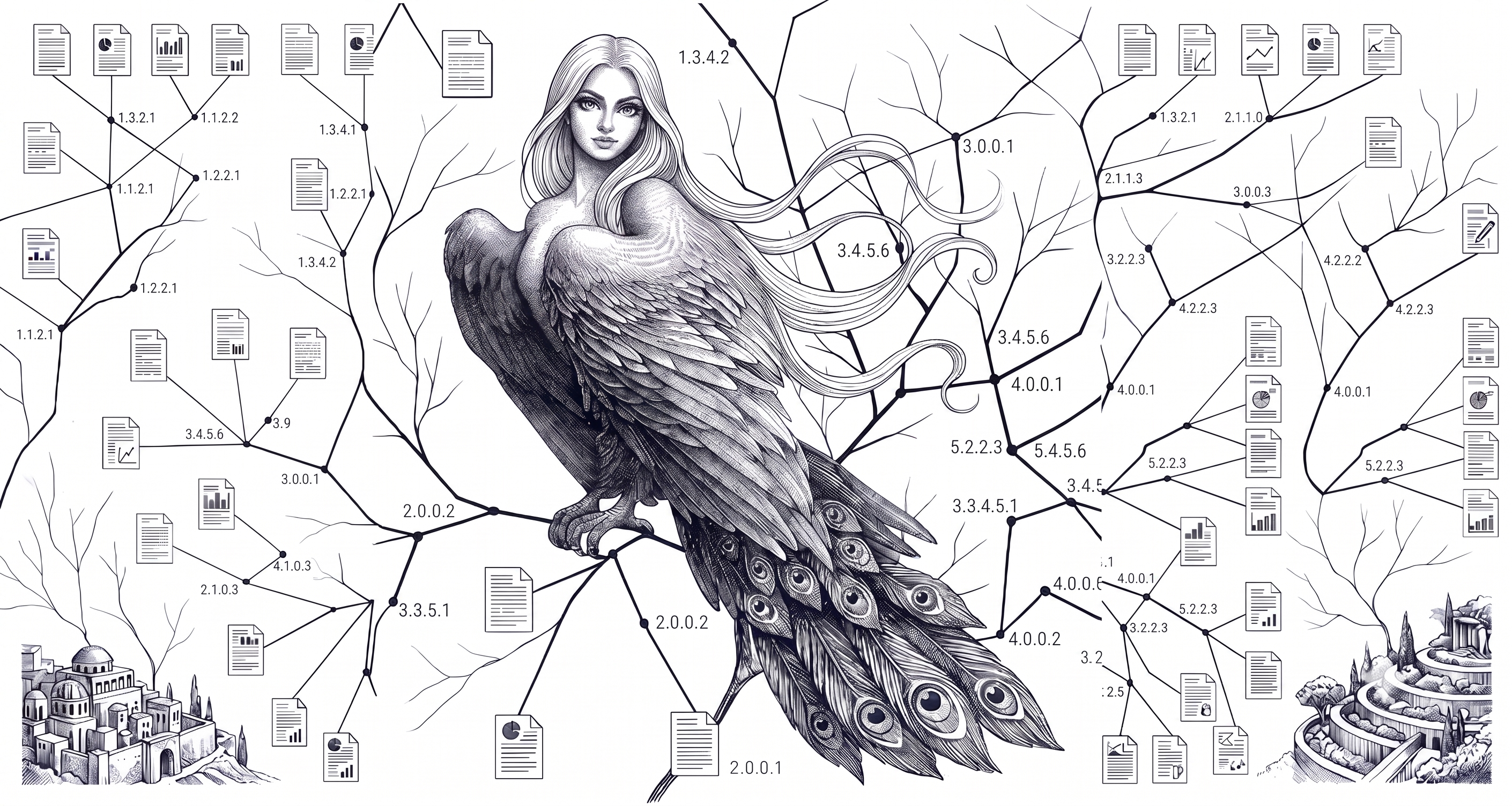
The name comes from Алконост (Alkonost), the Slavic paradise-bird of joyful song — traditionally depicted paired with Сирин (Sirin, sorrow/night), the tool this ecosystem already calls syryn.
What it is
Open Alkonost in your browser and you get a Kanban-style board, a searchable backlog table, tags and color-coded modules, and a full markdown editor for writing out what each task actually involves — tables, formulas, diagrams included.
Everything is stored in a plain checklist file you could just as easily open in a text editor, back up, or put under version control. Nothing is sent anywhere; the whole thing runs on your own machine.
Features
Board & Backlog
Move cards between status columns by dragging them, or use the "move to" dropdown on any card — handy if drag-and-drop isn't convenient (touch screens, for example). Every task also shows up in a filterable backlog table below the board, no matter its status, so nothing is ever truly hidden.
Show only what matters right now
Got a long backlog but only want to see active work on the board? Type a short list of statuses (e.g. selected, active, testing, done) and the board shows only those columns — everything else stays out of the way in the backlog table until you need it.
Tags, modules, people
Add hashtags, assign a task to a module or team (each with its own color), flag something urgent, or assign it to a person — all clickable as filters.
Full task descriptions
Click a task to open its full description in a side panel, rendered as real formatted text — headings, tables, formulas, and diagrams, not just plain text. Click the pencil icon to edit it, with a live preview underneath so you can see exactly what your text will look like as you type, even if you don't know markdown syntax.
Works across multiple projects
Point Alkonost at a folder containing several projects and it finds all of them — switch between projects and boards from the same running instance.
Autosave, themes, small screens
Every change saves itself automatically — no save button to remember. Pick from eight color themes. The layout adapts to narrow windows and touch devices.
Install
pip install alkonost
For developers
git clone https://github.com/szholobetsky/alkonost.git
cd alkonost
pip install -e .
Quick start
alkonost
Open http://localhost:8090 in your browser. Run it from the folder where you keep your project (or a folder that contains several projects) — Alkonost looks for existing boards there and lets you pick one. If nothing exists yet, just click + Add Task to start a board from scratch, right there in the browser.
Common options:
alkonost -p 8090             # custom port (default: 8090)
alkonost --root D:\Work      # folder to look in (default: current folder)
alkonost --bind 127.0.0.1    # this computer only (default: reachable on your network)
Two ways to fill a board
By hand — click + Add Task, give it a title and any tags you like, and go. Each task can get its own + Add SubTask and its own written description (+ Add spec), directly in the app. No other tool required.
Generated from a task breakdown — if you're already using 1bcoder (a companion AI assistant) to break a large task down into smaller steps, its output turns into an Alkonost board automatically, with no manual setup:
- one flow expands a task description into an outline of smaller sections
- another writes a clear, structured description for each of the smallest steps
- a final one collects the whole outline into a single checklist
Point Alkonost at the same folder, and that checklist is your board — editable from either side, so you can keep refining the breakdown with 1bcoder while managing day-to-day progress in Alkonost.
Quick call: from one big task to a full board
The full pipeline for turning a single task description into a ready-to-use board, using 1bcoder:
1. Start 1bcoder in your project folder and point it at your model
pip install 1bcoder
1bcoder
/model gemma3:1b
/host localhost:11434
(/host only if you're not using the default local Ollama setup — see 1bcoder's own docs for other backends.)
2. Load your task description
Write out what you're trying to build in a plain text file, then load it:
/read task.txt
3. Expand it into an outline — deepagent_md turns the task into a tree of smaller and smaller sections. How you phrase the task and the plan: labels decides what kind of tree you get:
For a technical, architecture-first breakdown (modules → layers → concrete classes/routes/tables):
/flow deepagent_md "how to implement such system" --ctx 2 --maxdepth 4 plan: inter-module boundaries (frontend/backend/database), intra-module layers (e.g. MVC), concrete objects (class/method/route/table)
For a product-style breakdown (feature → user story → the exact technical flow behind it) — phrase the task itself like an app-store listing, not "how to implement":
/flow deepagent_md "the feature list for this app's store page, written the way a user reads it before downloading — never mentioning backend, database, or implementation details" --ctx 2 --maxdepth 3 plan: a single non-overlapping user-facing capability — named the way a product manager would name a feature on a roadmap — never a technical mechanism or system layer or a non-functional/performance concern (those are not epics), one single user story within that capability — written strictly as "As a [app user] I want [one specific action] so that [one specific benefit]" — describe exactly one thing the user does in one sitting — never combine multiple actions or backend responsibilities into one story, the complete closed end-to-end technical flow that fully implements that one story — name the actual screen or UI element — the actual API endpoint and method — the actual database fields written or read — and the exact response the user sees
Drop --maxdepth to 2 for just epic → user story, with no third level spelling out the technical flow — faster, but leaves less for the next step to work with.
4. Write a real description for each smallest step
/flow deepagent_spec plan1
(plan1 is whatever plan name deepagent_md printed when it finished — check its output.)
5. Roll the whole tree up into one checklist
/flow deepagent_task plan1
This is the file Alkonost reads as a board.
6. Open it in Alkonost
alkonost --root .
Pick the project and plan you just generated, and everything deepagent_md/deepagent_spec/deepagent_task produced is already there as cards you can edit, move, and re-tag.
Requirements
Python 3.10 or newer. Everything else (Flask, Waitress) installs automatically with pip.
For developers
Project layout
alkonost/
├── alkonost/
│   ├── discovery.py    # finds projects/boards under a folder
│   ├── planmd.py       # reads a task-breakdown tree, if one exists
│   ├── spec.py         # reads/writes task description files
│   ├── tasks.py        # reads/writes the board's checklist file
│   ├── colors.py       # module → color legend
│   ├── dashboard.py    # "show only these statuses" setting
│   ├── config.py       # remembers your last-used project/plan/theme
│   ├── flask_api.py    # the web server
│   ├── __main__.py      # CLI entry point
│   └── ui/              # the browser UI (no build step)
├── tests/
│   ├── fixtures/         # sample data for the Python tests
│   ├── js/               # Node test suite for the UI
│   └── test_*.py         # pytest suite
├── pyproject.toml
├── README.md
└── .gitignore
Tests
Python side (parsing, discovery, the web API):
pip install -e ".[dev]"
pytest
Client-side (ui/app.js — rendering, autosave, filtering). No build step, no extra dependency — runs on Node's built-in test runner (Node 18+):
node --test tests/js/*.test.js
Part of the SIMARGL toolkit
alkonost is one of eight tools that together form an intellectual development support system:
| Tool | Role |
|---|---|
| simargl | Task-to-code retrieval — given a task description, finds which files and modules are likely affected, using semantic similarity over git history |
| svitovyd | Project map — scans any codebase and produces a structural map of definitions and cross-file dependencies; exposes it as an MCP server |
| 1bcoder | AI coding assistant for small local models — surgical context management, agents, parallel inference, proc scripts |
| yasna | Session memory — indexes conversations from all AI agents so you can find what was discussed, when, and where |
| radogast | Context drift monitor — measures how far an AI agent's conversation has drifted from the original task |
| vyrii | Local AI web UI — chat, translate, web research, RAG, and file management via Gradio; powered by Ollama or any OpenAI-compatible backend |
| syryn | Bluetooth identity beacon — returns hostname, mDNS, and active network interfaces for headless devices |
| alkonost | Task-board viewer/editor — Trello-style board and backlog over 1bcoder's deepagent_task output, with full spec rendering and autosave |
- simargl answers: what code is related to this task?
- svitovyd answers: how is the code structured and what depends on what?
- 1bcoder answers: how do I work with local models efficiently?
- yasna answers: where did I already discuss this?
- radogast answers: is the AI agent still on track toward the goal?
- vyrii answers: how do I access all of this through a browser?
- syryn answers: what is the address of this headless device?
- alkonost answers: where do I see and edit the tasks generated from a spec tree?
Together they cover the full development loop: understand the codebase, find relevant history, work with AI locally, access everything through a web UI, remember what was decided, verify the context stays on target, locate a headless device, and manage the resulting tasks.
About
(c) 2026 Stanislav Zholobetskyi, Oleh Andriichuk Institute for Information Recording, National Academy of Sciences of Ukraine, Kyiv PhD research: «Intelligent Technology for Software Development and Maintenance Support»
1 maintainer

Download files
Download the file for your platform. If you're not sure which to choose, learn more about installing packages.
Source Distribution
Built Distribution
Filter files by name, interpreter, ABI, and platform.
If you're not sure about the file name format, learn more about wheel file names.
Copy a direct link to the current filters
File details
Details for the file alkonost-0.1.0.tar.gz.
File metadata
- Download URL: alkonost-0.1.0.tar.gz
- Upload date:
- Size: 46.8 kB
- Tags: Source
- Uploaded using Trusted Publishing? No
- Uploaded via:
twine/6.2.0 CPython/3.11.9
File hashes
| Algorithm | Hash digest | |
|---|---|---|
| SHA256 |
0aa6f8dcdbbc14e7dcf309c10c58cbc88ff3d39112e2a7e013aa9e88bbadaef3
|
|
| MD5 |
d1d28df1d32760d7cb3582855e1f4919
|
|
| BLAKE2b-256 |
a7d933e35f0fd452df42d8fa95ae34471d44de80627196c46ef3c94669d19cd2
|
File details
Details for the file alkonost-0.1.0-py3-none-any.whl.
File metadata
- Download URL: alkonost-0.1.0-py3-none-any.whl
- Upload date:
- Size: 49.7 kB
- Tags: Python 3
- Uploaded using Trusted Publishing? No
- Uploaded via:
twine/6.2.0 CPython/3.11.9
File hashes
| Algorithm | Hash digest | |
|---|---|---|
| SHA256 |
5ac1bedada1b34998880d157340a28ce5b7a4a1a2161376804cfc58b488db879
|
|
| MD5 |
72b0347b63edcce37a3fb8c9113dc171
|
|
| BLAKE2b-256 |
b0b14eb3bf203704b0a32b7710fd619596acb25f43090648254d7c601c115d35
|













