
🐦 AlphaFinch
AI evolves trading strategies while you sleep.
Then they sit an exam they can't cheat.










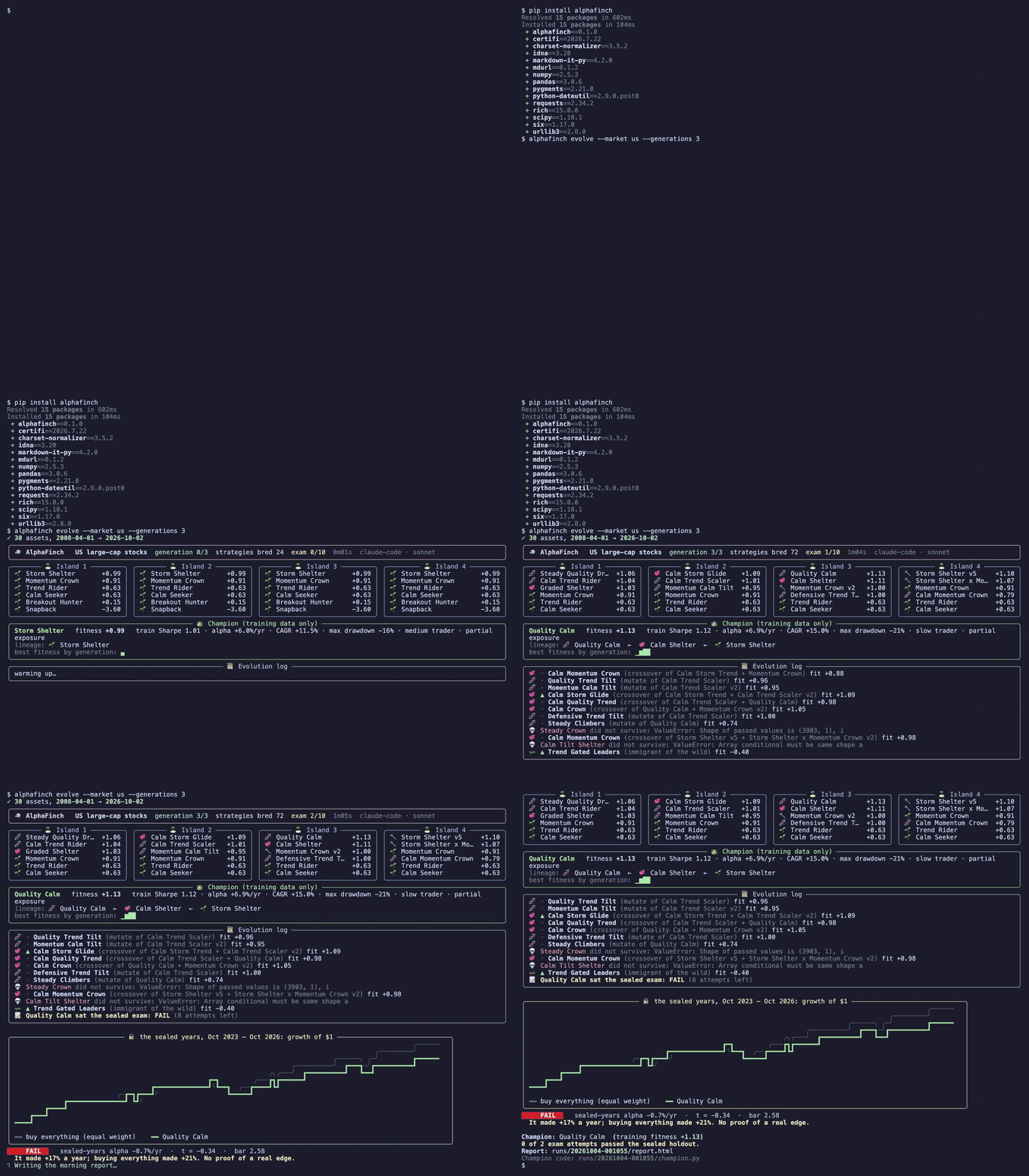
Works with Claude Code, Anthropic, OpenAI, Ollama, any OpenAI-compatible server, or no AI at all.
AlphaFinch is an AlphaEvolve-style lab for markets. An AI writes trading strategies as short Python functions, backtests them, and breeds the fittest: mutating them, crossing them and letting populations evolve on separate islands.
The catch with every AI trading demo: evolution is the best overfitting machine ever built. Run it long enough and it will "discover" a brilliant strategy in pure noise. AlphaFinch is built around that problem. The most recent years are locked in a sealed exam that neither evolution nor the AI ever sees, and the bar to pass accounts for every attempt.
Most runs end with nothing passing. That's the honest answer, and the point.
What it found
We pre-registered every test before running it (docs/) and report every result.
- One market, three sealed years: 0 of 10 passed on the S&P 500 and NIFTY 200 (details; earlier runs on industries and India: 0 of 8, details). Training scores rose while out-of-sample alpha fell: overfitting, caught in the act.
- So we rebuilt the search to score alpha, choose champions on years breeding never saw, and demand an edge that holds across random halves of the stocks. On a stand-in exam it beat the original search in 4 of 4 matched runs (details).
- Then the world exam: five strategies, bred only on data before 2017, were frozen and tested unchanged on seven stock markets they had never seen, from October 2017 to October 2026.
| Strategy | Alpha / year | t (bar 2.33) | Markets with positive alpha | |
|---|---|---|---|---|
| Quiet Sector Tether v2 | +2.9% | 3.40 | 7 of 7 | ✅ PASS |
| The Team (India-bred) | +2.3% | 2.14 | 6 of 7 | 🟡 PROMISING |
| Quiet Intraday Relay v2 | +0.9% | 1.03 | 5 of 7 | 🟡 PROMISING |
| Two others | negative | ❌ FAIL |
Quiet Sector Tether buys, within each sector, the stocks that move least with the market and shorts those that move most. It is essentially "betting against correlation", an anomaly published by AQR researchers in 2020: the AI rediscovered it from pre-2017 US data, and it held up in the UK, the Eurozone, Japan, Hong Kong, Australia, Canada and Korea. It survives higher trading costs (t 2.94 at 15 bps), a causal beta hedge (t 3.22) and the six standard Fama–French factors (alpha +2.5%/yr, t 2.64).
The caveats are in the full write-up: it is weaker in 2020–26 alone (t 2.17), short-borrowing fees aren't modelled, and Korea banned short selling for parts of the period. It's frozen in forward/ to be judged again on data that doesn't exist yet.
Quick start
Needs Python 3.10+. No API keys or data subscriptions: market data is free and downloaded on first use. Prefer the latest code? pip install "alphafinch[all] @ git+https://github.com/shloksobti/alphafinch".
pip install "alphafinch[all]"

alphafinch demo                                # offline: synthetic market, no AI, no network (~1 min)
alphafinch evolve india                        # NIFTY 200 stocks; AI provider auto-detected
alphafinch evolve india --long-only            # same, but no shorting (cash market)
alphafinch evolve india-futures                # NSE futures: NIFTY, BANKNIFTY, every F&O stock
alphafinch evolve futures                      # 39 global futures: indices, bonds, FX, commodities
alphafinch holdings runs/<run>/champion.py india   # what the champion wants to hold today
alphafinch world-exam runs/<run>/champion.py   # test it on 7 markets it has never seen
alphafinch replay runs/<run>                   # re-watch a finished run as a short story
Two choices shape every run: the market (a plain word, e.g. india) and the rules (flags, e.g. --long-only). Type alphafinch alone for an overview, alphafinch evolve -h for every option, or read the guide.
What a run takes. The default run (20 generations × 4 islands) makes a few hundred AI calls and takes roughly 20–40 minutes. The first run on a market also downloads its data (a few minutes, then cached). With claude-code it uses your existing subscription; with an API key you pay your provider's usual rates.
What you get in runs/<timestamp>/:
| File | Contents |
|---|---|
report.html |
The morning report: champion, exam verdict, equity curves, the team, the lab notebook, the family tree |
champion.py |
The champion's code, ready for backtest, holdings or world-exam |
team.py |
A diversified team of survivors, when one forms |
population.json |
Every strategy bred, with its scores |
alphafinch replay runs/<timestamp> re-tells any finished run as a short story:
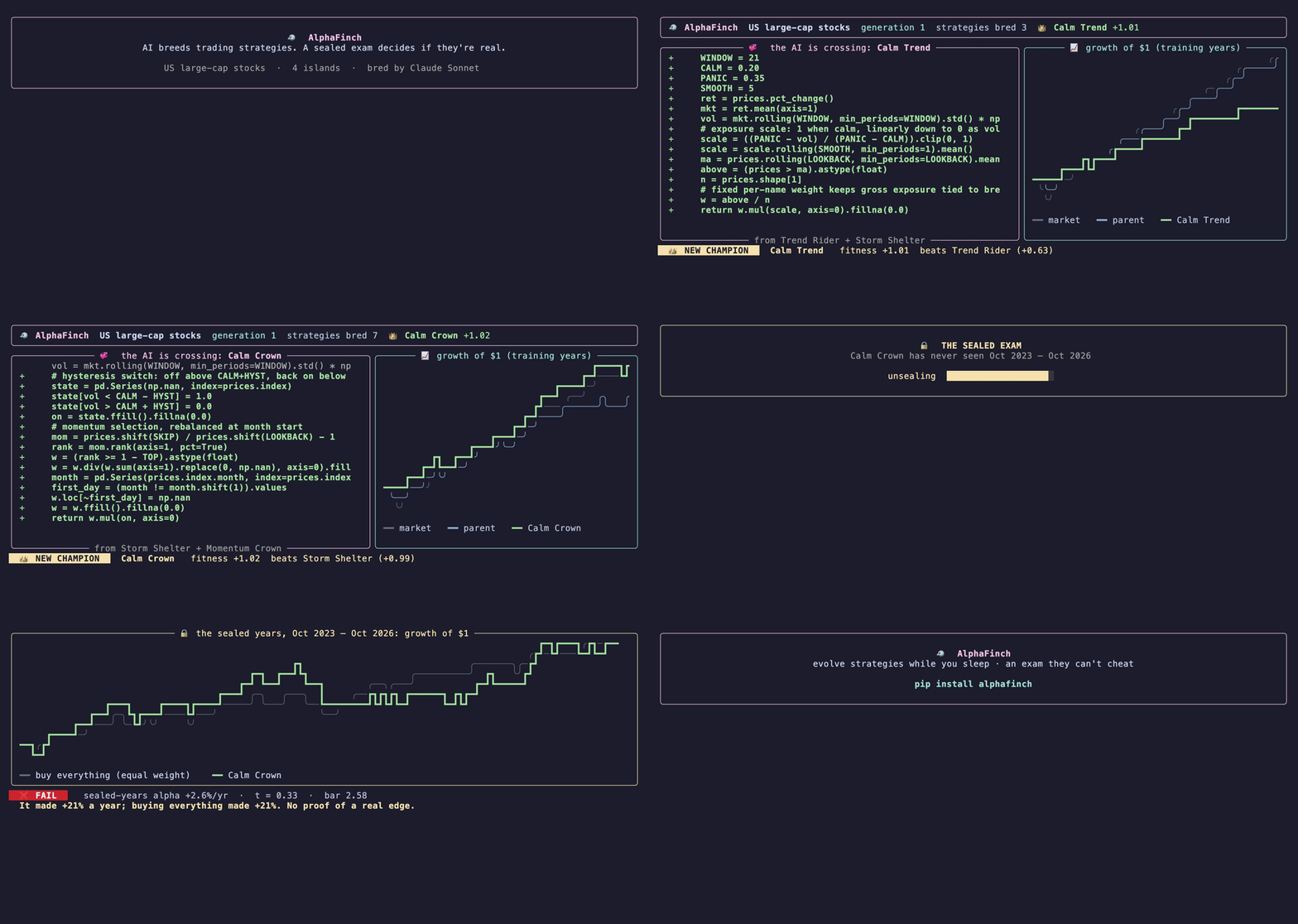
How it works
breed ─▶ choose ─▶ 🔒 sealed exam ─▶ 🌍 world exam ─▶ ⏳ forward test
Breeding. Four islands, each with a population of strategies. Every generation the AI mutates a parent using its report card, crosses two parents into one idea, or invents an immigrant from a fresh hypothesis. No-AI operators tweak a constant or blend two portfolios. Champions migrate between islands, and each island keeps the best strategy in every niche (fast or slow, market-neutral or market-hugging), so the population can't collapse onto one idea.
Fitness rewards a real edge, not a lucky one:
- Alpha, not returns. Each of four training eras is scored on its appraisal ratio: return beyond market exposure, per unit of risk. The worst era counts as much as the typical one.
- Broad, not narrow. The portfolio is re-scored on random halves of the stocks, and the worst half counts.
- Stable, not knife-edge. Parameters are nudged and neighbours re-scored. Penalties for heavy trading and bloated code.
The AI works like a researcher. Every strategy starts with a written hypothesis. A lab notebook of every idea tried, and how it fared, goes into each prompt. A toolkit (tk) makes sector-neutral long/short books, residual returns and volatility targeting one-liners. Use --strong-model to give crossovers and new ideas to a bigger model.
Choosing the champion. The last three training years are held back from breeding. The top ten finalists and a diversified team are scored once on those years, and the best becomes the champion. The AI never sees those scores.
The sealed exam. The most recent three years. Each attempt reveals only PASS or FAIL, and the bar is t⁻¹(α / attempts), valid however adaptively the search ran (the theory). Results are graded PASS, PROMISING (t > 1, with the years of data a pass would need) or FAIL.
The world exam. Three years of one market can rarely prove a realistic edge. So a frozen strategy runs unchanged on seven other markets, and the evidence is pooled. The verdict uses the lower of two pooled t-statistics (Newey–West and Stouffer), so a strategy has to convince both. Calibrated with placebos: 0 of 200 random strategies passed.
The forward test. alphafinch forward freeze runs/<run> today, alphafinch forward score in six months. No model has seen tomorrow's data.
Trading rules
Two choices shape every run: the market (what can be traded) and the rules (how). Rules are enforced by the engine on every strategy's positions, so a strategy can't break them and still look good, and the AI is told them up front.
| Flag | Rule |
|---|---|
| (none) | Long or short, up to 1× capital |
--long-only |
Buy only, no leverage: the cash / spot market |
--market-neutral |
Longs and shorts roughly equal, with a borrow fee on shorts |
--max-position 5% |
No single position above 5% |
--leverage 2 |
Total exposure up to 2× capital |
Futures markets get futures rules automatically: shorting is as easy as buying, up to 3× exposure.
Futures
futures: 39 global futures across stock indices, government bonds, currencies, energy, metals and agriculture, for hypotheses like trend-following, crisis alpha, carry or cross-asset signals.india-futures: NSE futures, NIFTY and BANKNIFTY plus every F&O stock.
Free continuous futures prices fake big gains or losses at every contract roll: on Yahoo's natural-gas series a rolled position "earned" +20% a year when it really lost 12%. So AlphaFinch builds futures from funds that hold and roll the real contracts (and Indian stock futures from each stock's total return), converted to excess returns over the short-term interest rate, which is what a futures position earns.
Safety and honesty
- Sandbox: AI-written code may import only
numpy,pandasandmath, with no file, network or dunder access. It runs in separate processes with restricted builtins, a CPU limit and a timeout. - Look-ahead detector: every strategy is re-run on truncated histories. If past weights change when future data is removed, it's discarded.
- No hindsight by name: code that hard-codes a ticker or sector is rejected, so the AI can't simply pick stocks it knows did well.
- Costs: 5 bps per unit of turnover. Weights act from the next close.
- Survivorship: universes are today's index members. Alpha is measured against the same list, which limits the bias but doesn't remove it.
Bring any AI
--provider |
Setup | Notes |
|---|---|---|
claude-code |
Claude Code installed | no API key; runs claude -p |
anthropic |
ANTHROPIC_API_KEY |
default claude-opus-5-5 |
openai |
OPENAI_API_KEY |
pick with --model |
ollama |
a local model at localhost:11434 |
free and private |
compatible |
--base-url … --model … |
any OpenAI-compatible server |
none |
nothing | tweaks and blends only, offline |
--provider auto (the default) uses the first one it finds. A Claude Code skill is included in integrations/claude-code.
Markets and data
All free, no keys:
| Market | Universe |
|---|---|
us |
S&P 500 since 2010, with SEC fundamentals (point-in-time, the day after each 10-K) |
india |
NIFTY 200 since 2010 |
india-futures |
NSE futures: NIFTY, BANKNIFTY and every F&O stock, since 2012 |
futures |
39 global futures since 2012 |
uk europe japan hongkong australia canada korea |
FTSE 100, Eurozone large caps, Nikkei 225, Hang Seng, ASX 200, TSX 60, KOSPI 200 |
us30 crypto industries synthetic |
30 US mega-caps, 15 coins, 49 US industries since 1970, simulated |
Or use your own list: --tickers RELIANCE.NS,TCS.NS,INFY.NS (any Yahoo symbols).
Strategies see prices plus data.open/high/low/volume, data.sector, data.macro (VIX, index, oil, gold, rates and more) and, for the US, data.fund (market cap, earnings yield, book-to-market, ROE, sales growth).
US fundamentals need a contact email, because the SEC asks every client for one: export ALPHAFINCH_SEC_CONTACT="Your Name you@example.com".
Write your own
def strategy(prices, data):
    """Sector Spread: sector-neutral 6-month momentum. Hypothesis: news diffuses slowly within industries."""
    score = tk.neutralize(tk.zscore(prices.pct_change(126)), data.sector)
    return tk.rebalance(tk.long_short(score, q=0.2), every="M")
A strategy returns, for every day, the fraction of capital to hold in each asset (negative means short). It may use numpy, pandas, math and the built-in toolkit tk, must never use future data, and may not name tickers. The guide lists every field and toolkit function.
alphafinch backtest my_strategy.py us      # training years only; the sealed years stay sealed
alphafinch holdings my_strategy.py us      # what it wants to hold after the latest close
alphafinch world-exam my_strategy.py       # 7 stock markets it has never seen
FAQ
Will this make me money? Probably not, and AlphaFinch is built to tell you so. A PASS is a lead worth researching, not a trading signal.
Why not just backtest on all the data? With enough tries, something always worked by luck. Only data the search never touched can tell luck from skill.
Can I re-run until something passes? You can, but then the exam means nothing. Count your earlier looks (--alpha, --prior-looks) or test on new markets and new data.
Does it tell me what to buy? alphafinch holdings shows the positions a strategy wants today. That's the output of a research tool, not a recommendation: check the exam verdict and the caveats first.
Can I use my own data? Any Yahoo symbols with --tickers. Other sources can be added in alphafinch/data.py, which returns a simple Panel of aligned tables.
Development
git clone https://github.com/shloksobti/alphafinch && cd alphafinch
pip install -e ".[all,dev]"
pytest -q                     # about 40 tests, offline, under a minute
Issues and pull requests are welcome: new markets, data sources, toolkit functions and exams especially.
Citation
The sealed exam's bar comes from:
Shlok Sobti, Deflate by Bits, Not Trials, SSRN 7557458 (2026). papers.ssrn.com/abstract=7557458
About
Built by Shlok Sobti at Invsify, a SEBI-registered investment advisory in India. AlphaFinch is an independent open-source research project: nothing in this repository is investment advice or a recommendation from Invsify.
Research and educational software. Backtests ignore taxes, capacity limits and slippage beyond the modelled costs; borrow fees are charged only under --market-neutral.
MIT License.
1 maintainer

Metadata
1 maintainer
Release files for alphafinch 0.1.1
For a detailed explanation of source distributions (sdists) and built distributions (wheels), please see the package formats documentation.
Source distribution (sdist)
| File | Size | Uploaded | |
|---|---|---|---|
| alphafinch-0.1.1.tar.gz | 77.0 kB | Details |
Built distribution (wheel)
| File | Interpreter | ABI | Platform | Reset |
|---|---|---|---|---|
| alphafinch-0.1.1-py3-none-any.whl | Python 3 | none | any | Details |
Total release size: 159.2 kB
Release files / alphafinch-0.1.1.tar.gz
| Download URL | alphafinch-0.1.1.tar.gz |
|---|---|
| Size | 77.0 kB |
| Tags | Source |
|
SHA-256 checksum How to use checksums |
fc8a104f21654a79e9714e56c50f96367e37e20658388ed32a09ff511de21807
|
|
BLAKE2b-256 checksum How to use checksums |
ceb39f3151a0d94603147c60309cc31585a92d66a03ad0eea31d7dc396f579e5
|
| Upload date | |
|
Uploaded using Trusted Publishing? What is trusted publishing? |
Yes |
| Uploaded via |
twine/7.0.0 CPython/3.13.14
|
Provenance
Provenance describes where a file came from. On PyPI, provenance is shared via attestations, which provide a verifiable record of the build or publishing details. View details, limitations and caveats.


PyPI Publish Attestation
PyPI verified that this artifact, at this checksum, originated from the publisher listed below.
Signed by GitHub Actions, verified by PyPI on Oct 4, 2026.
Transparency logRelease files / alphafinch-0.1.1-py3-none-any.whl
| Download URL | alphafinch-0.1.1-py3-none-any.whl |
|---|---|
| Size | 82.2 kB |
| Tags | Python 3 |
|
SHA-256 checksum How to use checksums |
2699d4f903833dcbfb827508d0eb9a4e58423c303a319ff2acb815c29d68a521
|
|
BLAKE2b-256 checksum How to use checksums |
64dfe636920071b60db484dcf1c7f6c7eface55f821049d1fcd268a359e062f6
|
| Upload date | |
|
Uploaded using Trusted Publishing? What is trusted publishing? |
Yes |
| Uploaded via |
twine/7.0.0 CPython/3.13.14
|
Provenance
Provenance describes where a file came from. On PyPI, provenance is shared via attestations, which provide a verifiable record of the build or publishing details. View details, limitations and caveats.
PyPI Publish Attestation
PyPI verified that this artifact, at this checksum, originated from the publisher listed below.
Signed by GitHub Actions, verified by PyPI on Oct 4, 2026.
Transparency log













