
alphafold3_tools
Toolkit for alphafold3 input generation and output analysis



How do I reference this work?
- Moriwaki Y et al. High-throughput prediction of protein–protein interactions uncovers hidden molecular networks in biosynthetic gene clusters, Comput. Struct. Biol. J; doi: 10.34133/csbj.0149
Installation
Requirements:
- Python 3.12 or later
# install from PyPI
python3 -m pip install alphafold3-tools
Alternatively, uv is recommended to install and develop the package. See the instructions of installation:
# For Linux or macOS
curl -LsSf https://astral.sh/uv/install.sh | sh
# For macOS (Homebrew)
brew install uv
Then, install the package with uv:
git clone git@github.com:cddlab/alphafold3_tools.git
cd alphafold3_tools
uv sync
Usage
All tools are provided as subcommands of a single af3tools command, e.g. af3tools msatojson -i input.a3m. Run af3tools --help to list all subcommands, af3tools <subcommand> -h for subcommand-specific help, and af3tools --version to print the version (or af3tools <subcommand> -v for an individual subcommand's version).
msatojson
msatojson is a command to convert an a3m-formatted multiple sequence alignment (MSA) file to JSON format. The input name can be specified with the -n option.
af3tools msatojson -i input.a3m -o input.json -n inputname
The input a3m MSA file can be generated by MMSeqs2 webserver (or ColabFold). colabfold_batch --msa-only option is useful to generate a3m MSA files only.
msatojson can accept a directory containing multiple a3m files. In this case, the output JSON files will be saved in the specified output directory.
af3tools msatojson -i /path/to/a3m_containing/directory -o /path/to/output/directory
Writing MSA as separate files (--write_msapath)
By default, msatojson embeds MSA sequences directly in the output JSON under the unpairedMsa and pairedMsa keys. Use --write_msapath to write the MSA content to separate .a3m files instead and reference them via unpairedMsaPath and pairedMsaPath keys. This keeps the JSON compact when working with large MSAs.
af3tools msatojson -i input.a3m -o output.json --write_msapath
The behavior depends on whether the input a3m contains a paired MSA (i.e. multi-chain complex):
| Input type | unpairedMsaPath |
pairedMsaPath |
|---|---|---|
| Single-chain (no paired MSA) | Path to the original -i file (no new file written) |
"" |
| Multi-chain (paired MSA present) | {output_dir}/{name}_unpaired_{chain_id}.a3m |
{output_dir}/{name}_paired_{chain_id}.a3m |
For example, processing a two-chain complex testcomplex.a3m with -o /path/to/output/testcomplex.json produces:
/path/to/output/
  testcomplex.json                # JSON with unpairedMsaPath / pairedMsaPath
  testcomplex_unpaired_A.a3m     # unpaired MSA for chain A/B
  testcomplex_paired_A.a3m       # paired MSA for chain A/B
  testcomplex_unpaired_C.a3m     # unpaired MSA for chain C/D/E
  testcomplex_paired_C.a3m       # paired MSA for chain C/D/E
[!NOTE]
unpairedMsa/unpairedMsaPathandpairedMsa/pairedMsaPathare mutually exclusive in the output JSON. When--write_msapathis enabled, only the*MsaPathvariant appears.
Template search (--include_templates)
From version 0.2.0, templates can be also added to the output JSON file. Use the --include_templates option to include templates. The directory path /path/to/mmcif_files containing mmCIF files and the corresponding pdb_seqres.txt file must be specified with the --pdb_database_path and --seqres_database_path options, respectively.
--max_template_dateoption can be used to set the maximum template date. The default value is2099-09-30, which means no filtering based on template date. If you want to the same results as AlphaFold3, set this value to2021-09-30.--max_subsequence_ratiooption can be used to set the maximum subsequence ratio for template filtering. The default value is0.95(same as the default value of AlphaFold3). However, if you want to include all templates regardless of the subsequence ratio, set this option to1.0.-doption can be used to enable debug mode, which will print debug information during the template search process.
# Example command to include templates in the output JSON file
af3tools msatojson -i input.a3m -o output.json \
    --include_templates \
    --pdb_database_path /path/to/mmcif_files \
    --seqres_database_path /path/to/pdb_seqres.txt \
    --max_template_date 2099-09-30 \
    --hmmbuild_binary_path /path/to/hmmbuild \
    --hmmsearch_binary_path /path/to/hmmsearch \
    --save_hmmsto \
    --max_subsequence_ratio 1.0 \
    -d
[!NOTE]
- This feature requires HMMER 3 or later to be installed and accessible in your PATH. For macOS users, you can install HMMER via Homebrew:
brew install hmmer
--hmmbuild_binary_pathand--hmmsearch_binary_pathoptions can be used to specify the paths to thehmmbuildandhmmsearchbinaries, respectively, if they are not in your PATH.--save_hmmstooption saves the intermediate hmmsearch Stockholm (.sto) file. When the input a3m contains multiple protein chains, one file is written per chain, named{name}_{chain_id}.hmmsearch.sto(e.g.myprotein_A.hmmsearch.sto,myprotein_C.hmmsearch.sto). Files are written to the same directory as the output JSON file.- When processing a directory with
--include_templates, each hmmsearch subprocess uses 4 CPU cores by default, and the number of parallel workers is automatically capped tocpu_count ÷ 4to avoid CPU oversubscription.- The
pdb_seqres.txtfile can be downloaded from wwPDB. The file size is about 356 MB (as of Dec. 2025).
Guessing the homo-oligomer count from templates (--guess_copies)
By default, the number of copies of each protein chain in the output JSON (the length of the id list) is taken from the stoichiometry recorded in the a3m header. Use the --guess_copies option to instead infer the homo-oligomer count from the biological assembly of each chain's first template.
For each protein sequence, msatojson looks up the first template hit (PDB ID + chain ID), reads that structure's biological assembly information from the mmCIF file, and counts how many copies of the same polymer entity it contains. That count becomes the number of chain IDs assigned to the sequence, overriding the a3m header stoichiometry. For example, if the first template of a chain is the homohexamer 1BJP, that chain is assigned six IDs ("id": ["A", "B", "C", "D", "E", "F"]). When there are multiple protein sequences, the chain-ID letters are shifted so that IDs never overlap between sequences. If no template is found, or the structure has no usable biological assembly information, the count falls back to 1 (monomer).
--guess_copiesperforms a template search, so it requires--include_templatesand--pdb_database_path(as well as--seqres_database_path); the command exits with an error if these are missing.
# Example command to guess the number of chain copies from templates
af3tools msatojson -i input.a3m -o output.json \
    --include_templates \
    --pdb_database_path /path/to/mmcif_files \
    --seqres_database_path /path/to/pdb_seqres.txt \
    --max_template_date 2099-09-30 \
    --guess_copies \
    -d
[!NOTE]
--guess_copiesoverrides the stoichiometry from the a3m header. If you want to keep the header stoichiometry, simply omit this option.- The estimate is based purely on the first template's deposited biological assembly, which is the author's/software's assignment and may not reflect the true biological oligomeric state. Review the assigned copy count when it matters.
fastatojson
fastatojson is a command to convert a FASTA file to JSON format compatible with AlphaFold3.
af3tools fastatojson -i input.fasta [-s 1 2 3 ...] [-d]
-i: Input FASTA file. Mandatory.-s: Model seeds to be used. Optional. Default is1. Multiple seeds can be specified.-d: Debug mode. Optional. If specified, the command will print debug information.
For example, if you have a FASTA file containing two sequences, input.fasta:
>P12345
KAKDLSKCLS
>Q67890
KADFILCSLK
>I23L45_I3PLS2
LAKDCL:KKALS
You will obtain three JSON files, p12345.json, q67890.json, and i23l45_i3pls2.json. The last one contains two sequences, LAKDCL and KKALS, which are separated by a colon (:). The output JSON files will look like this:
{
  "name": "i23l45_i3pls2",
  "dialect": "alphafold3",
  "version": 1,
  "sequences": [
    {
      "protein": {
        "id": ["A"],
        "sequence": "LAKDCL"
      },
      "protein": {
        "id": ["B"],
        "sequence": "KKALS"
      }
    }
  ],
  "modelSeeds": [1],
}
modjson
modjson is a command to modify an existing AlphaFold3 input json file. This tool is useful to add/modify the ligand entities and User-provided CCD string in an input json file.
af3tools modjson -i input.json -o output.json [-n jobname] [-p] \
       [-a smiles "CCOCCC" 1 -a ccdCodes PRD 2] \
       [-u userccd1.cif userccd2.cif]
-i: Input json file. Mandatory.-o: Output json file. Mandatory.-n: Job name. Optional. Sets the job name in the input JSON file.-p: Purge all ligand entities from the input JSON file at first.-a: Add ligand to the input JSON file. Provide 'ligand type', 'ligand name', and 'number of the ligand molecule'. The 'ligand type' must be either 'smiles' or 'ccdCodes'. Multiple ligands can be added.- Example:
-a smiles "CCOCCC" 1 -a ccdCodes PRD 2 -a ...
- Example:
-u: Add user provided ccdCodes to the input JSON file. Multiple files can be provided.- Example:
-u userccd1.cif userccd2.cif
- Example:
[!NOTE] A
*_data.jsonfile in the AlphaFold3's output directory can be also used as an input JSON file ofmodjson.
Template search (--include_templates)
modjson can also add template information to an existing JSON file (for example one produced by msatojson without templates, or an AlphaFold3 *_data.json). This runs the same template-search pipeline as msatojson --include_templates on each protein chain's MSA (read from its unpairedMsa, or from unpairedMsaPath), and stores the result in that chain's templates field. The template options are identical to msatojson, and the ligand options (-a/-u) work independently of template search.
af3tools modjson \
    -i A6VX99_2.json \
    -o A6VX99_2_templates.json \
    --include_templates \
    --pdb_database_path /path/to/mmcif_files \
    --seqres_database_path /path/to/pdb_seqres.txt \
    --max_template_date 2099-12-31 \
    --max_subsequence_ratio 1.0 \
    --hmmbuild_binary_path /path/to/hmmbuild \
    --hmmsearch_binary_path /path/to/hmmsearch \
    [--guess_copies] [--save_hmmsto] [-O/--overwrite-templates]
--include_templates: Search and add template information to each protein chain. Requires--pdb_database_path,--seqres_database_path, and the HMMER binaries (--hmmbuild_binary_path/--hmmsearch_binary_path, defaulting to the ones onPATH).--max_template_date/--max_subsequence_ratio: Same as inmsatojson. Setting--max_subsequence_ratio 1.0disables subsequence-ratio filtering.-O/--overwrite-templates: Overwrite existing template information. By default, a protein chain that already has a non-emptytemplateslist is preserved (skipped); only chains with empty/absent templates are searched. With-O, every protein chain is re-searched and its templates replaced. This option only affects template overwriting; other entities are unaffected.--save_hmmsto: Save the intermediate hmmsearch Stockholm (.sto) file per chain, named{name}_{chain_id}.hmmsearch.sto, in the output JSON's directory.--guess_copies: Infer the homo-oligomer count of each protein chain from its first template's biological assembly and set the chain's copy count (idlist length) accordingly, overriding the existing count. Requires--include_templatesand--pdb_database_path. Chain ids are renumbered contiguously afterwards.
[!NOTE]
--write_msapathis available only inmsatojson;modjsonkeeps the MSA representation of the input JSON unchanged.
paeplot
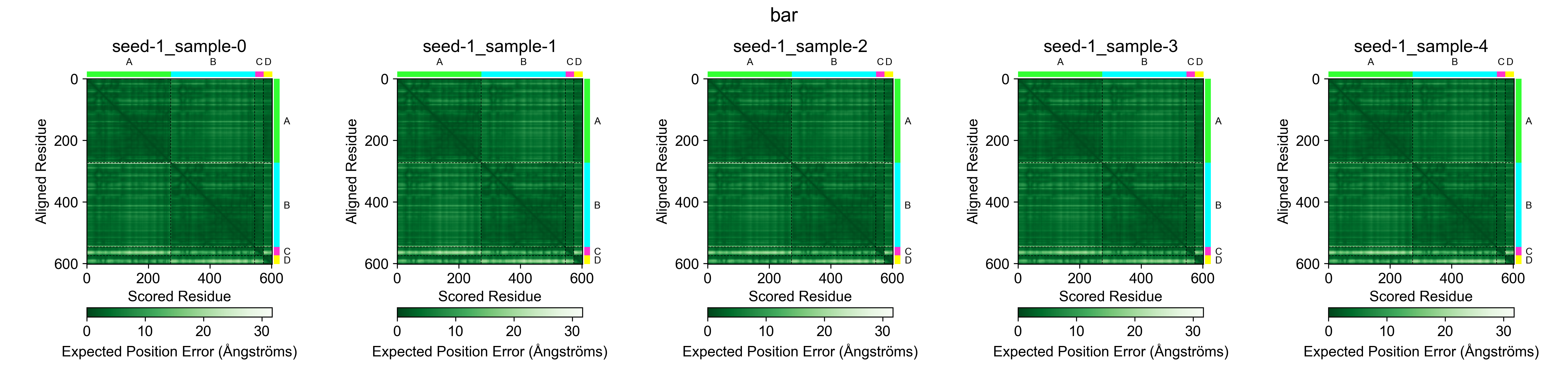
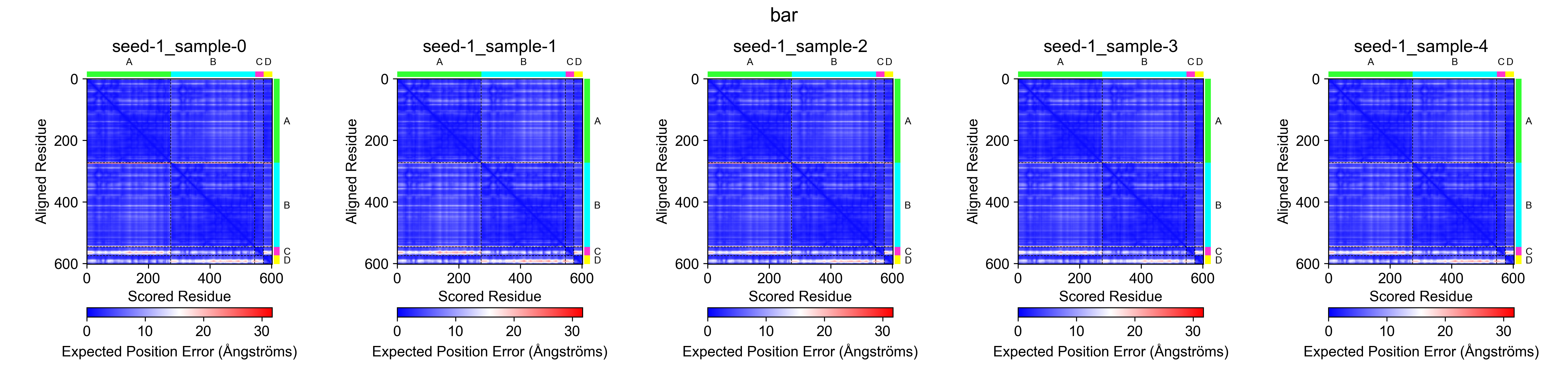
paeplot is a command to plot the predicted aligned error (PAE). The color map can be specified with the -c option. The default color map is bwr (ColabFold-like), but Greens_r is also available for AlphaFold Structure Database (AFDB)-like coloring.
af3tools paeplot -i /path/to/alphafold3_output/directory [-c {Greens_r,bwr}] [--dpi 300] [-n foo] [-f {png,svg}] [-a] [-t "PAE Plot"] [--chain-cmap {pymol,unhcr,<matplotlib_colormap_name>}]
arguments:
-i: Input directory containing the AlphaFold3 output files. Mandatory.-c: Color map for the PAE plot. Optional. Default isbwr. Choose eitherGreens_rorbwr.--dpi: DPI of the output image. Optional. Default is100, but300is recommended for publication-quality images.-n: Name prefix for the output image file. Optional.-f: Output image file format. Optional. Choose eitherpngorsvg. Default ispng.-a: If specified, the plot will include all models in the output directory.-t: Title of the plot. Optional.--chain-cmap: Color map for chain coloring on top and right. Optional. Choose eitherpymol,unhcr, or any valid matplotlib colormap name. (e.g.tab20) Default ispymol.
superpose_ciffiles
superpose_ciffiles is a command to superpose the output mmCIF files. The command creates a multi-model mmCIF file containing all the predicted model.cif subdirectories. The output file name can be specified with the -o option. By default, the output file will be saved as foo_superposed.cif in the input directory.
-c option can be used to specify the chain ID to be superposed.
af3tools superpose_ciffiles -i /path/to/alphafold3_output/directory [-o /path/to/output/directory/foo_superposed.cif] [-c A]
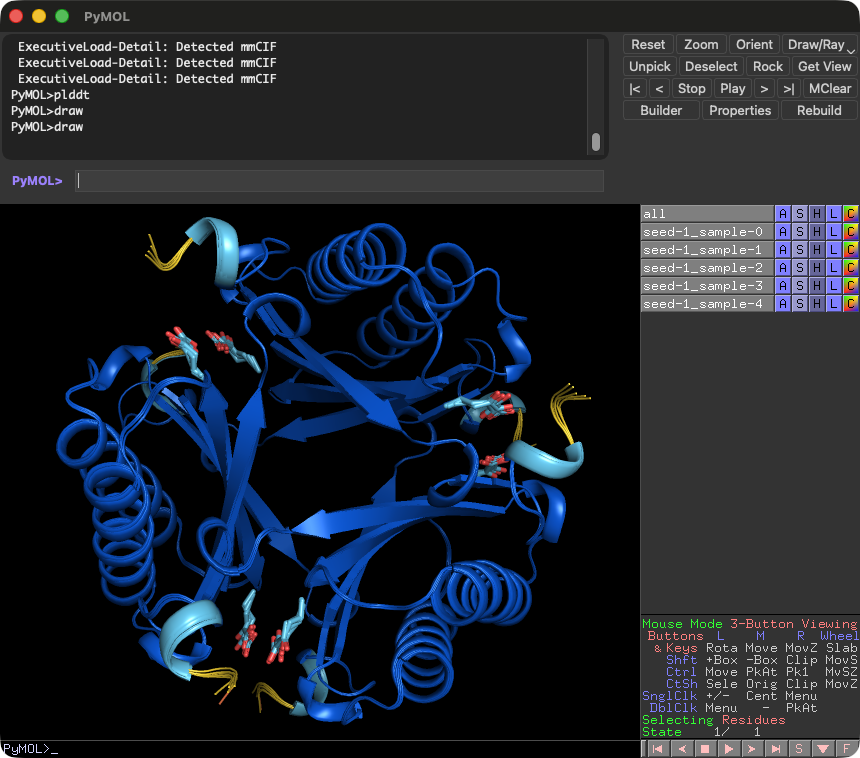
In PyMOL, the following command will be useful to visualize the plDDT values.
color 0x0053D6, b < 100
color 0x65CBF3, b < 90
color 0xFFDB13, b < 70
color 0xFF7D45, b < 50
util.cnc
[!NOTE] To visualize only an object of
seed-1_sample-0with plddt values, type the following command in PyMOL.color 0x0053D6, seed-1_sample-0 and b < 100 color 0x65CBF3, seed-1_sample-0 and b < 90 color 0xFFDB13, seed-1_sample-0 and b < 70 color 0xFF7D45, seed-1_sample-0 and b < 50
sdftoccd
sdftoccd is a command to convert sdf file to ccd format. Please refer to the AlphaFold3's input document for the detail of User-provided CCD format.
af3tools sdftoccd -i input.sdf -o userccd.cif -n STR
jsontomsa
jsontomsa is a command to extract MSA from the AlphaFold3 input JSON file. The output file name can be specified with the -o option.
af3tools jsontomsa -i /path/to/alphafold3_data.json -o /path/to/out.a3m
pdbtocif
pdbtocif is a command to convert a PDB file to mmCIF format. The output file name can be specified with the -o option.
af3tools pdbtocif -i input.pdb -o output.cif [--pdb_id XXXX]
This tool is useful for converting legacy PDB-formatted files into mmCIF format, which is required for template search in msatojson as well as for input to AlphaFold 3.
The --pdb_id option allows users to specify the PDB ID assigned to the output mmCIF file. This is particularly useful when using predicted structures (e.g., from the AlphaFold Structure Database) as templates, because such structures often have nonstandard identifiers (e.g., AF-P12345-F1-model_v1) that are not suitable for template search. By default, the PDB ID in the output mmCIF file is set to xxxx. The PDB ID must be a four-character string consisting of lowercase letters and/or digits, as the template search in msatojson is case-sensitive and the template database uses lowercase PDB IDs.
Other tools are being developed and will be added.
metrics
metrics calculates ipSAE and related interaction scores (ipTM, pDockQ, pDockQ2, LIS) for protein–protein (and protein–nucleic acid) complexes predicted by AlphaFold3, ColabFold, or Boltz. It is a reimplementation of ipsae.py (MIT License) by Roland L. Dunbrack Jr., extended with JSON output and batch processing support.
Basic usage — explicit file paths
Specify PAE and structure files directly, equivalent to the original ipsae.py interface:
af3tools metrics -p model_scores_rank_001.json -s model_relaxed_rank_001.pdb [-pc 10 -dc 10]
Options:
-p / --pae_file: PAE file (.jsonfor AF2/AF3,.npzfor Boltz)-s / --struct_file: Structure file (.pdbfor AF2/Boltz,.ciffor AF3/Boltz)-pc / --pae_cutoff: PAE threshold in Å for ipSAE / pDockQ / ipTM (default:10.0)-dc / --dist_cutoff: Cβ distance threshold in Å for ipSAE (default:10.0)--lis_pae_cutoff: PAE threshold in Å used by the LIS-family metrics (default:12.0)--lis_cb_cutoff: Cβ contact threshold in Å used by the LIS-family metrics (default:8.0)
Directory mode — automatic input detection
af3tools metrics -i /path/to/output_directory
When a directory is passed with -i, metrics auto-detects the prediction format:
| Format | PAE file | Structure file |
|---|---|---|
| AlphaFold3 | *_confidences.json |
*_model.cif |
| ColabFold | *_scores_rank_001_alphafold2_multimer_v3_model_*_seed_*.json |
*_relaxed_rank_001_*.pdb (falls back to *_unrelaxed_* if absent) |
Batch processing for ColabFold outputs
When the directory contains multiple ColabFold predictions, metrics automatically processes all of them in one run. A prediction with prefix foobar is considered complete when both foobar.done.txt and foobar_coverage.png exist in the same directory. Prefix validation runs in parallel across all available CPU cores.
# Process all completed predictions in a ColabFold output directory
af3tools metrics -i /path/to/colabfold_output_dir
Output files
Three files are written next to each structure file:
| File | Description |
|---|---|
{stem}_{pae}_{dist}.txt |
Summary score table |
{stem}_{pae}_{dist}_byres.txt |
Per-residue score table |
{stem}_{pae}_{dist}.pml |
PyMOL script for interface visualisation |
JSON output with ipSAE_min / ipSAE_max
af3tools metrics -i /path/to/output_directory --json
The --json flag replaces the .txt summary with a .json file. The JSON format extends the original ipSAE output by providing, for each chain pair, the asymmetric score for each direction as well as max and min values across the two asymmetric directions (ipSAE_max and ipSAE_min):
{
  "model_name": {
    "pae_cutoff": 10,
    "dist_cutoff": 10,
    "lis_pae_cutoff": 12,
    "lis_cb_cutoff": 8,
    "A-B": {
      "asym": [
        {"chain1": "A", "chain2": "B", "ipSAE": 0.382, "ipSAE_d0chn": 0.412, "ipSAE_d0dom": 0.401, "ipTM_af": 0.65, "pDockQ": 0.731, "pDockQ2": 0.612, "LIS": 0.524, "...": "..."},
        {"chain1": "B", "chain2": "A", "ipSAE": 0.315, "ipSAE_d0chn": 0.298, "ipSAE_d0dom": 0.307, "ipTM_af": 0.65, "pDockQ": 0.731, "pDockQ2": 0.589, "LIS": 0.511, "...": "..."}
      ],
      "max": {"chain1": "A", "chain2": "B", "ipSAE": 0.382, "...": "..."},
      "min": {"chain1": "A", "chain2": "B", "ipSAE": 0.315, "...": "..."},
      "lis_metrics": {"LIS": 0.743, "cLIS": 0.910, "LIA": 36298, "cLIA": 178, "iLIS": 0.822, "iLIA": 2541.9, "iLISA": 2089.7, "actifpTM": 0.979}
    }
  }
}
LIS-family metrics (AFM-LIS)
For every chain pair, the lis_metrics block carries the symmetric pair-level
Local Interaction Score (LIS)
family of scores, computed identically to AFM-LIS / lis.py:
| Metric | Definition |
|---|---|
LIS |
mean of 1 − PAE/cutoff over residue pairs with PAE < lis_pae_cutoff, averaged over the two asymmetric directions |
cLIS |
same as LIS but restricted to residue pairs in CB-CB contact (≤ lis_cb_cutoff) |
LIA |
count of residue pairs with PAE < lis_pae_cutoff (both directions combined) |
cLIA |
count of contacts with PAE < lis_pae_cutoff AND CB ≤ lis_cb_cutoff |
iLIS |
√(LIS × cLIS) |
iLIA |
√(LIA × cLIA) |
iLISA |
iLIS × iLIA |
actifpTM |
approximate actifpTM — per-residue contact-weighted TM-score, max over both directions |
The defaults (lis_pae_cutoff=12, lis_cb_cutoff=8) match AFM-LIS exactly and can be overridden from the CLI:
af3tools metrics -i /path/to/output --json --lis_pae_cutoff 10 --lis_cb_cutoff 6
All usage examples
# AF2/ColabFold — explicit file paths (original ipsae.py interface)
af3tools metrics -p foo_scores_rank_001_alphafold2_multimer_v3_model_1_seed_000.json \
                 -s foo_relaxed_rank_001_alphafold2_multimer_v3_model_1_seed_000.pdb

# AlphaFold3 — directory auto-detection
af3tools metrics -i /path/to/af3_seed-1_sample-0

# ColabFold — batch processing of an entire output directory
af3tools metrics -i /path/to/colabfold_output_dir

# Custom cutoffs
af3tools metrics -i /path/to/af3_seed-1_sample-0 -pc 15 -dc 15

# JSON output (includes ipSAE_min/ipSAE_max and the LIS-family metrics per chain pair)
af3tools metrics -i /path/to/af3_seed-1_sample-0 --json

# Override LIS-family cutoffs (defaults match AFM-LIS: 12 / 8)
af3tools metrics -i /path/to/af3_seed-1_sample-0 --json --lis_pae_cutoff 12 --lis_cb_cutoff 8

# ColabFold batch with JSON output
af3tools metrics -i /path/to/colabfold_output_dir --json
Acknowledgements
This tool uses the following libraries and tools:
- RDKit
- matplotlib
- numpy
- gemmi
- loguru
- IPSAE
- AFM-LIS (LIS / cLIS / iLIS / LIA / cLIA / iLIA / iLISA / actifpTM)
PDBeurope/ccdutils is used for the conversion of sdf to ccd. RCSB PDB's MAXIT v11.400 is used as a reference for the conversion of PDB to mmCIF.
1 maintainer

Download files
Download the file for your platform. If you're not sure which to choose, learn more about installing packages.
Source Distribution
Built Distribution
Filter files by name, interpreter, ABI, and platform.
If you're not sure about the file name format, learn more about wheel file names.
Copy a direct link to the current filters
File details
Details for the file alphafold3_tools-0.5.5.tar.gz.
File metadata
- Download URL: alphafold3_tools-0.5.5.tar.gz
- Upload date:
- Size: 24.9 MB
- Tags: Source
- Uploaded using Trusted Publishing? No
- Uploaded via:
twine/7.0.0 CPython/3.12.14
File hashes
| Algorithm | Hash digest | |
|---|---|---|
| SHA256 |
9f4ef96e2076236ad468c04c2c8a7899316b9b52b9738772149e7a11242a0d2c
|
|
| MD5 |
972dc9acd449798bd330a2d146bca691
|
|
| BLAKE2b-256 |
efc5a026d2381509450f01cc0d0c55ce2b4e5a8bc27df3d351d3853566118f4d
|
File details
Details for the file alphafold3_tools-0.5.5-py3-none-any.whl.
File metadata
- Download URL: alphafold3_tools-0.5.5-py3-none-any.whl
- Upload date:
- Size: 112.8 kB
- Tags: Python 3
- Uploaded using Trusted Publishing? No
- Uploaded via:
twine/7.0.0 CPython/3.12.14
File hashes
| Algorithm | Hash digest | |
|---|---|---|
| SHA256 |
12ac9f4280bad898fe59bcc03aa286553f0d94698a40acd3393d781ffe9c668b
|
|
| MD5 |
7e221e745db1ef655f9356a79694168f
|
|
| BLAKE2b-256 |
cb766af2f2d4eb407d443bd4a8382ea6b9b08bb39450f23c8146dd4eb0f6cac9
|














