
AlphaVerify - Multi-Asset Financial Strategy Debunker

Most “technical” indicators are essentially astrology with better charts.
AlphaVerify is built to put an end to all that bullshit.
How to look at the figures
Each figure tests one market condition.
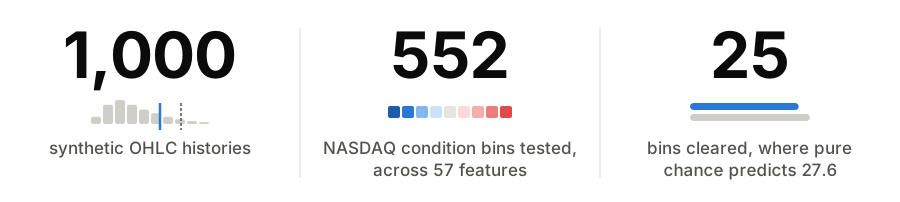
Left: while the condition holds, is the NASDAQ more likely (red) or less likely (blue) to move by a given percentage within 30 days? Right: the same test run on 1,000 random markets that contain no signal. To count as an edge, the real score (blue line) has to beat 95% of them (dashed line).
The golden cross - folklore
Traders everywhere watch for the 50-day average to cross above the 200-day. Once it runs about 10% above, the heatmap looks decisive: the odds of a 4% drop jump, the odds of a 4% rise fall, a 24.5-point swing. It looks like a real edge. It's folklore: random markets draw one at least this strong 8.4% of the time.

Above the 200-day - a textbook mirror
"Stay long while price is above the 200-day" is trend following's first rule. With price 4% to 6% above it, the picture is a near-perfect mirror: rises more likely, drops much less likely, a 27.4-point swing. Random markets draw one at least this strong 23% of the time.

Low bond yields - the 42-point edge
Cheap money lifts stocks; everyone knows that. When the 10-year Treasury yield sat below 1.34%, the NASDAQ was far more likely to rally 8% within a month: a 42-point swing that grows steadily with time. It looks like a macro regime you could trade. It isn't. Random markets draw one at least this strong 7.6% of the time. Close, but not an edge.

Moderate yields - same signal, opposite story
Move the yield to 2.5%-2.9% and the story flips: an 8% drop becomes likelier than a rise, a 21.2-point swing. Read alone, it's a second, bearish regime. Random markets draw one at least this strong 41% of the time.

Try it


PyTorch is mandatory. A dedicated CUDA-enabled GPU is strongly recommended.
The distribution, CLI, and Python package are named alphaverify.
The repository name remains alpha-verify. init copies one of the shipped
workspaces into ./workspaces, which is where every later command looks for it.
python -m pip install alphaverify

alphaverify init --workspace nasdaq_daily
alphaverify measure
alphaverify compare
alphaverify validate
alphaverify select
alphaverify forecast
From a checkout, python -m pip install -e . installs the same CLI, and init
is unnecessary because workspaces/ is already there; run commands from the
repository root and reinstall the editable package after updating it. To keep
workspaces anywhere else, pass --workspaces-dir DIR or set $ALPHAVERIFY_WORKSPACES.
After validate, the figure for every tested bin, including the four above, is in workspaces/nasdaq_daily/03_validation/plot/.
Each pipeline command also accepts --cuda when a CUDA-capable PyTorch installation and device are available.
How it works
| Stage | CLI Command | What it does | Mathematical form |
|---|---|---|---|
| 1 | measure | Measure conditional probabilities | π_condition(r, δ, k, t) |
| 2 | compare | Compare them with the baseline | G = π_condition − π_baseline |
| 3 | validate | Validate every supported bin against the null | p̂_k < 0.05 or p̂_k ≥ 0.05 |
| 4 | select | Retain cleared bins, rank them by evidence, and render their figures | K_selected = {k : p̂_k < 0.05} |
| 5 | forecast | List which nodes cleared and with which bins; combine those active on the last stored bar, one per family, and compare with their historical joint rate | N_cleared = {node(k) : k ∈ K_selected}; logit P = logit π_baseline + Σ_k (logit π_k − logit π_baseline) |
Validation writes 03_validation/; selection consumes only a current validation result and writes 04_selection/; the forecast consumes only a current selection and writes 05_forecast/. Every cleared bin is retained—there is no top-k ranking or secondary economic gate.
Repository map
- Source architecture — implementation boundaries, data flow, artifact contracts, and null mechanics.
- Workspaces — experiment declarations, plugins, generated artifacts, and safe workspace changes.
AlphaVerify is research software, not investment advice.
The complete numerical specification is available as LaTeX in
mathematics.tex.
1 maintainer

Release files for alphaverify 0.1.0
For a detailed explanation of source distributions (sdists) and built distributions (wheels), please see the package formats documentation.
Source distribution (sdist)
| File | Size | Uploaded | |
|---|---|---|---|
| alphaverify-0.1.0.tar.gz | 78.0 kB | Details |
Built distribution (wheel)
| File | Interpreter | ABI | Platform | Reset |
|---|---|---|---|---|
| alphaverify-0.1.0-py3-none-any.whl | Python 3 | none | any | Details |
Total release size: 156.1 kB
Release files / alphaverify-0.1.0.tar.gz
| Download URL | alphaverify-0.1.0.tar.gz |
|---|---|
| Size | 78.0 kB |
| Tags | Source |
|
SHA-256 checksum How to use checksums |
6a3a87429570c6c63228b15d40309a3b1e8b7b6d91e4d7db32ec2e98f9d0370d
|
|
BLAKE2b-256 checksum How to use checksums |
d24a7ddd3a4952581708107b1ce2e0a15c8e9811e092490275406847bd20d471
|
| Upload date | |
|
Uploaded using Trusted Publishing? What is trusted publishing? |
No |
| Uploaded via |
twine/7.0.0 CPython/3.12.10
|
Release files / alphaverify-0.1.0-py3-none-any.whl
| Download URL | alphaverify-0.1.0-py3-none-any.whl |
|---|---|
| Size | 78.0 kB |
| Tags | Python 3 |
|
SHA-256 checksum How to use checksums |
afc011c96d8d12c1c642506edc4eac6a23ebe5c564d19a1a24ef2c6a8cfff27b
|
|
BLAKE2b-256 checksum How to use checksums |
95fea61f8f6fe9e515d4c076d8c971899a8a85caddafebed806e94c99291cbb7
|
| Upload date | |
|
Uploaded using Trusted Publishing? What is trusted publishing? |
No |
| Uploaded via |
twine/7.0.0 CPython/3.12.10
|













