
AMBER (Agent-based Modeling with Blazingly Efficient Records)





AMBER is a Python framework for agent-based modeling that uses Polars for
efficient columnar population state. It provides an AgentPy-shaped OOP lane and
a high-performance vectorized lane (optional GPU on NVIDIA+CuPy). Multi-run
parallelism is opt-in (Experiment / ParallelRunner / GPUEnsembleRunner),
not automatic from a single .run().
🚀 Performance
AMBER stores the entire population as a columnar Polars DataFrame and
exposes a vectorized view API (agents.where(...), agents.at[ids],
scatter_add) that compiles per-step updates down to a handful of
columnar operations. Models can provide step_vectorized() and step_oop()
for explicit native lanes; legacy models with only step() keep the fallback.
The vectorized lane runs on GPU via model.gpu().run().
GPU requirements (read this first)
| Claim | Requires |
|---|---|
| CPU vectorized (default fast path) | pip install ambr (+ ambr[perf] / Numba recommended) |
| Headline AMBER (GPU) vs FLAME table below | NVIDIA GPU + CuPy (pip install 'ambr[gpu]' or a CUDA-matched wheel) |
| Apple Metal / MPS | Not supported — AMBER does not use Mac GPU |
Check the machine before quoting GPU numbers:
import ambr as am
am.print_status()          # must show GPU: yes for FLAME-class claims
print(am.recommend(1_000_000))
Default GitHub CI has no CUDA. Re-verify GPU claim paths on a CUDA host with:
python scripts/run_gpu_claims.py          # full (incl. large-N)
python scripts/run_gpu_claims.py --quick  # fast smoke
Headline comparison (committed evidence)
Single source of truth for the README table (do not mix other tables):
benchmarks/results/benchmark_results_snapshot_correct_10run_10m.json
(summary:
summary_table_snapshot_correct_10run_10m.md).
Other files under benchmarks/results/ (including
summary_table.md) are exploratory / historical and may use different
protocols — never combine them with the headline table without an explicit
caption.
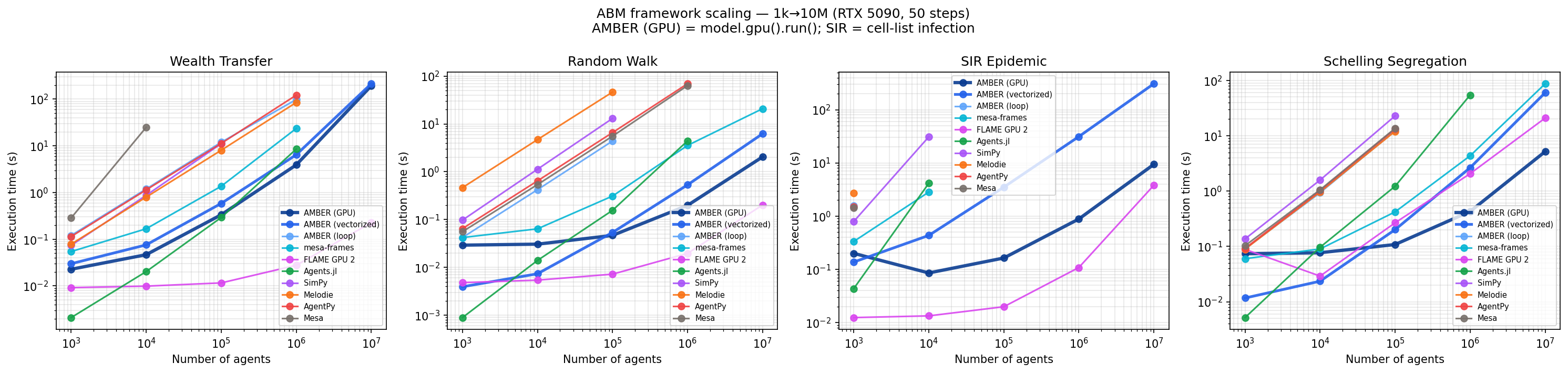
Protocol: NVIDIA RTX 5090; 10M agents; 50 steps; 10 runs retained (no outlier deletion); one untimed warm-up per cell; timed scope = construct + setup + step loop + result assembly. AMBER GPU synchronizes after the run; FLAME GPU 2 returns at a simulation-complete boundary. This is an implementation comparison under that protocol — not a claim of byte-identical dynamics across frameworks.
AMBER (GPU) vs FLAME GPU 2 at 10M agents (mean wall-clock):
| Model | AMBER (GPU) | FLAME GPU 2 | Speedup (FLAME / AMBER) |
|---|---|---|---|
| Wealth | 94 ms | 194 ms | ~2.05× |
| Random walk | 80 ms | 161 ms | ~2.00× |
| SIR (cell-list) | 2.08 s | 3.68 s | ~1.77× |
| Schelling | 295 ms | 18.7 s | ~63× (setup-inclusive; exploratory) |
- Wealth / walk / SIR are the comparable headline class (~1.8–2.1×).
- Schelling includes heavy Python-side setup inside the timed region for the FLAME harness; do not treat ~63× as a pure step-kernel speedup.
- Multi-framework scale-out charts (Mesa, mesa-frames, Agents.jl, …) are
exploratory and live under
benchmarks/results/; some cells OOM or hit budgets — missing cells are not zeros. - Reproducer:
benchmarks/run_all_frameworks.py.
Correctness gates:benchmarks/correctness_check.py.
Details:benchmarks/README.md.
API: implement step_vectorized() (or legacy step()); place with
.cpu(mode="vectorized") or .gpu(). GPU is vectorized-only. Private
optimized GPU loops require an explicit
approve_fast_path(evidence) label (caller-attested provenance; AMBER
checks presence of the label, not the evidence content) and
contract="off" — see docs/going_faster.rst.
Default CI has no CUDA. Optional GPU claims workflow
(.github/workflows/gpu-nightly.yml) runs scripts/run_gpu_claims.py --quick
only when GPU_RUNNER names a self-hosted CUDA runner. If that variable is
unset the job is skipped — that is not a CUDA pass. 0.5.0 GPU claims
were verified locally on an NVIDIA RTX 3090, not by GitHub Actions.
🚀 Quick Start
AMBER supports an AgentPy-shaped OOP lane and a vectorized lane on the same model. Start with whichever feels natural.
AgentPy-shaped (method broadcast, AgentList):
import ambr as am

class WealthAgent(am.Agent):
    def setup(self):
        self.wealth = 1
    def transfer(self):
        if self.wealth > 0:
            other = self.model.agents.by_id(self.model.agents.random())
            other.wealth += 1
            self.wealth -= 1

class WealthModel(am.Model):
    def setup(self):
        self.agents = am.AgentList(self, self.p.n, WealthAgent)
    def step_oop(self):
        # Explicit OOP lane (default mode is vectorized)
        self.agents.transfer()
    def update(self):
        self.record_model('total', int(self.agents.wealth.sum()))

results = WealthModel({'n': 50, 'steps': 20, 'seed': 1}).cpu(mode="oop").run()
print(results.model.tail(3).to_dicts())      # also results['model']
print(results.agents.head().to_dicts())
print(results.info.get("mode"), results.info.get("execution_lane"))
Vectorized (columnar; best at large N):
import ambr as am

class WealthModel(am.Model):
    model_reporters = {'total_wealth': lambda m: int(m.agents.wealth.sum())}

    def setup(self):
        self.add_agents(100, wealth=self.rng.integers(1, 10, size=100))

    def step_vectorized(self):
        # View API: where / column assign / scatter_add (not agents.array mutate).
        # agents.array(...) returns a read-only snapshot on the CPU Polars path.
        donors = self.agents.where(self.agents.wealth > 0)
        donors.wealth -= 1
        recipients = self.rng.choice(self.agents.ids.to_numpy(), size=len(donors))
        self.agents.at[recipients].scatter_add(wealth=1)

# Fluent placement: device + optional mode; run(mode=...) still overrides.
# GPU when NVIDIA+CuPy available; otherwise CPU vectorized.
_m = WealthModel({'steps': 100, 'seed': 42, 'show_progress': False})
results = _m.gpu().run() if am.GPU_AVAILABLE else _m.cpu(mode="vectorized").run()
print(results.info)
print(results.model.tail(5).to_dicts())
print(results.agents.head(10).to_dicts())
Coming from AgentPy? See docs/from_agentpy.rst.
Going faster / GPU — same Model class; pick placement and lane hooks (see
docs/going_faster.rst):
import ambr as am
am.print_status()                 # GPU? which lane?
print(am.recommend(1_000_000))  # one-line suggestion

# Same view-API model shape as the vectorized quickstart above
class WealthModel(am.Model):
    def setup(self):
        n = int(self.p.get("n", 100_000))
        self.add_agents(n, wealth=1)
    def step_vectorized(self):
        donors = self.agents.where(self.agents.wealth > 0)
        donors.wealth -= 1
        self.agents.at[
            self.rng.choice(self.agents.ids.to_numpy(), size=len(donors))
        ].scatter_add(wealth=1)

# Native path: step_vectorized + .gpu() when NVIDIA+CuPy are available
model = WealthModel({"n": 100_000, "steps": 50, "seed": 0, "show_progress": False})
if am.GPU_AVAILABLE:
    results = model.gpu().run()
else:
    results = model.cpu(mode="vectorized").run()  # Mac / no-CUDA fallback
print(results.info)

# Array-kernel lane (CuPy if available, else NumPy) for pure array state:
class Drift(am.ArrayKernelModel):
    def init_state(self, xp, n, rng, p):
        return {"x": rng.random(n, dtype=xp.float32)}
    def step_state(self, xp, state, rng, p):
        state["x"] = state["x"] + 0.01
        return state
    def metrics(self, xp, state):
        return {"mean_x": float(am.to_host(state["x"].mean()))}

print(Drift({"n": 100_000, "steps": 20, "show_progress": False}).run().info)
self.rng is the canonical seeded RNG (a NumPy Generator); self.random is
the stdlib one. Both are seeded from the seed parameter. Progress printing is
off by default (show_progress=True to re-enable).
New in 0.5.0: production-candidate. Breaking / install: matplotlib moved to
ambr[viz]; scikit-optimize was removed and replaced by SMAC underambr[advanced](SMAC + ConfigSpace + scikit-learn). Python 3.10–3.13 only. API:record_modelinsidestep()is kept; missing optimization metrics raise; SMAC defaults toon_error='raise';RunResults.saveuses a versioned manifest. Upgrade withpip install -U 'ambr>=0.5.0'. Full list: CHANGELOG.md.0.4.7: GPU claim script renamed to
scripts/run_gpu_claims.py; paper-campaign machine labels removed from user-facing docs.
⚡ Vectorized View API
The view API compiles per-step updates to a handful of Polars expressions — regardless of population size:
def step(self):
    # Bulk columnar reads/writes over the entire population
    self.agents.x = self.agents.x + self.rng.uniform(-1, 1, len(self.agents))

    # Filtered writes: only agents matching a condition
    infected = self.agents.where(self.agents.status == 1)
    infected.infection_time += 1

    # scatter_add: flow-of-resources with duplicate-id safety
    self.agents.at[[1, 1, 3]].scatter_add(wealth=1)  # agent 1 gets +2, agent 3 gets +1
Canonical API (0.5)
AMBER 0.5 settles on one obvious verb per task. The legacy spellings still work
(they emit a DeprecationWarning and are scheduled for removal in 1.0); set
AMBER_SUPPRESS_DEPRECATIONS=1 to silence them in benchmark / reproducibility runs.
Batch performance comes from these verbs (columnar writes), not from extra public
batch_* helpers.
| Task | Canonical | Legacy (deprecated → 1.0) |
|---|---|---|
| NumPy RNG | self.rng |
self.nprandom |
| Device / run mode | model.cpu(mode=...).run() / model.gpu().run() |
run(backend=...) |
| Record a model metric | model_reporters = {...} or record_model(k, v) |
record(k, v) |
| Filter agents | agents.where(expr) / agents[mask] / agents.at[ids] |
agents.select(...) |
| Per-agent write | agent.col = v |
agent.record(...), agent.update_data(...), update_agent_data |
| Bulk / multi-column write | agents.set(**cols) or view.col = … |
agents.record / update_data, batch_update_agents, Population.batch_* |
| Accumulate (duplicate ids) | agents.at[ids].scatter_add(...) |
double ordinary writes in one step |
| Array kernels | agents.borrow / agents.commit (or TensorLane) |
hand-maintained parallel NumPy buffers |
| Read agent objects | iterate model.agents, agents.by_id(i) |
agents.agents, agents.agent_ids |
| Bulk numpy round-trip | agents.numpy(...) + agents.set(...) |
.to_numpy() + per-column assign only |
| Typed parameters | params = {'n': (int, 200)}, then self.p.n |
int(self.p.get('n', 200)) |
| Grid wrap | GridEnvironment(torus=True) |
wrap= / .wrap |
| Agent table assign | view / _set_frame |
population.data = ... (setter warns) |
update() is a pure hook — overriding it no longer requires
super().update(). Declare model_reporters / agent_reporters for
declarative metrics, and set record_initial = True to capture a t=0 row.
🔒 Snapshot-view contract
What this is: an operational runtime monitor at instrumented read/write seams (OOP buffer vs view/lane, mutable borrows, cross-path writes).
What this is not: a proof that a vectorized or GPU rewrite preserves an
intended activation schedule, confluence, or bit-identical trajectories vs an
OOP loop. cert.clean means no monitored hazard was observed, not that every
possible ordering is equivalent.
Whether a vectorized refactor preserves an intended update schedule remains a semantic question for the modeller. Run with a contract mode and inspect the per-step records:
import ambr as am

class WealthModel(am.Model):
    def setup(self):
        self.add_agents(50, wealth=1)
    def step_vectorized(self):
        donors = self.agents.where(self.agents.wealth > 0)
        donors.wealth -= 1
        self.agents.at[self.rng.choice(self.agents.ids.to_numpy(), size=len(donors))].scatter_add(wealth=1)

model = WealthModel({"steps": 20, "seed": 0, "show_progress": False})
results = model.run(steps=20, contract="check")   # "off" | "check" | "warn" | "raise"
for cert in results["contract"]:
    if not cert.ok:
        print(cert.step, cert.violations)
check records a ContractCertificate per step; warn also emits a warning per
violation; raise stops on the first error. Mode off (default) adds no monitor
bookkeeping. cert.clean means that no monitored error or warning was observed,
not that every possible activation order is equivalent.
The monitor watches two write paths (and combinations):
- Buffered (OOP) —
agent.col = …/ queued cell writes - Lane / view —
agents.col = …,agents.set(...),borrow/commit - Cross-path — same column via both OOP and view in one step →
cross_path_write - Mutable raw arrays —
agents.array(...)→uncertified_mutable_borrow
scatter_add is the sanctioned multi-write reducer (not treated as a conflicting
ordinary commit). Prefer those APIs over assigning population.data directly.
🎮 GPU backend & batched calibration
Single-run (native): place a vectorized model on device with
model.gpu().run() when NVIDIA+CuPy are available. Prefer step_vectorized()
(legacy step() still works).
Numeric columns stay device-resident for the run. Contract modes use the
instrumented general path; private model-specific fast loops run only with
contract="off" and an explicit per-instance
approve_fast_path(evidence) declaration. The evidence string is a
caller-supplied provenance label, not something AMBER verifies. Without it,
gpu().run() uses the general path. Private loops are not covered by the
monitor. OOP agents use cpu(mode="oop") — not GPU.
import ambr as am

class WealthModel(am.Model):
    def setup(self):
        n = int(self.p.get("n", 1_000_000))
        self.add_agents(n, wealth=1)
    def step_vectorized(self):
        donors = self.agents.where(self.agents.wealth > 0)
        donors.wealth -= 1
        self.agents.at[
            self.rng.choice(self.agents.ids.to_numpy(), size=len(donors))
        ].scatter_add(wealth=1)

# Requires NVIDIA + CuPy. On CPU-only machines use .cpu(mode="vectorized").
model = WealthModel({"n": 1_000_000, "steps": 50, "seed": 0, "show_progress": False})
results = model.gpu().run() if am.GPU_AVAILABLE else model.cpu(mode="vectorized").run()
print(results.info)
# Private fast loop (only if the model defines one; evidence is not verified):
# model.approve_fast_path("my-bench-label").gpu().run(contract="off")
Many short runs (calibration): the ensemble axis (B simulations × N
agents) batches into one device pass — the natural fit when you evaluate
thousands of small replicate runs:
import numpy as np
import ambr as am
from ambr.gpu_ensemble import GPUEnsembleRunner, BatchedWellMixedSIR

# Needs NVIDIA + CuPy. B parameter sets in one (B, N) GPU pass.
B = 4
betas = np.full(B, 0.3)
gammas = np.full(B, 0.1)
i0 = np.full(B, 0.01)
runner = GPUEnsembleRunner(BatchedWellMixedSIR())
if am.GPU_AVAILABLE:
    traj = runner.run(
        n_agents=10_000, steps=30,
        params={"beta": betas, "gamma": gammas, "i0_frac": i0},
    )  # -> {metric: (B, steps)}
    print({k: v.shape for k, v in traj.items()})
else:
    print("GPU ensemble requires NVIDIA + CuPy; skip on this host")
# Optional SMAC loop: smac_batch_calibrate(BatchedWellMixedSIR(), bounds, loss_fn, ...)
# (needs pip install 'ambr[advanced]')
ambr.gpu provides the array-module abstraction (get_array_module, to_device,
to_host) and falls back to NumPy when CuPy is unavailable. Requires NVIDIA
GPU + CuPy (not Apple Metal/MPS).
🔬 Optimization
AMBER includes powerful optimization capabilities for parameter tuning:
import ambr as am
from ambr.optimization import ParameterSpace, grid_search

class MyModel(am.Model):
    def setup(self):
        n = int(self.p.get("agents", 50))
        self.add_agents(n, wealth=int(self.p.get("initial_value", 1)))
    def step_vectorized(self):
        donors = self.agents.where(self.agents.wealth > 0)
        donors.wealth -= 1
        self.agents.at[
            self.rng.choice(self.agents.ids.to_numpy(), size=len(donors))
        ].scatter_add(wealth=1)
    def update(self):
        self.record_model("total_wealth", int(self.agents.wealth.sum()))

parameter_space = ParameterSpace({
    "agents": [20, 40],
    "initial_value": [1, 5],
    "steps": 10,
    "seed": 0,
    "show_progress": False,
})
results = grid_search(MyModel, parameter_space, metric="total_wealth", minimize=False)
best_params = results[0]["parameters"]
print(best_params, results[0]["objective"])
Beyond grid_search, AMBER ships random_search, bayesian_optimization
(SMAC RandomForest surrogate; GP is unsupported), and SMACOptimizer
(same RandomForest stack) — plus the GPU batched ensemble above for
derivative-free calibration at scale.
📦 Installation
pip install ambr

# Optional extras
pip install 'ambr[perf]'              # Numba CPU scatter (recommended on Mac)
pip install 'ambr[gpu]'               # NVIDIA + CuPy (not Metal/MPS)
pip install 'ambr[viz]'               # matplotlib plot helpers
pip install 'ambr[advanced]'          # SMAC optimization
pip install 'ambr[advanced,viz]'      # SMAC + matplotlib (example plots)
import ambr as am
print(am.__version__)   # 0.5.0+
am.print_status()
🏗️ Features
- Simple API: AgentPy-shaped OOP lane + vectorized columnar views on one model
- High Performance: Polars DataFrames; optional Numba (
ambr[perf]) for scatters - Device placement: Keras-style
model.cpu(mode=...)/model.gpu()withstep_vectorized/step_oophooks (GPU is vectorized-only) - Speed lanes:
am.print_status()/am.recommend(n)/ArrayKernelModel - Snapshot-view monitor: operational diagnostics for observed write/borrow conflicts and uncertified mutable arrays (not a schedule proof)
- GPU backend: native vectorized path + optional approved private loops + CuPy helpers + batched ensemble for calibration
- Optimization: grid / random / Bayesian (SMAC) search, plus GPU-batched calibration
- Declarative reporting:
model_reporters/agent_reportersand a typedparamsschema - Environments: Support for grid, network, and continuous space environments
- OOP activation: optional
activate_agents("random"|"sequential"|"simultaneous")(not a schedule proof) - Plot helpers:
plot_timeseries/plot_gridfrom RunResults (ambr[viz]alias) - Experiments: Run multiple simulations with parameter sampling
- Random Number Generation: Reproducible simulations with controlled randomness
- RunResults:
results.agentsandresults['agents']both work
📚 Examples
Working examples are available in the examples/ directory:
- Schelling (grid) —
examples/schelling_vectorized.py(canonical occupancy helpers) - Wealth Transfer — economic inequality / dual-lane quickstart
- Virus Spread — epidemiological SIR model
- Flocking — Boids + optional tensor-lane variant
- Forest Fire — cellular automata fire spread
- GPU quickstart —
model.gpu().run()on a view-API model, orArrayKernelModel - Ensemble / SMAC smoke —
examples/smac_batch_sir_smoke.py(SMAC needsambr[advanced]) - SMAC calibration — basic / advanced Schelling multi-objective
📖 Documentation
- Docs: https://ambr.readthedocs.io/
- Paper: https://arxiv.org/abs/2601.16292 — package vs paper claims: docs/paper_and_package.rst
- Going faster (lanes / Numba / GPU): docs/going_faster.rst
- Environments & Schelling: docs/environments_schelling.rst
- From AgentPy: docs/from_agentpy.rst
- Deprecations (→ 1.0): docs/deprecations.rst
- Versioning / 1.0 roadmap: docs/versioning.rst, docs/roadmap_1_0.rst
- Public API surface: docs/public_api.rst
- Changelog: CHANGELOG.md
📝 How to cite?
If you use AMBER in academic work, please cite the paper:
@article{pham2026amber,
  title={AMBER: A Columnar Architecture for High-Performance Agent-Based Modeling in Python},
  author={Pham, Anh-Duy},
  journal={arXiv preprint arXiv:2601.16292},
  year={2026}
}
Paper: https://arxiv.org/abs/2601.16292
For the software, this repository also ships CITATION.cff
(GitHub “Cite this repository”). Manuscript drafts and build artifacts are
not kept in the library tree — only the public paper citation and software
metadata.
🤝 Contributing
We welcome contributions! See docs/contributing.rst (or the Contributing page on Read the Docs).
📄 License
This project is licensed under the BSD 3-Clause License - see the LICENSE file for details.
1 maintainer

Release files for ambr 0.5.1
For a detailed explanation of source distributions (sdists) and built distributions (wheels), please see the package formats documentation.
Source distribution (sdist)
| File | Size | Uploaded | |
|---|---|---|---|
| ambr-0.5.1.tar.gz | 123.7 kB | Details |
Built distribution (wheel)
| File | Interpreter | ABI | Platform | Reset |
|---|---|---|---|---|
| ambr-0.5.1-py3-none-any.whl | Python 3 | none | any | Details |
Total release size: 247.7 kB
Release files / ambr-0.5.1.tar.gz
| Download URL | ambr-0.5.1.tar.gz |
|---|---|
| Size | 123.7 kB |
| Tags | Source |
|
SHA-256 checksum How to use checksums |
e647922a0760e390fcde56c80a7100c002235748c7236b70a11c118f66626d7e
|
|
BLAKE2b-256 checksum How to use checksums |
bbeca380fc698e08434c18617f754d53757ffdeb03c8f62cc6dff726e6ddb2b2
|
| Upload date | |
|
Uploaded using Trusted Publishing? What is trusted publishing? |
Yes |
| Uploaded via |
twine/7.0.0 CPython/3.13.14
|
Provenance
Provenance describes where a file came from. On PyPI, provenance is shared via attestations, which provide a verifiable record of the build or publishing details. View details, limitations and caveats.


PyPI Publish Attestation
PyPI verified that this artifact, at this checksum, originated from the publisher listed below.
Signed by GitHub Actions, verified by PyPI on Aug 14, 2026.
Transparency logRelease files / ambr-0.5.1-py3-none-any.whl
| Download URL | ambr-0.5.1-py3-none-any.whl |
|---|---|
| Size | 124.0 kB |
| Tags | Python 3 |
|
SHA-256 checksum How to use checksums |
4eef017e37c3a45d4ab3833cab1b1fc5b8716c53715864c0991a372515d8d99a
|
|
BLAKE2b-256 checksum How to use checksums |
c7f71c718bc5b26e931ca9aa2aa802bc7e88d49e6585e0fef20d90fe67dd67cc
|
| Upload date | |
|
Uploaded using Trusted Publishing? What is trusted publishing? |
Yes |
| Uploaded via |
twine/7.0.0 CPython/3.13.14
|
Provenance
Provenance describes where a file came from. On PyPI, provenance is shared via attestations, which provide a verifiable record of the build or publishing details. View details, limitations and caveats.
PyPI Publish Attestation
PyPI verified that this artifact, at this checksum, originated from the publisher listed below.
Signed by GitHub Actions, verified by PyPI on Aug 14, 2026.
Transparency log













