
This release is a pre-release and may not be stable for production use.





Documentation | Installation | Quickstart | API reference
News
- [2026/10] 🔥 MoRI UMBP Empowers AMD Instinct™ MI355X GPU to Demonstrate Token-per-Dollar TCO Leadership on the Public AgentX Leaderboard (blog).
- [2026/07] 🔥 MORI powers Kimi's agentic AI serving solution with UMBP, co-designed by AMD and Moonshot AI for AMD Instinct™ GPUs (blog).
- [2026/05] 🔥 MORI powers SGLang on AMD Instinct™ MI355X achieves competitive TCO for large-scale DeepSeek disaggregated inference (blog).
- [2026/05] 🔥 MORI becomes the primary EP communication library for AMD platforms in Alibaba RTP-LLM (MORI-EP PR).
- [2026/05] MORI's SDMA-based AllGather collective is integrated into DeepSpeed for ZeRO-3 optimization on AMD GPUs, delivering up to 10% end-to-end training speedup by offloading AllGather traffic to dedicated SDMA copy engines (example, post).
- [2026/04] 🔥 Tencent OpenUCL adopts the Mori ecosystem, using Mori's EP-style dispatch/combine pattern in AMD GPU deployments and leveraging MORI-SHMEM for GPU-initiated communication.
- [2026/03] 🔥 MORI-SHMEM powers ByteDance Triton-distributed EP dispatch/combine kernels as the backend, delivering seamless integration and high performance on AMD GPUs (EP Kernels, MORI-SHMEM Integration).
- [2026/02] 🔥 MORI powers AMD's WideEP and PD disaggregation in SemiAnalysis InferenceX v2 benchmark (PR, InferenceX, blog).
- [2026/01] 🔥 MORI-EP and MORI-IO integrated into SGLang and vLLM for MoE Expert Parallelism and PD Disaggregation on AMD GPUs (sglang & MORI-EP, sglang & MORI-IO, vllm & MORI-EP, vllm & MORI-IO).
- [2025/12] MORI adds support for AMD's AINIC (Pollara) with SOTA performance (AINIC & MORI-EP, AINIC & MORI-IO).
- [2025/09] MORI-EP now seamlessly scales to 64 GPUs with SOTA performance (multiple optimizations, multi-QP support, low-latency kernel).
- [2025/09] MORI adds Broadcom BNXT (Thor2) IBGDA support (PR).
Introduction
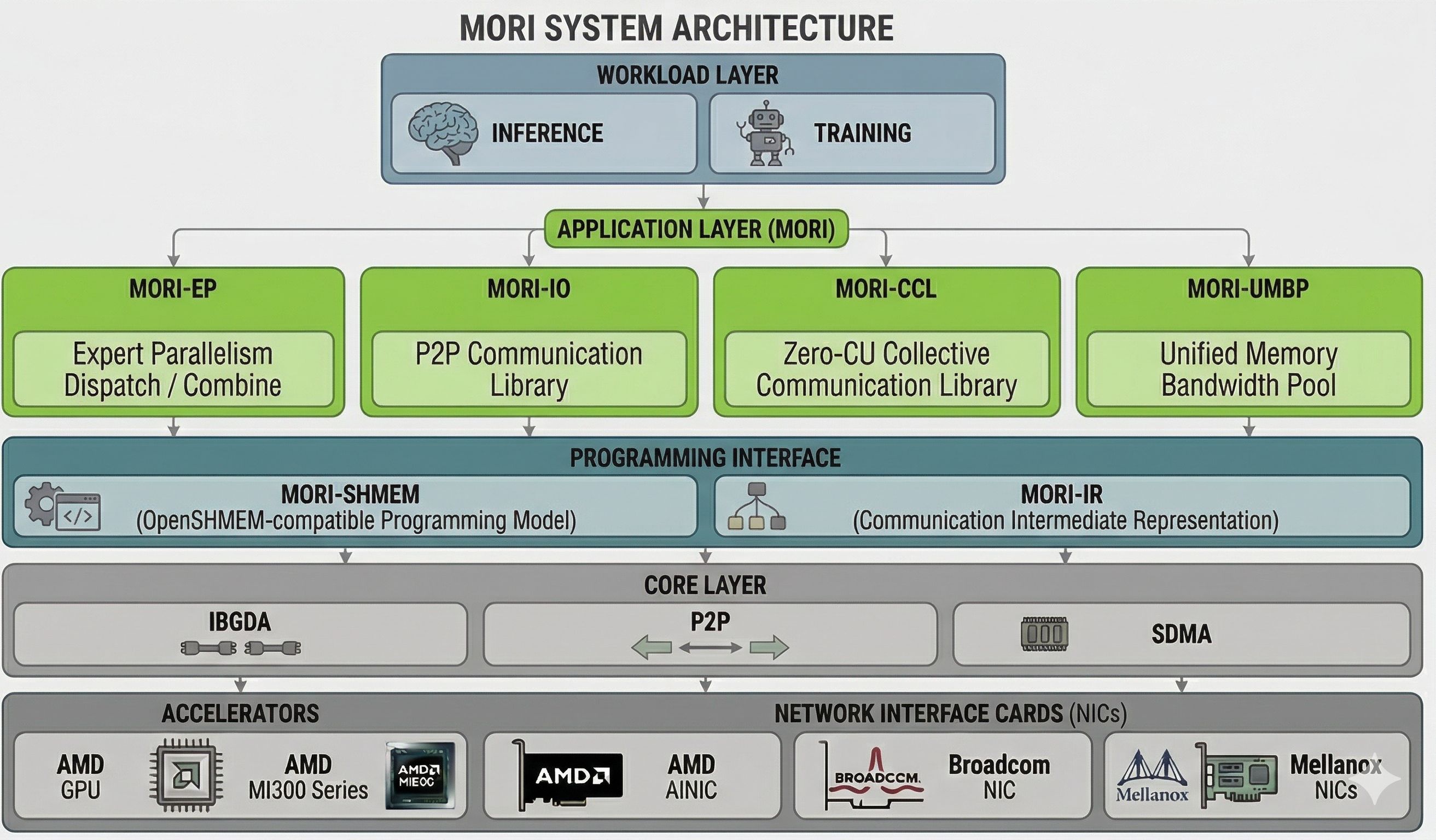
MORI (Modular RDMA Interface) is a bottom-up, modular, and composable framework for building high-performance communication applications with a strong focus on RDMA + GPU integration. Inspired by the role of MLIR in compiler infrastructure, MORI provides reusable and extensible building blocks that make it easier for developers to adopt advanced techniques such as IBGDA (Infiniband GPUDirect Async) and GDS (GPUDirect Storage).
To help developers get started quickly, MORI also includes a suite of optimized libraries—MORI-EP (MoE dispatch & combine kernels, in two generations: EPv1 on MORI-SHMEM and EPv2 on MORI-CCO), MORI-IO (p2p communication for KVCache transfer), MORI-CCL (collective communication), MORI-CCO (Next-Generation Collective Communication Object for GPUs) and MORI-FUSED (GEMMs fused with collectives, built on MORI-CCO)—that deliver out-of-the-box performance, with support for AMD Pensando DSC, Broadcom Thor2, and NVIDIA Mellanox ConnectX-7 NICs.
Features summary
- Applications
- MORI-EP: intra and inter-node dispatch/combine kernels with SOTA performance. Two generations:
- EPv1: built on MORI-SHMEM.
- EPv2: built on MORI-CCO. Designed natively for gfx1250 and rack-scale EP.
- MORI-FUSED: GEMMs fused with the all-reduce, reduce-scatter, all-to-all or all-gather next to them, overlapping the transfer with the GEMM over the SDMA copy engines
- MORI-IO: point-to-point communication library with ultra-low overhead
- MORI-CCL: lightweight and flexible collective communication library designed for highly customized use cases such as latency-sensitive or resource-constrained environment
- MORI-UMBP: unified memory & bandwidth pool with tiered storage and distributed key-value access for scalable memory management
- MORI-CCO: Next-Generation Collective Communication Object for GPUs. Natively designed for compute-communication fusion, with symmetric memory support.
- MORI-EP: intra and inter-node dispatch/combine kernels with SOTA performance. Two generations:
- Framework
- High-performance building blocks for IBGDA / P2P and more
- Modular & composable components for developing communication applications, such as transport management, topology detection and etc.
- Open-Shmem-style APIs
- C++ and Python level APIs
Documentation
📖 https://rocm.github.io/mori/ — the full documentation, with navigation and search.
It is built from docs/ on every push to
main, so it describes the development tree; each page's title names the commit.
| Topic | Description | Docs |
|---|---|---|
| Getting started | Installation, fabric checks and first steps | Installation · Quickstart |
| MORI-EP (EPv1, EPv2) | EPv1 (built on SHMEM) and EPv2 (built on CCO) dispatch/combine: API, kernel types and backends, configuration, usage examples, how to choose | EP Guide · Benchmark · RDMA bandwidth |
| MORI-FUSED | GEMMs fused with the all-reduce, reduce-scatter, all-to-all or all-gather next to them, built on MORI-CCO | Guide |
| MORI-CCO | Next-generation collective communication object: communicator, symmetric-memory windows, LSA / GDA / SDMA device APIs | CCO Guide |
| MORI-IO | P2P communication concepts, engine/backend/session design | IO Guide · Benchmark |
| MORI-UMBP | Unified memory & bandwidth pool: tiered storage, distributed KV access, transfer simulation | Single-Node Smoke Test · Simulation · Calibration · PD Benchmark · Tier-Management Benchmark |
| MORI-VIZ | Warp-level kernel profiler with Perfetto integration | Profiler |
Benchmarks
MORI-EP
Benchmark on DeepSeek V3 model configurations:
Bandwidth (4096 tokens, 7168 hidden, top-8 experts, FP8 dispatch + BF16 combine)
| Hardware | Kernels | Dispatch XGMI | Dispatch RDMA | Combine XGMI | Combine RDMA |
|---|---|---|---|---|---|
| MI300X + CX7 | EP8 | 307 GB/s | x | 330 GB/s | x |
| EP16-V1 | 171 GB/s | 52 GB/s | 219 GB/s | 67 GB/s | |
| EP32-V1 | 103 GB/s* | 57 GB/s* | 91 GB/s* | 50 GB/s* | |
| MI355X + AINIC | EP8 | 345 GB/s | x | 420 GB/s | x |
| EP16-V1 | 179 GB/s | 54 GB/s | 234 GB/s | 71 GB/s | |
| EP32-V1 | 85 GB/s | 46 GB/s | 110 GB/s | 61 GB/s |
Latency (128 tokens, 7168 hidden, top-8 experts, FP8 dispatch + BF16 combine)
| Hardware | Kernels | Dispatch Latency | Dispatch BW | Combine Latency | Combine BW |
|---|---|---|---|---|---|
| MI300X + CX7 | EP8 | 35 us | 134 GB/s | 47 us | 204 GB/s |
| EP16-V1-LL | 76 us | 96 GB/s | 122 us | 121 GB/s | |
| EP32-V1-LL | 157 us* | 48 GB/s* | 280 us* | 55 GB/s* | |
| MI355X + AINIC | EP8 | 31 us | 142 GB/s | 36 us | 276 GB/s |
| EP16-V1-LL | 84 us | 87 GB/s | 108 us | 139 GB/s | |
| EP32-V1-LL | 152 us | 45 GB/s | 187 us | 76 GB/s |
* Stale data from previous kernel version; updated numbers pending re-benchmarking.
MORI-FUSED
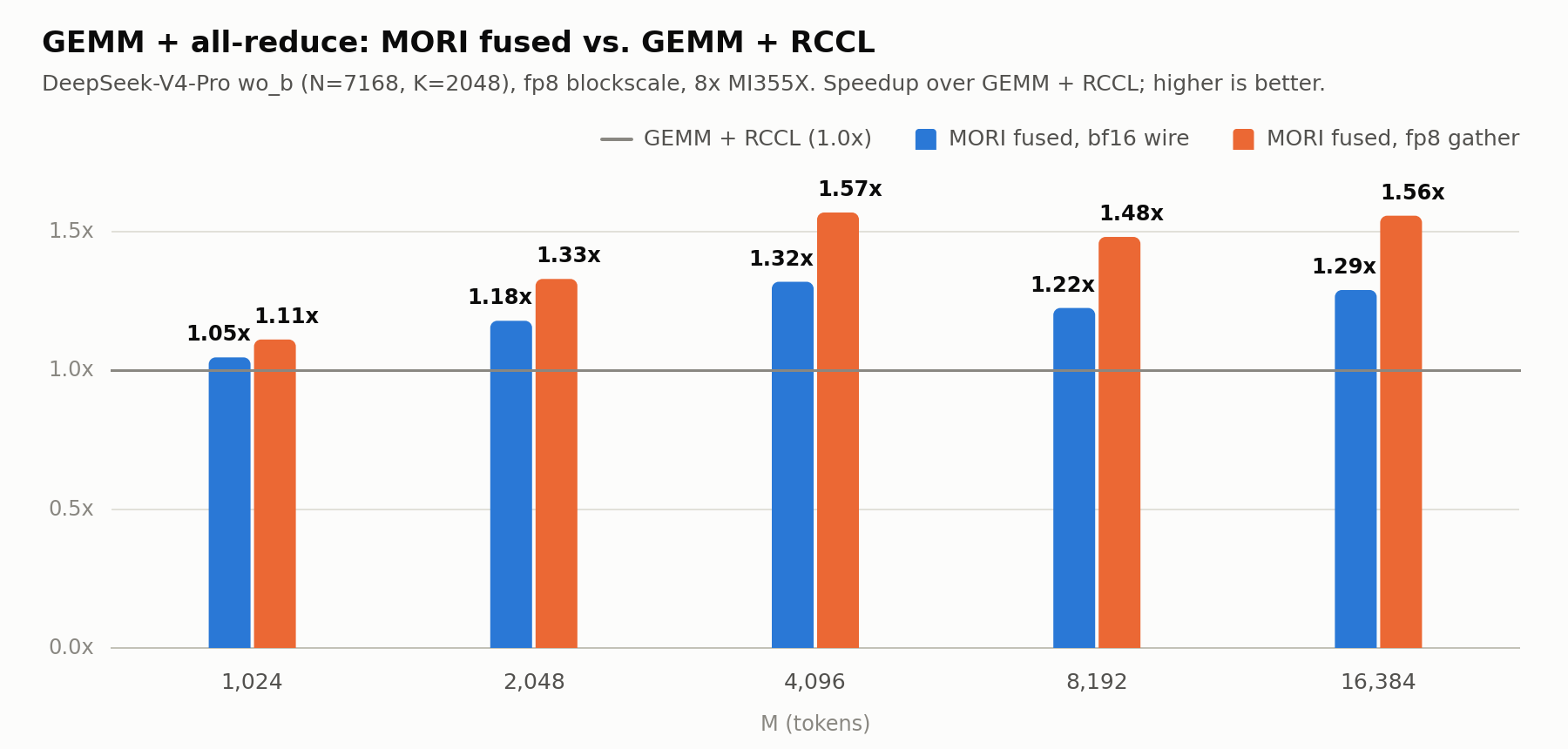
MORI-FUSED overlaps a collective with the GEMM next to it over the SDMA copy engines. The chart
compares GEMM + all-reduce (GemmAllReduceOp) with what a serving stack runs when nothing is fused:
the GEMM, then an RCCL all-reduce. The layer is DeepSeek-V4-Pro wo_b ([M, 7168], K=2048, fp8
blockscale) at TP8 on 8x MI355X.
Time per call (µs)
| M | GEMM + RCCL | MORI fused, bf16 wire | MORI fused, fp8 gather |
|---|---|---|---|
| 1,024 | 135.9 | 129.9 (1.05x) | 122.4 (1.11x) |
| 2,048 | 234.4 | 199.0 (1.18x) | 176.4 (1.33x) |
| 4,096 | 440.1 | 333.8 (1.32x) | 280.7 (1.57x) |
| 8,192 | 736.2 | 601.4 (1.22x) | 497.4 (1.48x) |
| 16,384 | 1454.1 | 1128.3 (1.29x) | 934.3 (1.56x) |
The other fused operators (GEMM + reduce-scatter, GEMM + all-to-all, GEMM + all-gather, all-gather + GEMM and all-to-all + GEMM) are measured in the MORI-FUSED guide.
MORI-IO
NOTE: This is the preview version of MORI-IO benchmark performance.
GPU Direct RDMA READ, pairwise, 128 consecutive transfers, 1 GPU, MI300X + Thor2:
+--------------------------------------------------------------------------------------------------------+
|                                            Initiator Rank 0                                            |
+-------------+-----------+----------------+---------------+---------------+--------------+--------------+
| MsgSize (B) | BatchSize | TotalSize (MB) | Max BW (GB/s) | Avg Bw (GB/s) | Min Lat (us) | Avg Lat (us) |
+-------------+-----------+----------------+---------------+---------------+--------------+--------------+
|      8      |    128    |      0.00      |      0.03     |      0.03     |    33.38     |    36.33     |
|      16     |    128    |      0.00      |      0.06     |      0.06     |    34.09     |    36.35     |
|      32     |    128    |      0.00      |      0.12     |      0.11     |    34.57     |    36.33     |
|      64     |    128    |      0.01      |      0.24     |      0.23     |    33.62     |    36.33     |
|     128     |    128    |      0.02      |      0.49     |      0.45     |    33.62     |    36.49     |
|     256     |    128    |      0.03      |      0.94     |      0.89     |    34.81     |    36.99     |
|     512     |    128    |      0.07      |      1.86     |      1.77     |    35.29     |    37.01     |
|     1024    |    128    |      0.13      |      3.84     |      3.53     |    34.09     |    37.09     |
|     2048    |    128    |      0.26      |      7.33     |      6.96     |    35.76     |    37.65     |
|     4096    |    128    |      0.52      |     12.94     |     12.46     |    40.53     |    42.09     |
|     8192    |    128    |      1.05      |     20.75     |     20.12     |    50.54     |    52.11     |
|    16384    |    128    |      2.10      |     29.03     |     28.33     |    72.24     |    74.02     |
|    32768    |    128    |      4.19      |     36.50     |     35.91     |    114.92    |    116.81    |
|    65536    |    128    |      8.39      |     41.74     |     41.39     |    200.99    |    202.70    |
|    131072   |    128    |     16.78      |     45.14     |     44.85     |    371.69    |    374.10    |
|    262144   |    128    |     33.55      |     46.93     |     46.76     |    715.02    |    717.56    |
|    524288   |    128    |     67.11      |     47.94     |     47.81     |   1399.99    |   1403.64    |
|   1048576   |    128    |     134.22     |     48.44     |     48.32     |   2770.90    |   2777.76    |
+-------------+-----------+----------------+---------------+---------------+--------------+--------------+
Hardware Support Matrix
GPU
| MORI-EP | MORI-IO | MORI-SHMEM | MORI-CCO | |
|---|---|---|---|---|
| MI308X | ✅ | ✅ | ✅ | ✅ |
| MI300X | ✅ | ✅ | ✅ | ✅ |
| MI325X | ✅ | ✅ | ✅ | ✅ |
| MI355X | ✅ | ✅ | ✅ | ✅ |
| MI450X | 🚧 | 🚧 | 🚧 | 🚧 |
NIC
| MORI-EP | MORI-IO | MORI-SHMEM | MORI-CCO | |
|---|---|---|---|---|
| Pollara | ✅ | ✅ | ✅ | ✅ |
| CX7 | ✅ | ✅ | ✅ | ✅ |
| Thor2 | ✅ | ✅ | ✅ | ✅ |
| Volcano | 🚧 | 🚧 | 🚧 | 🚧 |
✅ Supported 🚧 Under Development
Installation
Prerequisites
- ROCm >= 6.4 (hipcc needed at runtime for JIT kernel compilation, not at install time)
- On RHEL/Rocky/AlmaLinux also install
gcc-c++: that JIT needs the C++ standard headers, which ROCm's RPMs do not pull in. Without them every kernel compile fails withCould not find standard C++ header 'cmath'.
- On RHEL/Rocky/AlmaLinux also install
- System packages (required for
pip install; not bundled in wheels). On Debian/Ubuntu install at least:libibverbs-dev,ibverbs-utilsSee docker/Dockerfile.dev for the full apt list used in CI/dev images.
- Optional:
libopenmpi-dev,openmpi-bin— only needed when building C++ examples (BUILD_EXAMPLES=ON) or enabling MPI bootstrap (MORI_WITH_MPI=ON)
Or build docker image with:
cd mori && docker build -t rocm/mori:dev -f docker/Dockerfile.dev .
IBGDA NIC support (optional, for GPU-direct RDMA — auto-detected, no manual configuration needed):
| NIC | User library |
|---|---|
| AMD Pollara (AINIC) | libionic.so |
| Mellanox ConnectX | libmlx5.so (typically pre-installed) |
| Broadcom Thor2 | libbnxt_re.so |
Note: IBGDA requires vendor-specific DV (Direct Verbs) libraries. Mellanox
libmlx5is typically pre-installed with the kernel OFED stack. For Thor2 and Pollara, install the corresponding userspace library from your NIC vendor.
Recommended NIC firmware/driver versions (check with mori check or tools/env_check.sh):
| Vendor | Recommendation |
|---|---|
| AMD Pollara (AINIC) | >= 1.117.5-a-45 (1.117.1 major lacks IBGDA support); 1.117.5 builds after a-45 can mishandle retransmitted RDMA READs, see MORI-IO Known Issues |
| Broadcom (Thor2) | 237.1.137.x / 235.2.86.x; known bad: 231.x, 232.x |
| Mellanox (ConnectX, mlx5) | No known minimum; tested on ConnectX-7 |
Validate the environment
Before a cross-node run, check the fabric:
mori check <peer_ip> # or: tools/env_check.sh <peer_ip>
Seven steps — kernel PCI P2PDMA support (CONFIG_PCI_P2PDMA, read from /proc/kallsyms; warns only), NIC firmware and driver, QoS/PFC, DCQCN, then intra-node,
inter-node bandwidth and latency meshes over every NIC pair, on host memory and
on GPU memory. Exits non-zero if any check failed, and reports the fabric
topology, which decides what can run on it.
Install
MoRI can be installed in three ways: from PyPI (stable), nightly pre-built wheels (latest dev), or from source.
From PyPI (stable release)
pip install amd_mori
Nightly (pre-built, tested daily)
pip install --pre amd-mori-nightly
Deprecated: the GitHub Pages nightly index (
https://rocm.github.io/mori/nightly/) is being retired. Please install nightly builds from PyPI (amd-mori-nightly) as shown above.
Note:
amd-moriandamd-mori-nightlyboth provide themoriPython module. Do not install both at the same time — uninstall one before installing the other.
From source
git clone --recursive https://github.com/ROCm/mori.git
cd mori
pip install .
For a venv build, add --no-build-isolation — and install the build
dependencies first, because that flag is exactly what stops pip from reading
them out of pyproject.toml:
pip install -r requirements-build.txt
pip install . --no-build-isolation
Skipping the first line leaves the build without Cython, and it only warns
before dropping the mori.cco.cco extension, taking the flydsl EP backend with
it — on an install that otherwise reports success. python tools/verify_install.py checks for exactly that.
No hipcc needed at install time — host code compiles with a standard
C++ compiler. GPU kernels are JIT-compiled on first use and cached to
~/.mori/jit/. If a GPU is detected during install, kernel precompilation
starts automatically in the background.
To manually precompile all kernels (e.g. in a Docker image build):
MORI_PRECOMPILE=1 python -c "import mori"
Verify installation
python -c "import mori; print(mori.__version__)"
Testing
Test MORI-EP (dispatch / combine)
EPv2 (MORI-CCO)
cd /path/to/mori
export PYTHONPATH=/path/to/mori:$PYTHONPATH
python -c "import mori; print(mori.__file__)"

# Test correctness (8 GPUs, gfx942 or gfx950: on gfx125x the default HIP backend
# rejects some of the cases these run, such as scatter combine and StdMoE)
pytest tests/python/ops/dispatch_combine_v2/test_dispatch_combine_v2_intranode.py -q
torchrun --standalone --nproc_per_node=8 tests/python/ops/dispatch_combine_v2/test_ep_backend_parity.py

# Benchmark performance
torchrun --standalone --nproc_per_node=8 tests/python/ops/dispatch_combine_v2/bench_ep.py
Two-node runs and their restrictions: see the EP Guide.
EPv1 (MORI-SHMEM)
cd /path/to/mori
export PYTHONPATH=/path/to/mori:$PYTHONPATH
python -c "import mori; print(mori.__file__)"

# Test correctness (8 GPUs)
pytest tests/python/ops/test_dispatch_combine_intranode.py -q
pytest tests/python/ops/test_dispatch_combine_async_ll.py -q
pytest tests/python/ops/test_dispatch_combine_internode_v1.py -q

# Benchmark performance
python tests/python/ops/bench_dispatch_combine.py
Test MORI-IO
cd /path/to/mori
export PYTHONPATH=/path/to/mori:$PYTHONPATH

# Correctness tests
pytest tests/python/io/

# Benchmark performance (two nodes). The runner defaults to the native C++
# benchmark (tests/cpp/io/bench_engine); pass --engine python for the torchrun path.
tools/run_internode_io_benchmark.sh --rank 0 --master-addr "<master_ip>" --ifname ens14np0 \
  -- --op write --enable-batch-transfer --enable-sess --buffer-size 32768 --transfer-batch-size 128
# (run the same command on the second node with --rank 1)
See the MORI-IO benchmark guide for both engines and tuning.
Contribution Guide
Welcome to MORI! We appreciate your interest in contributing. Whether you're fixing bugs, adding features, improving documentation, or sharing feedback, your contributions help make MORI better for everyone.
Code Quality
MORI uses pre-commit hooks to maintain code quality. After cloning the repository:
pip install pre-commit
cd /path/to/mori
pre-commit install

# Run on all files (first time)
pre-commit run --all-files
Pre-commit automatically checks code formatting, linting, license headers, and other quality checks on commit. To skip checks when necessary: git commit --no-verify
1 maintainer

Metadata
1 maintainer
Release files for amd-mori-nightly 1.2.6.dev20261119
For a detailed explanation of source distributions (sdists) and built distributions (wheels), please see the package formats documentation.
Built distributions (wheels)
| File | Interpreter | ABI | Platform | Actions Reset |
|---|---|---|---|---|
| amd_mori_nightly-1.2.6.dev20261119-cp312-cp312-manylinux_2_28_x86_64.whl | CPython 3.12 | CPython 3.12 | Linux glibc 2.28+ x86-64 | Details for amd_mori_nightly-1.2.6.dev20261119-cp312-cp312-manylinux_2_28_x86_64.whl |
| amd_mori_nightly-1.2.6.dev20261119-cp310-cp310-manylinux_2_28_x86_64.whl | CPython 3.10 | CPython 3.10 | Linux glibc 2.28+ x86-64 | Details for amd_mori_nightly-1.2.6.dev20261119-cp310-cp310-manylinux_2_28_x86_64.whl |
Total release size: 34.6 MB
Release files / amd_mori_nightly-1.2.6.dev20261119-cp312-cp312-manylinux_2_28_x86_64.whl
| Download URL | amd_mori_nightly-1.2.6.dev20261119-cp312-cp312-manylinux_2_28_x86_64.whl |
|---|---|
| Size | 17.3 MB |
| Tags | CPython 3.12 Linux glibc 2.28+ x86-64 |
|
SHA-256 checksum How to use checksums |
a0d7e6af9180548d55f54919f5ec5606cc6fe60f090041b471d9d55a4610ef15
|
|
BLAKE2b-256 checksum How to use checksums |
b7cc99f71a7fdfb56d6fa4149fb61b7f325093514d93ecd128d327aefe162a3e
|
| Upload date | |
|
Uploaded using Trusted Publishing? What is trusted publishing? |
No |
| Uploaded via |
twine/7.0.0 CPython/3.14.4
|
Release files / amd_mori_nightly-1.2.6.dev20261119-cp310-cp310-manylinux_2_28_x86_64.whl
| Download URL | amd_mori_nightly-1.2.6.dev20261119-cp310-cp310-manylinux_2_28_x86_64.whl |
|---|---|
| Size | 17.2 MB |
| Tags | CPython 3.10 Linux glibc 2.28+ x86-64 |
|
SHA-256 checksum How to use checksums |
e443dd34eca917162e6b2ea3a4e85b52e459b45101421325b9eb69d3273e0323
|
|
BLAKE2b-256 checksum How to use checksums |
af2e0bf024c1eb2142c8e9deb94ff12ccd92f28189dd363290f0c74e74e1c080
|
| Upload date | |
|
Uploaded using Trusted Publishing? What is trusted publishing? |
No |
| Uploaded via |
twine/7.0.0 CPython/3.14.4
|
Security for amd-mori-nightly 1.2.6.dev20261119
Provenance
Provenance describes where a file came from. On PyPI, provenance is shared via attestations, which provide a verifiable record of the build or publishing details. View details, limitations and caveats.
No provenance found
None of the files in this release were uploaded with provenance metadata.
A note on package security
PyPI is a repository for distributing packages, not a service for auditing them. While third-party security researchers and our staff do their best to detect and remove malicious packages, PyPI cannot guarantee the quality, security or suitability of any given package.
To learn more about protecting yourself from malicious actors, visit our package security documentation.














