
AMP: The Agent Memory Protocol 🧠
The Open Standard for Agentic Memory.


The (Short) Story
I was tired of building AI agents that forgot everything the moment I closed the terminal.
RAG (Retrieval Augmented Generation) is great for documents, but terrible for experience. It chunks text blindly, losing the narrative. When I asked my agents "Why did we decide this yesterday?", they gave me hallucinated nonsense.
So I built AMP. It's not just a database; it's a Hippocampus for your agents. It mimics the human brain's distinction between Working Memory (Short-term context) and episodic Long-Term Memory, giving your agents a continuous, evolving sense of self.
Why developers are switching to AMP?
🌌 Galaxy View (Visualization)
Don't just guess what your agent knows. See it. AMP comes with a stunning, 60fps local dashboard. Watch memories form constellations in real-time. Nodes cluster by semantic meaning—if two ideas are related, they physically move together.

🕸️ Force Mode (Physics)
Toggle to Force Mode to see the topological connections between your memories. It uses a physics simulation (D3.js) to show you how different memory clusters are "pulled" together by shared context.

🔍 Semantic Query
Stop guessing keywords. Query your agent's memory using natural language. I built a dedicated interface that not only finds relevant memories but shows you the Relevance Score (0-100%) so you know exactly why a memory was retrieved.

🔌 MCP Native (Plug & Play)
Built from day one for the Model Context Protocol.
- Claude Desktop: Add AMP to your config, and Claude remembers you forever.
- Cursor: Give your coding assistant persistent context of your project history.
🧠 The "3-Layer" Brain
I don't just dump text into a vector store. I structure it:
- ⚡ STM (Short Term): High-fidelity buffer. "What are we doing right now?"
- 📚 LTM (Long Term): Consolidated insights. "What did we learn last week?"
- 🕸️ Graph: Connections between entities. "How is
function Arelated tobug B?"
🏆 Best-in-Class Recall
I benchmarked AMP against the leading competitor (Mem0) on the complex LoCoMo dataset. The results weren't close.
| System | LLM Recall Accuracy | Why? |
|---|---|---|
| AMP | 81.6% 🚀 | Context-First. Preserves the narrative. |
| Mem0 | 21.7% | Extraction-First. Aggressive summarization loses detail. |
Quick Setup (30 seconds)
1. Install via uv (Recommended)
# Install the tool
uv tool install amp-memory

# Start the brain
amp serve
2. Or, Install via pip
pip install amp-memory
amp serve
3. Open the Dashboard
Visit http://localhost:8000.
The interface is Galaxy Mode by default. Switch to Force Mode to see physics-based connections.
4. Connect to IDEs & Tools
AMP works native with Antigravity, Cursor, VS Code Copilot, and Claude Desktop.
Add this to your MCP configuration file (usually mcp_config.json or claude_desktop_config.json):
{
  "mcpServers": {
    "amp-memory": {
      "command": "uv",
      "args": ["tool", "run", "amp-memory", "serve"],
      "env": {
        "PYTHONPATH": "."
      }
    }
  }
}
Now you can say:
"@amp remember that I am refactoring the login controller." "@amp what was the last bug we fixed?"
It knows.
Roadmap 🗺️
- Galaxy View: Visual Semantic Space.
- Graph API: D3.js powered visualization.
- Semantic Search: Vector-based relevance sorting.
- Cloud Sync: Sync memories across devices.
- Multi-Agent Swarm: Shared memory for agent teams.
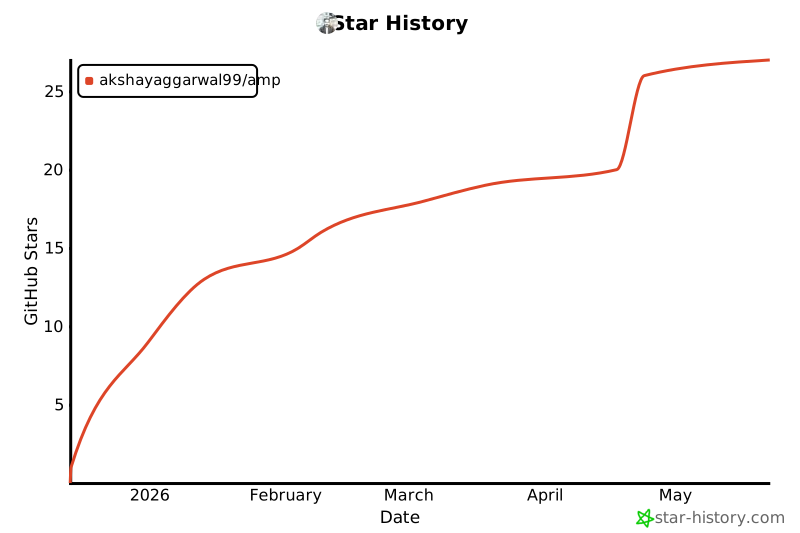
Star History
Made with ❤️ by Akshay.
1 maintainer

Metadata
1 maintainer
Release files for amp-memory 0.3.0
For a detailed explanation of source distributions (sdists) and built distributions (wheels), please see the package formats documentation.
Source distribution (sdist)
| File | Size | Uploaded | Provenance | |
|---|---|---|---|---|
| amp_memory-0.3.0.tar.gz | 1.6 MB | Without provenance | Details |
Built distribution (wheel)
| File | Interpreter | ABI | Platform | Reset |
|---|---|---|---|---|
| amp_memory-0.3.0-py3-none-any.whl | Python 3 | none | any | Details |
Total release size: 1.7 MB
Release files / amp_memory-0.3.0.tar.gz
| Download URL | amp_memory-0.3.0.tar.gz |
|---|---|
| Size | 1.6 MB |
| Tags | Source |
|
SHA-256 checksum How to use checksums |
a89b9f84989e5fb384cc9fce4083b64b1286931660b5441b6940f5b4bb7db42c
|
|
BLAKE2b-256 checksum How to use checksums |
c7f7a7b969f4e3cc2c578de9d593259e48d8c7b25d668645d61990a88ae2192d
|
| Upload date | |
|
Uploaded using Trusted Publishing? What is trusted publishing? |
No |
| Uploaded via |
uv/0.11.6 {"installer":{"name":"uv","version":"0.11.6","subcommand":["publish"]},"python":null,"implementation":{"name":null,"version":null},"distro":{"name":"macOS","version":null,"id":null,"libc":null},"system":{"name":null,"release":null},"cpu":null,"openssl_version":null,"setuptools_version":null,"rustc_version":null,"ci":null}
|
Release files / amp_memory-0.3.0-py3-none-any.whl
| Download URL | amp_memory-0.3.0-py3-none-any.whl |
|---|---|
| Size | 35.3 kB |
| Tags | Python 3 |
|
SHA-256 checksum How to use checksums |
fc0d6fa816cf3d83fbe2bab090abb8267a1652087f18db5567f324d5ecdd0a39
|
|
BLAKE2b-256 checksum How to use checksums |
4194257983f579e5f1798fc009cc085d0fb898f6dc114219658876fba6ce0500
|
| Upload date | |
|
Uploaded using Trusted Publishing? What is trusted publishing? |
No |
| Uploaded via |
uv/0.11.6 {"installer":{"name":"uv","version":"0.11.6","subcommand":["publish"]},"python":null,"implementation":{"name":null,"version":null},"distro":{"name":"macOS","version":null,"id":null,"libc":null},"system":{"name":null,"release":null},"cpu":null,"openssl_version":null,"setuptools_version":null,"rustc_version":null,"ci":null}
|
Security for amp-memory 0.3.0
Provenance
Provenance describes where a file came from. On PyPI, provenance is shared via attestations, which provide a verifiable record of the build or publishing details. View details, limitations and caveats.
No provenance found
None of the files in this release were uploaded with provenance metadata.
A note on package security
PyPI is a repository for distributing packages, not a service for auditing them. While third-party security researchers and our staff do their best to detect and remove malicious packages, PyPI cannot guarantee the quality, security or suitability of any given package.
To learn more about protecting yourself from malicious actors, visit our package security documentation.














