





Andrey is a causal discovery package for Python.
- Fast: Over 1,000x faster on PNL, and faster on most other supported methods.
- Accurate: up to 89% fewer errors than other popular packages.
- One API: 24 methods, each one function call.
- Agent-ready: a command line that answers in JSON, and a skill for coding agents.
uv add andrey-core
- With pip:
pip install andrey-core - Optional extras:
andrey-core[numba]for compiled CPU code,andrey-core[torch]for GPUs - Development version:
uv add git+https://github.com/Abel-ai-lab/andrey - Installation guide: the extras, a PyTorch build for your GPU, and building Andrey from source
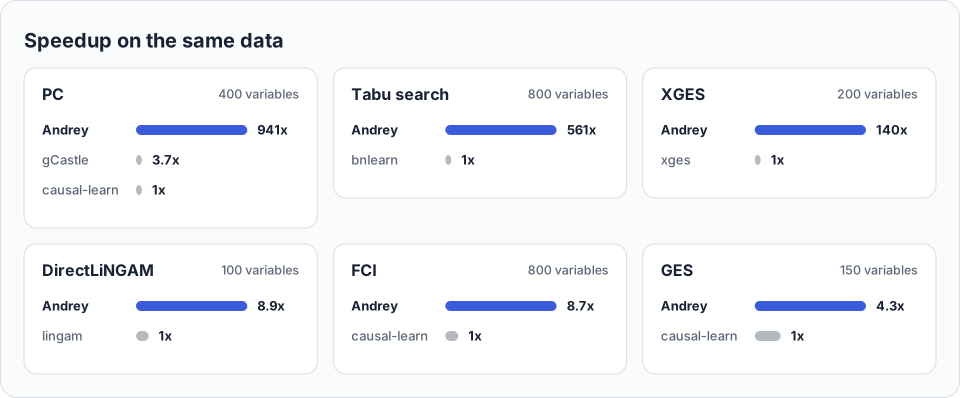
Four ideas make it fast; each is animated in a blog post:
- Do many things at once: thousands of independence tests run as one array operation, with the same results.
- Never compute twice: the correlation matrix is computed once and cached; GES memoizes its local scores.
- Skip what can't matter: tests with a closed form settle most edges before any matrix is inverted.
- Use the hardware you have: with the optional extras, Numba compiles GES's path checks and a GPU computes large tables.
What's inside
| Family | Methods | Returns |
|---|---|---|
| Constraint-based | pc, fci, gfci*, cdnod* |
CPDAG, PAG |
| Score-based | ges, gies*, xges, hc, tabu, exact_search*, calm* |
CPDAG, DAG |
| Permutation-based | boss, grasp |
CPDAG |
| Linear non-Gaussian | direct_lingam, ica_lingam, multi_group_direct_lingam* |
DAG |
| Time series | varma_lingam*, longitudinal_lingam* |
Temporal graph |
| Latent variables | gin*, rcd, camuv*, bottom_up_parce_lingam |
DAG, PAG |
| Pairwise direction | anm, pnl |
Two-node DAG |
* Experimental: no published benchmark yet, and the API may change.
Quick start
Learn the protein-signaling network of Sachs et al. (2005) from 853 cells, and score it against the known network:
import andrey
from andrey.data import load_dataset
from andrey.metrics import score

sachs = load_dataset("sachs")  # 853 cells, 11 proteins, and the known network
out = andrey.pc(sachs.data)    # learn a graph
print(out)

scores = score(out.structure, sachs.graph)
print({k: round(scores[k], 2) for k in ("shd", "skeleton_precision", "skeleton_recall")})
PC  cpdag  |  11 nodes  |  8 edges (6 undirected, 2 directed)

  raf -- mek
  plc -- pip3
  pip2 -- pip3
  erk -- akt
  erk -- pka
  akt -- pka
  p38 -> pkc
  jnk -> pkc
{'shd': 11, 'skeleton_precision': 1.0, 'skeleton_recall': 0.47}
PC finds 8 edges, all among the known network's 17. The structural Hamming distance (SHD) counts the edges to add, remove, or reorient to reach the known network: 11 here (9 edges are missing, and 2 are oriented that the known network leaves undirected), and 17 for a graph with no edges.
For your own data, pass a pandas DataFrame or a NumPy array: one row per sample, one column per variable. From a shell or an agent:
andrey run pc --data your_data.csv # JSON when piped, a summary in a terminal
To give your coding agent Andrey's skill, paste this prompt into it:
Install Andrey's agent skill: make sure the andrey-core package is installed, run
`andrey --skill`, and save its output as andrey/SKILL.md in your skills folder.
Learn more
- Documentation: guides and the API reference.
- Examples: notebooks, one method or task each.
- Demos: step through methods and explore results in your browser.
- Release cards: every size, time, and error count.
- Launch post, FAQ, and changelog.
- Roadmap: the planned work, in order.
Andrey is in alpha: the API may change between releases, so pin the version you use. Linux is fully tested; macOS and Windows install and run on the CPU, but the full test suite and the GPU speedups (CUDA / MPS) are not tested there yet.
Citing, license, contributing
If you use Andrey in your work, please cite it, or use the citation file:
@software{andrey,
  author = {{Abel AI Lab}},
  title = {Andrey: A very fast causal discovery package},
  year = {2026},
  version = {0.4.1},
  url = {https://andrey.abel.ai},
}
Andrey is released under the Apache License 2.0. Bug reports and pull requests are welcome in the issue tracker; the contributing guide explains how to set up a development environment.
Andrey is inspired by causal-learn, pgmpy, Tetrad, and many other causal discovery packages.
1 maintainer

Metadata
1 maintainer
Release files for andrey-core 0.4.1
For a detailed explanation of source distributions (sdists) and built distributions (wheels), please see the package formats documentation.
Source distribution (sdist)
| File | Size | Uploaded | |
|---|---|---|---|
| andrey_core-0.4.1.tar.gz | 308.1 kB | Details |
Built distribution (wheel)
| File | Interpreter | ABI | Platform | Reset |
|---|---|---|---|---|
| andrey_core-0.4.1-py3-none-any.whl | Python 3 | none | any | Details |
Total release size: 675.3 kB
Release files / andrey_core-0.4.1.tar.gz
| Download URL | andrey_core-0.4.1.tar.gz |
|---|---|
| Size | 308.1 kB |
| Tags | Source |
|
SHA-256 checksum How to use checksums |
ac8a3766ce6a3604ab0aba7abbc7183a7e9456a63919b8d552882f649b3aba5d
|
|
BLAKE2b-256 checksum How to use checksums |
0abd33292a04f207997cd8abff7e33f06650f0c2c41380efc244bd59bb36ccbe
|
| Upload date | |
|
Uploaded using Trusted Publishing? What is trusted publishing? |
Yes |
| Uploaded via |
twine/7.0.0 CPython/3.13.14
|
Provenance
Provenance describes where a file came from. On PyPI, provenance is shared via attestations, which provide a verifiable record of the build or publishing details. View details, limitations and caveats.


PyPI Publish Attestation
PyPI verified that this artifact, at this checksum, originated from the publisher listed below.
Signed by GitHub Actions, verified by PyPI on Oct 15, 2026.
Transparency logRelease files / andrey_core-0.4.1-py3-none-any.whl
| Download URL | andrey_core-0.4.1-py3-none-any.whl |
|---|---|
| Size | 367.2 kB |
| Tags | Python 3 |
|
SHA-256 checksum How to use checksums |
efb2261e79f51ec4ef4b2d702e813ba4691f745d604b4fe063e6b99744d505e8
|
|
BLAKE2b-256 checksum How to use checksums |
d44df24b33043b9c692df3dfe3ffbc2d3fc21ed9fe619e2947db645566cd21ce
|
| Upload date | |
|
Uploaded using Trusted Publishing? What is trusted publishing? |
Yes |
| Uploaded via |
twine/7.0.0 CPython/3.13.14
|
Provenance
Provenance describes where a file came from. On PyPI, provenance is shared via attestations, which provide a verifiable record of the build or publishing details. View details, limitations and caveats.
PyPI Publish Attestation
PyPI verified that this artifact, at this checksum, originated from the publisher listed below.
Signed by GitHub Actions, verified by PyPI on Oct 15, 2026.
Transparency log













