
A trainable continual-learning architecture (manas/buddhi/ahaṃkāra/citta) that learns without forgetting, knows when it doesn't know, watches for drift, and governs its own actions. Ships the Continual-Governance Benchmark (CGB): four faculties, four measured numbers (retention, calibrated abstention, drift false-alarm, governed escalation) on one leaderboard across tabular/vision/language, plus a tamper-evident hash-chained audit trail.

Project description
antahkarana — train a continual-learning mind on your data




antahkarana is a trainable architecture, not a frozen model. You bring your data (and optionally your
backbone); it trains a model that learns continually without forgetting, detects novelty / zero-days,
abstains when unsure, and consolidates in sleep. Four organs — manas · buddhi · ahaṃkāra · citta —
the mind is the same for every domain; only a thin adapter changes.
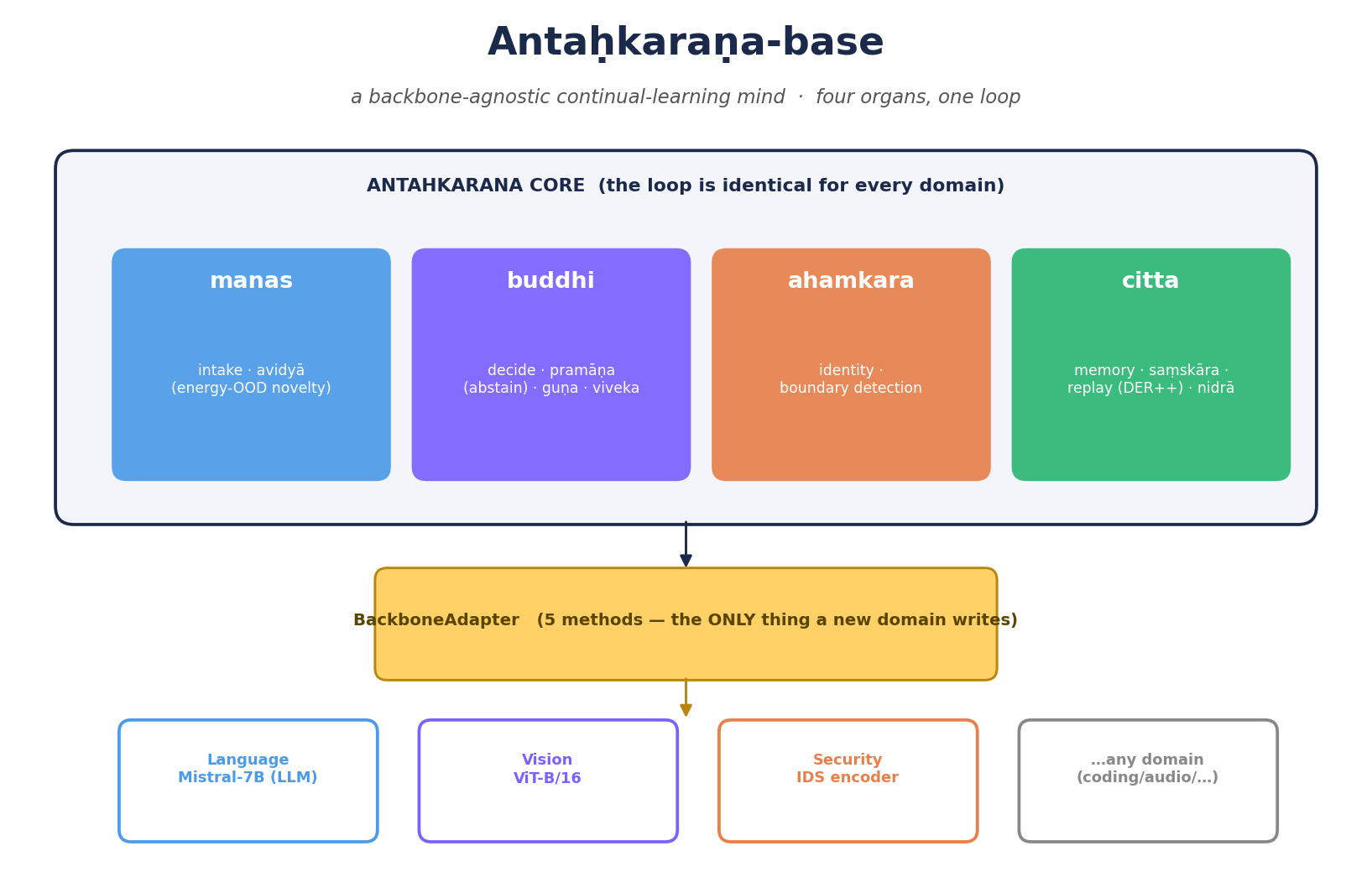
Built on the validated Antaḥkaraṇa-base core (gated G0–G5, proven across language · vision · security · with seeded, adaptive evaluation — see the model card for plots, results, and honest limits).
Install
pip install antahkarana              # core + tabular
pip install antahkarana[text]        # + HuggingFace LLM adapter
pip install antahkarana[bench]       # + the open Continual-Governance Benchmark (2.1)
pip install antahkarana[telemetry]   # + OpenTelemetry OTLP export (2.2)
Train on your data in ~10 lines (tabular)
from antahkarana import Antahkarana, TabularAdapter

# YOUR data: a list of tasks, each (X_train, y_train, X_test, y_test)
stream = TabularAdapter.make_stream(your_tasks)

bb   = TabularAdapter(input_dim=122, n_tasks=4, n_classes=2)   # built-in MLP — bring only data
mind = Antahkarana(bb, replay_strategy="der", avidya_strategy="energy")
res  = mind.train(stream)

print(res["forgetting"], res["final_row"], res["risk_coverage"])
New in 2.2 — Hardening (Gate G7): replay any incident from traces alone
The runtime becomes production-grade. Four opt-in modules (zero behavior change until enabled)
plus the new atk CLI, behind a falsifiable gate: G7 — replay any past incident end-to-end from
traces alone, and roll back a bad baseline refit in one command (20 gate tests, all green).
from antahkarana import Loop, telemetry

telemetry.install(out_dir="traces")                        # one trace per tick, one span per organ
loop = telemetry.instrument(Loop(...), loop_id="sensor-7")
loop.run()
atk replay traces/ --loop sensor-7 --tick 441 --diff 440   # → the first divergent organ attribute
atk policy test policies/        # versioned declarative policies: shadow lint + table tests + version lock
atk baseline rollback sensor-7   # baseline registry: canary shadow → promote → rollback, < 1s, no refit
antahkarana.telemetry— spans carry hashes/scores/verdicts, never raw sensed content; zero-deptraces/*.otlpjsonlfile exporter; real OTLP collectors via the[telemetry]extra.antahkarana.budget— declarative budgets + three-state circuit breakers that act through the control ring: exhausted budget or open breaker ⇒ an auditedsoft_block, one escalation per window; act failures trip the breaker open instead of killing the loop. Thread-safe ledgers (in-memory + SQLite), no lost debits under concurrency.antahkarana.policyspec— policies as versioned spec files (apiVersion: antahkarana.dev/v1) with load-time shadow analysis (a hard-blocked category can never be silently re-allowed), colocated table-driven tests, and a version lock: change the ruleset without bumpingmetadata.versionandatk policy testfails.antahkarana.registry— everyOneClassChangerefit is an immutable versioned artifact (fitted → canary → active → retired | rolled_back); the canary scores every tick in shadow and can never reach the ring; promotion and rollback are atomic pointer swaps.
New in 2.1 — the Continual-Governance Benchmark (CGB) + tamper-evident audit
Four faculties, four measured numbers, one leaderboard — retention ①, selective-risk AURC ②,
drift false-alarm rate ③, governed-escalation F1 + audit integrity ④ — across security-tabular,
vision, and language (frozen Mistral-7B + LoRA), plus measurable consolidation (ΔR = R_sleep −
R_noSleep) and a hash-chained AuditLog whose verify() makes governance a checkable contract.
Full board + honest negatives: CGB_RESULTS.
pip install "antahkarana[bench]"
python -m antahkarana.bench.run --suite cgi-v3-tabular --seeds 5 --out runs/tabular
New in 2.0 — the loop engine: watch · learn · improve · orchestrate

The same four organs that learn continually on training tasks now run as a governed loop engine on live observations. Generic agent loops watch and act; this one learns what's normal (fewer false alarms over time), remembers without forgetting, governs by construction (every action passes an audited control ring), and abstains when unsure. Fully additive — every 1.x symbol and default is unchanged.
from antahkarana import Loop, Policy

# A governed stock watcher: it stays silent until the right shoe appears,
# then ESCALATES to you — it never buys on its own (purchase is hard-blocked).
watch = Loop(
    sense=check_product_page,                         # your eyes: return the current observation
    change=lambda o, mem: 1.0 if (o["in_stock"] and o["price"] <= 175) else 0.0,
    category=lambda o: "purchase",
    signature=lambda o: f"{o['in_stock']}:{o['price']}",   # smṛti dedup — don't re-alert the same thing
    gate=Policy(name="shopper", hard_block=["purchase"]),  # the control ring: never auto-buy
    on_escalate=lambda obs, iv: notify_me(obs),
)
watch.run(max_steps=1000)
Four composing phases — each maps 1:1 to an organ:
Loop(watch) — a governed sentinel. Sense → score novelty → fire only on a real spike vs the running baseline (ahaṃkāra) → route through the control ring → dedup (smṛti). Hard-blocked actions escalate to a human, never auto-act; everything is audited.OneClassChange(learn) — a learned baseline forLoop: a Normal-only autoencoder that refits on a sliding window with held-out calibration and adapts to drift. Under drift, a static rule's false alarms blow up to 45–98% while the learned baseline holds them at the ~5% budget (3 seeds).ImproveLoop(improve) —build → critique → fix → repeatuntil a learned standard is met, then gate the ship. Monotone convergence in 3–4 rounds, and it never auto-ships (the finished draft is escalated for sign-off).Orchestrator(orchestrate) — buddhi fans out N specialist loops under ONE ring and ONE audit log, then ranks what surfaced so you see the critical thing first. The software spine of the air-gapped Box.
The loop engine is a thin governed runtime around your backbone — it supplies memory + calibrated novelty + the audited gate + the learning baseline; the reasoning/action inside each loop is yours. See
examples/loop_stock_watch.py.
New in 1.1.0 — four ways to not forget · scale-stable training · closed-loop plasticity

A backward-compatible release — every new behaviour is opt-in; the defaults reproduce 1.0. Validated on the NSL-KDD high-interference stream (3 seeds), cross-checked on UNSW-NB15 + vision; core gates green.
- Four complementary no-forgetting mechanisms — saṃskāra (EWC) · DER++ (now on the text adapter too) ·
OrthoLoRAstructural isolation (forgetting +0.288 → +0.215 where a penalty gives ~0) · forgetting-curve replay (nidrā) that rehearses the about-to-be-forgotten items first (rare-tail recall 0.276 → 0.314). MatraLAMBscale-stable optimization (Antahkarana(optimizer="lamb")) — a trust-ratio step (mātrā) so a full backbone and a tiny adapter move in proportion to their own magnitude, and one lr is stable across any scale. At the lr that used to collapse O-LoRA, forgetting +0.167 → +0.003 (≈ zero), accuracy up, robust on every seed; plusmax_grad_normgradient clipping (saṃyama).- Adaptive guṇa (
Antahkarana(adaptive_guna=True)) — plasticity closes the loop on measured forgetting: strictly Pareto-better where there's headroom (−11% forgetting and +accuracy), a safe no-op when there isn't. OneClassNovelty— complementary zero-day detector for threats sitting inside the known-data manifold (UNSW Backdoor AUROC 0.47 → 0.93).

Full details + the honest negatives we kept (and didn't ship): CHANGELOG · API.md.
The 1.0 foundation — stable API, with the control ring + calibrated novelty built in
The public API is now frozen under SemVer — 13 symbols (Antahkarana, the adapters, FeatureOOD,
NoveltyCalibrator, the eval metrics, and the Policy / RiskRouter / Tier / Intervention control ring).
A breaking change to any of them — or to the frozen BackboneAdapter contract — bumps the major version, so your
adapters and training code keep working while organ implementations stay free to improve. Full surface +
guarantees: API.md. The two capabilities that landed on the road to 1.0 are part of that stable surface:
The control ring (Layer-2 policy)
A swappable risk-tier router over any trained backbone. One consolidated brain (the weights = Layer-1 disposition), many deployment policies (config = Layer-2) — change safety posture without retraining, and every decision is logged (transparency by construction).
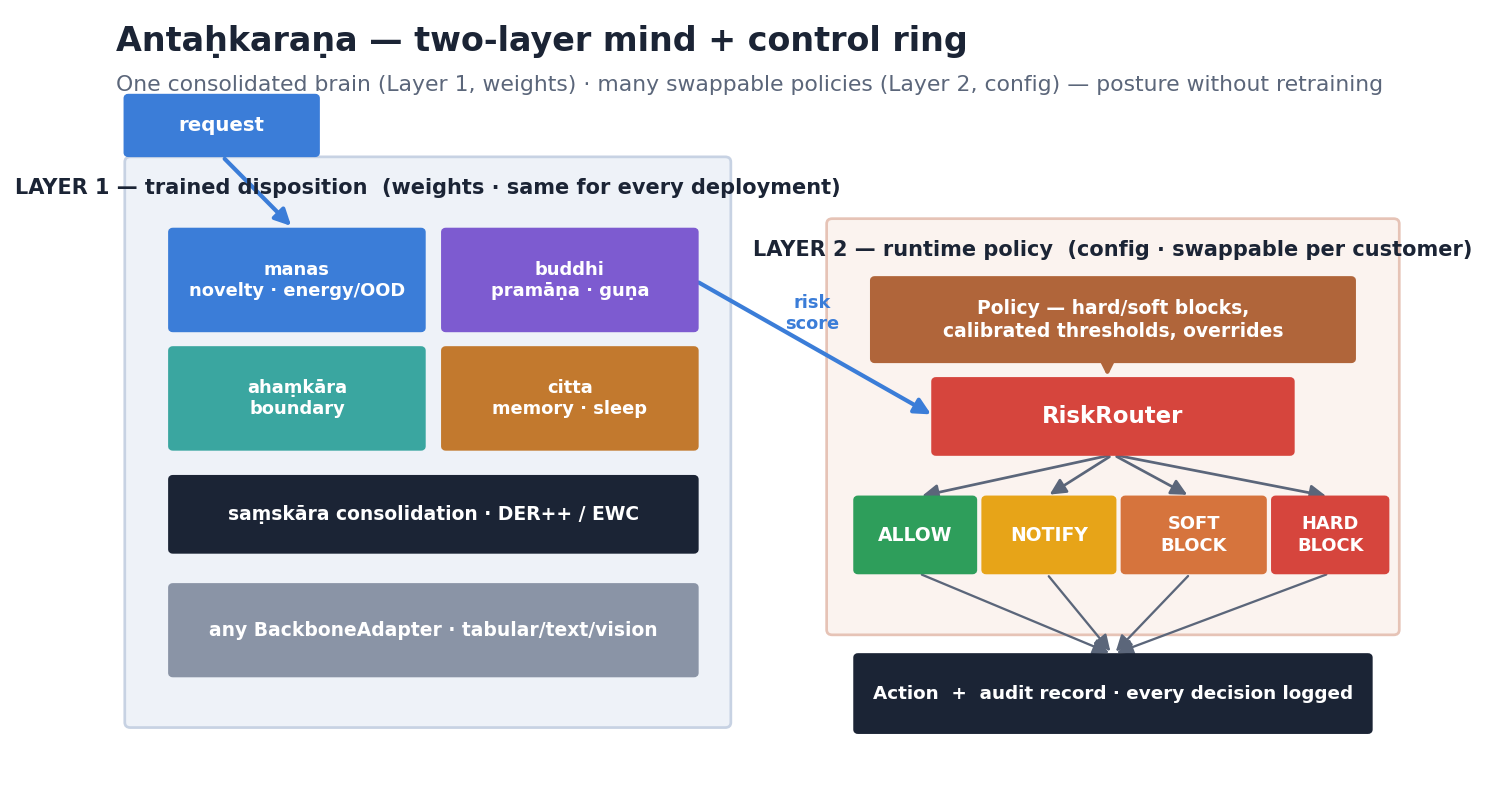
A request flows through the consolidated organs (Layer 1); manas emits a risk score; the RiskRouter applies the deployment Policy (Layer 2) to pick a tier — ALLOW / NOTIFY / SOFT_BLOCK / HARD_BLOCK — and logs every decision.
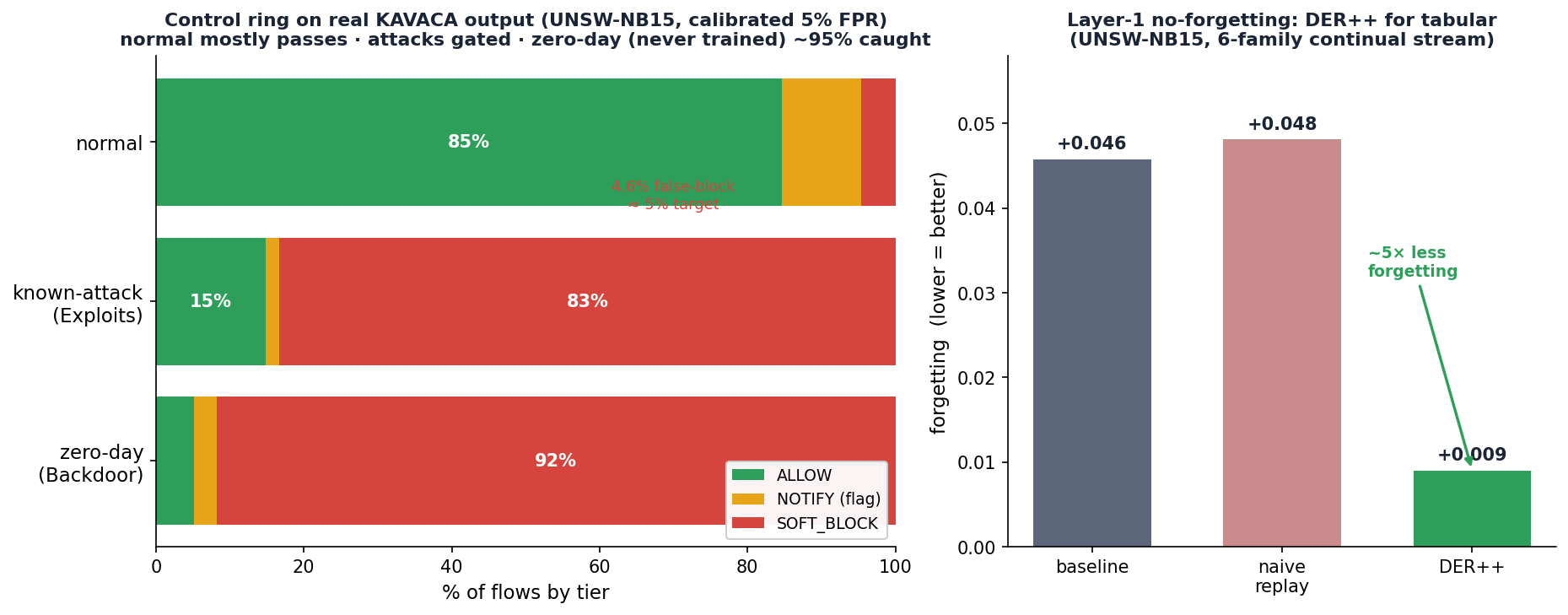
Validated on UNSW-NB15: calibrated to ~5% false-block on normal traffic, the ring gates known attacks and catches ~95% of a held-out zero-day family it never trained on — built on the Layer-1 DER++ no-forgetting win.
from antahkarana import Policy, RiskRouter
ring = RiskRouter(Policy.load("policy.yaml"))     # hard/soft blocks, thresholds, operator overrides
iv   = ring.gate(score=novelty, category="intrusion")
# iv.tier ∈ {allow, notify, soft_block, hard_block};  iv.allowed / iv.notify / iv.reason drive the response
See examples/control_ring.py.
Calibrated novelty — NoveltyCalibrator (manas → ring)
Raw novelty scores live on arbitrary scales, so a fixed ring threshold over- or under-blocks. NoveltyCalibrator
maps one or more signals (energy, FeatureOOD, …) to a calibrated [0,1] against a normal reference
(empirical CDF) — so a ring threshold of 0.95 is a 5% false-alarm rate, and manas output is directly ring-ready.
from antahkarana import NoveltyCalibrator
cal = NoveltyCalibrator(mode="mean")                  # "mean" steadier · "max" more sensitive
cal.fit(energy=normal_energy, feature=normal_feat)    # calibrate against NORMAL data
p = cal.score(energy=new_energy, feature=new_feat)    # 0..1 ; 0.95 ≈ 5% false alarms
Honest note: no unsupervised fusion of energy+feature beat the best single signal on held-out UNSW-NB15 families — calibration's value is the FPR-tunable scale, not an AUROC boost.
Core (since 0.3.0) — DER++ replay + feature-space novelty
DER++ works for tabular (replay_strategy="der"): on a 6-family UNSW-NB15 stream it cut forgetting from
+0.048 (naive) to +0.009 — the no-forgetting guarantee holds on modern data, not just text/vision.
FeatureOOD adds a penultimate-feature novelty detector (Mahalanobis / kNN) complementary to the
default energy score — measured to rescue families where energy fails (Backdoor AUROC 0.37→0.79) while energy
remains better where it already works. Pick per deployment or ensemble; energy stays the default.
from antahkarana import FeatureOOD
det   = FeatureOOD("mahalanobis").fit(known_features, known_labels)   # bb.features(inputs) -> embeddings
score = det.score(new_features)        # higher = more novel / likely zero-day
Text (any HuggingFace causal-LM + LoRA)
from antahkarana import Antahkarana, TextAdapter
bb     = TextAdapter("mistralai/Mistral-7B-v0.1")             # frozen base, small LoRA trains
stream = TextAdapter.make_stream(your_text_tasks)             # [(train_pairs, eval_pairs), …]
Antahkarana(bb).train(stream)
Any other modality
Copy antahkarana/adapters/template.py (CustomAdapter) and implement 5 methods over your encoder
(audio, graph, multi-modal, robotics, …). The continual-learning mind is unchanged.
Runnable examples
python examples/train_tabular.py     # concept-drift stream: naive forgets, the core doesn't
python examples/train_security.py    # continual threat detection (attack families) + calibrated triage
What you get back
train() returns: the task×task accuracy matrix, final_row, final_avg, forgetting,
risk_coverage (calibrated abstention), recovery (sleep), and the trajectory (per-task guṇa/novelty).
Knobs
Antahkarana(bb, samskara=, replay_strategy="naive"|"der", avidya_strategy="msp"|"energy", sleep=, base_lr=, epochs=)
— turn each organ on/off and swap in the SOTA implementation (DER++ dark-knowledge replay, energy-OOD novelty).
Ship it closed-source
python build_wheel.py compiles the engine to binary .so (Nuitka) and drops the source, leaving only the
public interface readable — others can pip install and train on their data without seeing your code.
(For maximum IP protection, serve it behind an API instead.)
60-second tour
python examples/try_it.py # no-forgetting · zero-day · abstention · control ring
(API stability + the frozen BackboneAdapter contract are covered under The 1.0 foundation above; full surface in
API.md.)
Author — Deepak Soni · Apache-2.0
Release history Release notifications | RSS feed


Download files
Download the file for your platform. If you're not sure which to choose, learn more about installing packages.
Source Distribution
Built Distribution
Filter files by name, interpreter, ABI, and platform.
If you're not sure about the file name format, learn more about wheel file names.
Copy a direct link to the current filters
File details
Details for the file antahkarana-2.2.0.tar.gz.
File metadata
- Download URL: antahkarana-2.2.0.tar.gz
- Upload date:
- Size: 112.4 kB
- Tags: Source
- Uploaded using Trusted Publishing? No
- Uploaded via: twine/6.2.0 CPython/3.9.6
File hashes
| Algorithm | Hash digest | |
|---|---|---|
| SHA256 |
0d9ed95d4a131d20a51f93383a3040a47b5368986e0e5f7c326d8cb63a45f42e
|
|
| MD5 |
f3a7efd2ac1d2e97837c6105ae4cf69a
|
|
| BLAKE2b-256 |
0799485848cf2df22aa642bb93f95ec63a2cec9794de44d830fa2421fc1df465
|
File details
Details for the file antahkarana-2.2.0-py3-none-any.whl.
File metadata
- Download URL: antahkarana-2.2.0-py3-none-any.whl
- Upload date:
- Size: 134.4 kB
- Tags: Python 3
- Uploaded using Trusted Publishing? No
- Uploaded via: twine/6.2.0 CPython/3.9.6
File hashes
| Algorithm | Hash digest | |
|---|---|---|
| SHA256 |
14e28f727c8134c1859d0c8fef7e4b7c9fe2c5efc8170faa054c8372e38d13ec
|
|
| MD5 |
735b07f2d50e844d0d56c38893aa7334
|
|
| BLAKE2b-256 |
d0527dae02e33683dca0b9db11f7e682da27da624e4db6eeb150180ff5dcb7a6
|






