
antenna-cad
Design compiler for antenna and phased-array PCBs: YAML spec in — synthesized layout, KiCad DRC, and openEMS full-wave verification out. Deterministic Python core, agent-ready via MCP.




Compile antenna and phased-array design intent into simulation-ready KiCad PCB layouts.
antenna-cad is a Python design compiler for printed antennas. You describe requirements
(frequency, substrate, polarization, gain); it synthesizes geometry, writes a
DRC-checkable .kicad_pcb, simulates the layout with openEMS, and reports predicted
performance against the requirements. Every step is deterministic and runs headlessly,
with no KiCad GUI and no LLM in the loop. Agents can drive the same typed API, but
nothing depends on one.
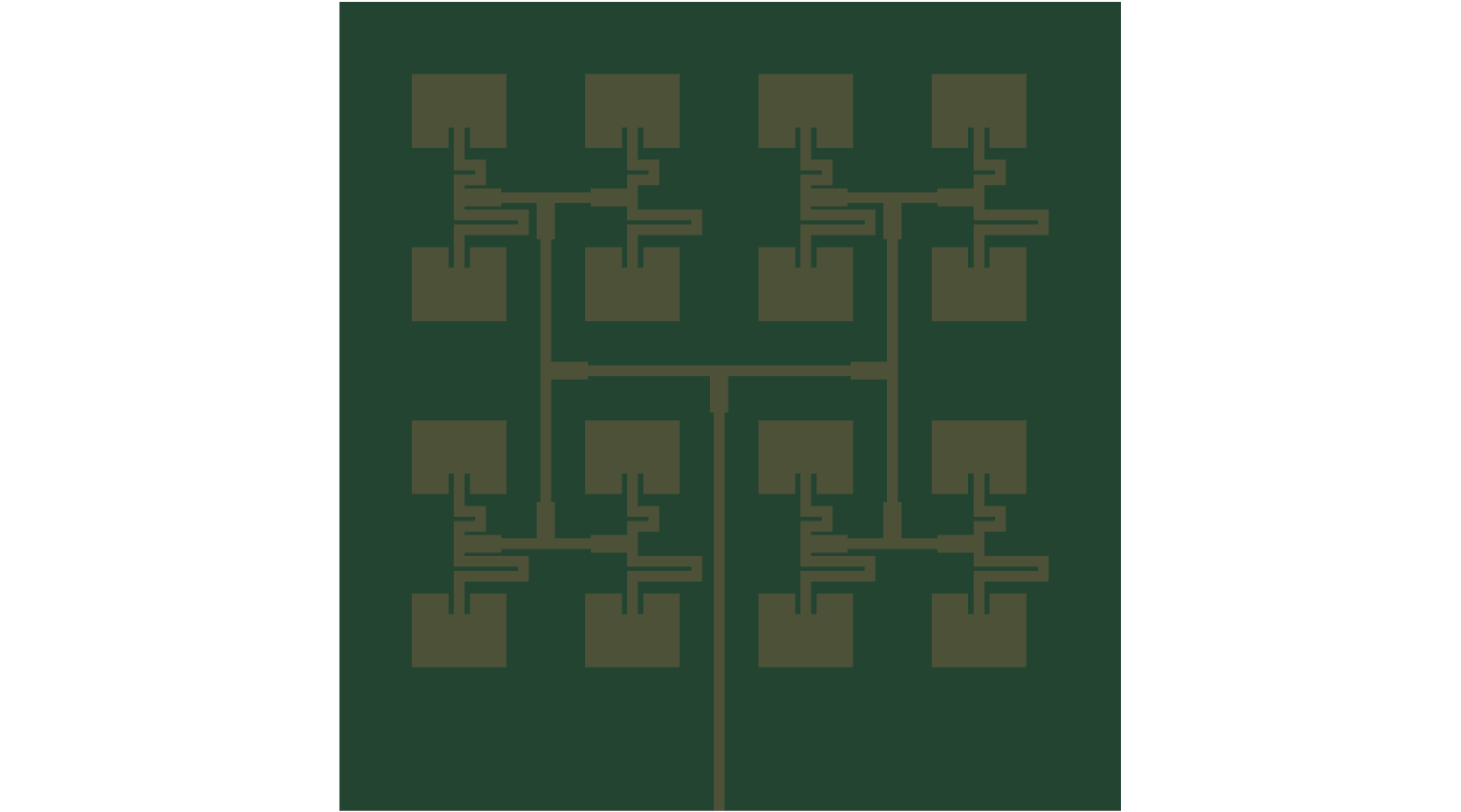
A 4×4 corporate-fed patch array at 10 GHz: synthesized, routed, DRC-checked, and full-wave simulated from a 15-line spec file. No human drew any copper.
From spec to verified board
design:
  name: array_2x2_10ghz
requirements:
  center_frequency: 10 GHz
  impedance: 50 ohm
  substrate: RO4350B
  substrate_height: 0.508 mm
element:
  type: rectangular_patch
array:
  nx: 2
  ny: 2
  spacing: 0.6 lambda
pip install antenna-cad
antenna-cad report spec.yaml -o build/ --tune
That one command synthesizes the patches and the corporate feed (quarter-wave transformers, phase-compensated mirrored rows), emits a KiCad board, runs real KiCad DRC, simulates the exact layout in openEMS FDTD, iterates a simulate-and-correct tuning loop, and writes a verification report:
| Board (KiCad render) | Return loss | Radiation pattern |
|---|---|---|
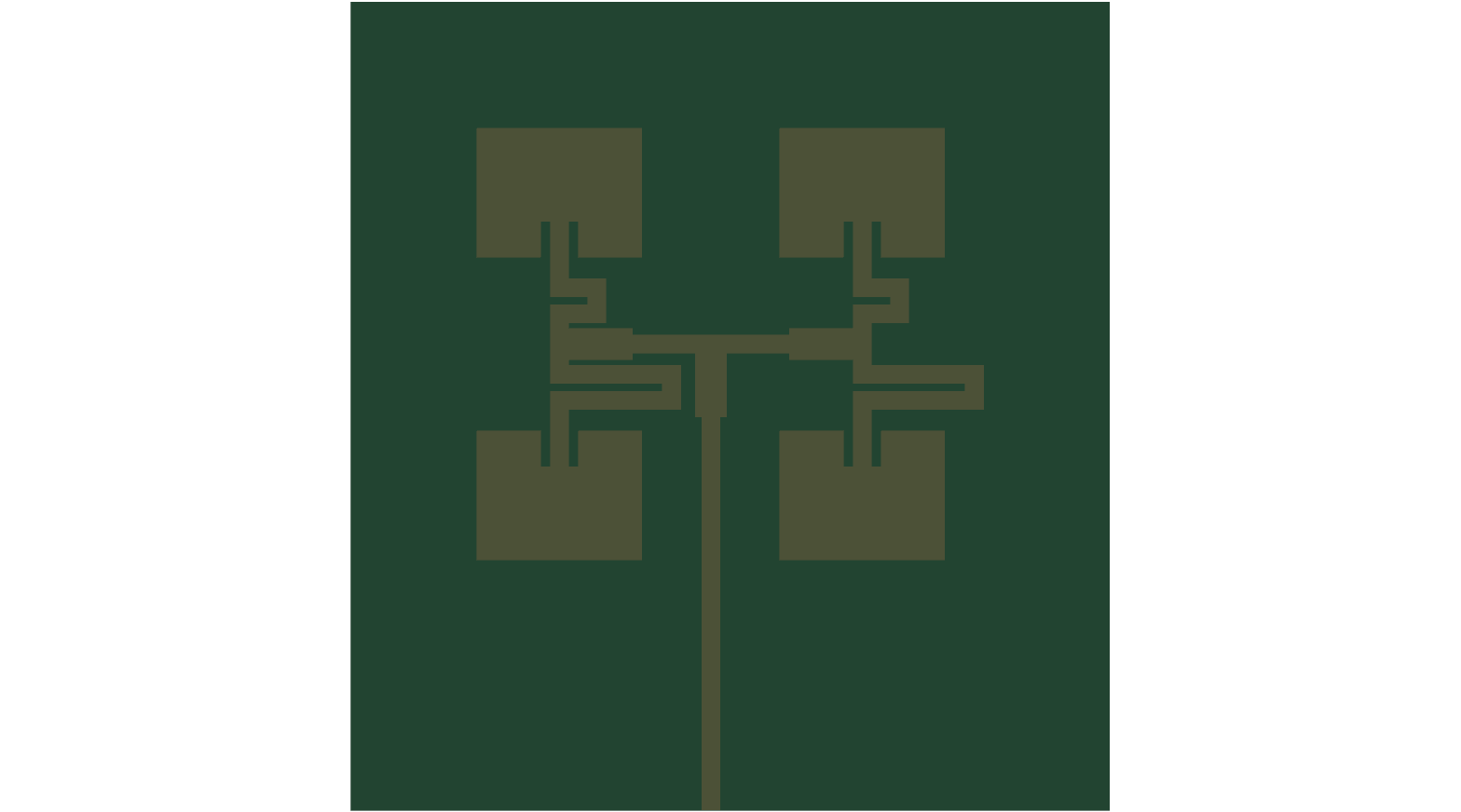 |
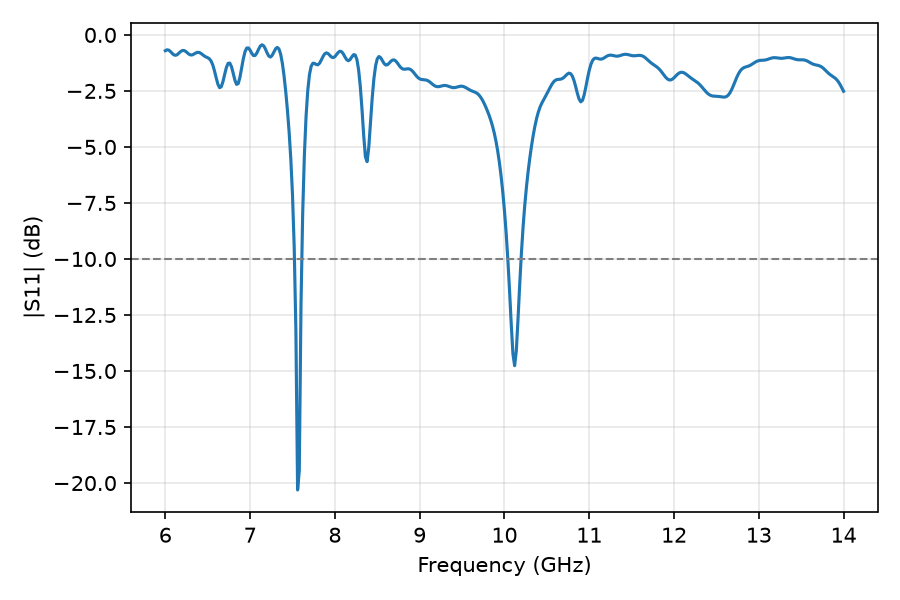 |
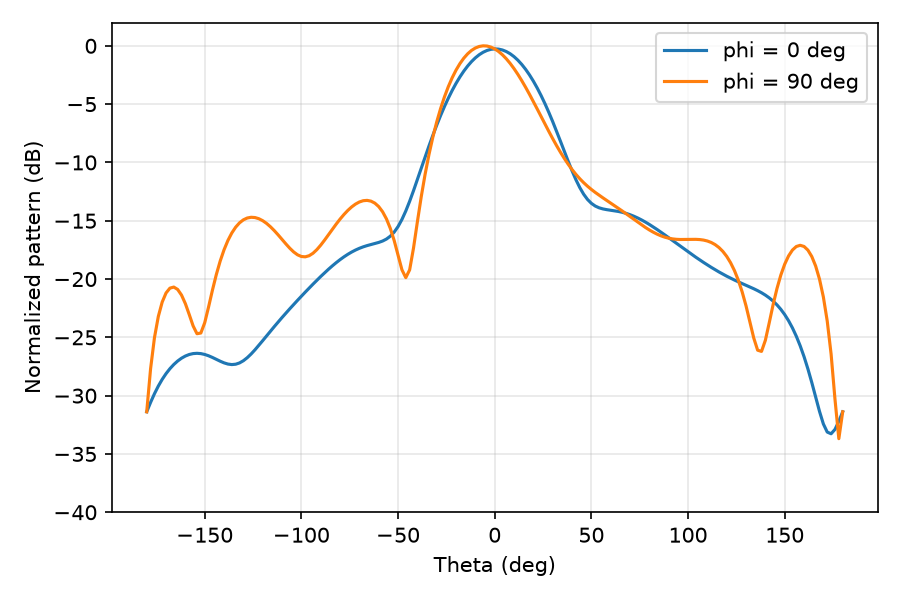 |
Measured for this 2×2 (openEMS, tuned): resonance 10.12 GHz against the 10 GHz target, S11 −14.8 dB, directivity 12.8 dBi, gain 11.7 dBi, single broadside beam.
flowchart LR
    S[spec.yaml] --> SYN[analytic synthesis]
    SYN --> IR[typed design IR]
    IR --> K[KiCad board + DRC]
    IR --> EM[openEMS FDTD]
    EM --> R[report + metrics]
    R -->|simulate-and-correct| SYN
    K --> FAB[Gerbers / STEP]
Verified examples
| Example | Result (openEMS) | |
|---|---|---|
| Single patch, 10 GHz | f_res 9.84 GHz, S11 −11.5 dB, D 6.8 dBi |  |
| 2×2 corporate-fed array | tuned: f_res 10.12 GHz, S11 −14.8 dB, D 12.8 dBi, gain 11.7 dBi | |
| 4×4 corporate-fed array | D 16.8 dBi, gain 15.4 dBi, −13 dB E-plane sidelobes; match limited to −8 dB (why) | |
Every number above is a real openEMS result from the committed example specs; the
figures rebuild from checked-in run data with uv run python figures/make_figures.py.
Design principles
- Compiler, not file generator. The source of truth is a typed internal representation of the design — geometry, stackup, nets, ports, constraints, units. KiCad, Gerber, and solver files are build artifacts compiled from it.
- Deterministic core. The same spec produces the same board, byte for byte.
Verification runs through real engines: KiCad DRC (
kicad-cli) and full-wave FDTD (openEMS). - Physical quantities carry units (via pint).
10 GHzand8.42 mmare values in the API; bare floats cross into backends only at explicit conversion boundaries. - Narrow scope by design. This targets the structures printed antennas need (patches, microstrip lines, impedance transformers, feed trees, ground pours, via fences) rather than general PCB autorouting or schematic capture.
Install
pip install antenna-cad            # core: synthesis, IR, KiCad emission
pip install "antenna-cad[pam]"     # + phased-array-modeling lattice interop
pip install "antenna-cad[mcp]"     # + MCP server for agents
pip install "antenna-cad[dxf]"     # + DXF export
KiCad 8+ provides DRC, rendering, and manufacturing export (brew install --cask kicad on macOS; distribution package kicad on Linux). openEMS runs natively where
its Python bindings are installed, or reproducibly in Docker:
docker build -t antenna-cad-openems docker/
For agents (MCP)
The same pipeline is exposed as typed MCP tools — synthesize, layout, DRC, simulate, report, export — so an agent can iterate designs against real DRC and full-wave feedback instead of hallucinating copper:
pip install "antenna-cad[mcp]"
antenna-cad mcp serve
{
  "mcpServers": {
    "antenna-cad": {"command": "antenna-cad", "args": ["mcp", "serve"]}
  }
}
Conventions
The MCP surface follows the family convention documented in APAB's mcp-conventions.md: same server layout, tool naming, error contract, and path-safety rules, so an agent connected to both servers sees one house style.
Citing
If antenna-cad contributes to academic work, please cite it (GitHub's "Cite this repository" button uses CITATION.cff; an archival DOI is planned):
@software{hodge2026antennacad,
  author  = {Hodge, John},
  title   = {antenna-cad: a design compiler for antenna and phased-array {PCBs}},
  year    = {2026},
  version = {0.1.1},
  url     = {https://github.com/jman4162/antenna-cad},
  license = {MIT}
}
License
MIT
#antenna #phased-array #kicad #pcb-design #openems #fdtd #microstrip
#patch-antenna #rf #electromagnetics #eda #mcp #python
1 maintainer

Release files for antenna-cad 0.2.0
For a detailed explanation of source distributions (sdists) and built distributions (wheels), please see the package formats documentation.
Source distribution (sdist)
| File | Size | Uploaded | |
|---|---|---|---|
| antenna_cad-0.2.0.tar.gz | 601.0 kB | Details |
Built distribution (wheel)
| File | Interpreter | ABI | Platform | Reset |
|---|---|---|---|---|
| antenna_cad-0.2.0-py3-none-any.whl | Python 3 | none | any | Details |
Total release size: 672.1 kB
Release files / antenna_cad-0.2.0.tar.gz
| Download URL | antenna_cad-0.2.0.tar.gz |
|---|---|
| Size | 601.0 kB |
| Tags | Source |
|
SHA-256 checksum How to use checksums |
bdd8a3582d595f23c35d59c06dc1bc50e22653dbc7a0ffb86ac255eb46112aeb
|
|
BLAKE2b-256 checksum How to use checksums |
297065d8dc8f39f96149c46100c5acef899b2099c8fc38c13205671d001c2be2
|
| Upload date | |
|
Uploaded using Trusted Publishing? What is trusted publishing? |
Yes |
| Uploaded via |
twine/7.0.0 CPython/3.13.14
|
Provenance
Provenance describes where a file came from. On PyPI, provenance is shared via attestations, which provide a verifiable record of the build or publishing details. View details, limitations and caveats.


PyPI Publish Attestation
PyPI verified that this artifact, at this checksum, originated from the publisher listed below.
Signed by GitHub Actions, verified by PyPI on Aug 12, 2026.
Transparency logRelease files / antenna_cad-0.2.0-py3-none-any.whl
| Download URL | antenna_cad-0.2.0-py3-none-any.whl |
|---|---|
| Size | 71.1 kB |
| Tags | Python 3 |
|
SHA-256 checksum How to use checksums |
697db3975899f5a1d02eca75946cb5c8a95f9d01d5be85acc50ebb49b5aa5d5c
|
|
BLAKE2b-256 checksum How to use checksums |
5b1ab728676e91f37b7fadfbd23e951c3270a6c4557e73fc2aeef48789596d39
|
| Upload date | |
|
Uploaded using Trusted Publishing? What is trusted publishing? |
Yes |
| Uploaded via |
twine/7.0.0 CPython/3.13.14
|
Provenance
Provenance describes where a file came from. On PyPI, provenance is shared via attestations, which provide a verifiable record of the build or publishing details. View details, limitations and caveats.
PyPI Publish Attestation
PyPI verified that this artifact, at this checksum, originated from the publisher listed below.
Signed by GitHub Actions, verified by PyPI on Aug 12, 2026.
Transparency log













