









Links
If you enjoy anytree

Getting started
Usage is simple.
Construction
>>> from anytree import Node, RenderTree
>>> udo = Node("Udo")
>>> marc = Node("Marc", parent=udo)
>>> lian = Node("Lian", parent=marc)
>>> dan = Node("Dan", parent=udo)
>>> jet = Node("Jet", parent=dan)
>>> jan = Node("Jan", parent=dan)
>>> joe = Node("Joe", parent=dan)
Node
>>> print(udo)
Node('/Udo')
>>> print(joe)
Node('/Udo/Dan/Joe')
Tree
>>> for pre, fill, node in RenderTree(udo):
...     print("%s%s" % (pre, node.name))
Udo
├── Marc
│   └── Lian
└── Dan
    ├── Jet
    ├── Jan
    └── Joe
For details see Node and RenderTree.
Visualization
>>> from anytree.exporter import DotExporter
>>> # graphviz needs to be installed for the next line!
>>> DotExporter(udo).to_picture("udo.png")
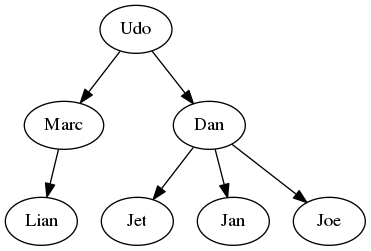
The DotExporter can be started at any node and has various formatting hookups:
>>> DotExporter(dan,
...             nodeattrfunc=lambda node: "fixedsize=true, width=1, height=1, shape=diamond",
...             edgeattrfunc=lambda parent, child: "style=bold"
... ).to_picture("dan.png")

There are various other Importers and Exporters.
Manipulation
A second tree:
>>> mary = Node("Mary")
>>> urs = Node("Urs", parent=mary)
>>> chris = Node("Chris", parent=mary)
>>> marta = Node("Marta", parent=mary)
>>> print(RenderTree(mary))
Node('/Mary')
├── Node('/Mary/Urs')
├── Node('/Mary/Chris')
└── Node('/Mary/Marta')
Append:
>>> udo.parent = mary
>>> print(RenderTree(mary))
Node('/Mary')
├── Node('/Mary/Urs')
├── Node('/Mary/Chris')
├── Node('/Mary/Marta')
└── Node('/Mary/Udo')
    ├── Node('/Mary/Udo/Marc')
    │   └── Node('/Mary/Udo/Marc/Lian')
    └── Node('/Mary/Udo/Dan')
        ├── Node('/Mary/Udo/Dan/Jet')
        ├── Node('/Mary/Udo/Dan/Jan')
        └── Node('/Mary/Udo/Dan/Joe')
Subtree rendering:
>>> print(RenderTree(marc))
Node('/Mary/Udo/Marc')
└── Node('/Mary/Udo/Marc/Lian')
Cut:
>>> dan.parent = None
>>> print(RenderTree(dan))
Node('/Dan')
├── Node('/Dan/Jet')
├── Node('/Dan/Jan')
└── Node('/Dan/Joe')
Extending any python class to become a tree node
The enitre tree magic is encapsulated by NodeMixin add it as base class and the class becomes a tree node:
>>> from anytree import NodeMixin, RenderTree
>>> class MyBaseClass(object):  # Just an example of a base class
...     foo = 4
>>> class MyClass(MyBaseClass, NodeMixin):  # Add Node feature
...     def __init__(self, name, length, width, parent=None, children=None):
...         super(MyClass, self).__init__()
...         self.name = name
...         self.length = length
...         self.width = width
...         self.parent = parent
...         if children:
...             self.children = children
Just set the parent attribute to reflect the tree relation:
>>> my0 = MyClass('my0', 0, 0)
>>> my1 = MyClass('my1', 1, 0, parent=my0)
>>> my2 = MyClass('my2', 0, 2, parent=my0)
>>> for pre, fill, node in RenderTree(my0):
...     treestr = u"%s%s" % (pre, node.name)
...     print(treestr.ljust(8), node.length, node.width)
my0      0 0
├── my1  1 0
└── my2  0 2
The children can be used likewise:
>>> my0 = MyClass('my0', 0, 0, children=[
...     MyClass('my1', 1, 0),
...     MyClass('my2', 0, 2),
... ])
>>> for pre, fill, node in RenderTree(my0):
...     treestr = u"%s%s" % (pre, node.name)
...     print(treestr.ljust(8), node.length, node.width)
my0      0 0
├── my1  1 0
└── my2  0 2
Documentation
Please see the Documentation for all details.
Installation
To install the anytree module run:
pip install anytree
If you do not have write-permissions to the python installation, try:
pip install anytree --user
1 maintainer

Metadata
1 maintainer
Release files for anytree 2.8.0
For a detailed explanation of source distributions (sdists) and built distributions (wheels), please see the package formats documentation.
Source distribution (sdist)
| File | Size | Uploaded | Provenance | |
|---|---|---|---|---|
| anytree-2.8.0.tar.gz | 189.5 kB | Without provenance | Details |
Built distribution (wheel)
| File | Interpreter | ABI | Platform | Reset |
|---|---|---|---|---|
| anytree-2.8.0-py2.py3-none-any.whl | Python 3, Python 2 | none | any | Details |
Total release size: 231.2 kB
Release files / anytree-2.8.0.tar.gz
| Download URL | anytree-2.8.0.tar.gz |
|---|---|
| Size | 189.5 kB |
| Tags | Source |
|
SHA-256 checksum How to use checksums |
3f0f93f355a91bc3e6245319bf4c1d50e3416cc7a35cc1133c1ff38306bbccab
|
|
BLAKE2b-256 checksum How to use checksums |
d845de59861abc8cb66e9e95c02b214be4d52900aa92ce34241a957dcf1d569d
|
| Upload date | |
|
Uploaded using Trusted Publishing? What is trusted publishing? |
No |
| Uploaded via |
twine/3.1.1 pkginfo/1.5.0.1 requests/2.22.0 setuptools/41.0.1 requests-toolbelt/0.9.1 tqdm/4.41.1 CPython/3.7.3
|
Release files / anytree-2.8.0-py2.py3-none-any.whl
| Download URL | anytree-2.8.0-py2.py3-none-any.whl |
|---|---|
| Size | 41.7 kB |
| Tags | Python 2 Python 3 |
|
SHA-256 checksum How to use checksums |
14c55ac77492b11532395049a03b773d14c7e30b22aa012e337b1e983de31521
|
|
BLAKE2b-256 checksum How to use checksums |
a865be23d8c3ecd68d40541d49812cd94ed0f3ee37eb88669ca15df0e43daed1
|
| Upload date | |
|
Uploaded using Trusted Publishing? What is trusted publishing? |
No |
| Uploaded via |
twine/3.1.1 pkginfo/1.5.0.1 requests/2.22.0 setuptools/41.0.1 requests-toolbelt/0.9.1 tqdm/4.41.1 CPython/3.7.3
|
Security for anytree 2.8.0
Provenance
Provenance describes where a file came from. On PyPI, provenance is shared via attestations, which provide a verifiable record of the build or publishing details. View details, limitations and caveats.
No provenance found
None of the files in this release were uploaded with provenance metadata.
A note on package security
PyPI is a repository for distributing packages, not a service for auditing them. While third-party security researchers and our staff do their best to detect and remove malicious packages, PyPI cannot guarantee the quality, security or suitability of any given package.
To learn more about protecting yourself from malicious actors, visit our package security documentation.














