
anytype-llm-wiki



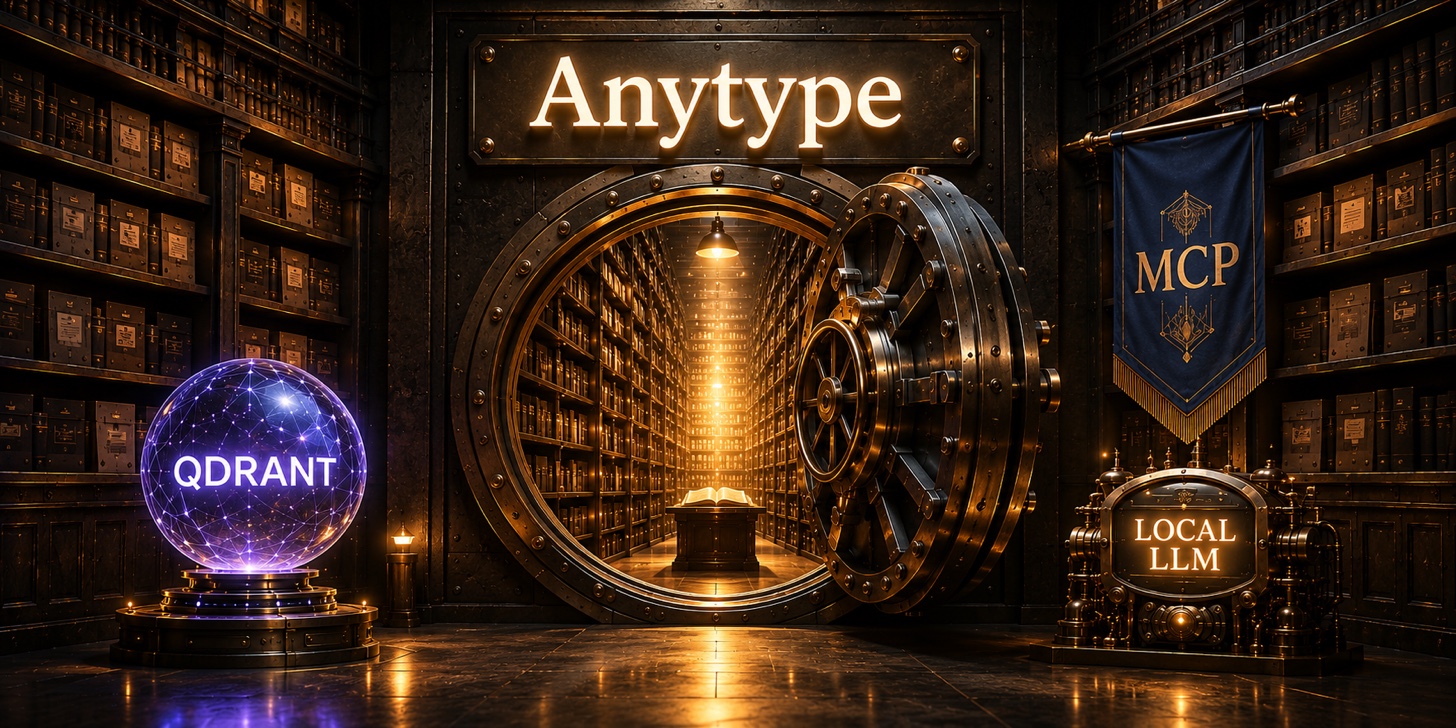
A local-first, typed "second brain" on Anytype — for humans and AI agents.
It takes Andrej Karpathy's LLM-wiki idea — let an LLM compile your sources into a curated, interlinked knowledge base you can then query — and builds it on Anytype's native Objects, Types, and Relations instead of flat Markdown files. Everything is exposed over the Model Context Protocol, so Claude Code, Cursor, any MCP client — or your own autonomous agents — can both read and write it. It runs entirely on your machine.
Why a typed graph instead of flat notes or plain RAG?
- Typed Objects and bidirectional Relations — not files. Knowledge lands as
Entity,Concept, andSourceobjects linked by real, traversable relations in a queryable database. Markdown wikis (Obsidian, Logseq) give you backlinks over text files; Anytype gives you a typed knowledge graph. - It detects contradictions. When newly ingested facts conflict with an already-linked entity, both positions are kept and cross-linked (
wiki_contradictions) and flagged for review — never silently overwritten. Your knowledge base tells you when it disagrees with itself. Flat wikis and vector stores can't. - Cited synthesis, not just search.
wiki_queryreturns a prose answer drawn only from your wiki, citing the exact Objects it used — and can file the answer back so the wiki gets a little better every time it's used. - Local-first. Anytype + Ollama (embeddings & extraction) + Qdrant (vectors), all on
localhost. Nothing leaves your machine by default. See Security & data flow.
Use cases
1. A research / knowledge wiki (for you)
Point it at sources — Wikipedia articles, papers, internal docs, your own notes — and it compiles them into typed, interlinked Entities and Concepts with provenance, deduping and merging as it goes. Then ask questions in plain language and get answers synthesized only from your wiki, each citing the Objects it drew from. It's Karpathy's LLM-wiki pattern on a real database: the graph is browsable in Anytype, and every fact traces back to a Source.
→ Path: wiki_bootstrap → wiki_ingest → wiki_query (walkthrough).
2. A secondary brain for an AI agent fleet
Give autonomous agents a persistent, typed memory that survives sessions and is shared across projects. Agents narrate what they learn (wiki_remember) — decisions, durable facts, and the relations between things — and read it back with citations (wiki_query) before starting new work. Consolidation makes repeated writes safe (it dedups, supersedes, and flags contradictions instead of overwriting), and a periodic wiki_lint surfaces contradictions and staleness for review. One brain, contradiction-aware, that compounds as the fleet works.
→ Path: register as an MCP server in your agent runtime, then wiki_remember / wiki_query.
This is exactly how we use it at Aldeia IT: as the shared long-term memory for our autonomous SDLC agent fleet.
3. A research buffer that cuts repeated web search
Researching a topic across many sessions means re-fetching the same facts from the web again and again. Ingest findings once and the wiki becomes a local, cited cache: future questions are answered from accumulated knowledge first, with a live web search reserved for genuine gaps — fewer tokens, faster answers, and a provenance trail.
→ Concrete example: a Capoeira genealogy research project uses it as exactly this kind of buffer — caching lineage and history research so repeated LLM web-searches are avoided.
How it works
Everything runs locally — no off-machine egress. An MCP client calls the
anytype-llm-wiki server, which orchestrates three local backends: Anytype (the
typed knowledge graph), Ollama (extraction / reasoning LLM + embeddings), and
Qdrant (vectors).
Questions are answered only from your wiki, with citations — and the Q&A can be filed back so future questions retrieve from it. The wiki gets more useful the more you use it:

📊 Full visual guide → — the write pipeline, the typed object model, and the self-auditing health check.
Objects carry their knowledge in properties (wiki_facts, wiki_definition, …), not in the object body — so an ingested object shows an empty body in the Anytype client by design; the content is fully indexed and retrievable.
Quick start
Prerequisites
- Anytype desktop (REST API on port 31012)
- Ollama with an embedding model:
ollama pull bge-m3(extraction also uses a small local generation model, e.g.ollama pull qwen2.5:7b) - Qdrant:
docker run -p 6333:6333 qdrant/qdrant
Install
From PyPI — this puts an anytype-llm-wiki command on your PATH:
uv tool install anytype-llm-wiki # or: pipx install anytype-llm-wiki
Or run from source (for development)
git clone https://github.com/Aldeia-IT/anytype-llm-wiki.git
cd anytype-llm-wiki
uv sync
Then prefix the commands below with uv run (e.g. uv run anytype-llm-wiki doctor).
Running anytype-llm-wiki with no subcommand starts the MCP server over stdio.
Configure
Create a .env (only ANYTYPE_API_KEY is required):
ANYTYPE_API_KEY=your-anytype-api-key     # Anytype → Settings → API
# Optional (defaults shown):
ANYTYPE_API_URL=http://127.0.0.1:31012
QDRANT_URL=http://127.0.0.1:6333
OLLAMA_URL=http://127.0.0.1:11434
EMBED_MODEL=bge-m3
Verify & provision
anytype-llm-wiki doctor                          # read-only preflight (Anytype, Qdrant, Ollama)
anytype-llm-wiki wiki-bootstrap --space-id <id>  # idempotently create the typed wiki schema
wiki-bootstrap is safe to re-run — it reconciles the space to the expected schema without creating duplicates. Re-run it after an upgrade that changes the schema (the CHANGELOG flags those).
Register as an MCP server
Claude Code:
claude mcp add anytype-llm-wiki -e ANYTYPE_API_KEY=your-key -- anytype-llm-wiki
Claude Desktop / Cursor / other clients — add to your MCP config:
{
  "anytype-llm-wiki": {
    "command": "anytype-llm-wiki",
    "env": { "ANYTYPE_API_KEY": "your-key" }
  }
}
No install?
uvx anytype-llm-wikiruns the latest from PyPI without installing — use"command": "uvx", "args": ["anytype-llm-wiki"]in the JSON config.
Try it in 5 minutes
Build a research wiki and query it (from an empty space):
# 1. Provision the typed schema.
anytype-llm-wiki wiki-bootstrap --space-id <id>

# 2. Compile a source into typed, interlinked Objects (auto-reindexes).
anytype-llm-wiki wiki-ingest --space-id <id> \
  --source https://en.wikipedia.org/wiki/Retrieval-augmented_generation

# 3. Ask a question — answered only from your wiki, with citations.
#    --file-back stores the Q&A so it can be retrieved by FUTURE queries.
anytype-llm-wiki wiki-query --space-id <id> \
  --question "What is retrieval-augmented generation?" --file-back
Give an agent memory — once registered over MCP, your agent can:
wiki_remember(space_id, "Qdrant 1.12 added native multi-tenancy via payload partitioning.", subject_hint="Qdrant")
wiki_query(space_id, "What do we know about Qdrant multi-tenancy?")
The MCP tools
| Tool | What it does |
|---|---|
semantic_search |
Search the vault by meaning. query, space_id?, types?, ingested_after?, ingested_before?, source_type?, domain_tags?, limit? (default results exclude wiki_source excerpts unless types=["wiki_source"] or source_type is given) |
reindex_anytype |
Trigger an incremental reindex. space_id? |
wiki_bootstrap |
Provision the typed wiki schema in a space. space_id, domain_tags? |
wiki_ingest |
Compile a source (URL or file) into curated, interlinked Objects with provenance; auto-reindex. source, space_id, domain_hint? |
wiki_remember |
Consolidate an agent's natural-language narration into typed Objects (LLM merge/dedup/conflict-flag). Fleet-safe queue-submit: concurrent writers never block or lose writes (no read-after-write). space_id, knowledge, subject_hint?, kind?, relations?, domain_tags?, source? |
wiki_query |
Query the wiki for a synthesized, source-cited answer (tiered retrieval + local synthesis); optionally file the answer back. question, space_id, file_back?, types?, ingested_after?, ingested_before?, source_type? (no-op — accepted for API symmetry), domain_tags? |
wiki_lint |
Read-only structural health check (contradictions, orphans, staleness, asymmetric relations, …), ranked by severity. space_id, severity_threshold?, include_duplicates? |
Extraction and synthesis run on local Ollama by default (WIKI_EXTRACT_MODEL, default qwen2.5:7b); pointing WIKI_EXTRACT_ENDPOINT at a hosted API moves that processing off-machine behind a one-time consent gate — see Security & data flow.
Key behaviors worth knowing
- Contradiction detection is automatic, but scoped. At ingest, when an updated entity's new facts conflict with an already-linked peer, both are cross-linked via
wiki_contradictionsand left for review (wiki_lintflags themHigh). Today detection is entity-only and bounded to linked entities (wiki_conceptscope deferred) — an entity that contradicts something it isn't linked to won't surface a finding yet. Don't over-trust a clean contradiction column. - Cited synthesis + a compounding loop.
wiki_queryanswers only from retrieved Objects and cites them insources_consulted— including the 1-hop linked neighbours that actually fed the answer, not only the top-k seeds, so the citation list honestly reflects every Object the answer drew from (neighbour fan-out is bounded byWIKI_QUERY_MAX_NEIGHBORS, default 16, and deterministically ordered). File-back still records only the seed Objects, sowiki_drew_fromstays seed-scoped. A clean answer that meets the file-back gate (≥ 3 cited sources and ≥ 100 words, orfile_back=True) is stored as a typed Query Object; after the next reindex it becomes retrievable itself — so the wiki improves with use. Treat citation titles and deeplinks as untrusted data — surface them, but don't auto-follow a deeplink as trusted. (Filed answers surface only after that reindex — see known limitations.) - Safe repeated writes (
wiki_remember). Reworded duplicates merge, genuinely new facts append, superseding facts replace (the prior text is recorded in the WikiLog and recoverable), contradictions are flagged not overwritten, and re-asserting the same knowledge converges to a no-op. - Fleet-safe concurrent writes (no read-after-write). Independent agents on separate PIDs/terminals can
wiki_rememberthe same space at once: each durably queues its subjects (a lock-free append to the work-log) and whichever process holds the per-space lock drains them — nobody blocks, nobody's learnings are dropped. A submit may return before its subjects are applied, so awiki_queryimmediately afterward may not see them yet (the wiki is for the next agent, not the submitter's own next line). Same-host only — see known limitations. Thewiki-drainCLI forces a synchronous drain when you need one. - Tiered retrieval. Below
WIKI_INDEX_THRESHOLD(default 200) Objects,wiki_queryreads the whole wiki directly (exhaustive and fast); above it, it uses vector search plus 1-hop neighborhood expansion. - Incremental, schedulable indexing. Only changed objects are re-embedded. For continuous indexing, run
reindex_anytypeon a schedule (cron/launchd — a sample launchd plist ships atdocs/samples/com.aldeia.anytype-llm-wiki-reindex.plist). For high agent write-rates, setWIKI_AUTO_REINDEX=falseand batch a scheduled reindex, since reindex cost scales with total space size.
Performance
Benchmarked on a Mac Mini (Apple Silicon):
| Operation | Time |
|---|---|
| Single search query | 0.22s |
| Index 50 chunks | 0.73s |
| Full reindex (500 chunks) | ~7s |
Configuration
ANYTYPE_API_KEY is the only required variable; sensible defaults cover the rest.
| Variable | Default | Description |
|---|---|---|
ANYTYPE_API_URL |
http://127.0.0.1:31012 |
Anytype REST API endpoint |
QDRANT_URL |
http://127.0.0.1:6333 |
Qdrant endpoint |
OLLAMA_URL |
http://127.0.0.1:11434 |
Ollama endpoint |
EMBED_MODEL / EMBED_DIMS |
bge-m3 / 1024 |
Embedding model and its vector dimensions (must match) |
WIKI_EXTRACT_MODEL |
qwen2.5:7b |
Local model for extraction / synthesis / consolidation |
WIKI_ALIAS_ADJUDICATION |
off |
⚠️ EXPERIMENTAL — enable at your own risk. LLM alias-merge in entity resolution (Step 3). Off by default. Only runs on a vetted model; enabling it on an unvetted model makes the MCP server refuse to start (loud [CONFIG ERROR]). See the warning below. |
WIKI_ALIAS_VETTED_MODELS |
(empty) | Comma-separated extra extraction-model prefixes trusted for alias adjudication, unioned with the built-in qwen3.5-mlx. Adding your model here is the override (there is no force flag). |
⚠️
WIKI_ALIAS_ADJUDICATIONis experimental — leave it off unless you accept the risk. What it does: on a write, when exact- and fuzzy-title matching don't find an existing object, it asks a local LLM whether the new entity is the same real-world entity as a lexically-similar existing one (an alias / abbreviation / rename) and, if so, merges into it instead of creating a duplicate — automatically catching dupes likek8s→Kubernetes. The risk: the judgment is destructive and irreversible-ish (the new object is never created), and even a vetted model over-merges distinct entities on real, messy data (observed ~7–10% on a real graph — e.g. merging a person into the eponymous project, a testnet into its mainnet, or a collection into one of its members). It is deliberately conservative and gated behind this off-by-default flag + a vetted-model startup check, but it can still corrupt your graph. For curation we recommend the non-destructive path instead:wiki_lint --include-duplicates, which only surfacespotential_duplicatesuggestions for a human to review and merge. |WIKI_EXTRACT_ENDPOINT| (unset → local Ollama) | Hosted LLM endpoint for extraction (off-machine; consent-gated) | |WIKI_INDEX_THRESHOLD|200| Object count at whichwiki_queryflips Tier 1 → Tier 2 | |WIKI_QUERY_MAX_NEIGHBORS|16| Cap on distinct 1-hop neighbourswiki_queryfans out to fetch and cite per query | |WIKI_AUTO_REINDEX|true| Auto-reindex after each write (setfalseto batch via a scheduled reindex) | |WIKI_LOCK_DIR/WIKI_WORKLOG_DIR|~/.local/share/anytype-llm-wiki/{locks,worklog}| Host-local lock + durable subject work-log. A same-host agent fleet writing one shared vault must share both (see known limitations §10); the work-log holds narrated content transiently — treat as sensitive (data flow) |
Additional WIKI_SYNTH_* and WIKI_LINT_* tuning knobs exist with sensible defaults — you won't normally need them.
Architecture
- Anytype client — reads/writes objects via the REST API; handles pagination and auth.
- Chunker — splits markdown by headings, falls back to paragraphs; each chunk carries object/space/type/heading metadata.
- Embedder / Indexer — Ollama
/api/embed; incremental bylast_modified_date, re-embedding only changed objects and cleaning up vectors for deleted ones. - Wiki pipeline — LLM extraction → entity/concept resolution → typed Objects with bidirectional Relations → contradiction detection → cited synthesis.
- MCP server — FastMCP over stdio, exposing the seven tools above.
- doctor — read-only preflight (Anytype, Qdrant, Ollama, embedding model).
📊 Architecture — Visual Guide — diagrams of the components, the write/read pipelines, the typed object model, and the health check.
For the internals — the write pipeline, how consolidation corrects reality, entity-resolution & duplicate handling, the concurrency model, and the no-drop subject work-log — see Architecture & internals.
Supply-chain posture
Dependencies are pinned in two layers: uv.lock locks every direct and transitive dependency to an exact, content-hashed version (CI runs uv lock --check), and pyproject.toml declares compatible ranges with next-major upper bounds so a transitive resolution can't silently cross a major version. Release artifacts are built cache-free and signed with a SLSA build-provenance attestation; once wheels are published you'll be able to gh attestation verify them against this repo.
Roadmap
- Hybrid search — metadata filtering (object type + date range) ships now; keyword/sparse fusion remains roadmap (#327); tag/source filtering tracked in #336
- Contradiction detection beyond linked entities (semantic pre-filter) and across Concepts
- Cross-space federation with access control
- Webhook-based indexing when Anytype adds webhook support
See the GitHub Releases and CHANGELOG for what's shipped.
Comparison
| anytype-llm-wiki | Flat-file wiki (Obsidian / Logseq) | Plain vector RAG | |
|---|---|---|---|
| Storage | Typed Anytype Objects + Relations | Markdown files + backlinks | Chunks in a vector DB |
| Knowledge model | Entities/Concepts in a queryable graph | Documents you organize by hand | Opaque chunks |
| Contradiction handling | Detected & cross-linked for review | None | None |
| Answers | Synthesized, with Object citations | You read & connect | Retrieved snippets |
| Agent read and write | Yes (MCP) | Manual | Read-mostly |
| Local-first | Yes (Ollama + Qdrant) | Yes | Varies |
It also differs from API-access MCPs like anyproto/anytype-mcp (object CRUD, no semantic/vector search) and wethegreenpeople/anytype-mcp (ChromaDB, full re-embed on start): embedding-backed semantic retrieval plus the typed-wiki pipeline is the core differentiator.
Contributing
Maintained by Aldeia IT for our own use and published openly. We're not actively soliciting contributions right now and may be slow to respond to issues and PRs — but you're welcome to fork it. Security issues: please use private reporting, not a public issue. Dev setup and expectations are in CONTRIBUTING.md; please be kind (Code of Conduct).
License
MIT. See CONTRIBUTING.md for contribution licensing (inbound = outbound).
Trademarks
Anytype is a trademark of Any Association. This project is not affiliated with, sponsored by, or endorsed by Any Association or the Anytype project; the name is used solely to identify the platform this software integrates with.
1 maintainer

Metadata
1 maintainer
Release files for anytype-llm-wiki 0.8.0
For a detailed explanation of source distributions (sdists) and built distributions (wheels), please see the package formats documentation.
Source distribution (sdist)
| File | Size | Uploaded | |
|---|---|---|---|
| anytype_llm_wiki-0.8.0.tar.gz | 2.2 MB | Details |
Built distribution (wheel)
| File | Interpreter | ABI | Platform | Reset |
|---|---|---|---|---|
| anytype_llm_wiki-0.8.0-py3-none-any.whl | Python 3 | none | any | Details |
Total release size: 2.4 MB
Release files / anytype_llm_wiki-0.8.0.tar.gz
| Download URL | anytype_llm_wiki-0.8.0.tar.gz |
|---|---|
| Size | 2.2 MB |
| Tags | Source |
|
SHA-256 checksum How to use checksums |
bc1be8e4809c44de17a6eeab0b478693e30286b590d0c33cdfa64a5ba696f92e
|
|
BLAKE2b-256 checksum How to use checksums |
7ced95828be620180bd32af0c9d5523a225ce5f71cee08ffd35ecbe3150086c6
|
| Upload date | |
|
Uploaded using Trusted Publishing? What is trusted publishing? |
Yes |
| Uploaded via |
uv/0.11.21 {"installer":{"name":"uv","version":"0.11.21","subcommand":["publish"]},"python":null,"implementation":{"name":null,"version":null},"distro":{"name":"Ubuntu","version":"24.04","id":"noble","libc":null},"system":{"name":null,"release":null},"cpu":null,"openssl_version":null,"setuptools_version":null,"rustc_version":null,"ci":true}
|
Release files / anytype_llm_wiki-0.8.0-py3-none-any.whl
| Download URL | anytype_llm_wiki-0.8.0-py3-none-any.whl |
|---|---|
| Size | 124.4 kB |
| Tags | Python 3 |
|
SHA-256 checksum How to use checksums |
11be4c95b1222332bbab86512820e9929895617842eb0c2bee19cd485811a368
|
|
BLAKE2b-256 checksum How to use checksums |
0c63a3c00e9da50eb3248b10ca6589b5a8b4f04958abbe56b9ae14a664b7c2e6
|
| Upload date | |
|
Uploaded using Trusted Publishing? What is trusted publishing? |
Yes |
| Uploaded via |
uv/0.11.21 {"installer":{"name":"uv","version":"0.11.21","subcommand":["publish"]},"python":null,"implementation":{"name":null,"version":null},"distro":{"name":"Ubuntu","version":"24.04","id":"noble","libc":null},"system":{"name":null,"release":null},"cpu":null,"openssl_version":null,"setuptools_version":null,"rustc_version":null,"ci":true}
|














