
A benchmark suite for Autoregressive PDE Emulators in JAX.





Installation • Quickstart • Documentation • Background • Citation

APEBench is a JAX-based tool to evaluate autoregressive neural emulators for PDEs on periodic domains in 1d, 2d, and 3d. It comes with an efficient reference simulator based on spectral methods that is used for procedural data generation (no need to download large datasets with APEBench). Since this simulator can also be embedded into emulator training (e.g., for a "solver-in-the-loop" correction setting), this is the first benchmark suite to support differentiable physics.
Installation
pip install apebench
Requires Python 3.10+ and JAX 0.4.12+ 👉 JAX install guide.
Quick instruction with fresh Conda environment and JAX CUDA 12 on Linux.
conda create -n apebench python=3.12 -y
conda activate apebench
pip install -U "jax[cuda12]"
pip install apebench
Quickstart
Train a ConvNet to emulate 1D advection, display train loss, test error metric rollout, and a sample rollout.

import apebench
import seaborn as sns
import matplotlib.pyplot as plt
import numpy as np

advection_scenario = apebench.scenarios.difficulty.Advection()

data, trained_nets = advection_scenario(
    task_config="predict",
    network_config="Conv;26;10;relu",
    train_config="one",
    num_seeds=3,
)

data_loss = apebench.melt_loss(data)
data_metrics = apebench.melt_metrics(data)
data_sample_rollout = apebench.melt_sample_rollouts(data)

fig, axs = plt.subplots(1, 3, figsize=(13, 3))

sns.lineplot(data_loss, x="update_step", y="train_loss", ax=axs[0])
axs[0].set_yscale("log")
axs[0].set_title("Training loss")

sns.lineplot(data_metrics, x="time_step", y="mean_nRMSE", ax=axs[1])
axs[1].set_ylim(-0.05, 1.05)
axs[1].set_title("Metric rollout")

axs[2].imshow(
    np.array(data_sample_rollout["sample_rollout"][0])[:, 0, :].T,
    origin="lower",
    aspect="auto",
    vmin=-1,
    vmax=1,
    cmap="RdBu_r",
)
axs[2].set_xlabel("time")
axs[2].set_ylabel("space")
axs[2].set_title("Sample rollout")

plt.show()
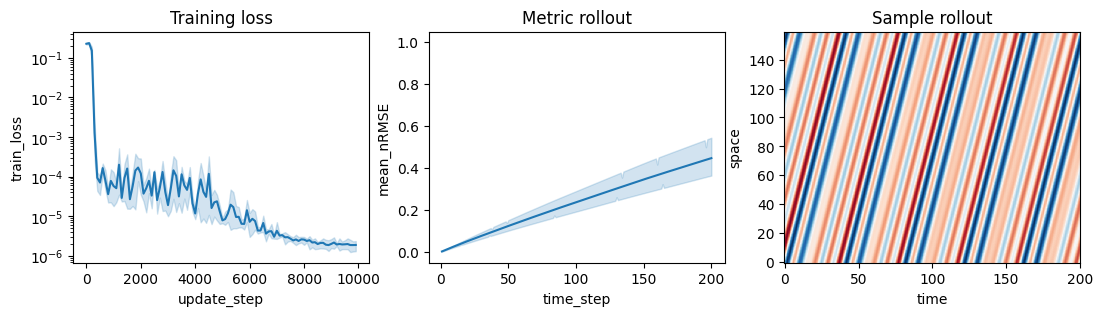
You can explore the apebench scenarios using an interactive streamlit notebook by running
streamlit run explore_sample_data_streamlit.py

Documentation
Documentation is a available at tum-pbs.github.io/apebench/.
Background
Autoregressive neural emulators can be used to efficiently forecast transient phenomena, often associated with differential equations. Denote by $\mathcal{P}_h$ a reference numerical simulator (e.g., the FTCS scheme for the heat equation). It advances a state $u_h$ by
$$ u_h^{[t+1]} = \mathcal{P}_h(u_h^{[t]}). $$
An autoregressive neural emulator $f_\theta$ is trained to mimic $\mathcal{P}h$, i.e., $f\theta \approx \mathcal{P}_h$. Doing so requires the following choices:
- What is the reference simulator $\mathcal{P}_h$?
- What is its corresponding continuous transient partial differential equation? (advection, diffusion, Burgers, Kuramoto-Sivashinsky, Navier-Stokes, etc.)
- What consistent numerical scheme is used to discretize the continuous transient partial differential equation?
- What is the architecture of the autoregressive neural emulator $f_\theta$?
- How do $f_\theta$ and $\mathcal{P}_h$ interact during training (=optimization
of $\theta$)?
- For how many steps are their predictions unrolled and compared?
- What is the time-level loss function?
- How large is the batch size?
- What is the opimizer and its learning rate scheduler?
- For how many steps is the training run?
- Additional training and evaluation related choices:
- What is the initial condition distribution?
- How long is the time horizon seen during training?
- What is the evaluation metric? If it is related to an error rollout, for how many steps is the rollout?
- How many random seeds are used to draw conclusions?
APEBench is a framework to holistically assess all four ingredients. Component
(1), the discrete reference simulator $\mathcal{P}_h$, is provided by
Exponax. This is a suite of
ETDRK-based
methods for semi-linear partial differential equations on periodic domains. This
covers a wide range of dynamics. For the most common scenarios, a unique
interface using normalized (non-dimensionalized) coefficients or a
difficulty-based interface (as described in the APEBench paper) can be used. The
second (2) component is given by
PDEquinox. This library uses
Equinox, a JAX-based
deep-learning framework, to implement many commonly found architectures like
convolutional ResNets, U-Nets, and FNOs. The third (3) component is
Trainax, an abstract implementation of
"trainers" that provide supervised rollout training and many other features. The
fourth (4) component is to wrap up the former three and is given by this
repository.
APEBench encapsulates the entire pipeline of training and evaluating an
autoregressive neural emulator in a scenario. A scenario is a callable
dataclass.
Citation
This package was developed as part of the APEBench paper (arxiv.org/abs/2411.00180) (accepted at Neurips 2024). If you find it useful for your research, please consider citing it:
@article{koehler2024apebench,
  title={{APEBench}: A Benchmark for Autoregressive Neural Emulators of {PDE}s},
  author={Felix Koehler and Simon Niedermayr and R{\"}udiger Westermann and Nils Thuerey},
  journal={Advances in Neural Information Processing Systems (NeurIPS)},
  volume={38},
  year={2024}
}
(Feel free to also give the project a star on GitHub if you like it.)
Funding
The main author (Felix Koehler) is a PhD student in the group of Prof. Thuerey at TUM and his research is funded by the Munich Center for Machine Learning.
License
MIT, see here
fkoehler.site · GitHub @ceyron · X @felix_m_koehler · LinkedIn Felix Köhler
1 maintainer

Release files for apebench 0.1.1
For a detailed explanation of source distributions (sdists) and built distributions (wheels), please see the package formats documentation.
Source distribution (sdist)
| File | Size | Uploaded | |
|---|---|---|---|
| apebench-0.1.1.tar.gz | 38.1 kB | Details |
Built distribution (wheel)
| File | Interpreter | ABI | Platform | Reset |
|---|---|---|---|---|
| apebench-0.1.1-py3-none-any.whl | Python 3 | none | any | Details |
Total release size: 85.4 kB
Release files / apebench-0.1.1.tar.gz
| Download URL | apebench-0.1.1.tar.gz |
|---|---|
| Size | 38.1 kB |
| Tags | Source |
|
SHA-256 checksum How to use checksums |
c5ddd47799f0799b2c2e72c27d3d81993f6fa218a04b1df93d4c1850e4893bf9
|
|
BLAKE2b-256 checksum How to use checksums |
ff03ca6da80d8ba7516acc04745733c65f97193afcf554fafe405223a92dde5f
|
| Upload date | |
|
Uploaded using Trusted Publishing? What is trusted publishing? |
Yes |
| Uploaded via |
twine/5.1.1 CPython/3.12.7
|
Provenance
Provenance describes where a file came from. On PyPI, provenance is shared via attestations, which provide a verifiable record of the build or publishing details. View details, limitations and caveats.


PyPI Publish Attestation
PyPI verified that this artifact, at this checksum, originated from the publisher listed below.
Signed by GitHub Actions, verified by PyPI on Nov 9, 2024.
Transparency logRelease files / apebench-0.1.1-py3-none-any.whl
| Download URL | apebench-0.1.1-py3-none-any.whl |
|---|---|
| Size | 47.3 kB |
| Tags | Python 3 |
|
SHA-256 checksum How to use checksums |
ad06abd3adfc4aa9c497a53650bc5eed86abe56ab24c7c523a31cd6ef9278731
|
|
BLAKE2b-256 checksum How to use checksums |
366c811b2dd61da9caecbb9b967dab09314303274ec08e3ed77143098070c438
|
| Upload date | |
|
Uploaded using Trusted Publishing? What is trusted publishing? |
Yes |
| Uploaded via |
twine/5.1.1 CPython/3.12.7
|
Provenance
Provenance describes where a file came from. On PyPI, provenance is shared via attestations, which provide a verifiable record of the build or publishing details. View details, limitations and caveats.
PyPI Publish Attestation
PyPI verified that this artifact, at this checksum, originated from the publisher listed below.
Signed by GitHub Actions, verified by PyPI on Nov 9, 2024.
Transparency log













