

Feature flags and runtime control for Python APIs — rollouts, rate limits, manage maintenance windows across single ASGI services or a multi-service fleet without redeploying.



[!IMPORTANT]
api-shieldis deprecated. This package has been renamed towaygate. No further releases will be published here.Migrate now:
pip install waygate
# or: uv add waygate
Imports change from
shield→waygateand the CLI command fromshield→waygate. See the waygate repository for full documentation.
Key features
Core (shield.core)
These features are framework-agnostic and available to any adapter.
| Feature | Description |
|---|---|
| ⚡ Zero-restart control | State changes take effect immediately — no redeployment or server restart needed |
| 🔄 Sync & async | Full support for both async def and plain def route handlers — use await engine.* or engine.sync.* |
| 🛡️ Fail-open by default | If the backend is unreachable, requests pass through. Shield never takes down your API |
| 🔌 Pluggable backends | In-memory (default), file-based JSON, or Redis for multi-instance deployments |
| 🖥️ Admin dashboard | HTMX-powered UI with live SSE updates — no JS framework required |
| 🖱️ REST API + CLI | Full programmatic control from the terminal or CI pipelines — works over HTTPS remotely |
| 📋 Audit log | Every state change is recorded: who, when, what route, old status → new status |
| ⏰ Scheduled windows | asyncio-native scheduler — maintenance windows activate and deactivate automatically |
| 🔔 Webhooks | Fire HTTP POST on every state change — built-in Slack formatter and custom formatters supported |
| 🚦 Rate limiting | Per-IP, per-user, per-API-key, or global counters — tiered limits, burst allowance, runtime mutation |
| 🚩 Feature flags | Boolean, string, integer, float, and JSON flags — targeting rules, user segments, percentage rollouts, prerequisites, and a live evaluation stream. Built on the OpenFeature standard |
| 🏗️ Shield Server | Centralised control plane for multi-service architectures — SDK clients sync state via SSE with zero per-request latency |
| 🌐 Multi-service CLI | SHIELD_SERVICE env var scopes every command; shield services lists connected services |
Framework adapters
FastAPI (shield.fastapi) — ✅ supported
| Feature | Description |
|---|---|
| 🎨 Decorator-first DX | @maintenance, @disabled, @env_only, @force_active, @deprecated, @rate_limit — state lives next to the route |
| 📄 OpenAPI integration | Disabled / env-gated routes hidden from /docs; deprecated routes flagged; live maintenance banners in the Swagger UI |
| 🧩 Dependency injection | All decorators work as Depends() — enforce shield state per-handler without middleware |
| 🎨 Custom responses | Return HTML, redirects, or any response shape for blocked routes — per-route or app-wide default on the middleware |
| 🔀 ShieldRouter | Drop-in APIRouter replacement that auto-registers route metadata with the engine at startup |
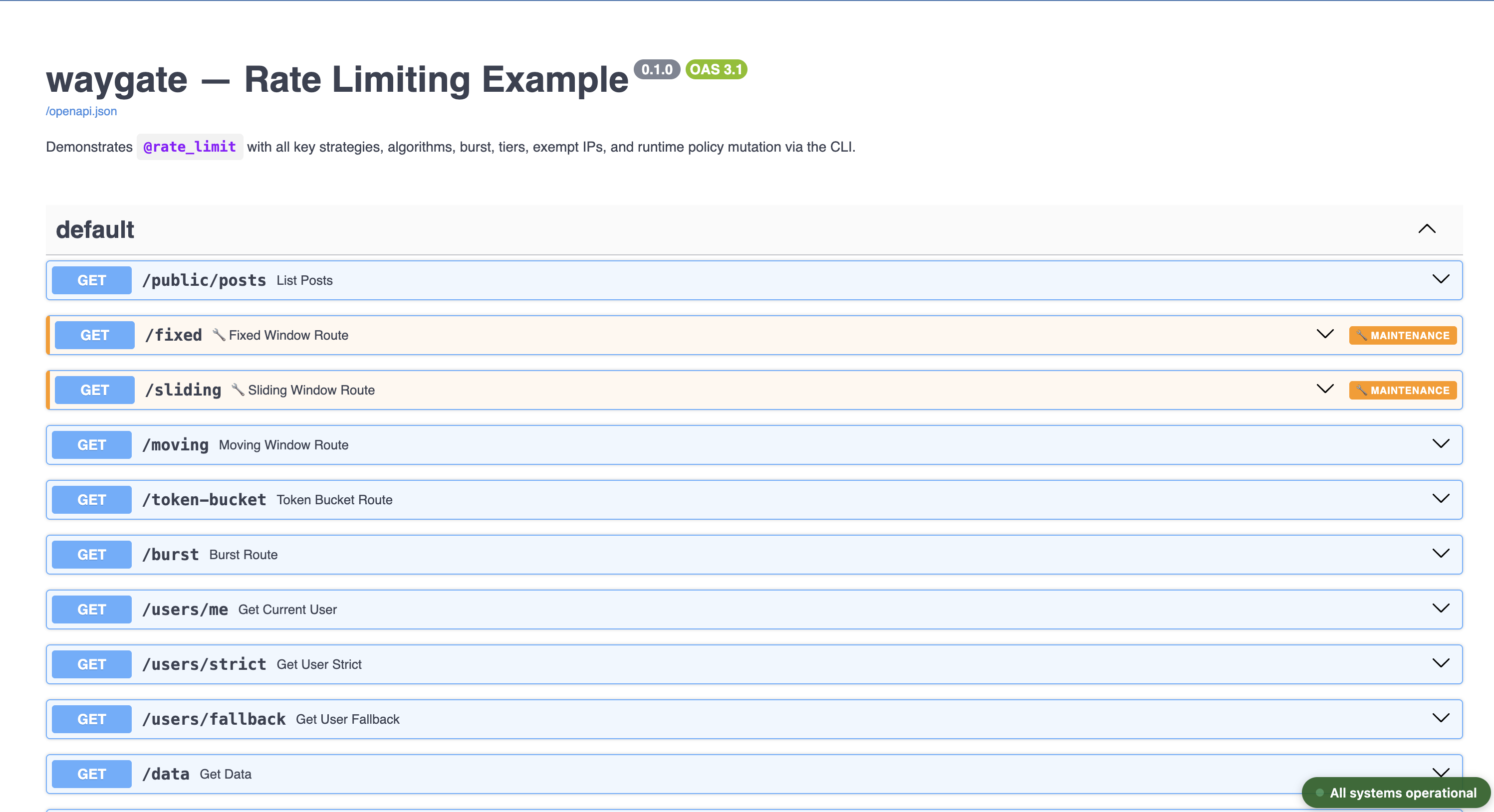
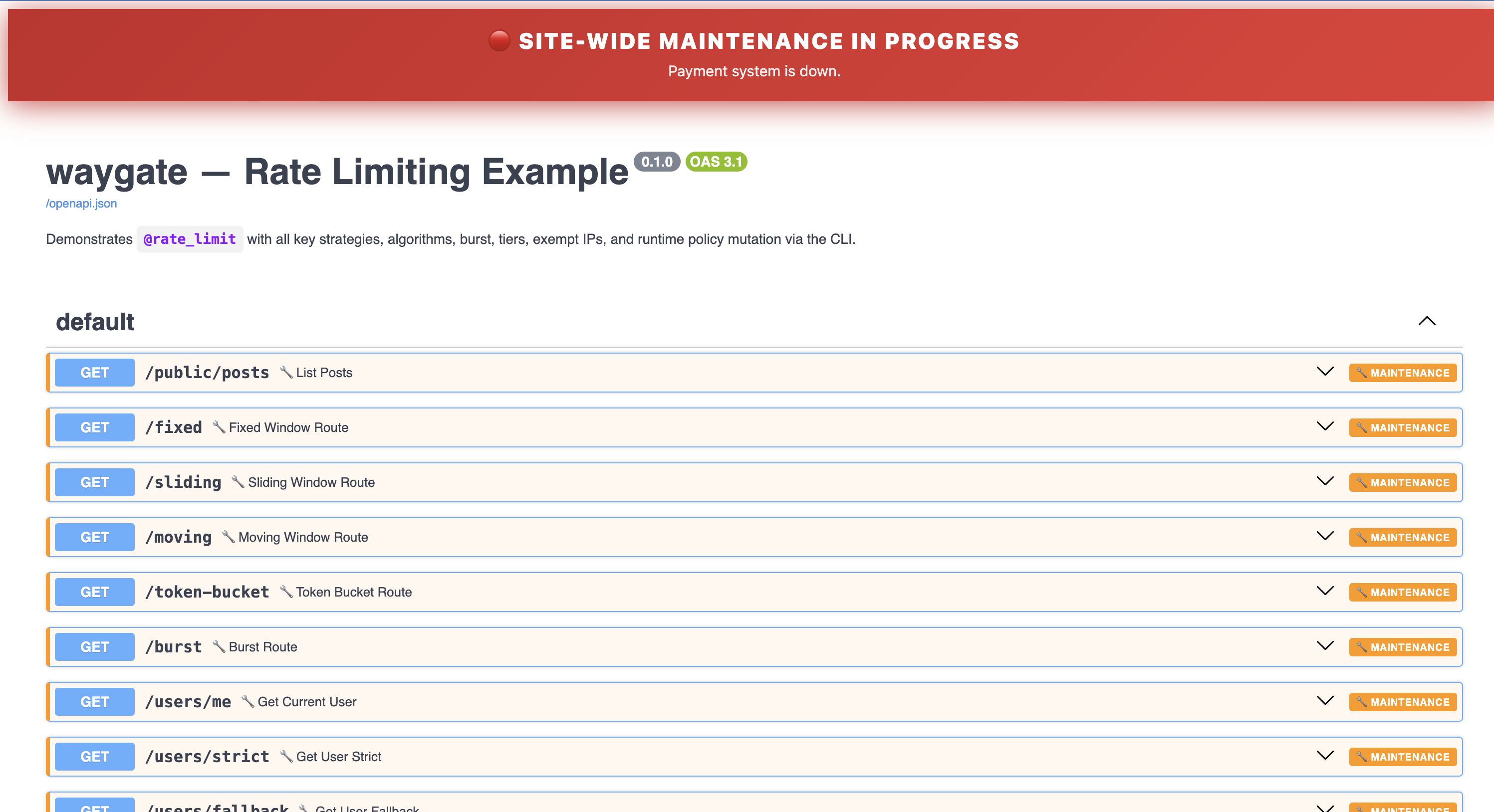
Disabled and env-gated routes hidden from /docs. Maintenance banners injected live.
Install
uv add "api-shield[all]"
# or: pip install "api-shield[all]"
Quickstart
FastAPI is the currently supported adapter. Litestar, Starlette, Quart, and Django (ASGI) are on the roadmap.
from fastapi import FastAPI
from shield.core.config import make_engine
from shield.fastapi import (
    ShieldMiddleware, ShieldAdmin, apply_shield_to_openapi,
    maintenance, env_only, disabled, force_active, deprecated,
)

engine = make_engine()

app = FastAPI()
app.add_middleware(ShieldMiddleware, engine=engine)

@app.get("/payments")
@maintenance(reason="DB migration — back at 04:00 UTC")
async def get_payments():
    return {"payments": []}

@app.get("/health")
@force_active
async def health():
    return {"status": "ok"}

apply_shield_to_openapi(app, engine)
app.mount("/shield", ShieldAdmin(engine=engine, auth=("admin", "secret")))
GET /payments  → 503  {"error": {"code": "MAINTENANCE_MODE", ...}}
GET /health    → 200  always
Manage routes from the CLI — no code changes, no restarts:
shield config set-url http://localhost:8000/shield
shield login admin
shield status
shield enable GET:/payments
shield global enable --reason "Deploying v2" --exempt /health
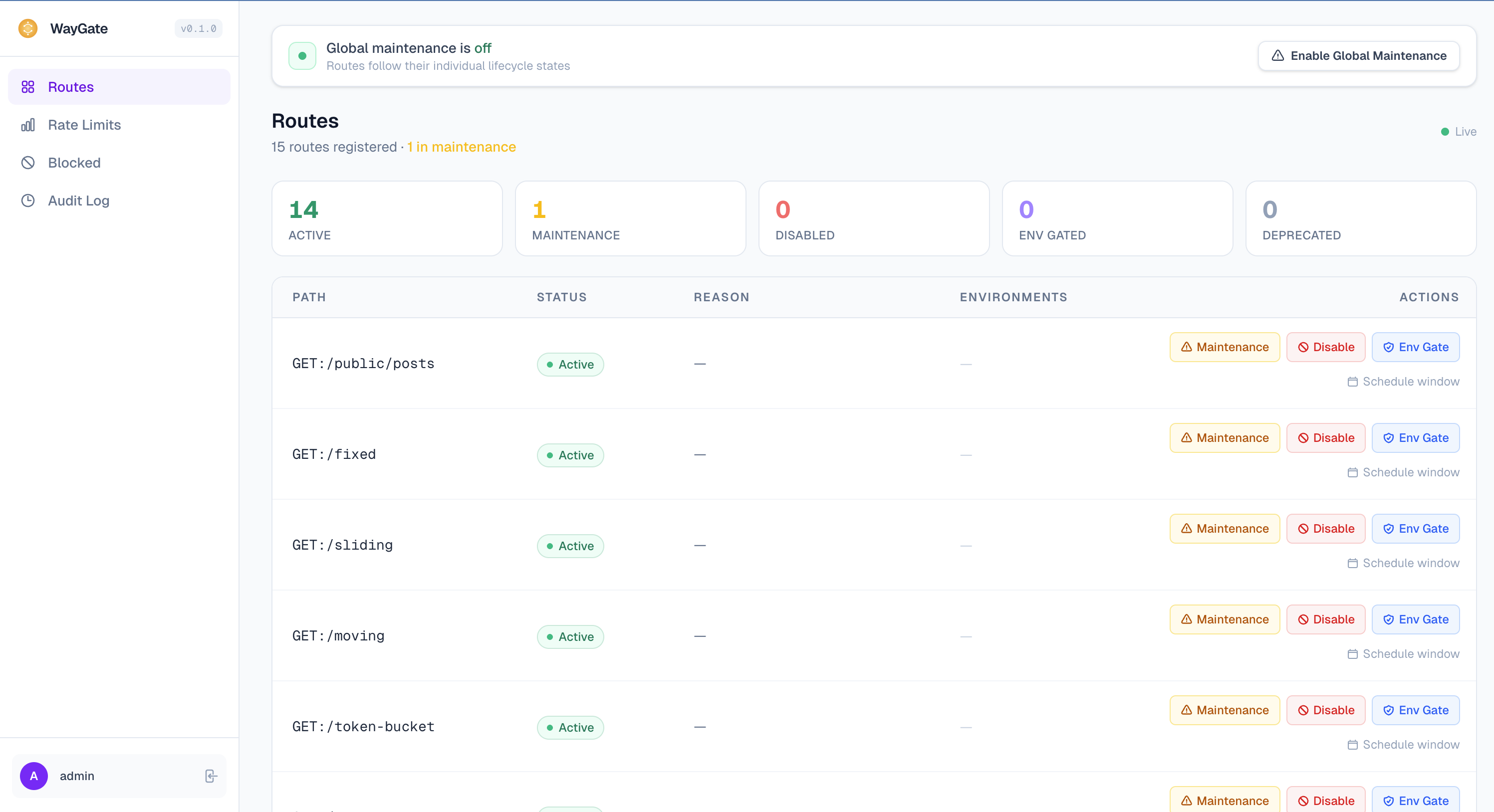
Admin dashboard — route states, audit log, rate limits, and feature flags. No JS framework required.
Decorators
| Decorator | Effect | Status |
|---|---|---|
@maintenance(reason, start, end) |
Temporarily unavailable | 503 |
@disabled(reason) |
Permanently off | 503 |
@env_only("dev", "staging") |
Restricted to named environments | 404 elsewhere |
@deprecated(sunset, use_instead) |
Still works, injects deprecation headers | 200 |
@force_active |
Bypasses all shield checks | Always 200 |
@rate_limit("100/minute") |
Cap requests per IP, user, API key, or globally | 429 |
Custom responses (FastAPI)
By default, blocked routes return a structured JSON error body. You can replace it with anything — HTML, a redirect, plain text, or your own JSON — in two ways:
Per-route — pass response= directly on the decorator:
from starlette.requests import Request
from starlette.responses import HTMLResponse, RedirectResponse
from shield.fastapi import maintenance, disabled

def maintenance_page(request: Request, exc: Exception) -> HTMLResponse:
    return HTMLResponse(
        f"<h1>Down for maintenance</h1><p>{exc.reason}</p>", status_code=503
    )

@router.get("/payments")
@maintenance(reason="DB migration", response=maintenance_page)
async def payments():
    return {"payments": []}

@router.get("/orders")
@maintenance(reason="Upgrade in progress", response=lambda *_: RedirectResponse("/status"))
async def orders():
    return {"orders": []}
Global default — set once on ShieldMiddleware, applies to every route without a per-route factory:
app.add_middleware(
    ShieldMiddleware,
    engine=engine,
    responses={
        "maintenance": maintenance_page,   # all maintenance routes
        "disabled": lambda req, exc: HTMLResponse(
            f"<h1>Gone</h1><p>{exc.reason}</p>", status_code=503
        ),
    },
)
Resolution order: per-route response= → global responses[...] → built-in JSON. The factory can be sync or async and receives the live Request and the ShieldException that triggered the block.
Rate limiting
from shield.fastapi.decorators import rate_limit

@router.get("/public/posts")
@rate_limit("10/minute")               # 10 req/min per IP
async def list_posts():
    return {"posts": [...]}

@router.get("/users/me")
@rate_limit("100/minute", key="user")  # per authenticated user
async def get_current_user():
    ...

@router.get("/reports")
@rate_limit(                           # tiered limits
    {"free": "10/minute", "pro": "100/minute", "enterprise": "unlimited"},
    key="user",
)
async def get_reports():
    ...
Policies can be mutated at runtime without redeploying (shield rl and shield rate-limits are aliases):
shield rl set GET:/public/posts 20/minute   # raise the limit live
shield rl reset GET:/public/posts           # clear counters
shield rl hits                              # blocked requests log
Requires api-shield[rate-limit]. Powered by limits.
Feature flags
api-shield ships a full feature flag system built on the OpenFeature standard. All five flag types, multi-condition targeting rules, user segments, percentage rollouts, and a live evaluation stream — managed from the dashboard or CLI with no code changes.
from shield.core.feature_flags.models import (
    FeatureFlag, FlagType, FlagVariation, RolloutVariation,
    TargetingRule, RuleClause, Operator, EvaluationContext,
)

engine.use_openfeature()

# Define a boolean flag with a 20% rollout and individual targeting
await engine.save_flag(
    FeatureFlag(
        key="new-checkout",
        name="New Checkout Flow",
        type=FlagType.BOOLEAN,
        variations=[
            FlagVariation(name="on",  value=True),
            FlagVariation(name="off", value=False),
        ],
        off_variation="off",
        fallthrough=[
            RolloutVariation(variation="on",  weight=20_000),  # 20%
            RolloutVariation(variation="off", weight=80_000),  # 80%
        ],
        targets={"on": ["beta_tester_1"]},   # individual targeting
        rules=[
            TargetingRule(
                description="Enterprise users always get the new flow",
                clauses=[RuleClause(attribute="plan", operator=Operator.IS, values=["enterprise"])],
                variation="on",
            )
        ],
    )
)

# Evaluate in an async route handler
ctx = EvaluationContext(key=user_id, attributes={"plan": user.plan})
enabled = await engine.flag_client.get_boolean_value("new-checkout", False, ctx)

# Evaluate in a sync def handler (thread-safe)
enabled = engine.sync.flag_client.get_boolean_value("new-checkout", False, {"targeting_key": user_id})
Manage flags and segments from the CLI:
shield flags list
shield flags eval new-checkout --user user_123
shield flags disable new-checkout          # kill-switch
shield flags enable new-checkout
shield flags stream                        # live evaluation events

shield segments create beta_users --name "Beta Users"
shield segments include beta_users --context-key user_123,user_456
shield segments add-rule beta_users --attribute plan --operator in --values pro,enterprise
Requires api-shield[flags].
Framework support
api-shield is built on the ASGI standard. The core (shield.core) is completely framework-agnostic and has zero framework imports. Any ASGI framework can be supported — either via a Starlette BaseHTTPMiddleware (for Starlette-based frameworks) or a raw ASGI callable for frameworks like Quart and Django that implement the ASGI spec independently.
ASGI frameworks
| Framework | Status | Adapter |
|---|---|---|
| FastAPI | ✅ Supported | shield.fastapi |
| Litestar | 🔜 Planned | — |
| Starlette | 🔜 Planned | — |
| Quart | 🔜 Planned | — |
| Django (ASGI) | 🔜 Planned | — |
Want support for another ASGI framework? Open an issue.
WSGI frameworks (Flask, Django, …)
[!IMPORTANT] WSGI support is out of scope for this project.
api-shieldis an ASGI-native library. Bolting WSGI support in through shims or patches would require a persistent background event loop, thread-bridging hacks, and a fundamentally different middleware model — complexity that would compromise the quality and reliability of both layers.WSGI framework support (Flask, Django, Bottle, …) will be delivered as a separate, dedicated project designed from the ground up for the synchronous request model. This keeps both projects clean, well-tested, and maintainable without trade-offs.
Watch this repo or open an issue to be notified when the WSGI companion project launches.
Backends
Embedded mode (single service)
| Backend | Persistence | Multi-instance | Best for |
|---|---|---|---|
MemoryBackend |
No | No | Development, tests |
FileBackend |
Yes | No (single process) | Simple single-instance prod |
RedisBackend |
Yes | Yes | Load-balanced / multi-worker prod |
For rate limiting in multi-worker deployments, use RedisBackend — counters are atomic and shared across all processes.
Shield Server mode (multi-service)
Run a dedicated ShieldServer process and connect each service via ShieldSDK. State is managed centrally; enforcement happens locally with zero per-request network overhead.
# Shield Server (centralised — runs once)
from shield.server import ShieldServer
shield_app = ShieldServer(backend=MemoryBackend(), auth=("admin", "secret"))

# Each service (connects to the Shield Server)
from shield.sdk import ShieldSDK
sdk = ShieldSDK(server_url="http://shield-server:9000", app_id="payments-service")
sdk.attach(app)
| Scenario | Shield Server backend | SDK rate_limit_backend |
|---|---|---|
| Multi-service, single replica each | MemoryBackend or FileBackend |
not needed |
| Multi-service, multiple replicas | RedisBackend |
RedisBackend (shared counters) |
Documentation
Full documentation at attakay78.github.io/api-shield
| Tutorial | Get started in 5 minutes |
| Decorators reference | All decorator options |
| Rate limiting | Per-IP, per-user, tiered limits |
| Feature flags | Targeting rules, segments, rollouts, live events |
| ShieldEngine reference | Programmatic control |
| Backends | Memory, File, Redis, Shield Server, custom |
| Admin dashboard | Mounting ShieldAdmin |
| CLI reference | All CLI commands |
| Shield Server guide | Multi-service centralized control |
| Distributed deployments | Multi-instance backend guide |
| Production guide | Monitoring & deployment automation |
License
1 maintainer

Metadata
1 maintainer
Release files for api-shield 0.8.3
For a detailed explanation of source distributions (sdists) and built distributions (wheels), please see the package formats documentation.
Source distribution (sdist)
| File | Size | Uploaded | |
|---|---|---|---|
| api_shield-0.8.3.tar.gz | 1.3 MB | Details |
Built distribution (wheel)
| File | Interpreter | ABI | Platform | Reset |
|---|---|---|---|---|
| api_shield-0.8.3-py3-none-any.whl | Python 3 | none | any | Details |
Total release size: 1.6 MB
Release files / api_shield-0.8.3.tar.gz
| Download URL | api_shield-0.8.3.tar.gz |
|---|---|
| Size | 1.3 MB |
| Tags | Source |
|
SHA-256 checksum How to use checksums |
0cb81f426ba37a82d9ff60ae3e56248b8a2f28f873d53ed527ac68a4ac6c8d03
|
|
BLAKE2b-256 checksum How to use checksums |
19f85ad0fa61059d3856607cb252e7c161d3f28e6d6fb1ce30b981a224aba30e
|
| Upload date | |
|
Uploaded using Trusted Publishing? What is trusted publishing? |
No |
| Uploaded via |
twine/6.2.0 CPython/3.13.1
|
Release files / api_shield-0.8.3-py3-none-any.whl
| Download URL | api_shield-0.8.3-py3-none-any.whl |
|---|---|
| Size | 297.6 kB |
| Tags | Python 3 |
|
SHA-256 checksum How to use checksums |
c6c75968b3a34e4108e9551e55e7dda310bf3fe21e96dcac697ba9cd583a95d0
|
|
BLAKE2b-256 checksum How to use checksums |
6f66ce6b303be63532692cd9b4db9c5706bb3b187a0b629b617b5f2920756908
|
| Upload date | |
|
Uploaded using Trusted Publishing? What is trusted publishing? |
No |
| Uploaded via |
twine/6.2.0 CPython/3.13.1
|














